Caucasus Work Permits & Visas: Employer Guide to Types & Sponsorship
TL;DR
Expanding your team into the Caucasus region (Armenia, Georgia, Azerbaijan) unlocks new talent pools, but it also means navigating a trio of work visa and permit regimes. If you’re a decision-maker planning to hire internationally, whether your HQ is in the USA or you’ve tapped employer of record services in India, Turkey or other MENA markets, understanding each country’s process is critical.
This comprehensive guide will walk you through securing an employer of record work visa in the Caucasus Region, breaking down visa types, sponsorship steps, timelines, and compliance must-knows in Armenia, Georgia, and Azerbaijan.
We’ll compare hiring via an Employer of Record (EOR) vs. setting up your own local entity, highlight how EOR services simplify immigration, payroll, and compliance, and even serve up a step-by-step EOR sponsorship process. Stick around for real examples, a checklist of common mistakes (and legal penalties), and punchy, actionable tips – all clear, compliance-driven, and BS-free.
Quick Navigation
- TL;DR
- Hiring Local vs. Foreign Talent in the Caucasus
- Armenia Work Visa, Permit & Requirements
- Georgia Work Permit, Visa & Residence Requirements
- Azerbaijan Work Permit & Visa Requirements
- EOR vs. Setting Up Your Own Entity in the Caucasus
- How EOR Services Simplify Immigration & Compliance in the Caucasus
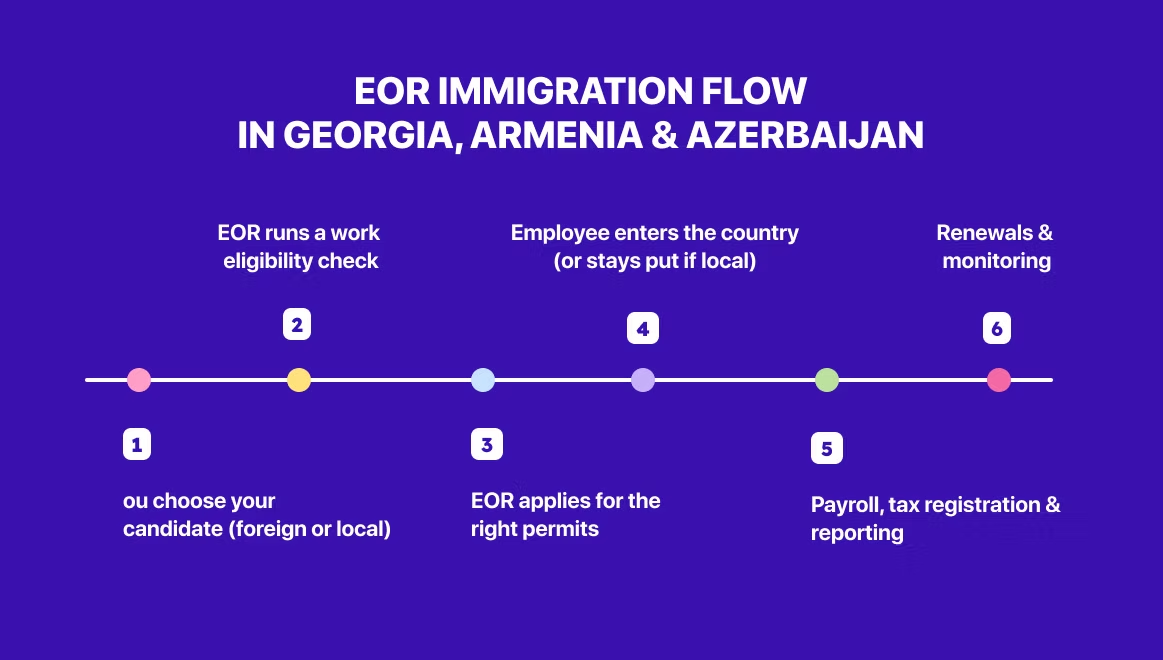
- Step-by-Step: EOR Visa Sponsorship Process in the Caucasus
- Compliance Checklist for Employers in the Caucasus
- Final Guidance
- Actionable Tips & Takeaways for Global Employers Expanding into the Caucasus
- Final Takeaway
- Frequently Asked Questions
Hiring Local vs. Foreign Talent in the Caucasus
Hiring a local citizen versus a foreign national in the Caucasus is two very different ballgames. Local hires are straightforward: no visas or work permits are required for citizens in their home country, just standard employment onboarding (local labour contracts, tax registration, payroll setup, etc.). Foreign hires, on the other hand, trigger immigration compliance in each country – meaning work visas, permits, residence status, and sponsorship procedures come into play. In short, a local Georgian or Armenian can start work immediately under local law, but if you’re bringing in a foreigner, you’ll need to navigate that country’s bureaucracy to keep things legal.
Each Caucasus nation has its own rules for employing foreigners:
- Armenia: Generally requires a work permit and residence permit for foreign employees (with a few exceptions, like citizens of certain Eurasian Union countries).
- Georgia: Historically did not require a formal work permit (many foreigners could work under visa-free entry or a simple residence permit), but new laws in 2026 are introducing a work permit requirement for most foreign workers.
- Azerbaijan: Has the strictest regime – no foreigner can work without prior authorisation (work and residence permit), and even short assignments require permits.
Bottom line: Hiring locals spares you the immigration hassle, while hiring foreigners means extra steps to stay compliant. Next, let’s break down those steps country by country.
Armenia Work Visa, Permit & Requirements

Armenia welcomes travellers from many countries visa-free or on easy e-visas, but when it comes to legally working in Armenia, most foreigners need a sponsored work permit. Tourists from the U.S., EU, UK and others can enter Armenia without a visa (or get an e-visa) and stay up to 180 days in a year. However, a visa-free entry or a tourist visa does not entitle someone to work. If a foreign national is going to live and work in Armenia, you must go the extra mile to obtain a work permit and a temporary residence permit for them.
Work Permit & Residence Permit
Armenia uses an integrated process where a work permit (permission for the employer to hire a foreigner) is typically coupled with a temporary residence permit (permission for the employee to live in-country). Once the work permit is approved, the foreign employee can receive a residence card allowing them to stay beyond the initial 180 days. Think of the work permit as the green light for the job, and the residence permit as the document that lets them remain in Armenia for that job.
Key Requirements
To sponsor a foreign employee in Armenia, the employer must first register on the government’s workpermit.am portal. A formal job offer is needed, and the candidate must have the qualifications and experience for the role. The online application will include the job description, the foreigner’s details, and various documents (passport copy, proof of qualifications, photos, etc.). Armenian authorities will conduct a labor market test – essentially checking if no local candidate is available – and a security check before approval. Don’t worry: this review is usually quick (often a few weeks) and employers can justify hiring the foreign specialist if no local can fill the niche.
Timeline
Plan for roughly 1 month from application to approval of the work permit. By law, most work permit decisions come within 20–30 business days, and residence permits similarly within 30 days. In practice, gathering all paperwork and then waiting for the residence card can make the total onboarding time around 2–3 months end-to-end, especially if done remotely. The good news: no separate government fee is charged for the work permit itself in Armenia – the main fee is for the residence card (~105,000 AMD, about $270).
Validity
Work permits and the linked temporary residence are typically granted for up to 1 year at a time, renewable annually as long as employment continues. After about 4 years of continuous renewals, a worker may become eligible for a longer-term or permanent residence (often after 5 years in-country). Armenia doesn’t impose quotas on foreign workers (so you’re not limited to a certain number), but you do need to document that a local worker wasn’t available for the role – that’s largely handled by the labour market test step.
Exemptions
Some foreigners don’t require a work permit due to international agreements or special status. For example, citizens of Eurasian Economic Union (EAEU) countries (Russia, Belarus, Kazakhstan, Kyrgyzstan) can work in Armenia without a permit. They still should be registered on the workpermit.am system, but it’s a formality. Additionally, certain high-level roles (like a foreigner who is the founder or CEO of an Armenian company) might not need a work permit, though they’d still need a residence status in most cases. Always double-check if an exemption applies, but assume most non-EAEU hires go through the standard process.
Visa Types
In terms of entry visas, Armenia issues a long-term work visa (often a multi-entry visa) once a work permit is approved. Many foreign hires actually enter Armenia on a simple tourist stamp or e-visa and then convert to work authorisation without leaving – Armenia allows in-country change of status. For example, your new hire might visit Yerevan on a visitor visa, you get their work permit approved while they’re there, and then they pick up their temporary residence card locally. No border runs required, as long as you file the paperwork correctly.
Real-World Example
Say a US-based tech company wants to relocate a software engineer from France to Yerevan. The engineer can fly in on a visa-free entry (France gets 180 days visa-free). The Armenian EOR (or local entity) posts the job on the portal, clears the labour test (not many Armenian locals with that niche skill, let’s assume), and submits the work permit application. Roughly 3–4 weeks later, approval comes through, and the engineer is issued a temporary residence card for one year. They sign a local employment contract in Armenian, and boom – they’re legally working in Armenia. If any step was skipped (e.g. no permit), both the company and the employee would be in hot water, facing fines in the hundreds of dollars and possible deportation or bans for the worker. Armenia takes compliance seriously, but its system is fairly clear once you break it down.
Georgia Work Permit, Visa & Residence Requirements

Georgia has been famous for its ultra-friendly immigration policy. Over 90 nationalities can enter Georgia visa-free for up to 365 days – yes, a full year on just a passport stamp. This includes the US, UK, EU countries, Canada, Australia, much of Latin America and Asia. In practice, that means a foreign employee could literally fly to Tbilisi tomorrow and start working remotely without any prior visa paperwork. No embassy visits, no consulate appointments. It’s so flexible it sounds fake – until you check the law twice.
But (big but) “flexible” doesn’t mean “lawless.” Georgia doesn’t require entry visas upfront, but long-term employment does require proper residence status. Here’s the deal: under the 365-day visa waiver, a foreigner can live in Georgia and even work remotely for their foreign employer for up to a year. However, they can’t do certain things without further paperwork, like open a local bank account, register as a local taxpayer, or stay beyond that year without a residency permit. And if they’re formally employed under a Georgian contract (say, by an EOR’s local entity), they are expected to have a residence permit regardless of the visa-free status. In other words, if your team member is sticking around, you need to do things right from day one.
Residence Permit vs. Work Permit
Georgia traditionally has not had a separate “work permit” system like other countries. Instead, the right to work comes with holding a residence permit (specifically, a work residence permit). Once a foreigner obtains a residence permit in Georgia on the basis of employment, that effectively authorises them to work under a local employment contract. There’s no prior labour market test or quota in Georgia; no pre-approval is needed just to enter. The process has been: hire the person (through an EOR or your entity), and then apply for their residence permit after they arrive. Permits are typically issued for 1 year (sometimes up to 5 years) andare renewable, allowing the person to live and work long-term.
2026 Update – New Work Permit Law
Important to note, effective March 1, 2026, Georgia is introducing a formal work permit requirement for most foreign workers.
This is a big change: previously, a foreigner with any legal stay (visa-free or with a residence card) could work. Now the government wants employers to submit a work permit application as well, to better monitor foreign labour. Foreign employees already in Georgia before March 2026 have until January 1, 2027, to obtain the new work permit.
The work permit will likely be a separate approval in addition to the residence permit. And yes, there will be fines for foreigners working without a permit – penalties apply to both the employer and the foreign national, with repeat offences doubling or tripling the fines. In short, Georgia is tightening up compliance (no more long-term “tourist-workers”). As an employer, you’ll need to file that extra paperwork. The processing time for these new permits is expected to be ~30 days, and more regulations are forthcoming on how it all works.
For now, if you’re hiring in Georgia via an EOR, the EOR will handle any residence permit (and new work permit) needs on your behalf. If you’re doing it yourself, you’ll need to stay on top of these new rules. Don’t assume Georgia’s leniency means you can skip immigration formalities – if your foreign hire never obtains proper residency or a future work permit, they’re essentially working illegally. That exposes them to deportation and you to fines and other legal headaches.
Process & Timeline
The typical process to legalise a foreign employee in Georgia has been:
- Employee enters Georgia (visa-free in most cases).
- Employer (or EOR) submits a residence permit application to the Ministry of Justice while the person is in-country. (This can often be done online or via a local service centre.)
- Processing takes about 30 days (there are options to expedite to 10 or 20 days for a fee).
- Once approved, the employee gets a Residence Card (a physical ID card), which they use for local ID, bank, etc.
If the new 2026 work permit system adds a step, it will likely slot in before or alongside the residence application. For instance, possibly the employer will file a work permit request with the Ministry of Labor, get approval, then the employee applies for residence. The specifics are being clarified by the government, but again, an EOR in Georgia will be well-positioned to navigate this for you.
Compliance Red Flags
Georgia is pro-business, but if you try to game the system you will get burned. Common mistakes include misclassifying a full-time employee as an “independent contractor” to avoid local employment law – Georgian authorities consider that illegal and can impose audits, back taxes, and penalties. Another mistake is letting someone work on a tourist status indefinitely – without a residence/work permit, that person is violating immigration law, not paying local taxes, and risks deportation and fines. And if you fail to register an official employment or pay local taxes, you face fines for every unregistered employee and even the risk of being blacklisted from sponsoring future work permits. In summary: visa-free does not mean consequence-free. After that initial honeymoon period, get your foreign hire a proper permit.
Example
A UK-based company finds a star developer in Georgia. She’s a British national who has been living in Tbilisi for a few months under Georgia’s 1-year visa waiver. The company can either set up a Georgian entity or use an EOR to hire her. If using an EOR, the EOR signs her onto a local Georgian employment contract and immediately files for her residence permit (tied to that contract). She continues working in the meantime (since she’s legally present). Within a month, she gets her 1-year residence card. Under new rules, the EOR/ employer will also ensure a work permit is obtained for her. If the company tried to just pay her as a contractor on tourist status long-term, both would be in trouble – Georgia now monitors “tourist workers” and will enforce the new permit requirements with fines and potential removal from the country. The EOR route avoids those risks entirely.
Azerbaijan Work Permit & Visa Requirements

Azerbaijan has a clear and strict approach to foreign employment.
Unlike Georgia, no entry visa or stamp alone allows a foreigner to work; even short business trips require caution.
If you plan to hire non-citizens in Azerbaijan, understand this upfront:
Work authorisation is mandatory before any work begins.
Entry Visas vs. Work Authorisation in Azerbaijan
Azerbaijan issues several visa types:
- Tourist visas
- Business visas
- Other short-term entry visas
None of these grants the right to work or earn income in Azerbaijan.
For example:
- A business visa allows meetings or conferences in Baku
- It does not allow employment with a local company or EOR
Even if someone is physically in Azerbaijan on a valid visa, they cannot begin working until a work permit is officially approved.
The rule is simple:
No work permit. No legal work.
Working on a business visa will be treated as illegal employment.
The Two-permit System in Azerbaijan
To legally employ a foreign national in Azerbaijan, two approvals are required:
1. Work Permit
Authorises the foreign national to hold a specific job with a specific employer.
2. Temporary Residence Permit
Allows the employee to reside in Azerbaijan during employment.
These permits are:
- Processed together
- LinkedIn validity
- Issued for the same time period
Validity
- Initial work permits are typically granted for 1 year
- Renewable annually
- After two years of continuous residence, permanent residency may become possible
Most foreign hires operate on annual renewals.
No Short-term Workarounds
Azerbaijan does not offer practical short-term work visas for employment.
Even:
- A 2-month project
- A temporary assignment
- A consultant engagement
Requires full work authorisation in advance.
There are very limited technical exceptions, but they are not viable hiring strategies.
Assume every employment relationship requires a full permit process.
Enforcement is strict.
Sponsorship & Work Permit Application Process
To sponsor a foreign employee in Azerbaijan:
- You must have a local Azerbaijani entity
- Or use an Employer of Record (EOR) as the legal sponsor
There is no workaround for foreign companies without local presence.
The application is submitted to the State Migration Service.
Required Steps
- File official work permit application
- Provide job description and role details
- Submit passport copies with notarised translations
- Provide education certificates
- Submit medical clearance
- Include photographs
- Pay state fees
- Justify the need for a foreign hire
Some roles require demonstrating that a local candidate cannot fill the position.
Foreign Labour Quota System in Azerbaijan
Azerbaijan operates an annual foreign labour quota system.
This is one of the most critical compliance considerations.
How It Works
- Each year, the government sets industry-based quotas
- Companies must forecast how many foreign employees they plan to hire
- Applications must be submitted in advance
If quota allocations are exhausted:
- No additional permits are granted
- Even strong candidates cannot be approved
- Hiring is delayed until quotas reset
Quotas reset annually.
Timing matters significantly.
Many small or new companies fail to reserve quota spots early in the year and are later blocked from hiring.
Large companies and EOR providers typically apply for allocations proactively.
Timeline for Azerbaijan Work Permits
Expect the process to take:
- Approximately 4–8 weeks
- Longer if quotas or documentation issues arise
Typical stages include:
- Quota allocation
- Permit submission
- Review by Migration Service
- Issuance of a work permit
- Issuance of a residence card
Plan for at least two months of lead time.
Real-world Example
A global marketing firm wants to station a British marketing director in Baku via an Employer of Record.
The EOR:
- Secures quota allocation early in the year
- Submits full work permit application
- Provides documentation and justification
- Pays state fees
After approximately 6 weeks:
- The work permit is approved
- A temporary residence card is issued
- Employment officially begins
Only after approval does the employee start working and receiving a salary.
If the company had allowed the employee to begin work on a business visa:
- Labour inspectors could issue a stop-work order
- Fines up to $40,000 could apply
- Future sponsorship rights could be restricted
In Azerbaijan, compliance is not optional.
It is foundational.
EOR vs. Setting Up Your Own Entity in the Caucasus
When expanding into the Caucasus, companies face a classic choice:
- Use an Employer of Record (EOR) to hire compliantly
- Establish your own local entity and manage everything internally
Both paths can secure legal work status for foreign hires.
The difference comes down to:
- Cost
- Speed
- Control
- Risk
Let’s break it down clearly.
Using an Employer of Record (EOR) service

With an EOR:
- The EOR becomes the legal employer in-country
- Your company manages day-to-day performance
- The EOR handles payroll, compliance, permits, and HR
You do not register a company.You do not master local labor law.You do not personally deal with government offices.
Real-world Context
- In Georgia, an EOR can hire in weeks because no entity setup is required.
- In Azerbaijan, an EOR already understands quotas and permit bureaucracy, reducing rejection risk.
The EOR model allows fast hiring without building local infrastructure.
Pros of Using an EOR
Speed: Onboard in weeks, not months.
No upfront setup cost: No legal incorporation fees or accounting infrastructure.
Reduced compliance risk: Experts manage work permits, tax filings, and social contributions.
Scalability: Hire 1 person or 10. Scale down without winding up a company.
Operational simplicity: No need to hire local HR, legal, or payroll teams.
Cons of Using an EOR
Ongoing service fee: Monthly per-employee cost adds up at scale.
Less administrative control: The employment contract is technically between the employee and the EOR entity.
Branding limitations: Payslips and employment letters carry the EOR’s name.
For large long-term teams, cumulative fees may push companies toward entity setup.

Setting Up Your Own Entity
This means registering a subsidiary or branch in Armenia, Georgia, or Azerbaijan and becoming the employer yourself.
You manage:
- Company registration
- Bank accounts
- Payroll
- Work permits
- Tax filings
- Compliance
Pros of Establishing Your Own Entity
Full control: Direct employment relationship.
Brand consistency: Employees are officially part of your company.
Long-term cost efficiency: More economical when hiring dozens of employees.
Operational flexibility: Ability to sign local client contracts and generate revenue.
Market signal: A local entity demonstrates long-term commitment.
Cons of Establishing Your Own Entity
Startup complexity: Even where company registration is fast, operational readiness takes time.
Administrative burden: Immigration quotas, payroll filings, accounting, and labour compliance.
Full liability: Any compliance mistake is your responsibility.
Fixed overhead: Even during hiring slowdowns, entity costs continue.
Difficult exit: Closing a company can be more complex than opening one.
In Azerbaijan, especially, handling quota applications and notarised documentation can become a full-time operational function.
How EOR Services Simplify Immigration & Compliance in the Caucasus
In Armenia, Georgia, and Azerbaijan, immigration and employment laws differ significantly.
An EOR acts as your in-country compliance engine.
1. Immigration Expertise
Each country operates differently:
- Armenia uses the workpermit.am system
- Georgia is introducing new work permit rules in 2026
- Azerbaijan enforces strict annual quotas
An EOR already understands:
- Required documentation
- Processing timelines
- Government expectations
This reduces rejection risk and delays.
2. Hiring Without Opening an Entity
In Azerbaijan, this is critical.
If you do not have a local entity:
- You cannot sponsor work permits
- An EOR becomes the only compliant solution
In Georgia and Armenia, entity setup is optional but time-consuming.
An EOR allows hiring immediately.
3. Payroll & Tax Compliance
EOR services include:
- Local salary processing
- Tax withholding
- Social insurance payments
- Monthly reporting
Examples:
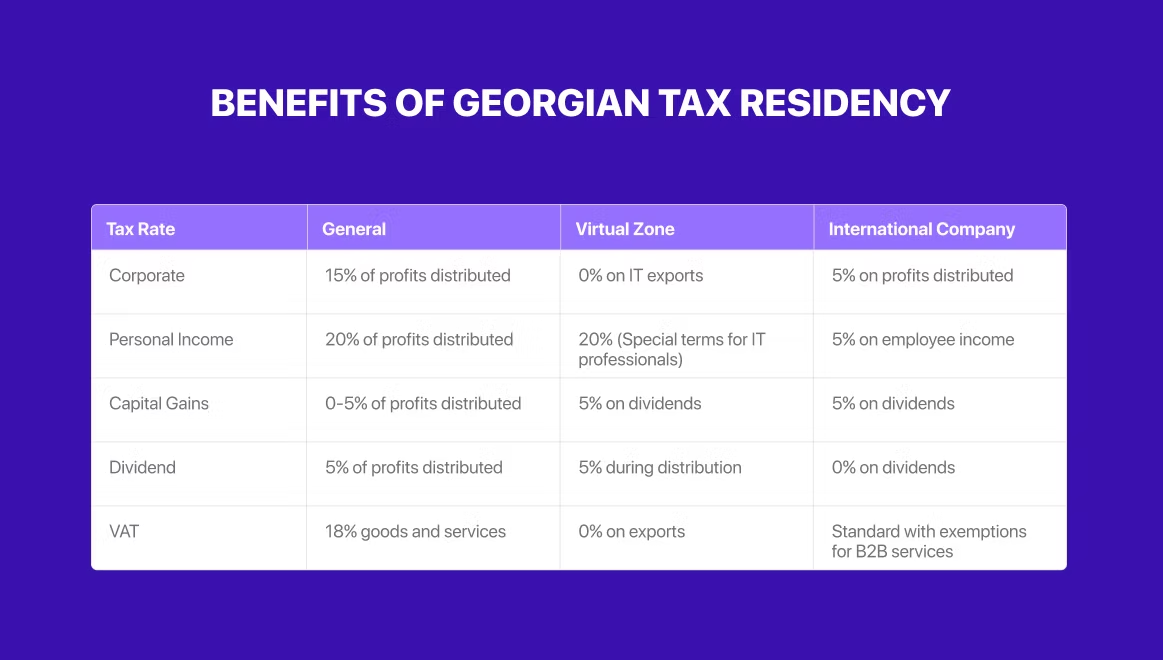
- In Georgia, EOR handles 20% income tax and pension contributions.
- In Azerbaijan, EOR ensures social insurance and medical contributions are paid properly.
Each country has unique reporting portals and deadlines.
EOR removes that administrative burden.
4. Local Employment Contracts
EORs provide:
- Contracts in the local language
- Legally compliant terms
- Mandatory clauses included
- Proper IP protection
Without this, companies must retain local lawyers.
EOR standardises the process.
5. Benefits & Workforce Support
EOR services often include:
- Mandatory pension enrollment
- Insurance registration
- Optional health benefits
- Workspace support
This allows you to offer competitive packages without infrastructure investment.
6. Ongoing Compliance Monitoring
Regulations evolve:
- Georgia’s 2026 work permit reform
- Armenia digital system updates
- Azerbaijan quota adjustments
EOR monitors changes and updates procedures accordingly.
You avoid accidental non-compliance.
7. Renewal & Risk Management
EOR tracks:
- Permit expiration dates
- Residence renewals
- Reporting deadlines
If authorities request additional documents, the EOR resolves it.
Continuity is maintained without disruption.

Step-by-Step: EOR Visa Sponsorship Process in the Caucasus
Hiring in Armenia, Georgia, or Azerbaijan through an Employer of Record follows a structured process.
While each country has specific nuances, the core framework remains consistent.
Below is a practical walkthrough of how EOR visa sponsorship works from start to finish.
1. Initial Intake & Documentation
You inform the EOR about the hire:
- Candidate details
- Country and city of employment
- Role title and duties
- Salary and compensation structure
The EOR gathers the required documents from both sides.
From the candidate:
- Passport copy
- CV and qualification documents
- Proof of address
- Photos
- Background documentation if required
From you:
- Job description
- Salary confirmation
- Engagement structure
The EOR checks country-specific criteria:
- Azerbaijan: Role eligibility and quota availability
- Armenia: Job description formatted for workpermit.am
- Georgia: Nationality status and visa-free eligibility
Early diligence prevents delays later.
2. Employment Contract & Offer Letter
The EOR prepares a local employment contract aligned with local labor law.
This contract:
- Lists the EOR’s local entity as the legal employer
- Reflects agreed salary and role terms
- Meets language and legal requirements
Examples:
- In Armenia, contracts are prepared in Armenian for permit submission
- In Georgia, a bilingual Georgian-compliant contract is issued
- In Azerbaijan, the contract aligns with Migration Service standards
The candidate signs an offer letter or contract to confirm acceptance.
3. Work Permit Application Submission
The EOR acts as the official sponsor and files the application.
Armenia
- Log in to workpermit .am
- Post job listing
- Trigger the labour market test
- Upload all required documentation
- Coordinate withthe Migration and Citizenship Service
Azerbaijan
- Secure annual quota allocation
- Submit work permit and temporary residence applications
- Provide notarised Azerbaijani translations
- Pay state fees
Georgia
- Submit a residence permit application
- Beginning in 2026, also file a formal work permit application
- Coordinate through the Ministry of Labour and Public Service Hall
The EOR ensures:
- Correct forms
- Complete documentation
- Proper fee payment
4. Government Review & Approval
Authorities review the application.
The EOR manages:
- Clarification requests
- Additional document submissions
- Labor test responses
- Apostille coordination if required
This stage varies by country:
- Armenia often processes within weeks
- Azerbaijan may require 4–8 weeks
- Georgia typically takes around 30 days
The EOR monitors progress and provides updates.
Once approved:
- Work permit authorisation is issued
- Residence permit eligibility is confirmed
5. Entry Visa Issuance & Arrival
Depending on nationality and country:
Armenia
- Visa-exempt nationals may already be present
- EOR converts status internally
- E-visa may be used if required
Azerbaijan
- An entry work visa is typically required after permit approval
- EOR provides an official invitation letter
- Employee obtains a visa at the embassy
Georgia
- Most nationalities enter visa-free
- Restricted nationalities require an e-visa or an entry visa
- Residence permit applied for in-country
The EOR ensures entry occurs under the correct status.
6. Post-arrival Compliance
After arrival and permit approval, the EOR handles:
Residence Registration
- Address registration where required
- Collection and issuance of a residence card
Payroll Registration
- Tax identification enrollment
- Social insurance registration
- Government reporting setup
Examples:
- Armenia: Register the employee in the tax portal after residence card issuance
- Georgia: Register the employee in the RS.ge electronic tax system
- Azerbaijan: Include employees in monthly migration and social security reports
Employment Formalities
- Confirm contract execution
- Notify authorities of employment start
- Add employee to payroll system
- Set up benefits enrollment
7. Onboarding & Operational Phase
The employee now works under your management.
The EOR:
- Runs monthly payroll
- Issues payslips
- Manages tax payments
- Answers HR compliance questions
Operational control remains with you.
Administrative compliance remains with the EOR.
8. Renewals & Ongoing Support
Most permits in the region are valid for one year.
The EOR:
- Tracks expiration dates
- Initiates renewal 2–3 months in advance
- Adjusts for legal changes
- Advises on salary thresholds or quota changes
Immigration compliance becomes an ongoing managed service.
Compliance Checklist for Employers in the Caucasus

Avoid these mistakes at all costs.
Skipping Work Permit or Residence Permit
Tourist or business visas do not allow employment.
Penalties:
- Azerbaijan: Fines up to 35,000 AZN (~$40,000)
- Armenia: Fines and possible deportation
- Georgia: New fines under updated work permit rules
Always secure authorisation before work begins.
Misclassifying Employees as Contractors
Calling a full-time employee a contractor to avoid compliance is illegal.
Risks include:
- Tax audits
- Back taxes and social contributions
- Legal disputes
- IP ownership risks
All three countries enforce misclassification rules.
Allowing Permit Expiry
Failure to renew permits on time results in:
- Illegal status
- Fines
- Forced departure
- Restarting the entire process
Begin renewals 60–90 days before expiration.
Failing to Register for Tax & Social Security
Once hired:
- Register the employee immediately
- Begin payroll reporting
- Submit tax and social contributions
Undeclared employment triggers fines and inspections.
Ignoring Quotas or Labour Tests
In Azerbaijan:
- Missing annual quota allocation blocksfor hiring
In Armenia:
- The labour market test must be completed
Repeated non-compliance may result in:
- Application rejection
- Increased scrutiny
- Potential sponsorship restrictions
Missing Post-approval Contract Deadlines
In Armenia:
- Employment contract must be signed within 15 working days of permit issuance
Failure can invalidate residence status.
Overlooking Labour Law After Hiring
Compliance continues after permit approval.
Common violations:
- Incorrect notice periods
- Failure to provide mandatory leave
- Not notifying migration authorities upon termination
Penalties range from fines to legal claims.
Final Guidance
Immigration compliance in the Caucasus is manageable when structured properly.
The risks of non-compliance are:
- Financial penalties
- Deportation of employees
- Reputational damage
- Lost expansion opportunities
An Employer of Record transforms:
- Immigration bureaucracy
- Payroll complexity
- Renewal tracking
Into a predictable operational system.
When handled correctly, the process becomes routine.
When handled poorly, it becomes expensive.
Choose carefully.
Actionable Tips & Takeaways for Global Employers Expanding into the Caucasus
Hiring in Armenia, Georgia, or Azerbaijan may look complex at first glance.
In reality, it becomes manageable when you approach it strategically.
Below are practical, founder-level tips to help you expand into the Caucasus with confidence.
Plan Ahead for Work Permits
Start the visa and work permit process 2–3 months before your target start date.
This buffer is essential:
- Armenia requires labor market testing and portal processing
- Azerbaijan involves quota approvals and multiple approvals
- Georgia is introducing new work permit requirements in 2026
Early preparation allows room to fix documentation issues without delaying onboarding.
Use an EOR for Speed and Compliance Stability
If speed and risk reduction matter, use an Employer of Record.
An EOR can:
- Onboard within weeks
- Handle quota planning in Azerbaijan
- Manage residence permits in Georgia
- Navigate Armenia’s workpermit.am system
The service fee is predictable.
The cost of a compliance mistake is not.
For example, Team Up’s Georgia EOR service starts at €199 per employee per month, covering payroll and compliance infrastructure. Compared to fines, legal retainers, or delayed hiring, that cost is minimal.
If Setting Up an Entity, Invest in Local Expertise
Going direct? Build your local compliance stack immediately:
- Immigration lawyer
- Payroll accountant
- HR consultant
Each country has different systems:
- Armenia’s digital portal process
- Georgia’s evolving permit rules
- Azerbaijan’s strict quota regime
Do not assume regulatory consistency across borders.
Prepare for Georgia’s 2026 Work Permit Reform
Starting March 2026, Georgia will require formal work permits in addition to residence permits.
If hiring in Georgia:
- Confirm your EOR is implementing the new process
- Transition existing contractors to compliant employment
- Avoid waiting until deadlines approach
The visa-free regime remains an advantage, but compliance expectations are tightening.
Use Georgia’s Visa-free Entry Strategically
Georgia’s 365-day visa waiver is a powerful operational advantage.
You can:
- Relocate talent quickly
- Begin operations immediately
- Complete residence paperwork afterward
Treat this flexibility as a launch window, not a long-term substitute for permits.
Monitor Azerbaijan’s Quota Announcements
Azerbaijan’s foreign labour quota system requires planning.
Key actions:
- Track annual quota announcements
- Submit allocation requests early in the year
- Coordinate with your EOR in advance
Mid-year hiring without quota availability can halt expansion entirely.
Choose Compliance Over Convenience
Shortcuts are expensive in the Caucasus.
Avoid:
- Paying “contractors” who function as employees
- Letting employees work under tourist status
- Delaying formal registrations
Penalties in Azerbaijan can exceed $40,000.
Georgia and Armenia also enforce fines and immigration consequences.
Compliance builds credibility with authorities and protects your employees’ legal status.
Prioritise the Employee Experience
Immigration processes are stressful for hires.
Support them by:
- Providing clear timelines
- Helping with document preparation
- Assisting with housing or registration steps
- Maintaining communication during processing delays
A supported employee integrates faster and stays longer.
Compliance is not just legal hygiene. It is talent retention.
Stay Updated and Adapt Quickly
Regulations evolve across the region.
Recent examples:
- Georgia is introducing work permit requirements
- Armenia is digitising immigration processes
- Azerbaijan is adjusting quotas and enforcement policies
Subscribe to regulatory updates or work with an EOR that tracks changes proactively.
Adaptation prevents disruption.
Final Takeaway
The Caucasus offers:
- Skilled technical talent
- Business-friendly tax structures
- Strategic geographic positioning
Armenia, Georgia, and Azerbaijan each provide opportunities.
The difference between a smooth expansion and a costly delay lies in planning and compliance discipline.
Whether you:
- Use an Employer of Record
- Establish your own entity
- Transition from EOR to the entity later
You now have a structured roadmap to manage visas, permits, quotas, and payroll without unnecessary risk.
The region is not complicated.
It is structured.
Approach it with preparation, and it becomes absolutely workable.
Hire confidently.
Frequently Asked Questions
1. What is the biggest change in Georgia for 2026?
Historically, foreigners could work in Georgia on a simple visa-free status or a D1 visa. Starting March 1, 2026, a Special Labour Permit is mandatory. Employers must now apply for this permit before the employee can apply for a residence permit or D1 visa. Working without it carries a 2,000 GEL fine for both the employer and employee.
2. Does Armenia require a work permit for all foreigners?
Generally, yes. Armenia uses a unified work and residence permit system.
- The Test: Employers must first notify the Ministry of Labour about a vacancy. If no Armenian citizen fits the role within 15 days, the employer may hire a foreigner.
- Exemptions: Citizens of EAEU countries (Russia, Belarus, Kazakhstan, Kyrgyzstan) do not need a work permit to work in Armenia due to regional treaties.
3. How does the "Local Labor Market Test" work in Azerbaijan?
Azerbaijan maintains strict protection for its local workforce. Before a Work Permit is issued, the State Migration Service verifies if a local citizen with the same qualifications is registered as unemployed. Employers must provide a detailed justification for why a foreign specialist is necessary for the specific project or role.
4. What are the 2026 salary thresholds in Georgia?
To qualify for the new 2026 Labour Residence Permit, the foreign employee's monthly remuneration must be at least five times the minimum subsistence level in Georgia. Additionally, the sponsoring company must show an annual turnover of at least 50,000 GEL per foreign employee (reduced to 35,000 GEL for medical/educational fields).
5. Can remote workers (Digital Nomads) stay in the Caucasus without a permit?
- Georgia: If you work for a foreign company with no Georgian clients, you are generally exempt from the Special Labour Permit. However, if you enter the country physically, you may still need a D1 visa/residency after 90–180 days.
- Armenia: Offers a "Digital Nomad" path, though most remote workers register as Individual Entrepreneurs to gain long-term residency.
6. What is the "IT Specialist" fast-track in Georgia?
Starting in 2026, Georgia has introduced a Temporary IT Residence Permit valid for 3 years.
- Criteria: The applicant must have 2+ years of IT experience and an annual income of at least $25,000 USD (equivalent in GEL). This route bypasses some of the standard labour migration bureaucracy.
7. How long is a Work Permit valid in Azerbaijan?
Work permits in Azerbaijan are typically issued for one year and can be extended for one year at a time, up to a maximum of five years. For high-level managers or specific investment projects, longer durations may be negotiated with the State Migration Service.
8. What happens if an employee's contract is terminated early?
- Georgia (New 2026 Rule): The employer must notify the Ministry of Labour within 5 calendar days of termination.
- Armenia: The employer must notify the Migration and Citizenship Service immediately. The employee’s residence permit is usually tied to the specific employer and may be revoked if a new sponsor isn't found quickly.
9. Are there mandatory medical checks in this region?
- Azerbaijan: Requires a comprehensive medical certificate, including tests for HIV and Hepatitis B/C, from a designated Baku clinic.
- Georgia: Does not typically require medical tests for the work permit, but requires mandatory medical and accident insurance for all foreign nationals (effective 2026).
10. What is the total timeline from hiring to "Day 1"?
- Georgia: 30 days for the Labour Permit + 10–30 days for residency/visa. Total: 2 months.
- Armenia: 15 days (labour test) + 30–45 days (permit processing). Total: 2–3 months.
- Azerbaijan: 30 business days for the permit + visa processing. Total: 2.5 months.
.svg)