What Is a PEO? Understanding Professional Employer Organizations in Eastern Europe
TL;DR
If you’re Googling what is a PEO in Eastern Europe, you’re probably standing at a fork in the road.
One path says “move fast.”
The other says, “Don’t blow this up later.”
Eastern Europe rewards the second choice.
To the uninitiated, the paperwork looks like a bureaucratic war crime. But for the savvy founder who sees the elite engineering talent in Warsaw or the booming tech ecosystem in Bucharest, it’s the most logical move on the 2026 map.
However, there is a fundamental truth you need to face: 2026 is the year European labor laws grew teeth. If you try to manage a team in Eastern Europe using a "one-size-fits-all" global software without local expertise, you aren't just risking a bad hire; you're begging for a regulatory audit.
As of early 2026, the question "What is a PEO in Eastern Europe" has become the most critical inquiry for HR managers and CFOs. In these markets, a Professional Employer Organization (PEO) isn't just an "outsourced HR" vendor. It is a co-employment partner that acts as your local legal shield in a territory where the laws just got a massive, high-tech upgrade.
So let’s be honest about what a Professional Employer Organization (PEO) actually does here. And what it absolutely does not.
Table of contents
- TL;DR
- Table of contents
- Why PEOs are misunderstood in Eastern Europe
- What is a PEO in Eastern Europe
- How a PEO works in Eastern Europe. Step by step
- PEO vs EOR in Eastern Europe: The 2026 Strategic Breakdown
- Common compliance traps companies hit with PEOs in Eastern Europe
- The verdict. Is a PEO your best move in Eastern Europe?
- Ready to hire in Eastern Europe without learning compliance the hard way?
- Frequently asked questions
Why PEOs are misunderstood in Eastern Europe
Before we dive into the "how," let’s clear up the biggest lie in the industry. Many providers use the terms PEO and EOR interchangeably. In Eastern Europe, that’s a dangerous mistake that can lead to permanent establishment (PE) tax risks.
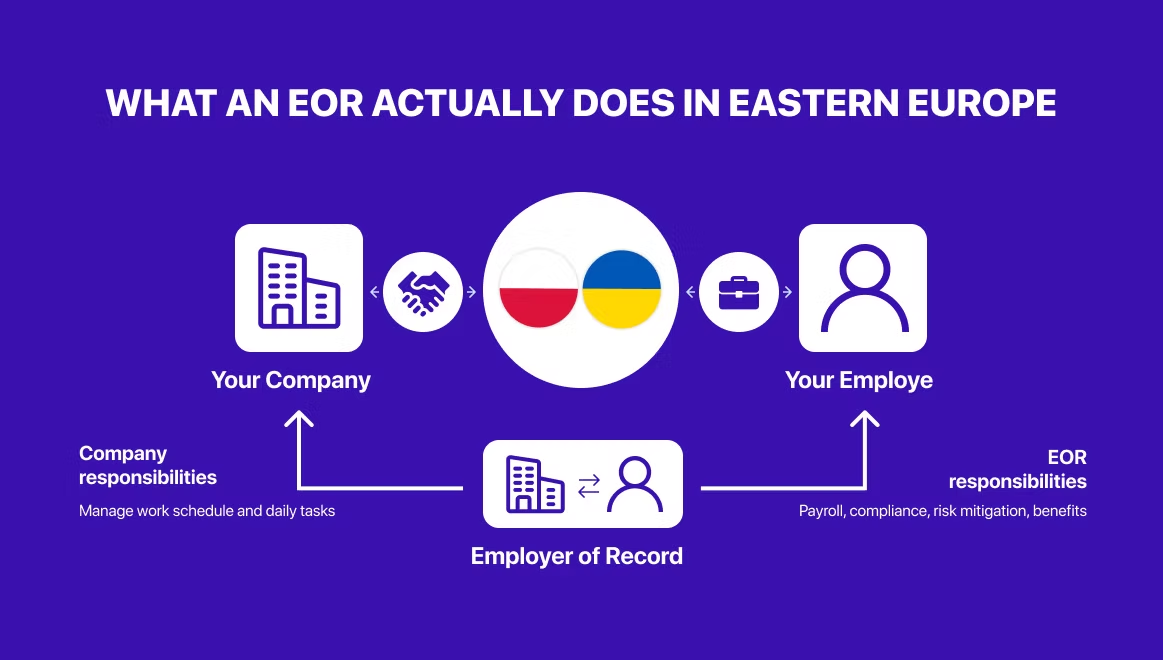
- PEO (Professional Employer Organization): You HAVE a local legal entity (e.g., a Polish Sp. z o.o. or a Romanian SRL). You use the PEO to handle the mess of local payroll, benefits, and the new 2026 transparency filings.
- EOR (Employer of Record): You DO NOT have an entity. The provider employs the talent on their own paper and "leases" them back to you.
If you are just testing the waters, you need an Employer of Record (EOR) in Eastern Europe. But if you’ve committed to the region and registered your company, a PEO is your lifeline. It allows you to focus on building your product while we handle the mandatory EU Pay Transparency audits that every employer in the region is currently scrambling to complete before the June 2026 deadline.

Understanding Professional Employer Organizations in Poland 2026
The most significant update for anyone hiring in Poland right now is the June 1, 2026, amendment to the Act on Foreigners.
- The Mandate: Poland has introduced a "hard block" on the labor market for certain visa types. You can no longer legalize employment for workers who are staying based solely on entry permits or visas from other Schengen states without a specific Polish residence and work permit.
- The Penalty: Improperly legalized workers aren't just a fine; they are an immediate operational shutdown for that team member.
- The PEO Value: A local PEO manages the Type A work permit process directly with the Voivodeship office. We ensure your staff are "Authorized Labor Migrants" before they even touch their laptop.
Understanding Professional Employer Organizations in Bulgaria (January 2026)
Bulgaria has officially adopted the Euro as of January 1, 2026. This isn't just a currency swap; it's a payroll overhaul that requires surgical precision.
- The Conversion Rule: Salaries must be converted at the fixed rate of 1.95583 BGN. Rounding errors on a 50-person team can lead to systemic labor law violations. In 2026, the law requires rounding in favor of the worker down to the nearest euro cent.
- Minimum Wage Spike: The minimum monthly wage has jumped to €620.20. If your junior staff or support teams haven't been adjusted, you are non-compliant as of three weeks ago.
- Dual Pricing Audit: Until June 30, 2026, you must still show pay slips in both currencies to ensure transparency during the transition.
Understanding Professional Employer Organizations in Romania (The 2026 Social Insurance Sprint)
Romania remains a high-growth hub, but its tax code is in a state of constant evolution.
- Dividend Tax Hike: As of January 1, 2026, the dividend tax rate has increased from 10% to 16%. For founders taking draws from a Romanian SRL, this changes the math on your "take-home" pay.
- Bank Account Mandate: Starting this year, every SRL must have a Romanian bank or treasury account. If you lack one, the tax authority can mark you as "fiscally inactive," suspending your VAT code and your ability to deduct expenses.
- The PEO Insight: We don't just "process" payroll; we act as your PEO Payroll partner in Eastern Europe to ensure your social health insurance (CASS) contributions are calculated on the new 2026 caps, protecting you from late-payment penalties that can reach RON 10,000.
The June 2026 Deadline: EU Pay Transparency
This is the "big one." By June 2026, the EU Pay Transparency Directive becomes fully enforceable across the region.
- No More Salary History: You are legally banned from asking candidates about their past salaries in Poland, Romania, or Bulgaria.
- Mandatory Pay Ranges: Every job posting must include a starting salary or a clear pay range.
- The "Right to Know": Your existing employees now have the right to request average pay levels, broken down by gender, for categories of workers doing the same work.
What is a PEO in Eastern Europe
If you’re running a business in 2026, you’ve probably heard the term Professional Employer Organization (PEO) tossed around in boardrooms or startup Slack channels. But let’s cut through the corporate noise.
At its core, a PEO is a co-employment partner. It’s not just a vendor you pay to cut checks; it’s a legal relationship where you and the PEO share the responsibilities of being an employer. You handle the "mission" the hiring, the strategy, and the day-to-day management—while the PEO handles the "machinery", the payroll, the taxes, and the ever-shifting compliance landscape.
The Anatomy of Co-Employment
Think of it like co-piloting a plane. You’re the captain in the left seat, deciding the destination and steering the ship. The PEO is the co-pilot in the right seat, monitoring the fuel (payroll), managing the navigation charts (compliance), and handling the radio (benefits administration).
1. The Division of Labor
- Your Job: You decide who to hire, what they do, and how much they get paid. You maintain full control over your company culture and performance management.
- The PEO’s Job: They become the "Employer of Record" for tax purposes. They issue the W-2s (or local equivalents), withhold taxes, and manage the "un-fun" stuff like workers' comp and unemployment insurance.
2. The Power of the "Pool."
The real secret sauce of a PEO is economies of scale. By "pooling" thousands of employees from hundreds of different small companies, a PEO gains the bargaining power of a Fortune 500 corporation.
- The Result: Your 10-person startup in Tbilisi or Warsaw gets access to the same high-tier health insurance rates and 401(k) / pension plans that a massive tech giant would offer.
How a PEO works in Eastern Europe. Step by step
This is what actually happens when companies use a PEO across Eastern Europe.
Step 1. You must already have a local entity
Before a PEO can help, you need:
- A registered company in the relevant country
- Local tax and social security registrations
- A local bank account for payroll
No entity. No PEO. There is no regional shortcut here.
This alone explains why PEOs are rarely the first move for foreign companies entering Eastern Europe.
Step 2. You hire employees under your company
With a PEO:
- Employment contracts are issued by your entity
- Local labor law applies in full
- Notice periods, severance, and documentation are your responsibility
The PEO may help prepare compliant documents. Legally, the employer is still you.
Step 3. The PEO administers payroll
This is where PEO payroll in Eastern Europe actually adds value.
Typically, a PEO supports:
- Monthly payroll calculations
- Income tax withholding
- Social security contributions
- Payslips and payroll records
But here’s the line that matters.
If payroll is incorrect or late, authorities don’t call the PEO. They call your company.
For the deeper mechanics, this matters: → PEO Payroll in Eastern Europe. How It Works and When It Doesn’t (PEO-04)
Step 4. Compliance and audits stay with you
Even with a PEO:
- Labor disputes name your entity
- Social security audits target your filings
- Termination claims hit your balance sheet
A PEO supports execution.
It does not absorb risk.
PEO vs EOR in Eastern Europe: The 2026 Strategic Breakdown
If you’re scaling in Eastern Europe, specifically Poland, Romania, or Bulgaria, you’ve likely hit the "Marmite" moment: the talent is incredible, but the paperwork looks like a bureaucratic war crime. In 2026, navigating this requires a choice between two models that sound similar but are legally worlds apart.
The core distinction is simple: Do you have a local legal entity?
The Fundamental Difference
| Feature | PEO (Professional Employer Org) | EOR (Employer of Record) |
| Entity Requirement | Mandatory. You must own a local Sp. z o.o. (PL) or SRL (RO). | None. You use the provider's local legal infrastructure. |
| Legal Relationship | Co-employment. You and the PEO share legal responsibility. | Sole Employer. The EOR is the only legal employer of record. |
| Liability | Shared. If a tax filing fails, you are still on the hook. | Transferred. The EOR assumes 100% of the legal risk. |
| Best For... | Optimizing a long-term, large-scale hub (50+ people). | Testing a market or hiring the first 1–20 employees fast. |
Eastern Europe 2026: Why the Choice is High-Stakes
The region isn't a "wild west" for hiring anymore. Governments in Poland, Romania, and Bulgaria have introduced digital-first compliance mandates that can trigger automated fines.
1. The "June 2026" Pay Transparency Wall
Every EU member state, including Poland, Romania, and Bulgaria, must comply with the EU Pay Transparency Directive by June 2026.
- The PEO Challenge: If you have an entity, you are legally responsible for auditing your gender pay gap and publishing salary bands. A PEO helps with the math, but the legal "heat" stays with your entity.
- The EOR Shield: The EOR takes the lead on this. Since they are the legal employer, they ensure the job postings and internal pay audits satisfy the labor inspectors.
2. Poland’s 2026 Minimum Wage & Service Reset
As of January 1, 2026, Poland’s minimum wage jumped to PLN 4,806.
- The Catch: New 2026 rules now count "periods of business activity" toward an employee's total seniority. This affects their vacation days and notice periods.
- PEO/EOR Role: Whether you use a PEO (to manage your entity's compliance) or an EOR (to shield you from it), these providers must recalculate every single contract’s seniority based on these retrospective changes.
3. Romania’s Digital Tax Mandate
Romania is leading the charge in "Real-Time Tax Reporting."
- The Requirement: Every employment contract modification must be reported via REGES-Online within 24 hours.
- Why EOR wins for speed: Setting up a local SRL and getting the digital signatures to access the Romanian government portals can take months. An EOR bypasses this entirely, allowing you to hire in days.
PEO vs. EOR: Pros and Cons
PEO (Professional Employer Organization)
Pros:
- Scale Pricing: Once you have 100+ devs in Poland, the per-head cost of a PEO is often lower than an EOR.
- Brand Identity: The employment contract has your company name on it, not the provider’s.
- Direct Equity: It’s easier to issue local stock options (ESOPs) through your own entity.
Cons:
- Slow Start: It can take 3–6 months to register an entity, open a local bank account, and get tax IDs.
- Permanent Establishment (PE) Risk: You are fully exposed to local corporate tax.
EOR (Employer of Record)
Pros:
- Instant Market Entry: Hire that "must-have" developer in Bucharest today, not next quarter.
- No Tax Headache: You don't have to deal with the local tax authorities directly.
- One Invoice: You pay one amount in EUR/USD, and the EOR handles the local Zloty/Leu/Lev conversions and social security.
Cons:
- Per-Employee Cost: In the long run, EOR fees are higher per head because they are selling you "risk mitigation" as a service.
- Limited Tenure: Some countries (like Bulgaria) have "Temporary Work Agency" limits. If you plan to keep a team for 5+ years, you eventually need an entity and a PEO.
The Verdict: Which One for You?
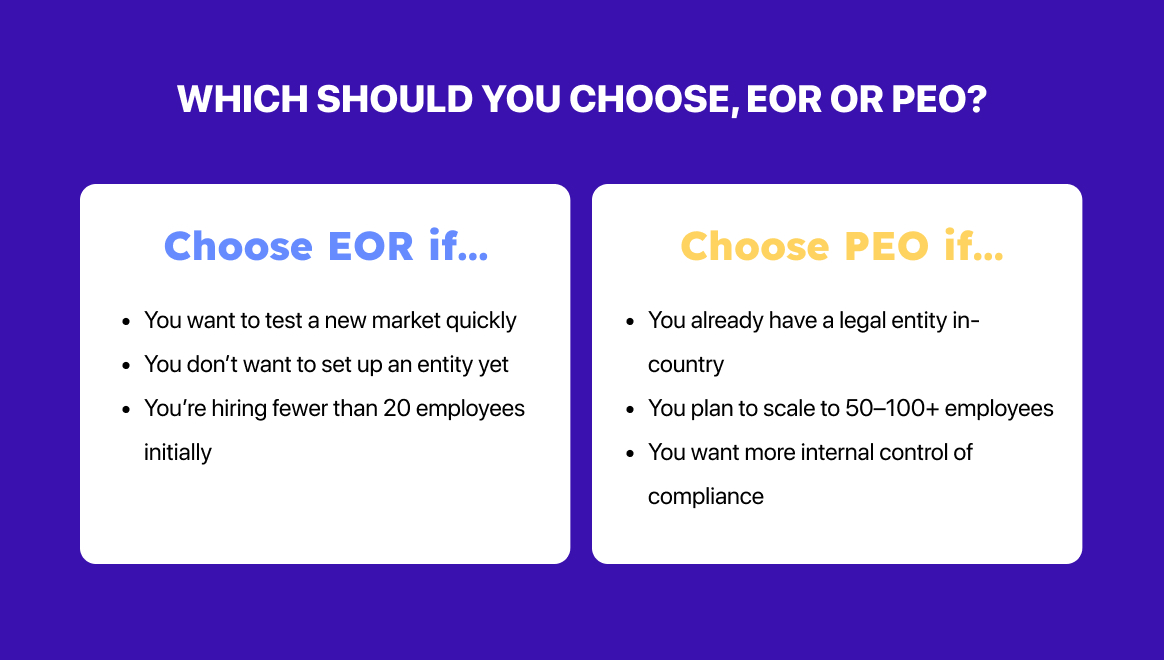
- Choose EOR if you are hiring your first 5–15 people in Eastern Europe and want to avoid the $20,000–$50,000 cost of setting up a local subsidiary.
- Choose PEO if you have already registered your company and need to offload the HR "mess" so you can focus on building your product.
Common compliance traps companies hit with PEOs in Eastern Europe

Expanding your footprint in Eastern Europe is a high-reward move, but as of 2026, the "margin for error" has vanished. Regional tax authorities have upgraded their digital tracking, and the EU has dropped a massive compliance hammer in the form of the Pay Transparency Directive.
If you're using a PEO in Poland, Romania, or Bulgaria, here are the four most common compliance traps that can sink your operation.
1. The "Ghost" Entity Trap
This is the most frequent mistake made by US or UK-based founders. Because "co-employment" is a standard legal concept in the US, many assume a PEO can employ people on their behalf in Europe without the company needing its own legal presence.
- The Reality: In Eastern Europe, PEO co-employment requires a local entity. You must have a Polish Sp. z o.o. or a Romanian SRL registered.
- The Trap: Using a PEO provider that doesn't insist on seeing your registration documents. If you hire through a PEO without an entity, you are essentially "shadow hiring," which triggers immediate Permanent Establishment (PE) tax penalties and can lead to a 5-year retrospective audit.
- Solution: If you don't have an entity, you must use an Employer of Record (EOR) in Eastern Europe, not a PEO.
2. The "June 2026" Pay Transparency Wall
The EU Pay Transparency Directive is the biggest HR shift in a decade. As of June 2026, pay secrecy is effectively illegal.
- The Trap: Thinking your PEO "handles it." While a PEO manages payroll, the legal obligation to report gender pay gaps and disclose salary bands in job postings rests on your company (the entity owner).
- The Risk: If an employee in your Warsaw office requests the "median pay for their category" and you can't provide it within two months, you are liable for discrimination claims.
- 2026 Mandate: You must now include a salary range in every job posting. Asking about "salary history" during interviews is now a punishable offense in Poland and Romania.
3. The B2B Reclassification Crackdown (Poland)
In 2026, the Polish National Labour Inspectorate (PIP) gained unprecedented powers to reclassify B2B contractors as full-time employees.
- The Trap: Keeping your "senior" team on B2B contracts to save on social security (ZUS) while using a PEO for your junior staff.
- The Risk: If a contractor uses company equipment, follows set hours, and reports to a manager, the PIP can retroactively turn that B2B contract into an employment contract.
- The PEO Failure: Most PEOs only look at the employees on their platform. They won't warn you about the 5 contractors you have on the side who are currently a ticking tax time bomb.
4. The "Seniority" Calculation Error (Poland 2026 Update)
As of May 1, 2026, for the private sector, Poland changed how "tenure" is calculated.
- The Mandate: Periods of B2B work, sole proprietorship, and even work performed abroad now count toward an employee's total seniority.
- The Trap: This seniority determines vacation days (20 vs. 26 days) and notice periods. Many PEO systems are still using the "old" calculation (based only on employment contracts).
- The Cost: If you fail to grant the extra 6 days of leave because you didn't count an employee's prior B2B years, you’re in breach of the Labour Code.
Compliance Risk Matrix 2026
| Trap | Regional Impact | Financial Penalty (Approx.) |
| No Local Entity | Poland, Romania, Bulgaria | 19–30% Corporate Tax + Fines |
| Salary History Ask | All EU Members | €2,000 – €10,000 per instance |
| B2B Misclassification | Poland (High), Romania | Back-dated ZUS/Social Security (up to 5 years) |
| Euro Conversion Error | Bulgaria | Fines for underpayment |
How to Navigate Out of the "Hard Parts"
Don't let these traps scare you off the region. The solution is Founder-level clarity:
- Audit your B2B contracts today. If they look like employees, move them to the PEO/EOR before the PIP inspector knocks.
- Integrate your PEO with a Transparency Tool. Ensure your pay bands are documented before the June deadline.
- Check your Seniority data. Ask your Polish team to provide documentation for their prior B2B years now so you aren't surprised by a "mass vacation" request in December.
The verdict. Is a PEO your best move in Eastern Europe?
<a id="verdict-peo-eastern-europe"></a>
Here’s the clear answer.
- If you’re already established, a PEO can improve efficiency.
- If you’re entering the market, a PEO is usually the wrong first step.
The companies that scale cleanly in Eastern Europe almost always follow this sequence:
- Start with an EOR
- Validate the market
- Set up an entity
- Introduce a PEO only when the scale justifies it
That sequence isn’t conservative. It’s disciplined.
Ready to hire in Eastern Europe without learning compliance the hard way?
Here’s what most providers won’t say plainly.
If you choose the wrong hiring model in Eastern Europe, you don’t just lose time.
You inherit compliance exposure that shows up years later. Usually at the worst moment.
That’s why companies work with Team Up.
Not because we promise shortcuts. Because we help you choose the right structure before mistakes get expensive.
What working with Team Up actually gives you
- Clear guidance. PEO, EOR, or neither
- Local execution you can defend in audits
- A clean path from first hire to scale
- Regional expertise anchored in Georgia
We don’t sell optimism. We sell structures that survive scrutiny.
If you’re hiring in Eastern Europe now
Before you:
- Open an entity you’re not ready for
- Sign a PEO contract that doesn’t do what you think
- Let “we’ll fix it later” become a liability
Talk to Team Up.
We’ll look at your plan and tell you, honestly, what works. And what doesn’t?
Frequently asked questions
1. Is a PEO legal in Eastern Europe?
Yes, but it’s nuanced. Unlike the US, where "co-employment" is a distinct legal category, most Eastern European countries (like Poland and Romania) treat PEO services under Labor Leasing or Outsourced HR Management frameworks. You remain the primary employer on the contract, but the PEO is legally authorized to manage your payroll and tax filings through a service agreement.
2. What is the difference between a PEO and a Payroll Provider?
A payroll provider is a calculator; a PEO is a shield.
- Payroll Outsourcing: They calculate the numbers, but you are responsible if the filing is late or the tax math is wrong.
- PEO: Through co-employment, the PEO shares the liability. They use their specialized legal team to ensure your filings meet the 2026 Digital Reporting standards in countries like Romania (REGES-Online).
3. Do I need a local bank account to use a PEO?
Usually, yes. Since a PEO requires you to have a local entity, that entity must have a functional bank account to receive the funds for payroll. However, some premium PEOs in 2026 offer Trust Account services where you can wire USD/EUR to them, and they handle the local currency distribution (Zloty, Leu, GEL) to your team.
4. How much does a PEO cost in 2026?
Pricing in Eastern Europe and the Caucasus has stabilized, but watch out for "hidden" software fees.
- Flat Fee: Typically $100 – $250 per employee/month.
- Percentage Model: Usually 3% – 6% of gross payroll.
- Hidden Costs: Always ask about "Onboarding Fees" ($200+) or "Offboarding Fees" ($500+), which many global giants hide in the fine print. At Team Up, we stick to transparent, fixed pricing.
5. Can a PEO help with Work Permits (D1 Visas)?
Absolutely. In fact, this is the #1 reason to use a PEO in 2026. With the March 2026 Georgia Work Permit crackdown and Poland's new June 2026 Foreigner Act, a PEO acts as your local "Sponsor" and liaison with the Ministry of Labor to ensure your foreign talent is fully legalized.
6. What happens if I want to cancel my PEO service?
This is the "Cons" side of the PEO. Because your payroll and benefits are integrated into their systems, leaving a PEO can take 30 to 90 days. You have to "offboard" your team from their insurance and tax ID and "onboard" them back onto your own internal systems.
.svg)