


5 Things to Know About EOR-Sponsored Visas in Turkey: Enterprise Guide
TL;DR: Hiring in Turkey With an Employer of Record
Turkey is one of the most strategically compelling talent markets in the world right now. A GDP of $1.2 trillion. The ICT sector is valued at $35.29 billion in 2025, growing at nearly 9% annually. Istanbul housing 60% of the country's tech talent, with 83% of all software engineering job postings concentrated there. A government that just committed $3.5 billion to the "Digital Turkey" program and is targeting AI at 5% of GDP. Turkey isn't a market you discover. It's a market you should already be building in.
But the moment you try to bring international talent into Turkey, or transfer a specialist from another office, you're stepping into one of the most structured and condition-heavy employment immigration systems in the region. EOR-sponsored visas in Turkey require navigating a dual-application process, a mandatory workforce ratio that catches almost every first-time enterprise team off guard, and salary floors tied to the national minimum wage that will break your permit application if you get them wrong.
This guide gives you the founder-level clarity you need to do this right. Five things. No fluff. Real compliance depth.
Why Hire in Turkey: The Enterprise Case for Employer of Record Expansion

Before we get into mechanics, the business case deserves its full moment.
Turkey's ICT sector doesn't just look good on a slide deck. It's operationally significant at scale. The sector is projected to reach $54 billion by 2030, growing at a compound annual rate of 8.93%. Cloud services are expanding at 9.16% CAGR as enterprises accelerate workload migrations. Istanbul alone is home to 60% of the country's tech talent, and its startup ecosystem is now valued at approximately $22 billion, making it one of the most concentrated innovation environments in the broader EMEA region.
What this means for an enterprise talent strategy:
The talent is here: Senior full-stack developers, AI/ML engineers, cloud architects, cybersecurity specialists, fintech leads. Turkey produces them at scale, and the government is actively creating 50,000 new AI-focused roles through its Digital Turkey initiative. The country's 117 technoparks are producing specialized talent that international companies are increasingly targeting.
The cost is competitive by design: Senior developers working for globally-minded Turkish companies earn $4,000–$10,000/month when paid in foreign currency. The same talent level at comparable roles in Germany or the UK costs 2–3x that. Turkey operates UTC+3, with direct timezone overlap into Europe, the Middle East, and the Gulf, making real-time collaboration genuinely practical.
The government wants foreign investment: Foreign direct investment inflows rose 5.6% in 2024, reaching $11.3 billion. The "Digital Turkey" program backs international tech partnerships explicitly. For enterprise teams in renewable energy, fintech, AI, and logistics, Turkey isn't just a talent source; it's a strategic operational hub.
The challenge is the immigration framework. Turkey's work permit system under International Labour Force Law No. 6735 is rigorous, employer-accountability-heavy, and unforgiving of process errors. For international companies without a registered Turkish entity, a properly run Employer of Record is the only compliant path to sponsoring a foreign national to work here.
Thing 1: Turkey Work Permit vs Work Visa: Why They Are the Same Document and Why It Matters

This is the structural insight that almost no one leads with, and it reframes everything about how you plan a Turkey hire.
In most countries, the work permit and work visa are two separate documents: one authorizes employment, the other authorizes entry and residence. In Turkey, they are integrated. A Turkish work permit, once approved by the Ministry of Labour and Social Security (MLSS), simultaneously functions as a residence permit for the duration of employment.
This has three significant operational implications:
Implication 1: There's no separate residence permit to process after arrival.Once the work permit is approved and the employee enters Turkey on their work visa, the permit card they receive covers both their right to work and their right to reside. You don't need to budget a parallel TRC process the way you would in Armenia or Azerbaijan.
Implication 2: Losing the work permit means losing the right to stay.
Because the permit functions as a residence permit, any cancellation, whether from non-payment of social security contributions, employer non-compliance, or permit lapse, immediately affects the employee's legal right to remain in Turkey. The exposure is direct and immediate. There is no grace period between losing work authorization and losing residence authorization.
Implication 3: Permit applications control everything.
You cannot get a residence card and worry about the work permit later. You cannot enter Turkey on a tourist visa and sort out the employment authorization in-country. The entire legal status is built around the work permit, which means getting the permit right and keeping it compliant is the single most critical compliance obligation in Turkish employment.
What Visa Sponsorship for Employment Means in Turkey
Employer sponsorship in Turkeyis not a letter. It is not a promise. It is a regulated work permit process run by the Republic of Türkiye Ministry of Labour and Social Security, typically through the Directorate's e-İzin application system. The employer is the filer. The employer is accountable for meeting evaluation criteria and for post-approval obligations like social security registration and compliant wage reporting.
For an international company without a Turkish entity, this means you need an EOR with a registered Turkish entity to be the filer. The EOR takes accountability for meeting all employer-side obligations, not just sponsoring the permit, but maintaining the conditions that keep it valid throughout the employment relationship.

Thing 2: Turkey’s 5-to-1 Rule Explained: Local Hiring Quotas and Employer Requirements
This is the requirement that blindsides enterprise teams more than any other in Turkish immigration law. It's called the Employment Criterion, and it operates as a mandatory workforce ratio that the MLSS evaluates before approving any work permit application.
For every one foreign employee the company wishes to hire, it must employ at least five Turkish citizens.
In plain terms: if your Turkish entity (or your EOR's entity) wants to sponsor a work permit for a foreign national, the sponsoring employer must demonstrate that at least five Turkish citizens are on its payroll. This is not a one-time threshold; it's an ongoing condition. If your Turkish employee headcount drops below the ratio during the validity of the permit, you're in violation.
Why this matters for EOR-sponsored hires:
When you engage an EOR in Turkey, the EOR's Turkish entity is the sponsor. An EOR with a large, active employee base in Turkey, serving multiple client companies, naturally maintains a headcount that satisfies the 5-to-1 ratio. An EOR with minimal Turkish operations, or one that subcontracts to a local affiliate, may struggle to document compliance. This distinction is critical and often overlooked during EOR selection.
The exemptions that actually apply, and how to read them:
The 5-to-1 rule is not absolute. The 5-to-1 rule is waived for up to the first five foreign employees if the company's net sales in the most recent year were at least 50,000,000 TRY. For many EOR providers, this sales threshold is easily met, but you need to verify it explicitly, not assume.
Additional exemptions exist for:
- The first three foreign hires at a company, if those foreign nationals have legally resided in Turkey for at least three of the previous five years (excluding student residence permits)
- Family members of Turkish citizens are exempt from both the employment and financial sufficiency criteria
- Government project employees, companies engaged in government service or procurement projects for which the foreign national will directly work
- Key employees under the Foreign Direct Investment Law, foreign companies with recognized FDI status, may sponsor key employees with relaxed ratio requirements.
- Shareholders holding more than USD 100,000 in company capital are exempt from the employment quota but still subject to other financial criteria.
- Certain advanced technology roles, where Turkish nationals with equivalent qualifications cannot be demonstrated to exist in the market; however, this now requires specific approval from the Directorate General, not just a self-certification
The Initial Grace Period for New Employers
Employment of at least 5 Turkish nationals is required. The first work permit is issued conditionally; starting from the 7th month, this employment quota becomes mandatory. This matters for newly established entities or for EOR clients who are among the first foreign hires at a particular entity. The permit can be issued conditionally in the early months, but the ratio must be met by month seven.
Real Example of the 5-to-1 Rule in Practice
A European logistics company wants to bring in a supply chain optimization specialist from India to its Istanbul operations. The company uses an EOR that serves only three other clients in Turkey and has a Turkish employee headcount of 12. With this EOR sponsoring one permit for the logistics company, the EOR entity must document that at least 5 of those 12 Turkish employees are not already allocated to the 5-to-1 ratio for the other three clients' existing foreign hires. If the math doesn't work, the application fails regardless of how strong the candidate is.
The lesson: ask your EOR provider exactly how they satisfy the 5-to-1 ratio on your behalf, specifically for your permit, before you commit to a hiring timeline.
Thing 3: Turkey Work Permit Process: The 10-Day e-İzin Deadline That Can Break Your Application
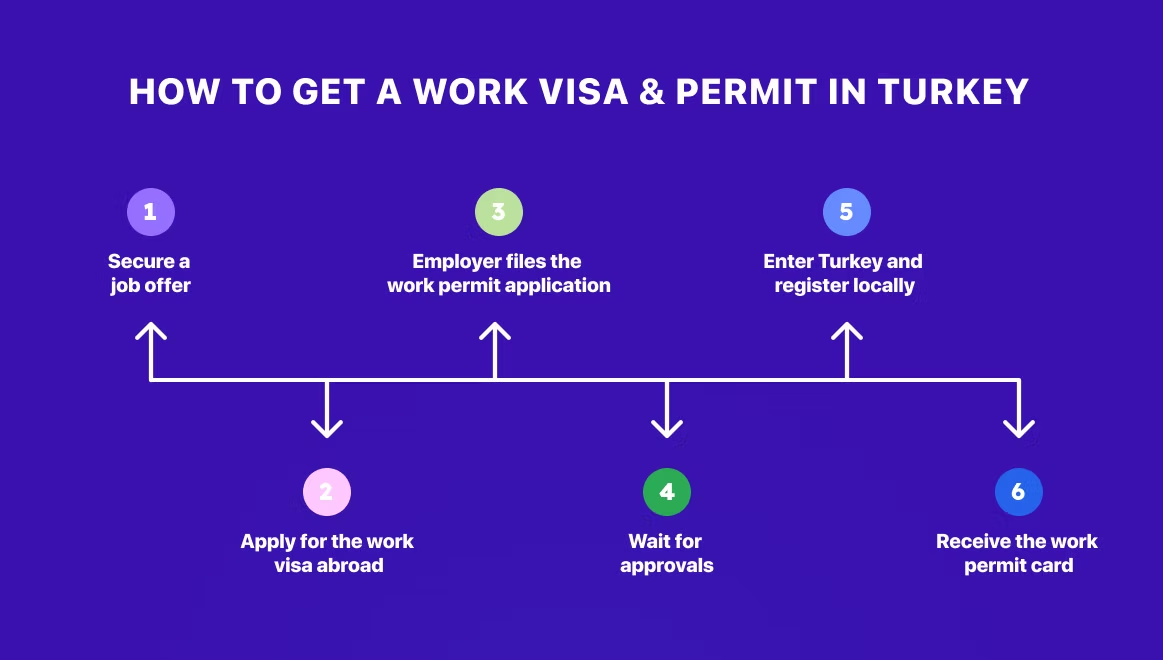
Turkey's work permit process is fundamentally different from most other markets in one architectural way: both the employee and the employer apply simultaneously, from different countries, through different systems, to different authorities.
Miss the synchronization window, and the entire application fails.
Here's how it works:
Step 1: Employee Consulate Application and Reference Number
The foreign national applies at the Turkish consulate or embassy in their home country. They submit their personal documents, passport, employment contract, diploma/graduation certificate (with sworn Turkish translation), two passport photos (taken within six months), valid medical insurance for the full stay, proof of accommodation in Turkey, and proof of means of subsistence (evidence of at least €50/day of available funds during their stay).
Upon completing the consulate application, the employee receives a 16-digit reference number.
Step 2: Employer Submission via e-İzin System (Within 10 Business Days)
Within 10 business days of the employee's consular application, the Turkish employer must submit an online filing via the Ministry's e-Permit system. This step requires uploading both company and employee documents.
The employer, your EOR in this context, submits through the Ministry's e-İzin online portal using the 16-digit reference number. Documents required from the employer side include:
- Work Permit Application Letter (on company letterhead)
- Foreign Personnel Application Form
- Turkish Trade Registry Gazette, confirming current shareholding and capital structure
- Balance sheet and profit/loss statement for the most recent year (certified by the tax office or a sworn public accountant)
- Notarized Power of Attorney authorizing the filing party to act on behalf of the entity
Step 3: Ministry of Labour (MLSS) Review Process
The Ministry of Labour and Social Security examines both the employee's visa request and the employer's electronic application together. This joint review typically takes up to 30 days. The Ministry applies all evaluation criteria, the 5-to-1 ratio, financial sufficiency, salary compliance, and professional qualifications during this review period.
Why the 10-Day Window Is the Biggest Operational Risk
If the employer does not file via e-İzin within 10 business days of the employee's consulate appointment, the application is automatically rejected for incompleteness. There is no extension, no late submission window, and no ability to explain the delay. The employee must restart from the beginning, a new consulate appointment, a new reference number, new 10-day clock.
For international companies managing this without a local EOR, the coordination challenge is significant. The employee is in their home country. The EOR's e-İzin filing requires employer-side documents that must be accurate, notarized, and in order. Any document gap on the employer side during those 10 days means a failed application.
An EOR with a properly managed Turkey process prepares all employer-side documents before the employee attends their consulate appointment, so the moment the 16-digit reference number arrives, the e-İzin filing is submitted the same day. That's the operational standard. Anything less is a risk.
What Happens After Work Permit Approval in Turkey
If approved, a permit card is issued, which also functions as a residence permit. Once approved, the Turkish consulate issues an entry visa. This is usually valid for up to 90 days, during which the employee must travel to Turkey. After arrival, the employee must be registered with the Social Security Institution (SGK) by the employer. Missing the SGK registration deadline is a separate violation with its own penalty structure.
Total timeline: From consulate appointment to entry visa and permit card: typically 4–6 weeks. Factor in document preparation time pre-consulate, and budget 7–10 weeks total from EOR engagement to fully authorized, resident employee.
Thing 4: Turkey Work Permit Salary Requirements: Legal Minimums and Role-Based Thresholds
This is the rejection trigger most enterprise teams never see coming.
Turkey doesn't just require that you pay your foreign hire a competitive salary. It specifies, by role category, the minimum gross monthly salary that must be offered, expressed as a multiple of the national gross minimum wage. These multipliers apply at the time of the permit application and must be maintained throughout the entire validity of the permit.
As of 2025, the mandatory salary multipliers are:
| Role category | Minimum gross monthly salary |
| Senior executives and pilots | 5× minimum wage |
| Engineers and architects | 4× minimum wage |
| Department managers | 3× minimum wage |
| Roles requiring expertise or mastery | 2× minimum wage |
| Household workers and other professions | 1× minimum wage |
Turkey's gross minimum wage is reviewed periodically, meaning the actual TRY floor shifts with each revision. High-level managers and pilots cannot be paid less than 5 times the minimum wage; engineers/architects cannot be paid less than 4 times the minimum wage; department managers cannot be paid less than 3 times the minimum wage.
Why Salary Thresholds Trigger Work Permit Rejections
Most international companies think about compensation in terms of market benchmarks, purchasing power parity, or internal pay bands. Turkey's Ministry doesn't care about any of that. It cares about the statutory multiplier. If you title your hire "Senior Engineer" but their contract shows a salary that's only 3.2× the minimum wage instead of the required 4×, the application is rejected. Clean. No second chance.
The published salary floors are role-based multiples of the current gross minimum wage at the application date. This is one of the cleanest rejection triggers. If you under-offer, you can be compliant with your own compensation philosophy and still fail the permit criteria.
Key Rules for Minimum Salary Compliance in Turkey
First, the multiplier applies to gross base salary only. Benefits such as housing allowance, transportation, bonus, and in-kind compensation do not count toward the minimum. If your package is designed around a lower base salary supplemented by benefits, you may be below the statutory floor even if total compensation is generous.
Second, the minimum must be maintained throughout the permit's validity, not just at the time of application. If Turkey's minimum wage increases mid-permit and your employee's salary is now below the new multiplied threshold, you are technically in breach of the permit conditions. An EOR with active payroll operations in Turkey monitors these movements and flags adjustments before they become violations.
Third, the multiplier thresholds have been revised upward from previous years. The October 2024 regulatory update, which forms the current operational baseline, increased certain category multipliers. In the updated criteria, senior executives and pilots are now required to be paid at least five times the minimum wage, adjusted from the previous 6.5× figure that appeared in older guidance. If you're working from a Turkey compliance playbook that predates October 2024, check the current figures before filing.
What This Means for Structuring Job Offers
Before you extend a job offer to a foreign national for a Turkey role, your EOR should calculate the minimum statutory salary floor for the specific role title you intend to use. Title matters here; "Engineer" and "Senior Engineer" may both require 4×, but "Engineering Director" may be classified as a manager at 3×, or as a senior executive at 5×, depending on how the role is described in the application. Get the classification right before the contract is signed. Renegotiating salary after a permit rejection adds weeks to the timeline and damages your credibility with the candidate.
Thing 5: Turkey IT Work Permit Exemptions: What Actually Qualifies and What Doesn’t
There's a widely circulated belief in global HR circles that Turkey has a broad exemption for tech workers, that you can essentially bypass the standard work permit criteria for IT roles. This belief is partially true and substantially oversimplified.
Here is the accurate picture.
What the IT Sector Exemption Covers
Turkey does allow targeted exemptions. One notable example is the information technology industry. Employment and financial eligibility criteria are not applied to specific expert IT roles in businesses operating in the IT sector.
That sounds expensive. In practice, it means the Employment Criterion (the 5-to-1 rule) and the Financial Sufficiency Criterion can be waived for specific expert IT roles in businesses specifically operating in the IT sector. It is not a blanket exemption for anyone with "developer" in their title.
Limitations of the IT Work Permit Exemption in Turkey
- The employer must qualify: The exemption applies to IT-sector businesses, companies whose primary business is IT. A manufacturing company that employs software engineers, or a fintech company whose legal registration is as a financial services firm, does not automatically benefit from the IT sector exemption for its tech hires. The exemption is sector-coded to the employer, not the role.
- The role must qualify as a specific expert IT position: Generic tech roles do not automatically qualify. The Ministry looks for specialized technical expertise that cannot be demonstrated to exist in the Turkish labor market at the required level. Vague role descriptions, "Software Developer," "IT Specialist", are significantly more vulnerable to rejection than precisely defined roles with documented specialization requirements.
- The exemption requires Directorate General approval: Updated criteria require specific approval from the Directorate General and additional documentation, indicating a more stringent process for claiming such exemptions. This is not a box you check on the application form. It is an affirmative determination that the Ministry makes based on the employer's sector registration and the role's technical specifications.
- The salary multiplier still applies: Even if the IT exemption removes the 5-to-1 and financial sufficiency hurdles, the minimum salary threshold for the role category still applies. An engineer exempted from the workforce ratio requirement must still be paid at least 4× the minimum wage.
What Enterprise Teams Get Wrong About IT Exemptions
If your Turkish entity (or EOR) is registered in the IT sector and you're hiring for a demonstrably expert technical role, specialized AI/ML engineer, cloud security architect, or distributed systems specialist, there is a credible path to using this exemption. It requires careful application preparation, documented justification for the role's specialized nature, and confirmation of the employer entity's sector classification.
If you're a non-IT company hiring tech talent, or if the role is broadly defined, don't build your timeline around this exemption. Apply through the standard track with full salary compliance and the 5-to-1 ratio satisfied by your EOR's workforce.
The Turquoise Card: Turkey’s Fast-Track for Highly Skilled Talent
For the most senior international talent, executives, internationally renowned scientists, high-level investors, and acclaimed artists, Turkey offers the Turquoise Card. Turquoise Card holders have the rights of a permanent work permit, and their spouse and dependent children are also granted residence permits.
The Turquoise Card is assessed on a points-based system and grants indefinite work and residence rights, the closest Turkey comes to a self-sponsoring long-term status. However, at the time of writing, the government has still not published an application form, nor developed a procedure for the filing of Turquoise Card applications. The legal framework exists; the operational pathway is not yet consistently available. For planning purposes, treat this as aspirational rather than operational unless your legal counsel has confirmed a live application route.
How to Hire in Turkey With an Employer of Record: End-to-End Work Permit Process
Here is the complete, sequenced playbook for EOR-sponsored visa sponsorship in Turkey, from first conversation to fully authorized employee on payroll.
Phase 1: Pre-Check and Hiring Strategy (Days 1–7)
Your EOR's Turkey legal team reviews:
- The candidate's nationality and whether their country has a Turkish consulate that processes work visas (most do; some nationalities require third-party visa centers)
- The role classification against the Ministry's salary multiplier table
- Whether the IT sector exemption applies, based on the EOR entity's sector registration and the role's technical specifications
- Whether any personal exemption applies (resident 3 of 5 years, FDI key employee, family of Turkish citizen, etc.)
- Financial sufficiency documentation, confirming the sponsoring entity meets the 500,000 TRY paid-in capital threshold, or 8,000,000 TRY net sales, or USD 150,000 exports.
- Document translation requirements for this specific nationality (diploma translations must be sworn translations)
Phase 2: Employer Document Preparation (Days 7–14)
All employer documents are prepared before the employee books a consulate appointment:
- Work Permit Application Letter (company letterhead)
- Trade Registry Gazette (current capital structure)
- Certified balance sheet and profit/loss statement
- Notarized Power of Attorney
- Foreign Personnel Application Form
Everything is ready before the 10-day clock starts.
Phase 3: Employee Consulate Appointment and Reference Number (Days 14–21)
The candidate attends the Turkish consulate in their home country with:
- Valid passport (minimum 60 days beyond the requested permit duration)
- Signed employment contract showing the role-compliant salary
- Two recent passport photos
- Medical insurance certificate covering the full stay period
- Proof of accommodation in Turkey (rental agreement or property document)
- Proof of daily subsistence funds (at least €50/day equivalent)
- Sworn Turkish translation of their diploma and qualifications
Upon completing the appointment, the candidate receives their 16-digit reference number and immediately communicates it to the EOR.
Phase 4: e-İzin Submission Within the 10-Day Window
The EOR files the employer-side application through the Ministry's e-İzin portal using the reference number. All pre-prepared employer documents are uploaded. The joint review clock begins from this submission date.
Phase 5: Ministry of Labour Review and Approval (Days 30–45)
The Ministry of Labour and Social Security conducts the joint review:
- 5-to-1 ratio verification
- Financial sufficiency assessment
- Salary floor compliance check
- Professional qualifications review
- Sector classification check (if exemption is claimed)
Typical decision timeline: up to 30 days from the employer's e-İzin submission. The Ministry may request additional documentation during review, respond promptly, as delays here extend the timeline.
Phase 6: Work visa issuance and entry (Days 45–55)
Upon approval, the Turkish consulate issues the entry work visa (valid for up to 90 days). The employee travels to Turkey. The EOR coordinates airport arrival logistics and confirms the first post-arrival compliance steps.
Phase 7: SGK registration and permit card activation (within 30 days of permit start date)
Employers must register foreign workers with the Social Security Institution (SGK) within 30 days of the permit's start date. Failure to pay these premiums is grounds for immediate permit cancellation.
The EOR registers the employee with the Turkish Social Security Institution, enrolls them in the mandatory social insurance scheme, and activates payroll in Turkish Lira. Employment contract signed under Turkish Labor Law No. 4857.
Employer must also notify the MLSS within 15 days of the employee's start date, and must notify again within 15 days if employment terminates. Missing these notification deadlines triggers administrative fines.
Work permit validity and renewals:
- Initial grant: up to 1 year, tied to specific employer and position
- First extension: up to 2 years (same employer)
- Second extension: up to 3 years (same employer)
- After 8 consecutive years of legal work and residence, eligible for an indefinite work permit
Total timeline from EOR engagement to authorized employee: 7–10 weeks on a standard track. Document preparation and consulate appointment scheduling are the primary variables.
The Real Cost of Non-Compliance in Turkey
Let's be direct. Turkey's immigration and labor compliance regime has real teeth, and the Ministry of Labour's enforcement posture has tightened since the 2024 regulatory update.
For the employee:
- Working without a valid work permit: deportation and re-entry ban. Turkey has a documented practice of enforcing these
- Overstaying a visa or entering on an inappropriate visa category: immediate status violation, fines, and potential ban
- Residence authorization automatically invalidated if the work permit is cancelled, no grace period
For the sponsoring employer (your EOR and, by extension, you):
- Administrative fines for each unauthorized foreign employee
- Fines for missing the 15-day start/termination notification obligations
- SGK contribution violations trigger permit cancellation, not just fines
- Restrictions on future work permit applications: Companies with compliance violations face heightened scrutiny on all subsequent applications.
- Reputational impact with the Ministry of Labour, which matters substantially if you plan to scale your Turkish operations
The SGK trap:
This is Turkey's most operational compliance trap. The work permit is issued. The employee starts work. The EOR must register with SGK within 30 days and begin contributions. If SGK registration lapses, is done incorrectly, or contributions fall behind, the Ministry treats this as an active permit violation. Not a late payment. An active violation. The permit can be cancelled mid-employment.
An EOR managing payroll in-country, with a Turkish-registered accountant and direct SGK access, processes this registration on day one, not at the deadline. That's the operational standard.
The employer change trap:
The employer is responsible for notifying the MLSS and DGMM of any changes in the employee's status, such as termination of employment, within a specified timeframe.
Work permits in Turkey are employer-specific. If your hire needs to move from one team structure to another, even within your organization's umbrella, and the change affects the legal employer entity, a new permit application is required. You cannot transfer a permit between employers. Any unauthorized employer change creates an immigration violation, even if the employee's day-to-day work hasn't changed at all.
Team Up's Advantage: What Local Infrastructure Means in Istanbul and Ankara

Turkey is not the market where you want to learn on the job.
The 10-business-day e-İzin window. The 5-to-1 ratio documentation. The salary multiplier thresholds shift with each minimum wage revision. The SGK registration deadline triggers permit cancellation if missed. The October 2024 regulatory update revised evaluation criteria across the board. These are not theoretical risks. They are the documented failure modes of international companies that came to Turkey with a generic EOR playbook.
Team Up operates with directly owned entities across Turkey and the broader region, including Georgia, Armenia, Azerbaijan, Kazakhstan, Uzbekistan, India, and Egypt. In Turkey, this means:
- Direct e-İzin access. Team Up's Istanbul-based legal and compliance team files through the Ministry's e-İzin system directly, not through a local affiliate or third-party broker. Direct access means the 10-day employer window is met on day one of the countdown, not day nine.
- A 5-to-1 ratio is never a question. Team Up's Turkish entity maintains an active headcount that satisfies the employment ratio across all client permits it sponsors. When you engage Team Up for a Turkey hire, the ratio is documented and confirmed before you commit to a candidate's start date.
- Salary floor accuracy. Team Up's Turkey legal team calculates the applicable minimum wage multiplier for your specific role title before the contract is drafted, not after the application is rejected. The minimum wage is monitored continuously, and payroll adjustments are triggered automatically when statutory floors change.
- SGK registration on day one. Every employee sponsored by Team Up is registered with the Social Security Institution on the first day of employment, not at the 30-day deadline. This is not optional. It's the only way to guarantee the permit remains valid from the start.
- October 2024 compliance baseline. The Ministry's updated evaluation framework, including the revised salary multipliers, the expanded financial thresholds, and the stricter IT sector exemption documentation requirements, is built into Team Up's standard Turkey permit workflow. No legacy playbooks. Current law only.
For enterprise teams building or scaling Turkish operations, whether in Istanbul's fintech ecosystem, Ankara's defense and deep-tech corridor, or Izmir's growing manufacturing tech cluster, Team Up is the local EOR provider that knows the difference between a permit approval and a permit rejection before the application is filed.
Bottom Line
Turkey is a market that rewards preparation. The talent is there, 60% of the country's tech professionals in Istanbul alone, a government investing $3.5 billion in digital infrastructure, and a cost structure that gives international companies a genuine margin advantage compared to Western European alternatives. The business case is real.
But the immigration framework is among the most condition-specific in any emerging market Team Up operates in. The dual-application process has its 10-day countdown. The 5-to-1 ratio must be documented before a single application is filed. The salary floors shift with every minimum wage revision. The SGK registration must happen on day one, not day thirty. The IT sector exemption requires Directorate General approval, not just a check in a box.
EOR-sponsored visas in Turkey work. They work efficiently and reliably, but only when the EOR has the infrastructure, the Turkish entity, the legal team, and the current compliance knowledge to run the process correctly from the first day.
That's not every EOR. It's the right EOR.
Talk to Team Up about your Turkey hiring plans.
FAQ: EOR-Sponsored Visas in Turkey
What does it mean to require sponsorship for employment in Turkey?
It means the foreign national doesn't have an independent right to work in Turkey and needs a registered Turkish employer to apply for a work permit on their behalf. The sponsor takes legal accountability for the permit conditions, salary compliance, SGK registration, and ongoing labor law obligations. Without an entity in Turkey, international companies use an EOR to provide this sponsorship.
Does the Turkish work permit replace the residence permit?
Yes. A Turkish work permit also doubles as a residence permit, which means it authorizes both living and working in the country for its duration. This is different from many other markets where work authorization and residence authorization are separate documents.
What is the 5-to-1 rule in Turkish immigration?
For every foreign national an employer sponsors for a work permit, the employer must maintain at least five Turkish citizens on its payroll. An EOR with active Turkish operations satisfies this ratio across its employee base. Certain exemptions exist for high-sales companies, FDI key employees, advanced technology roles, and foreign nationals with established Turkish residency.
What are the salary requirements for a Turkish work permit?
Salaries must meet mandatory minimums set as multiples of the Turkish gross minimum wage: 5× for senior executives and pilots, 4× for engineers and architects, 3× for department managers, 2× for specialized expertise roles, and 1× for other professions. Base salary only, benefits and bonuses do not count toward the threshold.
How long does a Turkish work permit take?
From consulate appointment to entry: typically 4–6 weeks. From EOR engagement to a fully authorized, resident employee: budget 7–10 weeks. Urgent processing is not a standard option in Turkey's MLSS system the way it is in Azerbaijan or Armenia.
Can a foreign national convert a tourist visa to a work permit inside Turkey?
Only if they already hold a valid short-term residence permit with at least six months of remaining validity, in that case, the employer can apply via e-İzin directly from within Turkey without a consulate appointment. A tourist visa does not qualify as the basis for an in-country work permit application. The standard path requires the consulate application from the employee's home country.
What happens if the employer misses the 10-day e-İzin window?
The application is automatically rejected. There is no extension, no late filing mechanism, and no appeal for the timing failure. The employee must start the process again from a new consulate appointment.
Can a work permit be transferred to a different employer in Turkey?
No. Work permits are employer-specific. A permit issued for Company A is not valid for Company B, even if both are EOR clients with the same EOR entity as sponsor. A new permit application is required for any employer change.
What is the Turquoise Card in Turkey?
The Turquoise Card is Turkey's indefinite work and residence permit for highly qualified foreign nationals, top-tier executives, internationally acclaimed scientists, and major investors. It is assessed on a points-based system and provides rights similar to permanent residency. In practice, the application process has not been consistently operational; verify the current status with in-country legal counsel before planning around it.
What are the penalties for employing a foreign national without a valid work permit in Turkey?
Fines per unauthorized employee, restrictions on future work permit applications, and potential deportation of the employee with a re-entry ban. Under Turkey's enforcement-tightened 2025 environment, non-compliance is actively identified during Ministry audits, particularly in Istanbul's tech and financial services sectors.
.svg)


