


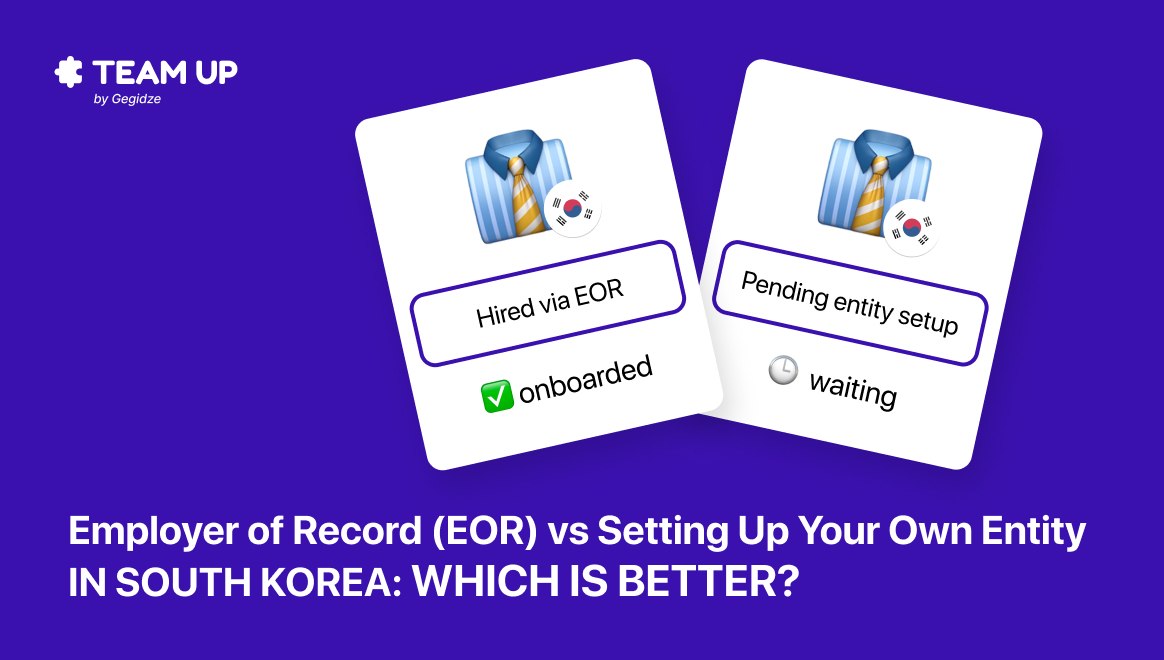
Employer of Record (EOR) vs Setting Up Your Own Entity in South Korea: Which is Better?
TL;DR
- The EOR vs entity South Korea decision is one of the most consequential choices a company makes when entering the Korean market. It determines your time to first hire, your capital commitment, your compliance exposure, and your exit options.
- Forming a Korean Jusik Hoesa (corporation) takes three to five months under optimal conditions. It requires minimum capital, notarised incorporation documents, National Tax Service (NTS) business registration, and four-insurance employer registrations across NPS, NHIS, MOEL, and COMWEL before your first employee can legally start.
- An EOR compresses that to three to five business days. The EOR is already the registered employer. Your new hire starts with compliant Labour Standards Act employment contracts, four-insurance coverage from day one, and a correctly issued Korean payslip — without your company holding a Korean business registration number.
- The true employer cost in Korea is approximately 115% to 120% of gross salary when four-insurance contributions and mandatory retirement benefit accruals are included. The entity model adds ongoing entity maintenance costs (accounting, audit, legal, bank fees) that the EOR model does not.
- Korean Labour Standards Act severance is mandatory for every employee who works more than one year — regardless of how the employment ends, including resignation. The severance calculation and 14-day payment deadline are managed by the EOR. Under the entity model, they are the company's direct operational responsibility.
- Entity dissolution in Korea takes six to twelve months minimum. An EOR wind-down can be completed within the contractual notice period. This asymmetry matters more than most companies expect when market conditions change.
- The inflection point where a local entity typically makes better unit economics than an EOR is around 40 to 60 employees with confirmed long-term Korea operations. Below that threshold, the EOR delivers better compliance outcomes and lower total cost of employment infrastructure.
- Team Up operates as a global EOR partner with South Korea employment infrastructure — covering Labour Standards Act contracts, four-insurance management, payroll tax compliance, E-7 visa sponsorship, and compliant termination management.
South Korea is one of the most technically sophisticated hiring markets in Asia. Seoul's Gangnam and Pangyo technology districts, the semiconductor corridor in Suwon and Hwaseong, and the research ecosystem in Daejeon have produced a workforce that global companies are actively competing for. The EOR vs entity South Korea question is what most of those companies hit within the first weeks of deciding to hire there seriously.
Both options work. The question is which one works for your specific situation — your headcount projections, your timeline, your risk tolerance, and your confidence in the permanence of your Korea presence. This article lays out both paths with the specificity that a real decision requires: the exact steps of entity formation, the compliance obligations that attach to each structure, the cost architecture differences, and the decision framework that gets you to the right answer without wasting three months on the wrong one.
One important framing before you start reading: the EOR is not a compromise. It is a structurally correct employment vehicle for a specific stage of Korea market engagement. It is not a shortcut around entity formation — it is an alternative architecture with its own compliance integrity, its own strengths, and its own limitations. Understanding both honestly is the point of this article.
Table of Contents
- TL;DR
- Why Companies Are Hiring in South Korea in 2026
- Path A: Setting Up a Local Entity in South Korea
- Path B: Using an Employer of Record in South Korea
- EOR vs Entity in South Korea: Which Hiring Model Is Better?
- Four-Insurance Compliance in South Korea: EOR vs Entity
- Labour Standards Act Compliance: EOR vs Entity
- True Cost Comparison: EOR vs Entity in South Korea
- Market Exit: The Asymmetry That Most Companies Overlook
- The Inflexion Point: When Does a Local Entity Beat the EOR in South Korea?
- EOR vs Entity South Korea: Full Side-by-Side Decision Table
- How to Decide: A Four-Stage Framework for Your Specific Korea Situation
- How Team Up Handles EOR Operations in South Korea
- Frequently Asked Questions
- Final Thoughts
Why Companies Are Hiring in South Korea in 2026
South Korea's hiring appeal is structural, not circumstantial. The country produces more engineering graduates per capita than almost any developed economy. Its semiconductor industry, led by Samsung and SK Hynix but supported by a deep tier-two and tier-three supplier ecosystem, has created a technical workforce that is genuinely world-class in chip design, manufacturing process engineering, and advanced materials science. Its software and AI talent pool, centred in Seoul, is increasingly competitive with Bangalore and Shenzhen for specialised technical hiring.
Why South Korea remains one of Asia's top talent markets
Foreign direct investment into Korea has increased consistently since 2022, driven partly by supply chain restructuring and partly by Korea's position under the CHIPS Act dynamics as a critical partner for the US semiconductor strategy. Companies that used to hire Korean talent through consulting arrangements or short-term project contracts are converting those relationships into permanent employment structures — and discovering, at that point, that the compliance architecture of Korean employment is significantly more demanding than they anticipated.
That gap between market opportunity and compliance complexity is exactly where the EOR vs entity question lives. The market is right. The talent is there. The question is how to access it legally, quickly, and at a cost that reflects the actual employer obligation, not just the gross salary number.
| South Korea's workforce is not cheap. Mid-level software engineers in Seoul command KRW 60,000,000 to KRW 90,000,000 per year in base salary. Senior technical professionals in semiconductor roles can reach KRW 150,000,000 and above. When four-insurance contributions, mandatory retirement benefit accruals, and the annual performance bonus (typically one to three months' salary in Korean corporate culture) are added, total employer cost for competitive Korean hires routinely exceeds KRW 80 million to KRW 120 million per person per year. Build your Korea headcount model on the real number from the start. |

Path A: Setting Up a Local Entity in South Korea
The legal entity options available to foreign companies
Foreign companies have three primary options for establishing a legal presence in South Korea. The Jusik Hoesa (주식회사, abbreviated J/H) is the standard Korean corporation — the equivalent of a US C-Corp or UK PLC. It requires a minimum paid-in capital (no statutory minimum for most industries, but KRW 100,000,000 is the practical minimum that Korean banks and counterparties take seriously), articles of incorporation, a Korean-language corporate seal (법인인감), and board resolution documentation. The Yuhan Hoesa (유한회사, Y/H) is a simpler limited liability structure with fewer disclosure requirements, often preferred by foreign subsidiaries that want to limit public reporting obligations. The Branch Office (지점) allows a foreign company to operate in Korea as an extension of the parent entity, without creating a separate Korean legal person — useful for specific operational purposes but not appropriate for a full employment structure since branch offices carry direct parent company liability for Korean operations.
For most international companies establishing Korea employment infrastructure, the Jusik Hoesa is the correct vehicle. It creates a separate Korean legal person, limits parent company liability, allows for Korean-side equity structure, and provides the legal foundation for all five of the compliance requirements that follow: business registration, four-insurance employer registration, payroll tax registration, employment contract issuance under the Labour Standards Act, and work permit sponsorship.
The full South Korea entity setup process explained
Entity formation in Korea follows a defined sequence. Each step has dependencies on the prior step, and each step has a realistic timeline that compounds. Companies that plan on three months and discover it takes five have typically underestimated the bank account approval timeline and the NTS registration verification period.
| Formation Step | Governing Body | Realistic Timeline | Common Delays |
| Corporate name registration | Supreme Court (court-en.scourt.go.kr) | 1–3 days | Name conflicts with existing registered companies |
| Articles of Incorporation drafted | Korean attorney/notary | 1–2 weeks | Translation issues, parent company signature chain |
| Corporate seal (법인인감) registered | District Court | 3–5 days | None — process is standardised |
| Business registration (사업자등록) | National Tax Service (NTS) | 1–3 days after seal | Registered address verification |
| Corporate bank account opened | Korean commercial bank | 2–6 weeks | AML documentation, parent company verification, branch manager KYC |
| NPS employer registration | National Pension Service | 3–5 days after bank account | Dependent on bank account completion |
| NHIS employer registration | NHIS Corporation | 3–5 days | Usually processed simultaneously with NPS |
| EI employer registration | Ministry of Employment & Labour | 3–5 days | Usually processed simultaneously |
| WCI (COMWEL) employer registration | COMWEL | 3–5 days | Industry risk category determination can delay |
| Total realistic timeline | 3–5 months | Bank account is the most frequent bottleneck |
The bank account step deserves specific attention. Korean commercial banks — including KB Kookmin, Shinhan, Hana, and Woori — apply rigorous AML and KYC procedures to foreign-invested company accounts. Parent company financial statements, beneficial ownership documentation, business plan verification, and in some cases, an in-person meeting with a Korean branch manager are all standard requirements. Banks can take four to six weeks, even for straightforward applications. In cases involving parent companies in certain jurisdictions or with complex ownership structures, rejections and resubmissions extend the timeline further.
The ongoing compliance obligations of operating a Korean entity
Forming the entity is the beginning, not the end of the cost. Once the Korean Jusik Hoesa is active, it carries ongoing obligations regardless of whether it is actively generating revenue. Statutory accounting records must be maintained in Korean under the Korean International Financial Reporting Standards (K-IFRS) or Korean GAAP. An annual external audit is required for companies above certain revenue or asset thresholds. Corporate income tax returns must be filed with NTS annually. VAT registration and quarterly VAT returns are required if the entity makes taxable supplies. Local business tax (지방소득세) applies at 10% of the corporate income tax liability. And a registered Korean address must be maintained, which typically means either a leased office or a registered agent service.
For a small Korea operation — five to fifteen employees — these ongoing entity maintenance costs (accounting, audit where required, legal, registered agent, and bank maintenance fees) typically run KRW 30,000,000 to KRW 60,000,000 per year before any employee salaries are considered. Spread across a small team, that is a meaningful addition to the per-employee cost of the Korea operation.
| One of the most frequent miscalculations in Korean entity formation is treating the legal setup as a one-time cost. The ongoing maintenance of a Korean Jusik Hoesa requires: a Korean-language accountant or accounting firm familiar with NTS and K-GAAP requirements, a payroll administrator who understands the four-insurance contribution schedules, NTS withholding tax remittances and annual year-end tax settlement (연말정산), and responsive management of regulatory correspondence from MOEL, NPS, NHIS, and COMWEL — all of which arrive in Korean. For companies without a local Korean operations team, these ongoing obligations are frequently underserved, creating a compliance backlog that surfaces in audits. |
Path B: Using an Employer of Record in South Korea

How an Employer of Record works in South Korea
An employer of record in South Korea is a registered Korean legal entity that acts as the formal employer for your hires. It holds the business registration number, the four-insurance employer registrations, the NTS payroll tax infrastructure, and the operational payroll systems that produce compliant Korean payslips and issue accurate withholding tax certificates. When your company engages an EOR, you are not renting a legal structure. You are accessing employment infrastructure that the EOR has spent years building and maintaining.
The employment contract is between the EOR and the employee. That contract is structured under the Labour Standards Act — probationary period correctly defined, working hours compliant with the 52-hour weekly cap, mandatory benefits correctly specified, and severance rights preserved. The EOR is the entity listed on the employee's NPS pension record, their NHIS health insurance card, their employment insurance contribution history, and their annual withholding tax certificate from NTS. Your company is the operational principal directing the work. The EOR is the employer of record managing the legal employment relationship.
Why EOR allows companies to hire without a local entity
When a candidate accepts an offer facilitated through an EOR, the onboarding sequence is fast and defined. The EOR prepares the Labour Standards Act-compliant employment contract, specifying the client company as the operational manager of the employee's work. The employee signs the contract with the EOR. Four insurance registrations are completed before the start date — NPS, NHIS, EI, and WCI registrations are all required before the first day, not on it. The first payroll run is processed using the correct NTS withholding tax schedule, with contributions to all four insurance schemes calculated on the standard monthly income (SMI) and remitted to the relevant government bodies.
The client company receives a monthly employer cost report showing gross salary, four-insurance contributions by scheme, retirement benefit accrual, withholding tax amounts, and the EOR service fee as separate line items. Nothing is bundled or obscured. The compliance record — contribution receipts, payslip copies, insurance registration certificates — is maintained by the EOR and available to the client for audit purposes at any time.
What compliance responsibilities does an EOR take over
The EOR model has real limitations that a balanced evaluation requires acknowledging. The employment contract names the EOR as the employer — which is legally accurate — and some Korean candidates, particularly those from large Korean chaebols or established Korean subsidiaries of multinationals, may prefer to be directly employed by the client company if it has a Korean entity. This is a talent acquisition consideration that varies by role, seniority and industry. For most mid-level and senior professional roles in Korea's international talent market, it is not a material barrier.
The EOR service fee adds a cost component that the entity model does not carry (beyond entity maintenance costs). For small teams, the EOR fee represents good value against the entity maintenance overhead. As headcount grows, the fee compounds. At 40 to 60 employees, the unit economics of the EOR versus the entity maintenance cost converge — and at scale above that, the entity typically becomes more cost-efficient.
Finally, the EOR model does not give the client company a direct Korean business registration, which may be required for certain client contracts, government procurement, or industry-specific licensing in Korea. If the business rationale for Korea requires a registered Korean entity for commercial reasons independent of the employment infrastructure, the entity model is the right choice regardless of the headcount economics.
EOR vs Entity in South Korea: Which Hiring Model Is Better?
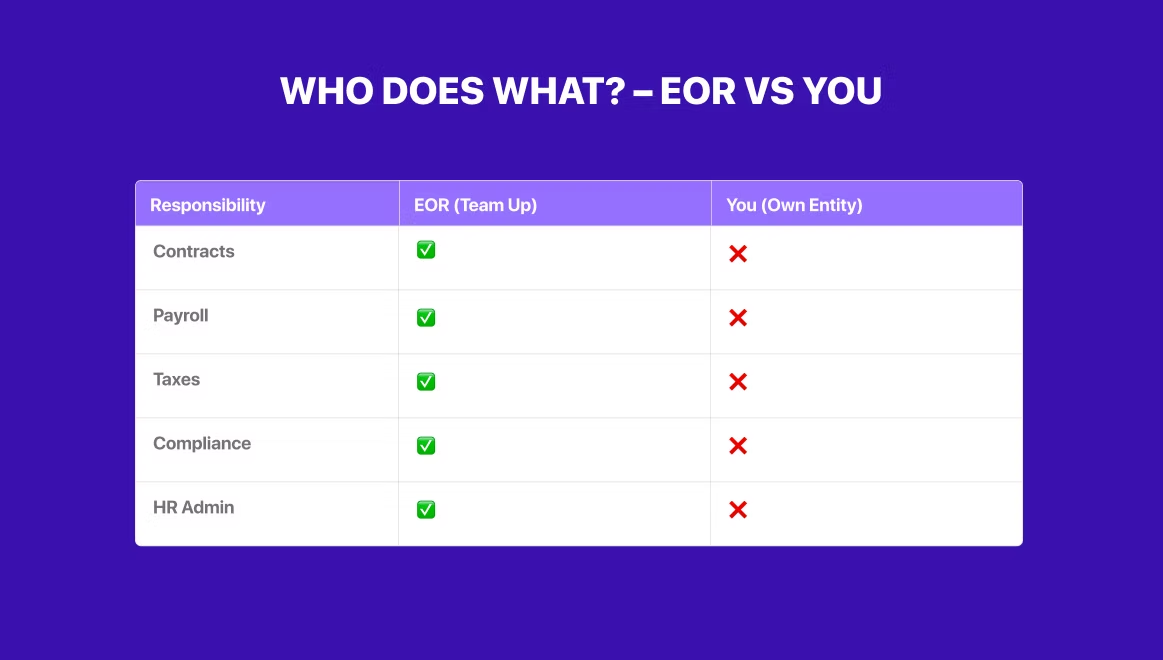
The key differences between EOR and entity setup in South Korea
Every employer in South Korea must provide employees with a written employment contract specifying their wages, working hours, rest days, annual leave entitlement, and place and nature of work. This is mandatory under Article 17 of the Labour Standards Act and applies from the first day of employment — including during any probationary period. Failure to provide a written contract is a criminal offence subject to a fine of up to KRW 5,000,000 per violation.
Under the entity model, the client company's Korean entity is responsible for preparing, issuing, and retaining these contracts. Under the EOR model, the EOR manages this obligation. The distinction matters operationally: for companies entering Korea without prior Korean HR infrastructure, the EOR brings Labour Standards Act contract templates that have been reviewed by Korean employment counsel and are updated as the Act changes. The entity model requires the client company to build or contract this capability independently.
Comparing hiring speed, compliance, and operational complexity
The 2018 Working Hours Reform capped total weekly working hours — regular hours plus extended work — at 52 hours for companies with five or more employees. The 52-hour cap is enforced by MOEL with criminal penalties: up to two years' imprisonment or KRW 20,000,000 in fines for responsible management who knowingly require or allow violations. For international companies managing Korean employees across time zones — particularly US West Coast companies expecting Korean team members to be available for late-afternoon Pacific Time calls — this is a live operational compliance risk.
Under both the entity and EOR models, the obligation sits with the entity managing the employment relationship. The EOR advises clients on working hour compliance and structures employment contracts with explicit working hour provisions. Clients directing EOR-employed staff are expected to manage working hours within the 52-hour limit as part of their operational management responsibility.
Which model offers greater flexibility for international companies
Year-end tax settlement is the process by which the employer reconciles each employee's actual annual income tax liability against the amounts withheld throughout the year. It runs in January for the prior calendar year. Employees submit deduction receipts — for medical expenses, education, charitable contributions, housing loan interest, and other deductible items — and the employer recalculates the withholding. Over-withheld amounts are refunded in the February payslip. Under-withheld amounts are collected. The final reconciliation is reported to NTS via the payment records statement. Under the EOR model, this entire process is managed by the EOR as a scheduled January compliance event. Under the entity model, it is the client company's internal HR responsibility.
Four-Insurance Compliance in South Korea: EOR vs Entity
Korea's four-insurance system covers National Pension (NPS), National Health Insurance (NHIS), Employment Insurance (EI), and Workers' Compensation Insurance (WCI, administered by COMWEL). Each requires a separate employer registration, operates on its own remittance schedule, and applies its own penalty structure for late or inaccurate contributions. The table below maps the management responsibility under each model.
| Insurance Scheme | Employer Rate (Approx.) | Who Registers? | Who Remits? | Who Carries Audit Risk? |
| National Pension (NPS) | 4.5% of standard monthly income | Entity / EOR | Entity / EOR | Entity / EOR |
| National Health Insurance (NHIS) | 3.545% of monthly income | Entity / EOR | Entity / EOR | Entity / EOR |
| Employment Insurance (EI) | 0.9%–1.85% (size-dependent) | Entity / EOR | Entity / EOR | Entity / EOR |
| Workers' Compensation (WCI) | 0.7%–18.6% (industry risk) | Entity / EOR | Entity / EOR | Entity / EOR |
The table above shows that mechanically, the same obligations apply under both models. The difference is operational: under the entity model, the client company's Korean HR or finance team manages all four registrations, tracks the annual standard monthly income (SMI) update deadline (November each year), and remits contributions on time to four separate government bodies. Under the EOR model, the EOR's payroll infrastructure manages all of this as a built-in operational function. For a company with three Korean employees and no Korean HR staff, the operational difference between these two scenarios is the difference between compliance and accidental non-compliance.
| The NPS standard monthly income (SMI) must be updated by November 30 each year to reflect salary changes from April through October. Companies that promote employees, give mid-year salary increases, or change compensation structure without updating the NPS SMI are systematically underpaying NPS contributions. NPS identifies this during its annual SMI reconciliation. Retroactive back contributions plus a 9% annual surcharge on underpaid amounts are the consequence. An EOR with payroll change management tied to NPS SMI obligations eliminates this exposure automatically. |
Labour Standards Act Compliance: EOR vs Entity
Written employment contract requirements under Korean law
Korea's Labour Standards Act mandates severance pay for every employee who has worked more than one continuous year — and this obligation applies regardless of why the employment ended. Resignations, mutual agreement terminations, redundancies, and dismissals for cause all trigger the same severance entitlement: 30 days' average wages for each full year of continuous service. The average wages calculation uses the average daily wage over the three months immediately preceding the termination date, including all regular wages, allowances, and recurring payments. The severance must be paid within 14 days of the termination date. Late payment carries an additional 20% per annum interest charge on the outstanding amount.
For a software engineer earning KRW 70,000,000 per year who resigns after three years, the mandatory severance is approximately KRW 17,500,000 — due within 14 days of their last working day, calculated on their average daily wage over the prior three months, not their base annual salary divided by 12. Most companies discover this calculation methodology for the first time when processing their first Korean departure. The EOR manages this calculation and the 14-day deadline as a standard termination event. The entity model requires the client's Korea HR team to manage it directly.
Employee Retirement Benefit Security Act: The DC Plan Obligation
Beyond the Labour Standards Act severance, the Employee Retirement Benefit Security Act (근로자퇴직급여 보장법) requires all employers to provide either a Defined Benefit (DB) pension plan or a Defined Contribution (DC) plan for employees who have worked at least one year. The DC plan — the most common structure for foreign-invested companies in Korea — requires the employer to contribute at least 1/12 of the employee's annual total wages each month into the employee's individual retirement account (IRP). These contributions are separate from NPS contributions. They are not optional, and the obligation begins from the first year of employment.
Under the entity model, the client company must establish the retirement plan, select a Korea-licensed IRP provider, execute the DC plan trust agreement, and remit monthly contributions correctly calculated on total annual wages (not just basic salary). Under the EOR model, the EOR manages the DC plan — selecting the provider, executing the trust infrastructure, and remitting contributions as part of the monthly payroll cycle. The client receives a monthly report showing DC contributions per employee alongside the four-insurance contribution breakdown.
Justifiable Cause Requirement for Dismissal
The Labour Standards Act prohibits ordinary dismissal without justifiable cause. This is not a procedural requirement that can be documented around. It is a substantive legal standard: the dismissal reason must be compelling enough to survive NLRC and court scrutiny. Redundancy dismissals require genuine business necessity — workforce reduction for economic reasons, not strategic reorganisation that happens to target specific employees. Performance dismissals require documented warnings, improvement plans with measurable targets and reasonable timelines, and a written dismissal notice at least 30 days before the effective date (or 30 days' wages in lieu). An EOR with Korean employment counsel available to review dismissal decisions reduces the risk of a legally non-compliant termination. A client company managing the dismissal process directly from outside Korea — in a language other than Korean, without direct access to the NLRC practice — is significantly more exposed.

True Cost Comparison: EOR vs Entity in South Korea
The Cost Components That Most Models Miss
A realistic cost comparison between the EOR and entity models requires including every component of the employer's financial obligation — not just the visible payroll costs but the infrastructure costs, the ongoing compliance costs, and the one-time formation and dissolution costs. The table below models both structures for a Korean operation with 10 employees earning an average of KRW 70,000,000 per year gross.
| Cost Component | EOR Model (10 employees) | Entity Model (10 employees) | Notes |
| Entity formation cost | KRW 0 | KRW 8,000,000–20,000,000 | Legal, notary, translation, registration |
| Bank account setup | KRW 0 | KRW 500,000–2,000,000+ | Fees vary; rejections cost time not money |
| Gross annual payroll (10 × KRW 70M) | KRW 700,000,000 | KRW 700,000,000 | Identical |
| Four-insurance employer contributions (~9%) | KRW 63,000,000 | KRW 63,000,000 | Identical — managed by EOR or entity |
| DC retirement plan contributions (1/12 p.a.) | KRW 58,333,333 | KRW 58,333,333 | Identical |
| Annual accounting and audit | KRW 0 (included in EOR) | KRW 15,000,000–40,000,000 | Varies by firm size and complexity |
| Payroll administration | KRW 0 (included in EOR) | KRW 10,000,000–20,000,000 | Internal hire or outsourced |
| Legal / HR counsel retainer | KRW 0 (included in EOR) | KRW 12,000,000–24,000,000 | For LSA compliance, NLRC advice |
| Registered address/office costs | KRW 0 | KRW 12,000,000–60,000,000 | Varies enormously by location |
| EOR service fee | KRW 35,000,000–56,000,000 | KRW 0 | Approx. KRW 350,000–560,000 per employee per month |
| Estimated total annual cost (excl. payroll) | ~KRW 35,000,000–56,000,000 | ~KRW 49,000,000–146,000,000 | Infrastructure costs only |
The cost comparison reveals something that surprises most companies: for a team of 10 employees, the entity model does not have an obvious cost advantage over the EOR. The entity maintenance costs — accounting, legal, payroll administration, and registered office — can easily exceed the EOR service fee, particularly in the first one to two years of operation when the entity is new and requires more intensive compliance management. The cost advantage of the entity model materialises clearly at higher headcount — 40 to 60 employees and above — where the EOR service fee compounds significantly while the entity maintenance costs scale sub-linearly.
| The cost model above excludes one critical component for the entity model: entity dissolution costs. When a Korean Jusik Hoesa is wound down, it requires a shareholders' resolution, a liquidation period, NTS tax clearance, MOEL notification (with 30-day advance notice for any workforce reduction), severance payments for all terminated employees calculated on their average wage, and filing of the dissolution registration with the court. The dissolution process typically costs KRW 5,000,000 to KRW 15,000,000 in professional fees and takes six to twelve months. This cost is zero under the EOR model. |
Market Exit: The Asymmetry That Most Companies Overlook
The entry decision gets most of the analytical attention. The exit reality gets most of the financial pain. This asymmetry is particularly sharp in Korea because the entity dissolution process is lengthy and sequenced — you cannot accelerate it by paying more, and you cannot skip steps.
To wind down a Korean Jusik Hoesa cleanly, the sequence is: shareholders' resolution approving dissolution; appointment of a liquidator; 30-day advance MOEL notification for any workforce reduction under the Labour Standards Act; severance calculations and payments for all terminated employees within 14 days of termination; final payroll run with NTS withholding reconciliation; NPS, NHIS, EI, and COMWEL de-registrations; VAT return filing and NTS tax clearance certificate application; final financial statements prepared and audited where required; court filing of dissolution registration; and publication of the dissolution notice in a Korean general daily newspaper. The realistic minimum timeline for this sequence, with no complications, is six months. With complications — a disputed severance, an MOEL labour inspection triggered by the termination wave, or an NTS audit of the final tax period — it extends to twelve months or more.
Under the EOR model, the wind-down involves: notifying the EOR of the intent to terminate the employment arrangement within the contractual notice period; EOR management of the LSA termination process for all affected employees — dismissal notices, severance calculations, 14-day payment deadline, four-insurance de-registrations; and final payroll reconciliation. The client company's obligation is limited to the contractual relationship with the EOR and the employment obligations that flow through it. The entity dissolution process does not apply.
This asymmetry is most consequential when the decision to exit Korea needs to be made quickly — in response to a business model change, a client relationship ending, a strategic pivot, or an economic cycle. The company that entered Korea via an EOR can exit in weeks. The company that formed a Jusik Hoesa is looking at six to twelve months of managed wind-down before the legal structure is finally closed.
The Inflexion Point: When Does a Local Entity Beat the EOR in South Korea?
The Financial Threshold
The inflexion point — where the entity model becomes more cost-efficient than the EOR — depends on EOR pricing, entity maintenance costs in your specific situation, and the marginal cost of each additional Korean employee. Using conservative estimates for both models, the EOR cost advantage typically holds up to approximately 40 to 60 employees. Below that threshold, entity maintenance overhead (accounting, legal, payroll administration, office costs) typically exceeds or closely matches the EOR service fee.
Above 60 employees, the EOR service fee starts to represent a meaningful annual cost that a well-managed internal HR and finance function could deliver at lower per-employee cost. The entity model's fixed costs spread across a larger headcount base, improving unit economics at scale.
The Certainty Threshold
Cost is not the only variable. Certainty matters as much. The entity model is a permanent commitment — or at least a commitment that takes six to twelve months to reverse. Companies that choose the entity model for 20 employees based on aggressive headcount projections, and then find their Korea operation stabilising at 20 employees rather than growing to 60, have committed to entity maintenance overhead without achieving the scale that justifies it.
The EOR model is the correct choice when confidence in the Korea headcount trajectory is less than certain, which describes most market entry situations. Once the operation has demonstrated that it will grow to and sustain the scale that justifies an entity, the transition from EOR to local entity is a managed process that a qualified EOR will coordinate: novation agreements for employment contract transfer, four-insurance registration transfer from EOR to the new entity, and payroll continuity management throughout the transition.
The Commercial Rationale Threshold
Some companies need a Korean entity not for employment reasons but for commercial reasons: a Korean government contract that requires a registered Korean supplier; an industry licence (financial services, healthcare, certain technology sectors) that is only available to registered Korean entities; or a client relationship that requires the supplier to be a registered Korean legal person. In these cases, the entity formation decision is driven by the business model, not the employment model. The EOR is not an alternative — it is, at most, a transitional structure while the entity is being formed.
EOR vs Entity South Korea: Full Side-by-Side Decision Table
Every decision-relevant factor in one place. Bring this to your CFO meeting.
| Decision Factor | EOR in South Korea | Korean Jusik Hoesa (Entity) |
| Time to first hire | 3–5 business days | 3–5 months (entity formation first) |
| Entity formation cost | None | KRW 8,000,000–20,000,000+ |
| Bank account requirement | None (EOR holds accounts) | Required — 2–6 week approval typical |
| Labour Standards Act compliance | EOR manages all LSA obligations | Client entity's direct responsibility |
| Four insurance registrations | EOR holds all four registrations | The entity must register with all four bodies |
| Annual year-end tax settlement | Managed by EOR in January | Client entity's internal HR responsibility |
| 52-hour working week monitoring | EOR advises: client manages operationally | Client entity's direct criminal liability |
| DC retirement plan | EOR establishes and manages | The entity must set up and remit monthly |
| LSA severance (14-day deadline) | EOR calculates and pays | Entity's direct obligation and timeline |
| NLRC wrongful dismissal exposure | EOR is named as the employer | Entity named directly in the NLRC claims |
| E-7 visa sponsorship | EOR sponsors immediately | Entity sponsors once registered (3–5 months) |
| Entity maintenance annual cost | Zero (included in EOR fee) | KRW 30,000,000–80,000,000+ per year |
| Exit timeline | Weeks — wind down within notice period | 6–12 months — entity dissolution process |
| Best headcount range | 1–50 employees | 50+ employees, permanent operations |
| Required for Korean entity contracts? | No | Yes — if client requires a Korean entity |
| Suitable for uncertain headcount trajectory | Yes — flexible structure | No — permanent commitment |
How to Decide: A Four-Stage Framework for Your Specific Korea Situation
Stage 1 — Answer the Commercial Question First
Do you need a registered Korean legal entity for commercial reasons independent of employment? If your Korea business requires a government licence, a Korean-entity-only contract, or regulatory approval that only flows to registered Korean companies, form the entity. The EOR is not a substitute for a commercial presence requirement. If you do not have a commercial reason requiring a Korean entity, move to Stage 2.
Stage 2 — Be Honest About Your Headcount Trajectory and Confidence
How many Korean employees will you have in 24 months — in the realistic scenario, not the optimistic one? If the realistic 24-month headcount is below 40, the EOR model almost certainly delivers better unit economics and compliance outcomes than an entity. If the realistic 24-month headcount is above 60, the entity may make financial sense from the start. Between 40 and 60, the answer depends on the certainty of that projection. Enter Korea with an EOR when the trajectory is uncertain. Transition to an entity when the trajectory is confirmed.
Stage 3 — Assess Your Compliance Management Capability
Can your organisation manage four-insurance contribution schedules, LSA employment contract requirements, the 52-hour weekly cap, annual year-end tax settlement, DC retirement plan contributions, and Korean-language regulatory correspondence from MOEL, NPS, NHIS, and COMWEL — without a dedicated Korea HR and finance team on the ground? Be honest. Many international companies overestimate their capacity to manage Korean employment compliance remotely. The EOR model is not an admission of weakness — it is a rational allocation of compliance management to a party that does this every day.
Stage 4 — Factor in the Exit Option Value
What is the probability that your Korea operation is significantly different in size or structure in three years compared to today? High probability of change — either significant growth or potential contraction — argues for the EOR's exit flexibility. High confidence in stable, permanent Korea operations argues for the entity's long-term cost efficiency. Most companies entering Korea in 2026 are in the first camp, not the second. The option value of being able to scale down or exit Korea within weeks rather than months is worth more than most headcount cost models account for.
How Team Up Handles EOR Operations in South Korea
Team Up operates as a global employer of record with a dedicated South Korea employment infrastructure. Here is what working with Team Up means in operational terms for companies choosing the EOR route:
- Legal employment from day one: Team Up is the registered Korean employer under the Labour Standards Act. Employment contracts are structured to LSA requirements — probationary period, working hours, mandatory benefits, and severance rights all correctly reflected. IMSS-equivalent four-insurance registrations are completed before the employee's start date.
- Four-insurance managed end-to-end: NPS, NHIS, EI, and WCI registrations are held by Team Up. Standard monthly income is updated annually in November. All four contribution remittances are made on time to their respective government bodies. Audit records are maintained for the statutory retention period.
- Payroll and NTS compliance: Monthly salary payments are processed under the Individual Income Tax Act withholding schedule. Annual year-end tax settlement (연말정산) is managed as a January compliance event, with employee deduction receipt collection, withholding recalculation, and NTS reporting.
- DC retirement plan management: Team Up establishes and manages a Korea-licensed DC retirement plan for each employee, contributing 1/12 of annual total wages monthly. Retirement benefit payments are processed correctly at termination alongside LSA severance.
- LSA severance and termination management: Severance is calculated on the correct average wage basis (three-month average daily wage), paid within the 14-day statutory deadline, and processed alongside final payroll and four-insurance de-registrations. Justifiable cause assessment for dismissal events is supported by Korean employment counsel.
- EOR to entity transition support: When your Korea headcount reaches the scale that justifies a local entity, Team Up coordinates the transition — novation agreements, four-insurance registration transfer from EOR to the new entity, payroll continuity management, and employment record handover — ensuring the transition does not create compliance gaps or employment continuity disruptions for your Korean employees.
- Multi-market global EOR: Team Up's employer-of-record infrastructure covers South Korea alongside Eastern Europe, the Caucasus, Turkey, Central Asia, India, and MENA — with a consistent contract structure, consolidated reporting, and a single operational contact for clients managing Korea alongside other emerging market operations.
Final Thoughts
The EOR vs entity South Korea decision is not a permanent choice. It is the right structure for the right stage. Most companies entering Korea in 2026 are at a stage where the EOR delivers faster access, lower infrastructure cost, clean compliance management, and real exit flexibility — without sacrificing any of the legal standing that Korean employees, Korean counterparties, or Korean regulators require.
The entity model is not wrong. At a sufficient scale, with confirmed permanence, and with the internal HR and compliance capacity to manage it correctly, a Korean Jusik Hoesa is the right long-term structure. The error is forming it too early — committing to three to five months of formation timeline, KRW 8,000,000 to KRW 20,000,000 in upfront costs, and KRW 30,000,000 to KRW 80,000,000 per year in ongoing maintenance — before the Korea operation has proven it will reach the scale that justifies the investment.
Start with the EOR. Hire fast. Get your Korea team operating. Build the compliance record. And when your headcount reaches the inflexion point — and your confidence in the Korea trajectory is high — transition to the entity with a managed handover that preserves every employee's seniority, benefit accruals, and insurance coverage. That is the sequence that works.
Team Up provides compliant EOR services in South Korea and across key emerging markets globally. Contact the Team Up team to receive a Korea employer cost breakdown for your headcount profile, a formation timeline vs EOR comparison for your specific situation, and a clear onboarding plan for your first Korea hire.
Frequently Asked Questions
Can I transition from the EOR model to a local entity later without disrupting my Korean employees?
Yes. The transition from an EOR to a local Korean entity is a managed process called a novation or assignment of employment contracts. The EOR, the new entity, and each employee sign a tripartite novation agreement transferring the employment relationship from the EOR to the new entity. Seniority accruals continue without interruption — the employee's years of service for severance calculation purposes are counted from their original hire date, not from the date of transfer. Four-insurance registrations are transferred through a baja patronal (employer exit) and alta patronal (new employer registration) sequence. The key is managing the timing so there is no gap in insurance coverage during the transfer. A qualified EOR coordinates this as a standard client service. Most companies complete the transition over four to six weeks with no material disruption to the employee experience.
Is the minimum capital requirement for a Korean Jusik Hoesa a real barrier?
There is technically no statutory minimum paid-in capital for a Korean Jusik Hoesa in most industries. However, there are practical minimums. Korean commercial banks will typically not open a corporate account for a new foreign-invested company with paid-in capital below KRW 100,000,000 (approximately USD 75,000 at current rates). Korean landlords will often require entity capital above this threshold as evidence of financial standing for office lease agreements. And Korean business counterparties — clients, suppliers, government agencies — use paid-in capital as a proxy for financial credibility. For most practical purposes, treat KRW 100,000,000 as the functional minimum capital commitment for a viable Korean entity.
What happens to my Korean employees if the EOR provider goes out of business?
This is a legitimate risk to evaluate when selecting an EOR provider. If the EOR ceases operations, the employment contracts it holds with your Korean employees do not automatically dissolve. Under Korean law, the employees retain their employment rights and the resulting obligations must be resolved — either by transition to a new employer arrangement or through statutory termination with full severance payment. The practical protection against this risk is selecting an EOR with: verifiable financial stability (ask for evidence of operating scale, client base, and financial standing); clear contractual obligations around transition management if the EOR ceases operations; and the operational infrastructure that demonstrates they are running a genuine Korean employment operation, not a shell arrangement. Team Up's multi-country EOR operations and transparent financial structure are specifically designed to address this concern.
Does forming a Korean entity give me better standing in NLRC disputes than using an EOR?
Not necessarily — and in some cases the reverse is true. When a client company uses an EOR, the NLRC claim is directed at the EOR as the named employer. The EOR has Korean employment counsel and operational experience managing NLRC proceedings. The client company is not directly in the dispute. When a client company has its own Korean entity and is managing employment directly, NLRC claims are directed at the entity — and if the entity does not have Korean employment counsel on retainer and experience with NLRC procedure, the handling of the dispute is at greater risk. NLRC standing depends on the quality of the compliance management, not on whether the employer is an EOR or a client entity.
How does the EOR handle situations where a Korean employee's salary changes during employment?
Salary changes during employment require updates across multiple compliance systems simultaneously: the employment contract must be amended with a written addendum; the NPS standard monthly income must be updated via the SMI revision process with the NPS (typically effective from the month after the change is reported); the NHIS contribution base must be updated; the Individual Income Tax Act withholding calculation must be adjusted; and the DC retirement plan contribution must be recalculated based on the new annual wage figure. An EOR with integrated payroll systems manages all of these updates from a single salary change notification from the client. Under the entity model, each system update requires a separate administrative action — and missed updates generate retroactive liability in the relevant scheme.
.svg)


