


How to Transition from an EOR to Your Own Legal Entity in Portugal

Most companies enter Portugal through an EOR. At some point, the math changes. Our guide to EOR vs setting up your own entity in Portugal compared both models side by side. This article goes deeper on one specific move: the transition itself.
Switching from an EOR to your own legal entity in Portugal involves corporate formation, tax registration, employee transfer, and a compliance handover that touches labor law, social security, and payroll simultaneously. Each step has a sequence that matters. Get the order wrong and you face gaps in employee coverage, duplicate tax filings, or broken employment continuity.
What follows is the operational playbook. It covers timing triggers, formation steps, employee transfer mechanics, and the compliance obligations that start the day your entity goes live.
Knowing When the Transition Makes Financial Sense
The Headcount Threshold
EOR fees in Portugal typically run between €300 and €600 per employee per month. For a team of three, that annual spend stays manageable. Once you cross eight to twelve employees, the total EOR cost often exceeds what a local entity would cost to maintain.
A London-based fintech company used an EOR for its first five hires in Lisbon. By month fourteen, its EOR spend reached roughly €36,000 per year. The company estimated that entity maintenance costs, including a local accountant, registered office, and payroll software, would run closer to €18,000. That gap made the transition worthwhile.
Revenue and Permanence Signals
Headcount is not the only trigger. If your Portuguese operation generates local revenue, Portuguese tax authorities may argue that you already have a permanent establishment. Operating through an EOR while earning Portuguese-source income creates ambiguity.
The benefits of using a global EOR in Portugal diminish once you need to invoice locally, sign commercial contracts under a Portuguese identity, or bid on public procurement. These activities practically require a local entity.
Comparing Ongoing Costs
| Cost Factor | EOR Model (10 employees) | Own Entity (10 employees) |
|---|---|---|
| Monthly service fees | €3,000–6,000 | €0 |
| Local accountant | €0 (included) | €300–800/month |
| Registered office | €0 (included) | €200–500/month |
| Payroll software | €0 (included) | €100–300/month |
| Annual audit (if required) | €0 | €2,000–5,000 |
| Legal compliance oversight | Included in EOR | €2,000–6,000/year |
The crossover point depends on your EOR's pricing and your entity's overhead. Run the numbers with actual quotes, not estimates.
The Step-by-Step Process of Setting Up a Portuguese Entity

Choosing the Right Legal Form
Most foreign companies incorporate a Sociedade por Quotas (Lda.), the Portuguese equivalent of a limited liability company. It requires a minimum of one shareholder and has no mandatory minimum share capital since reforms removed that barrier. A Sociedade Anónima (SA) suits larger operations but demands higher governance standards and a fiscal council.
The Lda. formation process runs through the Instituto dos Registos e do Notariado (IRN). You can use the Empresa na Hora (Company in the Hour) service for faster incorporation. This service handles name selection, articles of association, and commercial registration in a single appointment. Typical turnaround is one to five business days for the initial incorporation.
Tax and Social Security Registration
After incorporation, register with Autoridade Tributária e Aduaneira (the Portuguese tax authority, commonly called Finanças) for corporate income tax, VAT, and withholding tax obligations. Corporate income tax in Portugal follows a standard rate; confirm the current rate on the Finanças portal before your first filing period.
Employer registration with Segurança Social is mandatory before your first hire. The employer social security contribution rate has historically been 23.75% of gross salary. Confirm the current rate before running payroll, as adjustments occur periodically.
Bank account opening in Portugal can take three to six weeks for foreign-owned entities. Portuguese banks require notarized corporate documents, proof of beneficial ownership, and sometimes a physical meeting. Start this process in parallel with your tax registrations. Delays here often push back the entire timeline.
Transferring Employees from the EOR to Your Entity
The Novation Approach
Employee transfer is the most legally sensitive phase. Under Portuguese labor law, specifically the Código do Trabalho, employment relationships carry continuity rights. Your employees' seniority, accrued leave, and contractual terms must survive the transition.
The standard approach is a novation agreement: a trilateral document signed by the EOR, your new entity, and each employee. This agreement terminates the EOR contract and simultaneously creates a new one with your entity. Critical detail: the new contract must preserve or improve existing terms. Any reduction in compensation, benefits, or seniority protections could trigger a constructive dismissal claim.
Timing the Handover
Coordinate the transfer date with payroll cycles. A mid-month switch creates split payroll obligations. Both the EOR and your entity would need to file partial-month declarations to Segurança Social. That creates reconciliation headaches.
A UK SaaS company transferring seven employees from its EOR to a new Lisbon Lda. scheduled all transitions for the first of the calendar month. The EOR processed final payroll through the last day of the prior month. The new entity picked up from day one. Zero coverage gaps.
Plan for a thirty-day overlap period where your entity is fully operational but the EOR still holds the employment contracts. Use this window to test your payroll system, verify tax withholding calculations, and confirm EOR compliance requirements in Portugal are properly handed off.
What Employees Need to Know
Portuguese law requires that employees consent to the transfer. You cannot unilaterally move them. Prepare individual meetings explaining that their terms will not change. Provide the novation agreement at least two weeks before the target date. Employees who refuse the transfer remain with the EOR until their contracts end or a mutual agreement is reached.
Post-Transition Compliance You Cannot Afford to Miss

Monthly and Annual Obligations
Your entity assumes every obligation the EOR previously handled. That list is longer than most companies expect.
Monthly payroll filings go to both Finanças and Segurança Social. The Declaração Mensal de Remunerações (DMR) reports employee compensation and tax withholdings. It is due by the tenth of the following month. Social security contributions follow a similar monthly cycle.
Annual obligations include the IES (Informação Empresarial Simplificada), which combines your annual accounts, tax return, and statistical data into one submission. The deadline falls in mid-year for the prior fiscal year. Miss it and penalties accumulate quickly.
Workplace Safety and Reporting
Portuguese law mandates that every employer contract an external occupational health and safety service. This applies from your first employee. The Relatório Único, an annual report covering employment data, occupational safety, and training hours, must be filed each year.
Companies often overlook the requirement to register with ACT (Autoridade para as Condições do Trabalho), the Portuguese labor inspectorate. Your entity must communicate its existence and workforce details to ACT within the timeframes set by the Código do Trabalho.
Understanding EOR costs in Portugal helps you benchmark whether your post-transition overhead stays below what you were paying before. If it does not within eighteen months, the transition may have been premature.
Watch out: Novation agreements that reduce any contractual term, even a minor benefit like a meal allowance, can give employees grounds to claim constructive dismissal under Portuguese labor law. Mirror every term exactly.

FAQs
Can I transfer only some employees and keep others on the EOR?
Yes. A hybrid model works well during phased transitions. Your entity employs staff in roles tied to local revenue generation. The EOR retains employees in support functions or those on fixed-term contracts nearing expiry. Coordinate with your EOR to avoid duplicate employer of record services for the same individual. The EOR and your entity cannot both claim employment over one person simultaneously under Portuguese law.
What happens to employee seniority during the transfer?
The novation agreement must explicitly state that the employee's start date for seniority purposes remains the original hire date with the EOR. Portuguese courts use this date to calculate severance entitlements, vacation accrual, and trial period eligibility. If the novation resets seniority to the entity start date, the employee loses accrued rights. That creates legal exposure for your entity.
Do I need a local director or can a foreign national serve?
A foreign national can serve as director of a Portuguese Lda. They need a Portuguese tax identification number (NIF) and, if they are a non-EU citizen, may need to appoint a fiscal representative. No residency requirement exists for directors. The director does need a Portuguese NIF regardless of nationality, obtainable through Finanças or a Portuguese consulate abroad.
How long does the full transition typically take from decision to final employee transfer?
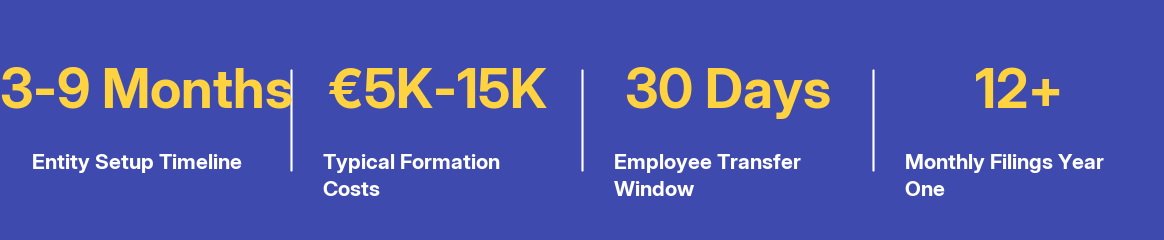
Budget six to nine months from decision to completed transfer. Entity formation takes three to eight weeks using Empresa na Hora. Bank account opening adds three to six weeks. Payroll setup, tax registration, and testing add another four to six weeks. Employee novation and the overlap period consume the final month. Companies that rush the process below five months typically encounter payroll errors or coverage gaps in social security.
What to Prepare Before Your First Transition Meeting
The transition from EOR to entity is a project with dependencies, not a switch you flip. Start by auditing every employment contract your EOR currently holds. Map each employee's terms, seniority dates, and benefit packages. Then engage a Portuguese labor lawyer and accountant before you file a single document. The companies that execute this cleanly are the ones that plan the overlap period, test payroll in parallel, and give employees time to understand the change.
If you are planning a transition from EOR to entity in Portugal and need a compliance walkthrough, schedule a consultation with Team Up.
Author: Team Up — EOR, PEO, and nearshoring across 20+ countries with owned entities in the Caucasus, Central Asia, Turkey, India, and Eastern Europe.
.svg)


