


EOR vs Setting Up Your Own Entity in Portugal

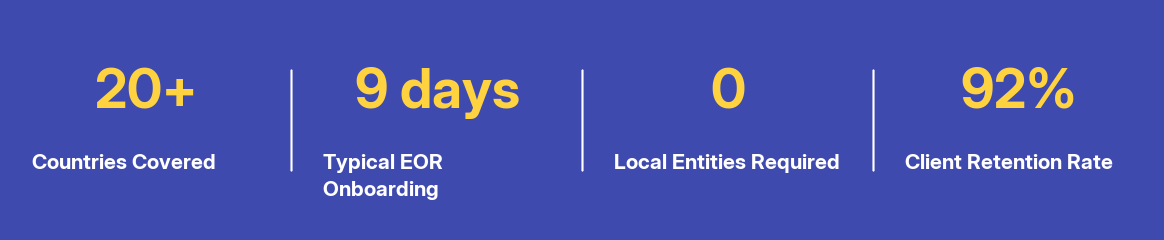
An employer of record lets you hire in Portugal without registering a company there. That sounds clean on paper, but the decision between an EOR and your own legal entity depends on headcount, timeline, and how long you plan to stay. A Munich fintech company needed two compliance analysts in Lisbon within three weeks. Setting up a Portuguese subsidiary would have taken months. Through an EOR, both analysts were on payroll in nine business days.
Portugal sits inside the EU, which means every employment contract must comply with both the Código do Trabalho and relevant EU directives. Getting that wrong carries real penalties. Whether you choose an EOR or build your own entity, the compliance burden is the same. The difference is who carries it.
This article breaks down both models on process, cost structure, operational control, and risk. It does not tell you which is "better." It tells you which fits the decision you are actually making.
What Is an Employer of Record?

Employer of Record Definition and Meaning
An employer of record is a third-party organization that legally employs workers on your behalf in a target country. You direct the employee's daily work. The EOR holds the employment contract, runs payroll, withholds taxes, and files statutory contributions.
The EOR is the legal employer. You are the economic employer. That distinction matters because Portuguese labour law assigns specific obligations to whoever signs the employment contract. The EOR assumes those obligations. You retain control over tasks, projects, and performance.
This structure exists so companies can hire compliantly without setting up a local entity. The EOR carries the compliance weight. You carry the management relationship.
How an EOR Differs from a Staffing Agency or PEO
A staffing agency supplies temporary workers. It owns the employment relationship and typically assigns workers to client projects for defined periods. A professional employer organisation (PEO) shares employment responsibilities with a company that already has a local entity. The PEO model is co-employment. Both parties hold obligations.
An EOR is neither of these. It is the sole legal employer. You do not need an entity. You do not share employment liability. The EOR files returns, manages terminations according to the Código do Trabalho, and administers statutory benefits. A UK digital agency hiring its first designer in Porto does not need a Portuguese entity, a PEO arrangement, or a temp agency. It needs an EOR.
What an EOR Means for Employees in Portugal
Portuguese employees hired through an EOR receive the same statutory protections as any other employee. The Código do Trabalho does not distinguish based on who the economic employer is. The EOR must issue compliant work contracts, respect mandatory notice periods, and provide all statutory benefits.
From the employee's perspective, their employer is the EOR. Their payslip comes from the EOR. Their social security contributions are filed by the EOR. Their day-to-day work, though, is directed by you. For a detailed breakdown of how this plays out in practice, see the complete EOR hiring guide for Portugal.
EOR Services vs Setting Up a Legal Entity in Portugal

What Setting Up a Legal Entity in Portugal Actually Involves
Registering a legal entity in Portugal starts at the Conservatória do Registo Comercial (Commercial Registry). You will need to choose a company form, most commonly a Sociedade por Quotas (Lda.) or Sociedade Anónima (SA). The process involves notarizing articles of association, obtaining a Portuguese tax identification number (NIF), opening a local bank account, and registering with the Segurança Social (Social Security).
Each step depends on the previous one. You cannot register for social security without a NIF. You cannot open a bank account without registration documents. A Toronto-based SaaS company that attempted this process for three developers found the sequential dependencies added weeks to their timeline. Portugal does offer a single-step "Empresa na Hora" incorporation, but post-incorporation obligations still take time.
Setting up an entity also creates a permanent establishment for tax purposes. That triggers corporate income tax obligations, annual accounting requirements, and audit thresholds.
How Global EOR Services Replace the Entity Setup Process
Global employer of record services bypass the entire entity registration chain. The EOR already has a legal presence in Portugal. Your employees are hired under the EOR's existing entity. No Conservatória filing. No NIF application. No bank account.
The EOR handles payroll registration, social security enrollment, and employment contract drafting under the Código do Trabalho. Onboarding through an EOR typically completes in 5 to 10 business days. For companies comparing providers in this market, the top EOR providers in Portugal vary on pricing, entity ownership, and service depth.
Operational Control: What Each Model Gives You
With your own entity, you control every HR decision directly. You set internal policies, manage terminations, and choose benefits beyond statutory minimums. With an EOR, the EOR makes the employment-law decisions. You direct the work. That split works well when your priority is speed and compliance. It works less well when you need deep integration of HR policy across a unified global structure.
Benefits of Using a Global EOR in Portugal
| Dimension | Own Entity | EOR |
|---|---|---|
| Employment contract holder | Your Portuguese subsidiary | The EOR's Portuguese entity |
| Time to first hire | Weeks to months (entity setup + registration) | Typically 5-10 business days |
| Compliance responsibility | Yours, managed internally or via local counsel | The EOR, contractually bound |
| Permanent establishment | Created automatically | Not created (EOR's entity is used) |
| HR policy control | Full direct control | Limited to daily work direction |
| Ongoing admin burden | Accounting, tax filings, social security, audits | Monthly service fee covers admin |
| Scalability | Fixed overhead regardless of headcount | Scales with headcount, up or down |
Speed to Hire: Getting Workers Onboarded Without Entity Delays
The table above captures the structural differences. Speed deserves separate attention. In Portugal, entity setup involves sequential dependencies that stretch timelines. A Berlin e-commerce company needed a Portuguese customer support lead before peak season. Entity registration would have missed the window. Through an EOR, the hire was onboarded in seven business days. The company tested the market for six months before deciding whether to incorporate.
That pattern is common. EOR arrangements let you hire first, commit later. You are not locked into a permanent establishment before you know whether the market justifies it.
Compliance Assurance Under Portuguese Labour Law
Portugal's labour law framework is employee-protective. The Código do Trabalho governs fixed-term and indefinite contracts, probation periods, overtime rules, and termination procedures. EU directives layer additional requirements on top, including the Transparent and Predictable Working Conditions Directive.
A global employer of record absorbs that compliance responsibility. It drafts contracts that meet Portuguese standards, files social security contributions on time, and manages terminations within the legal framework. For companies without Portuguese employment law expertise, this is not a convenience. It is a safeguard. The compliance checklist for EOR in Portugal covers the specific obligations in detail.
Scalability and Strategic Flexibility for Growing Teams
An EOR scales linearly. You pay per employee per month. Adding a fifth employee costs the same marginal rate as the first. Reducing headcount does not leave you with an empty subsidiary and ongoing reporting obligations.
A Singapore-based digital marketing agency started with one content strategist in Lisbon through an EOR. Within a year, the team grew to six. The agency never incorporated in Portugal. If the team had shrunk instead, the exit would have been clean. No liquidation, no winding-down filings.
That flexibility matters most during market testing. You avoid the sunk cost of entity setup before the business case is proven.
Risks and Costs of Each Approach
Employer of Record Risks: What Can Go Wrong and When
EOR arrangements carry specific risks. The most serious is misclassification. If Portuguese authorities determine that the relationship between the client company and the worker resembles direct employment, the EOR structure may be challenged. Factors that trigger scrutiny include the client providing equipment, setting fixed hours, and integrating the worker into internal reporting structures.
Loss of control is another risk. The EOR holds the employment contract. If you disagree with how the EOR handles a termination or a benefits decision, your recourse is contractual, not statutory. You are one step removed from the employment relationship.
Watch out: If your employees in Portugal report exclusively to your managers, use your email domain, and follow your internal policies with no EOR involvement in daily oversight, Portuguese labour authorities may reclassify the arrangement as direct employment — exposing your company to backdated social security and tax liabilities.
Cost Structure of EOR Services vs Entity Maintenance
| Cost Component | EOR Model | Own Entity Model |
|---|---|---|
| Setup cost | None or minimal onboarding fee | Incorporation fees, legal counsel, notary |
| Monthly recurring | Per-employee service fee | Accounting, payroll provider, HR admin |
| Social security | Included in EOR's payroll processing | Employer files and pays directly |
| Legal compliance | Covered by EOR | Requires local counsel or in-house expertise |
| Exit cost | Contract termination with EOR | Entity liquidation, final tax filings |
| Scaling cost | Linear (per employee added) | Mostly fixed overhead regardless of headcount |
EOR fees across the region typically fall between $200 and $600 per employee per month. For a breakdown specific to this market, see the cost analysis for EOR in Portugal. Own-entity costs are front-loaded. You pay incorporation, legal, and accounting fees before your first hire starts. Those costs exist whether you employ two people or twenty.
For small teams of one to five employees, the EOR model is almost always cheaper in the first two years. The break-even point shifts as headcount grows. A company with 15 or more employees in Portugal will often find that the cumulative EOR fees exceed the fixed overhead of maintaining a subsidiary.
Permanent Establishment Risk When Using an EOR Long-Term
Using an EOR does not create a permanent establishment for your company. The EOR's entity is the employer of record, not yours. That distinction holds as long as the arrangement is genuine.
The risk emerges over time. If your Portuguese team grows large, operates with significant autonomy, and generates revenue attributable to Portugal, tax authorities may argue that a permanent establishment exists regardless of the EOR structure. This is not unique to Portugal. It is an OECD-wide concern tied to transfer pricing and substance-over-form principles.
The timeline matters. A three-person team hired through an EOR for 18 months raises no flags. A 30-person operation running for five years through an EOR, with a local office and client-facing revenue, invites scrutiny. Companies planning long-term scale in Portugal should build an entity transition into their roadmap.
How to Transition from an EOR to Your Own Entity in Portugal
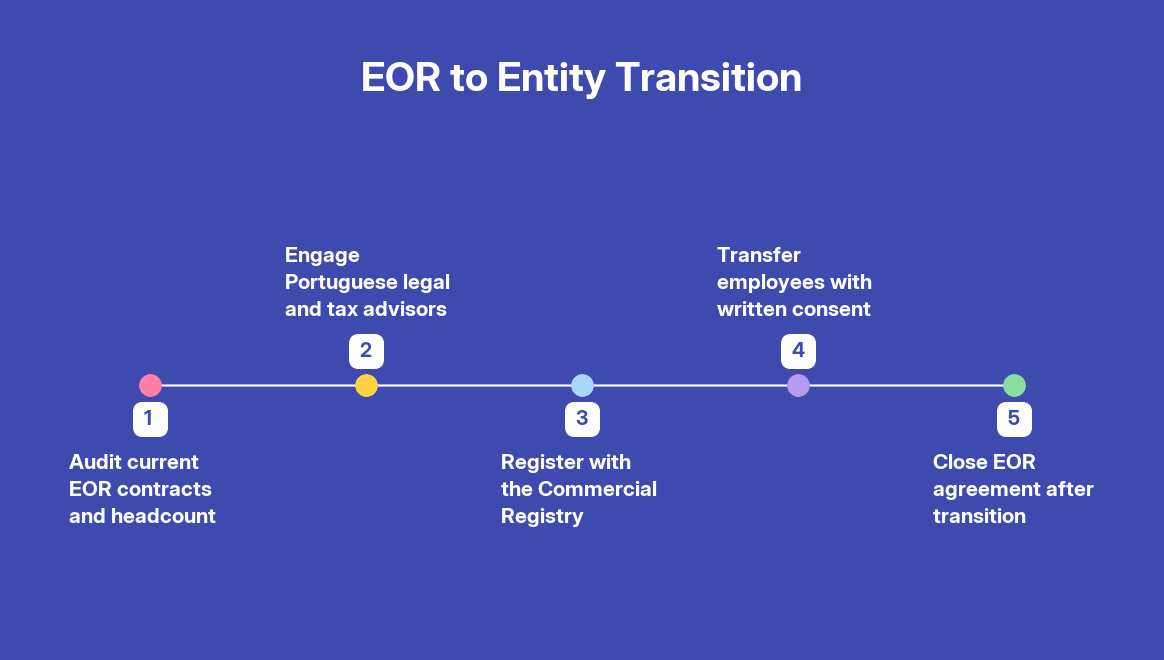
The transition from an employer of record to a standalone entity is not a single event. It is a structured migration that touches payroll, contracts, tax registration, and employee rights under the Código do Trabalho.
Start with a contract audit. Review every employment agreement the EOR holds on your behalf. Map each employee's tenure, accrued entitlements, and any collective bargaining obligations that apply to their role or sector. Portuguese law treats continuity of employment seriously. An employee who has worked three years under the EOR does not restart at zero when transferred to your entity.
A London-based fintech company with 11 employees in Lisbon ran both structures in parallel for four months during its transition. The overlap let them transfer employees in batches of three or four. That staggered approach prevented payroll gaps and gave each employee time to sign new contracts without pressure.
Registration with the Conservatória do Registo Comercial creates your legal presence. You then register separately with the tax authority and social security. Each registration carries its own timeline and document requirements. Engaging a Portuguese employment lawyer before you file avoids structural errors that delay the process by weeks.
Employee consent matters. Under Portuguese labour law, transferring an employment relationship requires the employee's agreement when the legal employer changes. You cannot simply notify them. Document each transfer with a new written contract that preserves their existing terms, seniority, and accrued rights. Once every employee has migrated, formally close your EOR agreement and confirm that no residual tax or social security obligations remain outstanding.
Choosing the Right Model for Your Portugal Expansion
The right structure depends on your headcount trajectory, your timeline, and how much operational control you need in Portugal. Neither model is universally better. Each carries trade-offs that shift as your business grows.
| Factor | EOR Model | Own Entity |
|---|---|---|
| Time to first hire | Days to weeks | Weeks to months |
| Upfront capital required | Monthly per-employee fee only | Incorporation, legal, accounting setup costs |
| Ongoing compliance burden | Handled by EOR provider | Your responsibility entirely |
| Direct control over HR policy | Limited by EOR contract terms | Full control |
| IP and data governance | Requires careful contractual structuring | Direct ownership and oversight |
| Permanent establishment risk | Grows with duration and commercial activity | Resolved by design |
| Scalability ceiling | Practical limit before entity makes more sense | No structural ceiling |
For companies hiring one to five people in Portugal with no local revenue, an EOR removes friction. A Munich e-commerce company used an EOR to hire two customer support agents in Porto. Total time from signed service agreement to first payroll run was nine business days. No entity registration. No local accountant. No opening a Portuguese bank account.
The calculus changes as you scale. Once your Portugal team reaches double digits, or once you generate Portuguese-source revenue, the cost of an EOR per employee often exceeds the amortized cost of running your own entity. The permanent establishment question also becomes harder to manage.
One factor that tables cannot capture is operational agility. An EOR lets you exit a market cleanly if a project ends. Closing a Portuguese entity involves liquidation filings, final tax returns, and employee termination procedures under the Código do Trabalho. That process can take months and cost more than the entity setup did. If your commitment to Portugal is conditional on a specific contract or client, the EOR model preserves your flexibility to withdraw.
Companies already exploring employer of record compliance in Portugal should map their decision against a two-year headcount projection. If the projection stays under ten, the EOR model likely holds. If it crosses ten with local revenue, start planning entity incorporation in parallel.
FAQs
Can a company use an EOR in Portugal indefinitely, or is there a point where setting up an entity becomes legally required?
No Portuguese statute imposes a fixed time limit on EOR use. The risk is permanent establishment. Portuguese tax authorities assess substance over form. If your company maintains a dedicated workforce, a fixed office, and generates Portuguese-source revenue over several years, the tax authority may determine that a permanent establishment exists regardless of the EOR structure. The trigger is economic substance, not a calendar deadline. Companies operating through an EOR beyond three to five years with growing local activity should seek a binding ruling from the Autoridade Tributária.
What happens to employees in Portugal if the EOR provider goes out of business or loses its operating licence?
The EOR is the legal employer. If it enters insolvency, employees become creditors in the insolvency proceedings for unpaid wages and accrued entitlements. The client company does not automatically inherit the employment contracts under Portuguese law. It can offer new contracts, but employees are not obligated to accept. This is why due diligence on your EOR provider's financial stability matters before you sign. Request audited financials and confirm whether the provider holds professional liability insurance that covers employee claims in a wind-down scenario.
Does using an EOR in Portugal affect an employee's right to claim unfair dismissal or statutory protections under Portuguese law?
No. Portuguese labour protections under the Código do Trabalho attach to the employment relationship itself. The employee holds full statutory rights against the EOR as the legal employer. If the client company instructs a dismissal and the EOR executes it without valid legal grounds, the employee can challenge the dismissal in a Portuguese labour court. Liability typically falls on the EOR, but courts may examine the client's role if evidence shows the client directed the termination. Tri-party liability is a real exposure when the client exercises day-to-day management authority.
If a company has already set up a legal entity in Portugal, can it switch to an EOR model for new hires?
You can run both structures, but the arrangement creates complexity. Employees on your entity payroll and employees on the EOR payroll may have different benefit packages, different holiday policies, or different termination procedures. Portuguese labour inspectors can flag these inconsistencies. The harder problem is tax. If you already have a permanent establishment through your entity, routing new hires through an EOR does not reduce your tax footprint. Some companies use an EOR as a bridge while downsizing an entity. That works if the entity closure proceeds on a defined timeline. Running both indefinitely invites questions from Autoridade Tributária about the commercial rationale.
Is an EOR in Portugal compliant with EU Posted Workers Directive requirements if employees travel or work across EU member states?
The Posted Workers Directive adds obligations beyond the Código do Trabalho. If a Portugal-based EOR employee works in France for more than a few days, the EOR must notify the French labour authority. The employee becomes subject to French minimum wage rules, working time limits, and health and safety standards for the duration of the posting. Short business trips typically fall below the notification threshold. Regular or extended cross-border work does not. Your EOR's compliance team should file A1 certificates through Portuguese social security before the employee travels. If the EOR lacks experience with posted worker filings across multiple EU states, that is a meaningful gap in their service.
Can an EOR in Portugal sponsor work permits for non-EU nationals?
Yes. The EOR, as the legal employer, can apply for work permits and residence authorizations through SEF or its successor agency. The EOR files the application, provides the employment contract, and demonstrates that the role meets the requirements for a residence permit. Processing times vary. Non-EU nationals from countries without bilateral agreements with Portugal face longer timelines. One edge case: if the employee needs a visa type that requires employer-specific sponsorship, switching EOR providers later may require a new work permit application rather than a simple transfer.
How does an EOR handle collective bargaining agreements that apply to specific sectors in Portugal?
Portugal has sector-level collective bargaining agreements that extend to all employers in the sector by government decree. The EOR must comply with whichever agreement covers the employee's actual work. This is not optional. If your employee works in hospitality, the applicable CBA sets minimum pay scales, overtime rates, and specific leave entitlements above the Código do Trabalho baseline. Some EOR providers default to statutory minimums and miss sector-specific obligations. Before onboarding, confirm that your provider has identified whether a portaria de extensão applies to your employee's role and sector. Non-compliance exposes both the EOR and the client to back-pay claims and regulatory fines.
What to Watch Next

Portugal's labour regulatory environment continues to evolve. The government has signalled further reforms to remote work legislation. Changes to the tax treatment of digital nomads and non-habitual residents may also reshape how foreign companies structure their presence. Monitor updates from the Autoridade Tributária and the Autoridade para as Condições do Trabalho for enforcement guidance that could affect EOR arrangements.
Your concrete next step: map your Portugal headcount against a two-year projection. If you expect to stay below ten employees with no local revenue, request employer of record pricing from two or three providers with owned or directly managed entities in Portugal. Compare their handling of sector-specific CBAs, posted worker filings, and work permit sponsorship. Those three capabilities separate a compliance-grade EOR from a payroll processor with a Portuguese address.
.svg)


