


What Is an Employer of Record and How Does It Work in Portugal?

Our parent article on EOR costs in Portugal covered pricing structures, included services, and how to compare providers. This article goes deeper on the foundational question: what an employer of record actually is, how it functions under Portuguese labor law, and where the legal boundaries sit between the EOR, the client company, and the employee.
Understanding the model matters because Portugal's labor code imposes specific obligations on the "employer" as a legal concept. Those obligations do not disappear when a foreign company hires remotely. They transfer to the EOR. Getting this structure wrong creates misclassification risk, tax exposure, and potential fines from the Autoridade para as Condições do Trabalho (ACT), Portugal's labor inspectorate.
How the EOR Model Works Under Portuguese Law
The Legal Employer vs. the Economic Employer
An EOR in Portugal becomes the legal employer of a worker. It signs the employment contract under the Código do Trabalho (Portuguese Labour Code). It registers the employee with Segurança Social, the national social security system. It withholds IRS (personal income tax) and remits employer social security contributions.
The client company remains the economic employer. It assigns work, manages performance, and sets project objectives. But it holds no direct employment relationship under Portuguese law.
This distinction matters because Portuguese labor courts look at who signed the contract. They examine who pays wages through official payroll channels. If neither points to a registered entity in Portugal, the arrangement risks being reclassified as disguised employment or illegal labor leasing.
The Contractual Triangle
Three contracts hold the structure together. The EOR signs an employment contract with the worker, governed by Portuguese law. The client signs a service agreement with the EOR, governed by commercial terms. The worker performs services for the client under the EOR's employment umbrella.
Each contract serves a different function. The employment contract triggers labor code protections. The service agreement defines billing, management responsibilities, and liability allocation. No direct employment contract exists between the client and the worker.
Portuguese law requires employment contracts for indefinite-term roles to be written when the relationship includes specific clauses like probation periods or non-compete terms. The EOR drafts these contracts to meet compliance requirements under Portuguese labor law. A London fintech hiring two product designers in Lisbon would not draft those contracts itself. The EOR does.
Social Security and Tax Registration
The EOR registers each employee with Segurança Social using its own Portuguese tax identification number (NIF). Employer contributions go to the social security system monthly. The rate has been set at 23.75% of gross salary for the employer portion, a figure that has been stable for years.
Employee contributions run at 11%. The EOR deducts this from gross pay before disbursing net salary. Monthly reporting to Segurança Social and tax authorities falls on the EOR. The worker's tax obligations are handled through payroll withholding. No action required from the client.
What the EOR Handles vs. What the Client Controls
| Responsibility | EOR | Client Company |
|---|---|---|
| Employment contract | Drafts, signs, and maintains | Reviews terms before signing |
| Payroll processing | Runs monthly payroll in EUR | Approves salary amounts |
| Tax withholding (IRS) | Calculates and remits | None |
| Social security | Registers and pays contributions | None |
| Benefits administration | Manages statutory and supplemental | Defines benefit budget |
| Termination process | Executes under Portuguese law | Initiates decision |
| Daily work direction | None | Full management authority |
| Performance reviews | None | Conducts directly |
| IP assignment | Ensures contractual assignment to client | Holds assigned IP |
Operational Day-to-Day Management Stays with the Client
The client directs the employee's work. It sets tasks, deadlines, and quality expectations. The EOR does not manage output. This is not outsourcing or staff augmentation in the traditional sense. The employee works as part of the client's team.
A Toronto-based SaaS company hiring a senior data analyst in Porto through an EOR would manage that analyst the same way it manages its Canadian team. Standups, sprints, and OKRs run through the client. The EOR handles everything that touches Portuguese employment law.
Where the Lines Blur
Termination is the sharpest friction point. Portuguese law heavily regulates dismissal. The Labour Code requires objective just cause for termination. Severance calculations follow statutory formulas tied to tenure and base compensation.
The client may decide it no longer needs the employee. But it cannot fire the person. It tells the EOR. The EOR then manages the termination process under Portuguese law. This includes notice periods, severance calculations, and documentation for ACT compliance. The step-by-step setup process for an EOR arrangement covers how these roles get defined before the first hire.
When Companies Use an EOR Instead of a Local Entity in Portugal
Speed of Market Entry
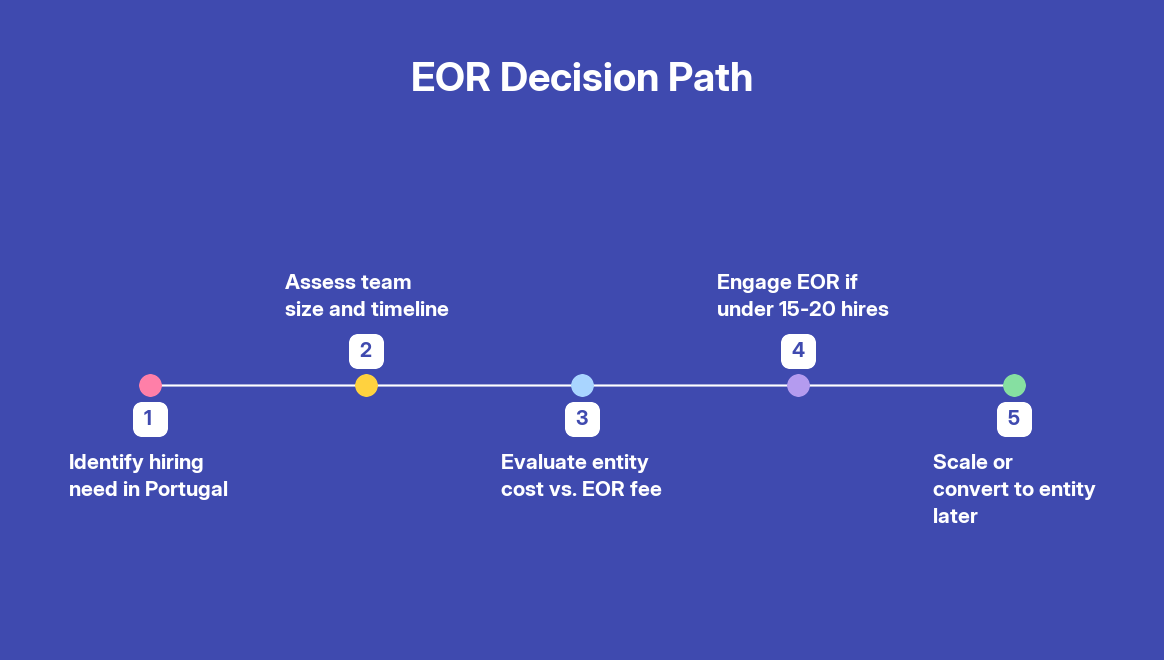
Setting up a Portuguese entity takes three to nine months. You need a local registered office, a legal representative, tax registrations with Autoridade Tributária, and Segurança Social enrollment. An EOR onboards employees in five to fifteen business days.
A Berlin e-commerce company that needed three customer support agents in Lisbon within two weeks could not wait for entity formation. The EOR made the first hire within eight business days.
Small Team Economics
Entity costs in Portugal include formation fees, annual accounting, corporate tax filings, and local director requirements. These fixed costs stay the same whether you employ two people or twenty. For teams under fifteen, the per-employee cost of maintaining an entity often exceeds monthly EOR fees.
EOR pricing in Portugal typically ranges from €300 to €700 per employee per month, depending on the provider and scope. That predictable monthly fee replaces a stack of fixed overhead that does not scale down.
Testing a Market Before Committing
Some companies hire in Portugal to test talent availability or client proximity before making a permanent infrastructure decision. An EOR lets you employ locally for twelve to eighteen months. If the team grows, you can transition employees to your own entity. If it does not work out, you wind down without liquidating a company.
For companies already hiring across multiple regions, an employer of record in Portugal fits into a broader multi-country hiring strategy without adding a new legal entity per market.
Common Misconceptions About EOR Arrangements in Portugal

"The EOR Owns My Employees"
The EOR is the legal employer. It does not own the employment relationship in a strategic sense. The client decides who to hire, what they work on, and when to end the arrangement. Intellectual property produced by the employee belongs to the client, provided the service agreement and employment contract include proper IP assignment clauses.
"EOR Is the Same as Temporary Work"
Portuguese law distinguishes between temporary work agencies (empresas de trabalho temporário) and EOR arrangements. Temporary agencies are regulated under specific licensing requirements. They supply workers for defined temporary needs.
An EOR provides permanent employment for ongoing roles. The employee's contract is typically indefinite-term. The relationship is not temporary or project-based by default. Confusing these models can trigger regulatory scrutiny from ACT.
Watch out: If your EOR provider in Portugal is licensed only as a temporary work agency, indefinite-term contracts may not be legally valid under their license. Confirm that your provider operates as a proper employer entity, not under a temporary agency framework.
"I Don't Need to Worry About Portuguese Labor Law"
The EOR handles compliance execution. The client still needs to understand Portuguese labor standards. Portugal mandates 22 working days of annual leave. Overtime rules cap weekly hours. Termination requires just cause or mutual agreement with severance.
If a client asks the EOR to terminate someone without cause and without severance, the EOR will refuse. It has to. Understanding these constraints avoids conflict and protects both parties.

FAQs
Can an employee hired through an EOR in Portugal receive stock options from the client company?
Yes, but the structure requires careful drafting. The EOR employment contract must reference the stock option plan. Portuguese tax law treats equity compensation as taxable income at exercise or vesting, depending on the plan type. The EOR withholds applicable IRS. The client grants the options through a separate equity agreement. Both documents must align to avoid double taxation or unreported benefit issues.
What happens if Portuguese labor law changes after the employee starts?
The EOR absorbs the compliance adjustment. When Portugal updates minimum wage levels, public holiday calendars, or social security rates, the EOR modifies payroll and contracts accordingly. The client sees the impact through updated invoices. No legal filings or contract amendments fall on the client. This is one reason comparing EOR providers on responsiveness matters.
Can the same EOR cover employees in Portugal and other European countries?
Yes. Many EOR providers cover multiple jurisdictions. Team Up, for example, covers Portugal alongside 20+ other countries. A single provider relationship simplifies vendor management. Each country still requires separate employment contracts and compliance handling. The EOR runs distinct payroll processes per jurisdiction.
Does the employee know they work for an EOR rather than the client directly?
Yes. The employee signs an employment contract with the EOR entity. Their payslip comes from the EOR. Segurança Social records show the EOR as employer. Transparency is legally required. Most employees understand the arrangement, especially in Portugal's growing remote work market. The client's brand and daily management experience remain unchanged.
What to Monitor Next
Portugal's government has signaled continued attention to remote work regulation and digital nomad frameworks. These changes could affect how EOR arrangements interact with tax residency rules and work permit requirements. If you plan to hire non-EU nationals through an EOR in Portugal, track updates from Autoridade Tributária and SEF's successor agency (AIMA). Start with a clear employment structure now, and build flexibility into your EOR service agreement for regulatory shifts ahead.
If you are planning your first hire in Portugal and want a compliance walkthrough specific to your situation, talk to Team Up's Portugal team.
Written by Team Up — EOR, payroll, and compliance across 20+ countries with owned entities in core markets.
.svg)


