


EOR Providers in Portugal: Comparing the Top 5 Companies

- What Is an Employer of Record (and Why It Matters in Portugal)
- Top EOR Providers in Portugal: Compared
- How to Choose the Best EOR Service for Portugal
- EOR Costs and Risks to Consider in Portugal
- How to Onboard an Employee Through an EOR in Portugal
- When an EOR Is the Right Choice for Portugal and When It Is Not
- FAQs
- What to Watch Next
EOR providers in Portugal give foreign companies a way to hire Portuguese talent without registering a local entity. A Toronto fintech company needed two compliance analysts fluent in EU regulatory frameworks. It onboarded both through an EOR in Lisbon within 7 business days. Twelve months later, the team had grown to five.
Portugal's Labor Code (Código do Trabalho) governs every employment relationship in the country. It mandates written contracts for fixed-term arrangements, registration with Segurança Social, and compliance with EU employment directives. Meeting those obligations from abroad, without a legal presence, is where an EOR earns its value.
This article evaluates five EOR providers operating in Portugal. It compares their compliance depth, pricing structures, onboarding speed, and use-case fit. It also covers the decision framework for choosing a provider and the financial and legal risks that buyers overlook.
What Is an Employer of Record (and Why It Matters in Portugal)

Employer of Record Definition: The Legal Relationship Explained
An EOR legally employs workers on behalf of a client company in a foreign country. Three parties share the arrangement. The EOR holds the employment contract and bears all statutory employer obligations. The client company directs the employee's daily work. The employee performs that work under a contract governed by local law.
In Portugal, this means the EOR registers the employee with Segurança Social. It withholds income tax. It pays employer contributions and files mandatory returns. The client company has no Portuguese entity and no direct employer liability.
Portugal's Labor Code defines the employment relationship through subordination, regularity, and economic dependence. The EOR satisfies these legal tests as the formal employer. That structure allows the client to hire without triggering permanent establishment risk.
EOR vs PEO in Portugal: A Critical Distinction
A Professional Employer Organization (PEO) operates through co-employment. It shares employer responsibilities with a client that already holds a local entity. An EOR replaces the need for that entity entirely.
This distinction matters in Portugal. Portuguese labor authorities require a registered employer to sign the contract and appear on Segurança Social filings. A PEO co-employment model assumes you already have that registered presence. If you do not have a Portuguese entity, a PEO cannot serve you. Only an EOR can.
A Stockholm e-commerce company explored both options before entering the Portuguese market. It had no local entity and no plans to incorporate one. The PEO model was structurally unavailable. The company used an EOR and hired three customer support agents within 10 days.
How an Employer of Record Works in Practice for Portugal Hires
The EOR drafts an employment contract compliant with Portugal's Labor Code. It registers the hire with tax authorities and Segurança Social. Monthly, it runs payroll, calculates withholdings, and remits social contributions.
Portugal requires written contracts for all fixed-term employment. The EOR ensures contract type, duration, and renewal clauses comply with statutory limits. It also manages mandatory benefits including paid annual leave and holiday allowances.
Day-to-day management stays with the client company. You assign tasks, set priorities, and run performance reviews. The EOR handles the legal and administrative layer underneath.
Top EOR Providers in Portugal: Compared

The Five Companies We Evaluated and Our Methodology
We evaluated five EOR providers active in Portugal: Team Up, Remote, Deel, Papaya Global, and Oyster HR. The evaluation focused on five dimensions specific to the Portuguese market: compliance depth under the Código do Trabalho, onboarding speed to first payroll, platform usability for managing Portuguese contracts, customer support availability in European time zones, and pricing transparency.
Each provider was assessed on its entity model in Portugal. Owned-entity providers bear direct compliance liability. Aggregator-model providers route employment through local partners, which introduces a third-party layer between the client and the worker.
Provider-by-Provider Breakdown: Strengths and Weaknesses
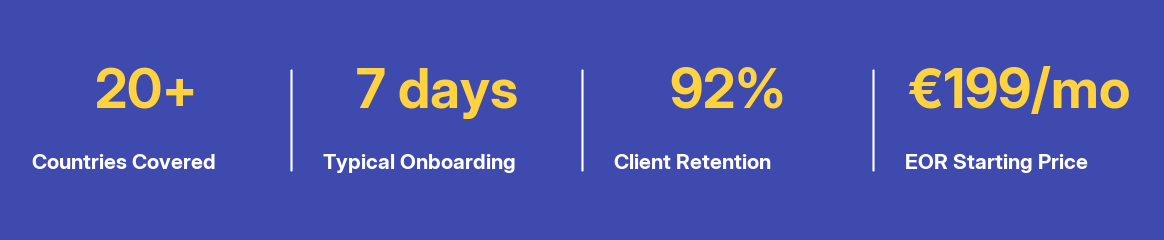
Team Up operates across 20+ countries with owned legal entities in its core markets. Its EOR starts at €199 per employee per month in Georgia. For Portugal, Team Up provides compliant hiring without a local entity, with in-country support and direct contract management. A Berlin SaaS company used Team Up to hire two frontend developers in Lisbon in 8 days, scaling to six within a year.
Remote uses a 100% owned-entity model and covers Portugal directly. Pricing runs in the $599 to $699 per month range. Platform maturity is strong. Support is responsive but fully digital.
Deel covers 150+ countries through a mix of owned entities and local partners. Its Portugal coverage uses a partner model. Deel requires a one-month security deposit per employee and applies FX markups embedded in exchange rates.
Papaya Global is an enterprise payroll analytics platform. It routes Portuguese employment through aggregator partners. The platform is built for large organizations managing existing global payrolls, not for companies making their first hire in Lisbon.
Oyster HR targets remote-first companies and covers Portugal. Its platform focuses on employee experience. Pricing is mid-range but limited customization for Portuguese-specific benefit structures has been reported.
Which Provider Fits Which Use Case in Portugal
A seed-stage startup hiring its first two Portuguese employees needs fast onboarding and low monthly cost. Team Up and Deel fit that profile. A mid-market company scaling a 15-person Lisbon office needs deeper compliance infrastructure and dedicated account management. Remote and Team Up are stronger there. An enterprise managing 200+ employees across 30 countries might lean toward Papaya Global's analytics layer, accepting higher cost and partner-model trade-offs.
How to Choose the Best EOR Service for Portugal
| Criterion | What to Look For | Why It Matters in Portugal |
|---|---|---|
| Entity model | Owned entity vs. local partner | Owned entities bear direct liability under the Código do Trabalho |
| Contract compliance | Fixed-term renewal handling | Portugal caps fixed-term contract renewals; violations trigger open-ended conversion |
| Segurança Social registration | Direct registration vs. delegated | Errors in social security registration create employer liability |
| EU data compliance | GDPR data processing agreements | Portugal enforces GDPR through the CNPD; fines apply to both controller and processor |
| Offboarding process | Severance calculation methodology | Portuguese severance rules vary by contract type and tenure |
Five Evaluation Criteria Specific to the Portuguese Market
Start with the entity model. An EOR with a Portuguese owned entity signs contracts under its own name and files directly with Segurança Social. A partner-model EOR delegates those filings to a local third party. If that partner makes a payroll error, the compliance gap sits between two organizations, not one.
Second, verify how the provider handles fixed-term contracts. Portugal's Labor Code restricts the number and duration of fixed-term renewals. Exceeding those limits automatically converts the arrangement into an open-ended contract. Your EOR must track renewal windows proactively.
Third, check GDPR data processing agreements. Portugal's national data authority, the CNPD, enforces EU data protection rules. Your EOR processes employee personal data. A weak DPA exposes both parties to regulatory action.
Red Flags to Watch During the Sales and Onboarding Process
Watch for providers that cannot name their Portuguese legal entity during the sales process. If the EOR routes through a partner, you should know that partner's identity before signing. Opacity here signals operational risk.
Another red flag: generic contract templates. Portugal requires written contracts for fixed-term employment, with specific clauses on duration, renewal, and justification. A provider offering a "global template" without Portuguese adaptation is cutting corners.
A Dubai logistics company discovered its previous EOR had been using a standard contract template across all EU markets. The Portuguese labor inspectorate flagged the contracts during a routine audit. Switching to a provider with Portugal-specific contracts resolved the issue within three weeks.
Questions to Ask Any EOR Before Signing a Contract in Portugal
Ask these before committing:
- Who is the named legal employer on the Portuguese contract?
- How do you handle fixed-term contract renewals and the conversion trigger?
- What is your Segurança Social registration process and timeline?
- Do you carry employer liability insurance in Portugal?
- What is your severance calculation methodology under the current Labor Code?
Watch out: Some EOR providers register employees under a staffing agency license rather than a direct employer arrangement. In Portugal, staffing agencies (empresas de trabalho temporário) operate under different regulatory rules and contract duration limits. Confirm which legal framework your EOR uses before signing.
EOR Costs and Risks to Consider in Portugal

How EOR Pricing Is Structured: Flat Fee vs Percentage Models
Most EOR providers charge through one of two models. The flat-fee model bills a fixed monthly amount per employee, typically ranging from $199 to $699 across the market. The percentage model takes a cut of gross salary, usually between 10% and 20%.
For Portugal hires, the percentage model becomes expensive quickly. Portuguese salaries for skilled roles in tech and finance sit above the Southern European average. A percentage-based EOR on a €4,000 monthly gross salary costs materially more than a flat-fee arrangement. Team Up's flat-fee model starting at €199 per employee per month avoids that scaling problem.
Hidden Cost Triggers Specific to the Portuguese Labor Market
Three cost triggers catch buyers off guard in Portugal.
First, holiday allowance. Portuguese employees receive a subsídio de Natal (Christmas allowance) and subsídio de férias (holiday allowance), each equal to one month's salary. Your EOR should include these in its cost projections from day one. Some providers quote monthly fees excluding these mandatory payments.
Second, termination costs. Portuguese severance calculations depend on contract type, tenure, and the reason for termination. Wrongful dismissal claims carry additional compensation. An EOR that does not model termination scenarios upfront creates a cost surprise you discover at the worst time.
Third, employer social contributions. Portugal requires employer contributions to Segurança Social at rates set by legislation. These rates are periodically adjusted. Confirm whether your EOR's quoted fee includes contributions or bills them separately.
Compliance and Operational Risks of Using an EOR in Portugal
Co-employment risk exists in every EOR arrangement. If Portuguese labor authorities determine that the client company, not the EOR, exercises effective employer control, they can reclassify the relationship. That reclassification creates tax liability, back-contributions, and penalties for the client.
GDPR exposure is the second major risk. Your EOR processes sensitive employee data under Portuguese jurisdiction. The CNPD has enforcement powers and has issued fines to data processors with inadequate safeguards. Your contract must specify data processing obligations, breach notification timelines, and sub-processor controls.
Dependency risk rounds out the picture. An Amsterdam design agency with eight employees in Porto discovered its EOR was exiting the Portuguese market with 60 days' notice. Migrating eight employment contracts to a new provider under Portuguese law required renegotiation of terms, new Segurança Social registrations, and continuity of accrued leave balances. The process took five weeks and cost the company two senior employees who left during the transition.
How to Onboard an Employee Through an EOR in Portugal
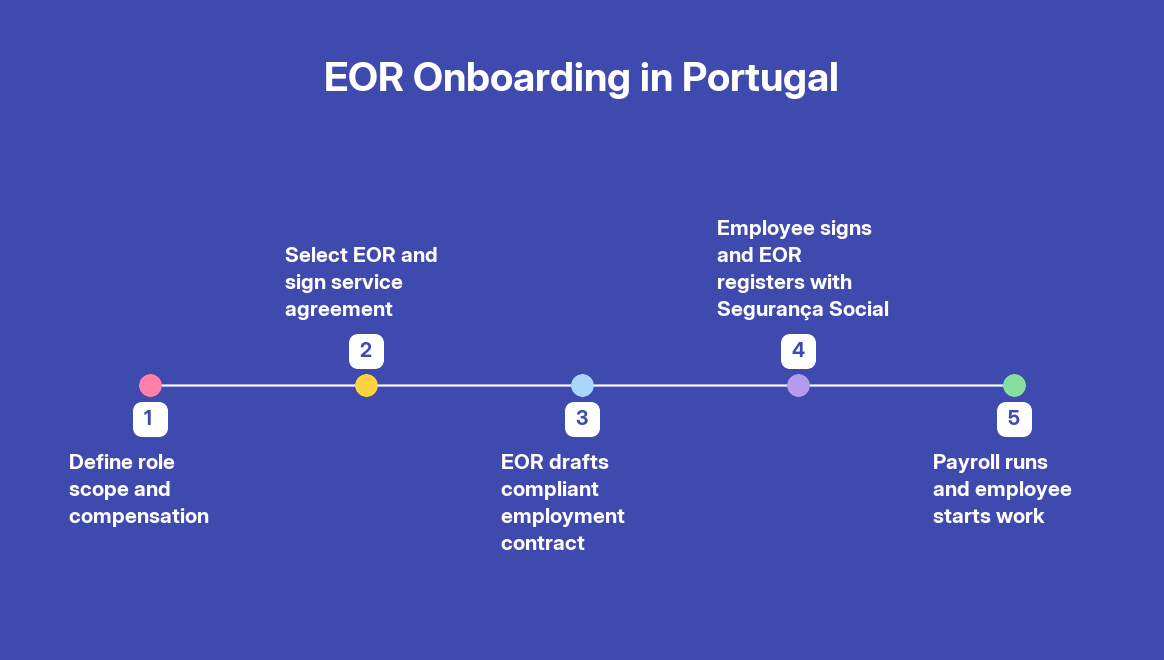
The onboarding sequence looks simple on paper. The compliance detail underneath each step is where providers differentiate themselves.
Before engaging any EOR, you need a clear job description, a target compensation band, and a decision on contract type. Portugal's Código do Trabalho distinguishes between fixed-term and indefinite contracts. That distinction shapes probationary periods, renewal limits, and termination exposure. Your EOR should advise on which contract type fits the role before drafting begins.
Once you sign the service agreement, the EOR prepares an employment contract that meets Portuguese statutory requirements. For fixed-term contracts, the law mandates written form. The contract must specify duration, renewal conditions, and the objective justification for the fixed term. Missing any of these elements can convert the arrangement to indefinite employment by operation of law.
A London fintech company onboarding its first Portuguese customer success manager through an EOR completed the entire process in 9 business days. The EOR handled Segurança Social registration, drafted the contract in Portuguese, and configured payroll withholding before the employee's first day. Six months later, the company had added two more roles through the same provider without delays.
After the employee signs, the EOR registers them with Segurança Social and configures tax withholding through the Portuguese tax authority. The EOR also enrolls the employee in any applicable benefits scheme. First payroll typically runs within the same calendar month if onboarding completes before the provider's payroll cutoff date.
When an EOR Is the Right Choice for Portugal and When It Is Not
Not every hiring scenario calls for an EOR. The decision depends on team size, timeline, and long-term intent.
| Factor | EOR Makes Sense | Direct Entity Makes Sense |
|---|---|---|
| Team size | 1–15 employees | 15+ employees with growth plans |
| Timeline to first hire | Under 2 weeks | 3–6 months acceptable |
| Contract duration | Project-based or uncertain | Indefinite, multi-year commitment |
| Local compliance expertise | None in-house | In-house legal and HR team |
| Cost priority | Avoid entity setup and maintenance costs | Volume discounts on social contributions |
| IP and data sensitivity | Standard commercial arrangements | Requires direct corporate control |
An EOR is strongest when you need speed and compliance without local infrastructure. A Toronto digital agency hired three Portuguese UX designers through an EOR in 11 days. The agency had no European entity and no Portuguese legal counsel. The EOR handled contracts, Segurança Social registration, and monthly payroll. Two years later, the team grew to eight, and the agency still uses the EOR because entity setup costs remain unjustifiable at that headcount.
The calculus shifts when your Portuguese team exceeds roughly 15 people. At that scale, the cumulative monthly EOR fees may approach or exceed the annualized cost of maintaining a local entity. A direct entity also gives you more control over collective bargaining agreement classification and direct relationships with Portuguese labor authorities.
For companies in between, a PEO model can bridge the gap. You maintain your own entity while outsourcing HR administration, payroll processing, and compliance monitoring. This works well when you already have a Portuguese subsidiary but lack local HR staff.
One scenario where an EOR is almost always the right call: testing a new market. If you are uncertain whether Portugal will become a permanent hiring market, committing to entity formation before validating demand is a costly mistake. An EOR lets you hire, evaluate, and scale without that fixed overhead.
FAQs
Can a Portugal-based employee hired through an EOR later transfer to a direct employment contract with the client company?
Yes, but the transfer requires careful handling. Under Portuguese labor law, the employee's existing contract with the EOR terminates and a new contract with your entity begins. Continuity of service is not automatic. You must negotiate whether accrued leave and tenure carry over. Most EOR agreements include a transfer clause, but some providers charge exit fees ranging from one to three months of the employee's salary. If your EOR contract lacks a transfer provision, negotiate one before signing. The new direct contract may trigger a fresh probationary period unless waived by mutual agreement.
Does using an EOR in Portugal mean the worker is entitled to collective bargaining agreements (CBAs)?
Portugal has one of Europe's most extensive CBA systems. The applicable CBA depends on the EOR's sector classification, not the client company's industry. This creates a mismatch risk. If the EOR is classified under a services or staffing sector, the CBA governing that sector applies to your employee. That CBA may mandate benefits above statutory minimums that you did not budget for, such as meal allowances, insurance top-ups, or additional paid leave. Before signing, ask the EOR which CBA applies to your employees and review the cost implications. Some providers absorb CBA-mandated extras in their fee; others pass them through.
What happens to a Portuguese employee hired via EOR if the EOR provider goes out of business or exits the Portuguese market?
The employee's rights under Portuguese labor law survive the EOR's exit. Accrued leave, severance entitlements, and social security contributions remain obligations that transfer to whoever assumes the employment relationship. If no successor employer steps in, the client company faces potential co-employment liability. Before signing with any provider, assess their financial health. Request audited financials or proof of insurance. Your service agreement should include a continuity clause specifying how employee contracts transfer in a wind-down scenario. Some companies require EOR providers to maintain escrow funds equal to three months of aggregate payroll as a safeguard.
Is there a maximum duration for using an EOR in Portugal before the arrangement must convert to a direct entity or employment?
Portuguese law does not impose a statutory maximum on EOR arrangements as a category. The risk comes from the underlying employment contract. The Código do Trabalho limits fixed-term contracts to a maximum duration, with a cap on renewals. Once that limit is reached, the contract converts to indefinite by operation of law. If your EOR has placed the employee on a fixed-term contract, that clock is ticking regardless of the EOR wrapper. Indefinite contracts have no duration limit, so the EOR arrangement itself can continue. This is a grey area where legal counsel is essential, especially for engagements exceeding two years.
How does Portugal's NHR (Non-Habitual Resident) tax regime affect EOR payroll obligations for new residents?
Employees who qualify for NHR status may benefit from reduced personal income tax withholding on Portuguese-source employment income. Your EOR must be able to configure payroll to reflect the NHR rate rather than the standard progressive withholding schedule. Not all providers have this capability. The NHR regime has been subject to significant legislative changes, and eligibility rules have narrowed for new applicants. Before onboarding a new resident under NHR assumptions, confirm the current regime status with the Portuguese tax authority (Autoridade Tributária) and verify your EOR can administer the correct withholding. Misconfigured payroll creates personal tax liability for the employee.
Can an EOR in Portugal sponsor work permits for non-EU nationals?
Yes, an EOR with a registered Portuguese entity can sponsor work permits. The process involves obtaining authorization from the Portuguese immigration authority (AIMA) and demonstrating that the EOR is the legal employer. Timelines for work permit approval vary. Non-EU nationals from countries without bilateral agreements may face longer processing. Your EOR should manage the full application, including the employment contract submission, residency permit scheduling, and Segurança Social enrollment. Ask providers whether they have completed non-EU sponsorships before. Some EORs operating through partner networks lack the direct entity registration needed to act as a licensed sponsor.
What happens to contractor arrangements in Portugal if the worker is reclassified as an employee?
Portuguese labor authorities actively pursue misclassification. If a contractor is reclassified, the engaging company owes back-dated social security contributions, holiday pay, and potentially severance. The reclassification is retroactive to the start of the working relationship. Penalties for unpaid Segurança Social contributions include surcharges. Converting a contractor to an EOR-employed worker before reclassification occurs eliminates this exposure. The EOR assumes the employment relationship and all associated statutory obligations from the conversion date forward. If you currently engage Portuguese contractors who work fixed hours, use company tools, or report to a manager, reclassification risk is high.
What to Watch Next
Portugal's labor regulatory environment is shifting in two areas worth monitoring. The government has signaled reforms to fixed-term contract rules under the Código do Trabalho. Any tightening of renewal limits or justification requirements will directly affect how EOR providers structure employment contracts for project-based roles. Track legislative updates through the Portuguese parliament's public gazette.
The NHR tax regime's future remains uncertain after recent legislative changes restricted new applicant eligibility. If you are hiring internationally mobile workers who rely on NHR benefits, confirm the current rules with the Autoridade Tributária before each new hire. Your EOR should proactively flag any changes that affect withholding calculations.
Your concrete next step: request a sample Portuguese employment contract from your shortlisted EOR providers. Compare how each handles CBA classification, fixed-term renewal language, and NHR payroll configuration. Those three elements reveal more about operational depth than any sales deck. For a detailed breakdown of Portugal's employment framework, see our complete employer of record in Portugal hiring guide.
.svg)


