


How Much Does It Cost to Use an EOR in Portugal?

Employer of record cost in Portugal depends on more than the monthly fee your provider quotes. A London fintech company recently hired two compliance analysts in Lisbon through an EOR in 6 business days. Their loaded cost per employee turned out to be roughly 30% higher than the quoted EOR fee alone. The gap came from Portugal's mandatory employer social security contributions, 13th and 14th month salary payments, and meal allowance obligations that the fee itself never covered.
That gap catches most buyers off guard. Portugal's Código do Trabalho layers statutory obligations that inflate total employment cost well beyond the headline price. Understanding what sits inside the EOR fee and what sits outside it is the difference between a sound budget and a quarterly surprise.
This article breaks down the pricing structures, mandatory employer costs, service scope, and selection criteria that determine what you actually pay when hiring through an EOR in Portugal.
What Is an Employer of Record?

An Employer of Record is a third-party organization that becomes the legal employer of your workers in a target country. You retain day-to-day management of the employee's tasks, goals, and output. The EOR handles everything the local government cares about: contracts, payroll, tax withholding, social security, and statutory benefits.
The Legal Relationship: EOR, Worker, and Client Company
Three parties define the structure. The EOR signs the employment contract and appears as the employer on all government filings. The worker performs their role under your operational direction. You pay the EOR a service fee plus the full loaded cost of employment.
This arrangement means you never need to incorporate a local entity. In Portugal, that would typically mean setting up a Sociedade por Quotas or a Sociedade Anónima. Entity formation in most European markets takes 3 to 9 months from first filing to operational payroll. An EOR collapses that timeline to days.
How an EOR Operates in the Portuguese Market
Portugal uses the Código do Trabalho as its primary employment law framework. The EOR drafts compliant employment contracts under this code. It registers the employee with Portuguese tax authorities and social security.
Each month, the EOR calculates gross-to-net pay. It withholds the employee's 11% social security contribution and applicable income tax. It remits the employer's approximately 23.75% social security contribution to Segurança Social. It administers the legally required 22 working days of annual leave.
A Stuttgart-based SaaS company used this model to place a product designer in Porto. Onboarding took 7 business days. Within four months, the team had grown to three employees, all managed through the same EOR relationship without any Portuguese entity. For deeper due diligence on comparing EOR providers in Portugal, the evaluation criteria differ from what you would apply in other markets.
What Does EOR Cost in Portugal?

Two pricing models dominate the EOR market. Both carry trade-offs depending on your salary levels and headcount.
Fee Model 1: Flat Monthly Fee Per Employee
Most EOR providers charge a fixed monthly amount per employee. This fee covers the provider's administrative and compliance overhead. It does not change when you give an employee a raise.
The flat model favors companies hiring senior talent at higher salaries. A principal engineer earning €6,000 per month costs the same EOR fee as a junior analyst earning €1,500. EOR fees across the European market typically fall between €300 and €700 per employee per month. Portugal-specific pricing tends to sit in the middle of that range.
Fee Model 2: Percentage of Gross Salary
Some providers charge a percentage of each employee's gross monthly salary. This model scales linearly with compensation. It works better for companies hiring at lower salary bands, where a flat fee would represent a disproportionate overhead.
The percentage model punishes raises and promotions. Every salary increase lifts your EOR cost automatically.
Mandatory Employer Costs That Sit Outside the EOR Fee
The EOR fee is not your total cost. Portugal's statutory employer obligations add a substantial layer on top.
The employer's social security contribution runs at approximately 23.75% of gross salary. Portuguese law requires a 13th month payment (Christmas allowance) and a 14th month payment (holiday allowance). Both equal one month's base salary. Spread across the year, these two payments alone add roughly 16.7% to annual compensation cost.
Meal allowances, workplace insurance, and occupational health services also sit outside most EOR fee quotes. Budget for total loaded cost, not just the service fee.
EOR vs. Setting Up a Legal Entity in Portugal: Cost Logic
Entity setup in Portugal means incorporation costs, registered office fees, accounting retainers, corporate tax filings at the standard 21% IRC rate, and ongoing annual compliance. For a team of one or two employees, those fixed costs dwarf the EOR fee.
A Boston e-commerce company evaluated both paths for three customer support hires in Lisbon. The EOR route reached operational payroll in 8 days. The entity path would have required a minimum of four months and an estimated first-year overhead several multiples of the combined annual EOR fees. At five or more employees, the entity math starts shifting. At fifteen, it often tips decisively toward self-employment infrastructure.
What Do EOR Services Include in Portugal?
| Service Category | Typically Included in EOR Fee | Typically Extra or Client-Managed |
|---|---|---|
| Monthly payroll processing | Yes | — |
| Tax withholding and remittance | Yes | — |
| Social security registration and filing | Yes | — |
| Employment contract drafting | Yes | — |
| 13th and 14th month administration | Yes (cost passed through) | — |
| Annual leave tracking (22 days) | Yes | — |
| Work permit and visa sponsorship | Sometimes included, often extra | Depends on provider |
| Employee benefits beyond statutory | — | Yes, add-on |
| Equipment procurement | — | Yes, add-on |
| IP assignment agreements | — | Client-managed or add-on |
| Recruitment and sourcing | — | Separate service |
Core Payroll and Tax Compliance Services
Every EOR operating in Portugal handles the monthly payroll cycle. That means calculating gross-to-net, withholding personal income tax under Portugal's progressive brackets, and remitting both the employee's 11% and the employer's approximately 23.75% social security contributions. The EOR files monthly and annual returns with the Autoridade Tributária.
A Copenhagen digital agency with two designers in Lisbon found that payroll compliance alone justified the EOR fee. Portuguese payroll requires monthly Declaração Mensal de Remunerações filings. Missing a deadline triggers penalties. The EOR absorbed that filing risk entirely.
Employment Contract Drafting Under Portuguese Law
The Código do Trabalho imposes specific requirements on employment contracts. Fixed-term contracts have maximum duration limits and mandatory renewal rules. Indefinite contracts carry probationary periods that differ by role seniority.
Your EOR drafts contracts that comply with these rules. It handles amendments when roles change. It manages termination procedures, which in Portugal require careful documentation and notice periods that scale with tenure.
Statutory Benefits and Leave Administration
Portuguese employees receive 22 working days of paid annual leave per year. The 13th and 14th month payments are not bonuses. They are statutory salary entitlements. The EOR calculates, accrues, and disburses these on the legally required schedule.
Sick leave, parental leave, and public holiday administration also fall within the EOR's scope. Portugal recognizes 13 mandatory public holidays annually. The EOR tracks all of these against each employee's calendar. For a full breakdown of compliance obligations in Portugal, the regulatory checklist extends further than most buyers expect.
Optional Add-Ons and What Typically Costs Extra
Work permit sponsorship is the most common add-on. Some providers include it in the base fee. Others charge separately. If you are hiring non-EU nationals, clarify this before signing.
Private health insurance, pension top-ups, and meal card programs beyond the statutory minimum also sit outside standard EOR packages. Equipment procurement and co-working space access are typically billed as separate line items. EOR services that include compliant hiring without a local entity cover the statutory floor. Everything above that floor is negotiable.
How to Choose the Best EOR for Portugal

Choosing an EOR for Portugal is a compliance decision first and a cost decision second. The cheapest provider means nothing if they mishandle a termination under Portuguese labor law.
Key Evaluation Criteria: Compliance Depth vs. Price
Start with entity structure. Does the provider operate through its own legal entity in Portugal, or does it subcontract to a local partner? Owned entities give you direct accountability. Partner networks add a layer of distance between you and the entity that actually employs your people.
Team Up operates through direct legal entities in its core markets. That ownership model means compliance decisions happen inside the organization, not through a third party the client has never met. A Tallinn recruitment agency that expanded to Lisbon through an EOR learned this distinction after its first provider routed all contract amendments through a Portuguese intermediary. Response times stretched to two weeks. They switched to a provider with an owned-entity presence and cut that turnaround to three days.
Questions to Ask Before Signing an EOR Contract
The right questions reveal whether a provider understands Portuguese specifics.
- How do you handle 13th and 14th month payments: accrued monthly or disbursed in lump sums?
- What is your process for fixed-term contract renewals under the Código do Trabalho?
- Do you carry workplace accident insurance (seguro de acidentes de trabalho) as the employer of record?
- What happens to the employment relationship if we terminate the EOR agreement?
- Is your Portuguese entity directly owned or operated through a local partner?
These are not theoretical questions. Each one maps to a specific compliance failure point.
Red Flags in EOR Proposals for Portugal
Watch for proposals that quote only the EOR fee without itemizing passed-through statutory costs. If a proposal does not mention the 23.75% employer social security contribution, 13th and 14th month obligations, or workplace insurance, the provider is either obscuring costs or does not understand Portugal.
Watch out: Some EOR proposals bundle the employer's social security contribution into a single "loaded cost" line without separating it from the service fee. This makes it impossible to benchmark the actual EOR margin against competitors. Always request a fee breakdown that isolates the provider's service charge from statutory pass-through costs.
Another red flag is vague termination language. Portuguese labor law makes dismissals procedurally complex. If the EOR contract does not specify who bears redundancy costs and how employee transitions work at contract end, you are exposed.
How to Set Up an EOR Arrangement in Portugal
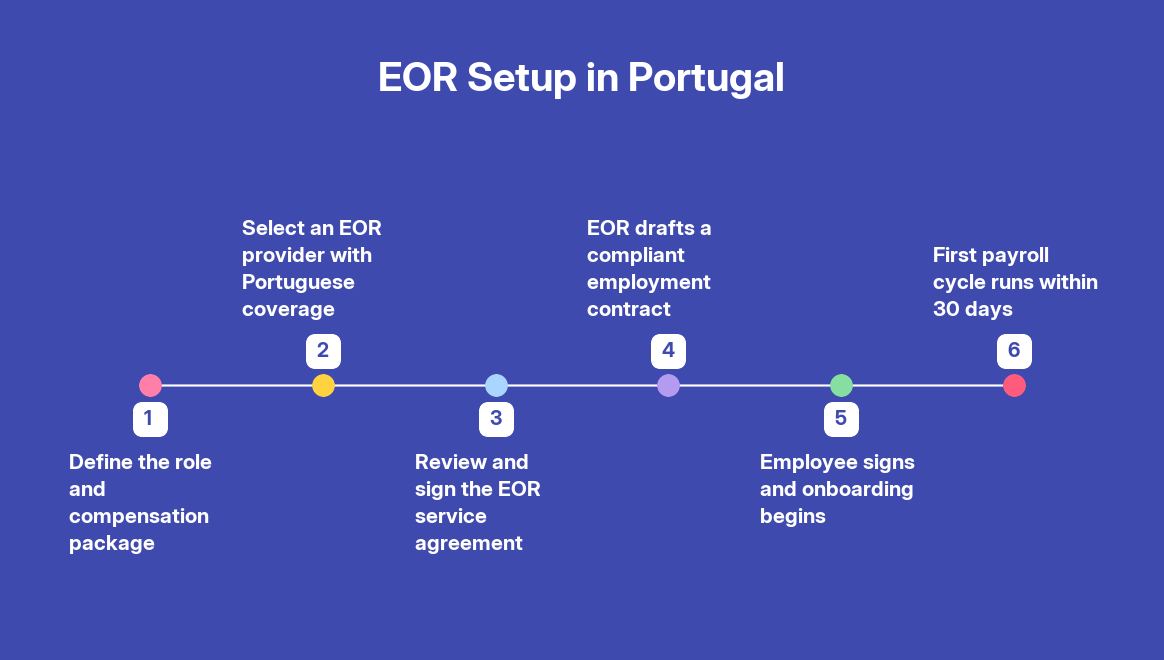
The process starts before you contact any provider. Define the role, seniority level, and target compensation range in advance. Portuguese employment contracts must specify working hours, job category, and remuneration details under the Código do Trabalho. Arriving at those decisions early prevents back-and-forth that delays onboarding.
A London-based fintech company hired two compliance analysts in Lisbon through an EOR in 11 days. They had already prepared job descriptions and salary benchmarks. That preparation cut what other clients report as a three-to-four-week process nearly in half.
Once you select a provider, the EOR service agreement governs your relationship with the EOR itself. This is separate from the employment contract the EOR signs with your hire. Read both documents carefully. The service agreement defines fee structure, liability allocation, and termination mechanics. The employment contract must comply with Portuguese labor law, including the mandatory trial period provisions and contract type classification.
Your EOR handles registration with Segurança Social, the Portuguese social security authority. The employer's social security contribution sits at roughly 23.75% of gross salary. Your employee contributes approximately 11%. These rates apply from the first payroll cycle, which typically runs within 30 days of the signed contract.
For companies already operating teams across multiple countries, an EOR in Portugal fits into a broader employer of record strategy. TeamUp covers Portugal alongside 20 other markets, so adding a Lisbon-based hire does not require a separate vendor relationship.
EOR vs. Setting Up a Local Entity in Portugal
The cost question rarely ends at the EOR fee. For companies weighing a local entity against an EOR, the comparison involves time, administrative burden, and ongoing compliance overhead beyond the monthly invoice.
| Factor | EOR in Portugal | Local Entity (Lda. or SA) |
|---|---|---|
| Setup timeline | 5 to 15 business days | 3 to 6 months typical |
| Upfront legal costs | None or minimal | Notary, registration, legal counsel |
| Ongoing accounting | Handled by EOR | Monthly bookkeeping, annual audits |
| Employer social security | Included in EOR cost | 23.75% managed in-house |
| Corporate tax filing | Not applicable | 21% IRC rate, filed annually |
| Headcount flexibility | Scale up or down per hire | Fixed overhead regardless of team size |
| Exit complexity | Contract termination with EOR | Company dissolution process |
A German e-commerce brand opened a Sociedade por Quotas in Lisbon to hire a customer support team. The incorporation took four months. Legal and accounting setup fees exceeded €15,000 before the first employee started. Eighteen months later, with only three employees in Portugal, they switched to an EOR and closed the entity. The ongoing payroll and compliance burden had consumed more finance team hours than the Portuguese operation justified.
The breakeven point depends on headcount. Most companies find that an EOR remains cost-effective for teams under 15 to 20 employees. Beyond that threshold, the per-employee EOR fee starts to exceed what in-house payroll administration would cost through a local entity. But the breakeven calculation must include the finance and HR hours your home office spends managing a foreign subsidiary. Those hours are real costs that rarely appear in spreadsheet comparisons.
Watch out: Closing a Portuguese entity is not instant. The dissolution process involves tax clearance certificates, creditor notification periods, and final filings with the commercial registry. Companies that switch from entity to EOR mid-operation should budget three to six months for the wind-down.
For companies exploring whether Portugal fits into a broader compliance framework across Southern Europe, the entity-versus-EOR decision often hinges on whether Portugal is a standalone market or part of a multi-country hiring strategy.
FAQs
Does EOR cost in Portugal change based on an employee's seniority or salary level?
It depends entirely on the fee model. Flat-fee EOR contracts charge the same amount whether you hire a junior analyst or a VP of engineering. Percentage-based models create a cost cliff for senior hires. A director earning €120,000 gross on a 10% fee model generates €12,000 in annual EOR fees. The same role on a flat-fee contract might cost €6,000 to €8,000 annually. Some companies specifically switch to flat-fee EOR contracts when bringing on executive-level talent to avoid this multiplier effect.
Can an EOR issue a fixed-term contract in Portugal, or only open-ended contracts?
The Código do Trabalho permits fixed-term contracts (termo certo), but caps their maximum duration at two years with up to three renewals. Some EOR providers restrict fixed-term arrangements or charge a premium because renewals and termination procedures require additional administrative handling. Ask your provider upfront whether fixed-term contracts carry a different fee schedule. If you need a six-month project hire, this pricing difference can materially change your total cost. Open-ended contracts (sem termo) are the default and generally simpler for EOR administration.
What happens to the employee if the EOR provider ceases operations or exits the Portuguese market?
This is a scenario most buyers never plan for. If the EOR exits Portugal, the employment relationship does not automatically transfer to you. Without a local entity, you may become the de facto employer under Portuguese law with no legal structure to support that role. Before signing, request contractual step-in rights that allow you to transfer the employee to another EOR. Check the provider's financial health. Some clients negotiate escrow arrangements covering three months of salary and social security contributions as a safeguard against abrupt market exits.
Are the 13th and 14th month salary payments included in the EOR fee or invoiced separately?
Provider contracts vary significantly on this point. Some EOR providers spread the holiday allowance (June) and Christmas allowance (November or December) across twelve monthly invoices. Others invoice them as lump sums in their respective months. The second approach creates cash flow spikes that surprise clients who have not reviewed the payment schedule section of their service agreement. Ask explicitly during contract negotiation whether these mandatory payments are amortized or invoiced as they fall due. The total annual cost is identical either way, but your monthly budget forecast will look very different.
Is there a minimum contract length when using an EOR in Portugal, and what are the exit costs?
Most EOR contracts carry a minimum commitment period of three to six months. Early termination typically triggers a fee equal to the remaining months on that minimum term. This contractual exit cost is separate from the statutory obligations you owe the employee. Under the Código do Trabalho, dismissing an employee triggers notice periods and potential compensação based on tenure. You face two parallel exit cost structures: the EOR's contractual termination fee and the employee's statutory entitlements. Budget for both when modeling total cost of exit.
Can I transfer an existing Portuguese employee from my local entity to an EOR?
Yes, but the transfer is not a simple administrative switch. The employee must consent to a new employment contract with the EOR as the legal employer. Their tenure, accrued leave, and any contractual benefits must be preserved or negotiated. Some EOR providers in Portugal handle these transitions routinely, including drafting the new contract to mirror existing terms. The critical risk is breaking continuity of service, which could reset the employee's seniority-based entitlements under Portuguese labor law. Get legal review before initiating the transfer.
Does the EOR handle employee benefits beyond statutory requirements in Portugal?
EOR providers in Portugal cover all statutory benefits: 22 days of annual leave, 13th and 14th month salaries, social security contributions, and mandatory insurance. Supplementary benefits like private health insurance, meal allowances above the tax-exempt threshold, or gym memberships vary by provider. Some EOR platforms offer benefits packages you can add for an additional monthly fee per employee. Others allow you to design custom benefits but charge administration fees on top. If competitive benefits matter for your role, confirm exactly what is included in the base EOR fee and what triggers add-on charges before you sign.
What to Watch Next
Portugal's labor market is shifting. The government has signaled ongoing reforms to the Código do Trabalho, with particular focus on remote work regulations and platform worker classification. These changes could affect how EOR providers structure contracts and price their services in coming years.
Monitor Segurança Social contribution rate announcements each budget cycle. Even small adjustments to the employer's 23.75% rate alter the total cost equation for every EOR-managed employee. The statutory minimum wage also moves annually by government decree, which affects entry-level hiring budgets.
Your concrete next step: request itemized quotes from at least two EOR providers covering Portugal. Ask each provider to break out the base fee, social security pass-through, and any charges for 13th and 14th month salary administration. Compare the total annual cost per employee, not just the headline monthly fee.
.svg)


