


How to Set Up an EOR Arrangement in Portugal: Step-by-Step Process for 2026

Our guide to EOR costs in Portugal covered pricing structures, fee ranges, and what shapes the total bill. This article goes deeper on the setup process itself. From scoping the engagement to running your first payroll cycle, each phase carries specific requirements under Portuguese labor law.
Getting the arrangement right at the start prevents compliance gaps that compound over time. Portugal's Código do Trabalho (Labour Code) imposes strict rules on contract form, trial periods, and mandatory registrations. Missing a step during setup does not just create administrative headaches. It can trigger fines from the Autoridade para as Condições do Trabalho (ACT), Portugal's labor inspectorate.
This guide walks through each phase in sequence, with the detail you need to brief your legal team or evaluate an EOR provider in Portugal.

Scoping the Engagement Before You Sign
Defining the Role and Employment Terms
The setup process starts before any contract is drafted. You need to define the role, compensation structure, and employment type clearly. Portuguese law distinguishes between fixed-term, indefinite-term, and very short-term contracts. Each carries different renewal limits and termination rules.
Fixed-term contracts in Portugal must run for a minimum of 12 months unless a specific legal exception applies. The Código do Trabalho permits shorter terms for temporary replacement of absent employees or seasonal activity. Your EOR should flag which contract type fits your situation during the scoping phase.
Compensation scoping matters equally. Portugal mandates 14 salary payments per year. Employees receive a holiday allowance and a Christmas allowance, each equal to one month's base salary. These two extra payments affect your total cost and must be built into the EOR's fee structure from day one.
Choosing Between Contract Types
A US fintech company hiring three customer support agents in Lisbon for an initial 18-month project would typically use fixed-term contracts. The EOR drafts each contract in Portuguese, specifying the objective justification for the fixed term. Without that justification, Portuguese courts can reclassify the contract as indefinite.
Indefinite contracts suit long-term roles. They carry no end date but give the employee stronger termination protections. Trial periods under indefinite contracts last 90 days for most roles. For senior management or highly complex technical positions, the trial period extends to 180 days. For roles requiring a university degree, 180 days also applies under the standard framework.
Your EOR should present a clear comparison during scoping. The choice between contract types shapes everything downstream: termination costs, renewal obligations, and social security registration timing. Understanding how an EOR works in Portugal at this stage helps you ask the right questions before committing.
The Onboarding Sequence From Contract to First Payroll
Employment Contract Execution
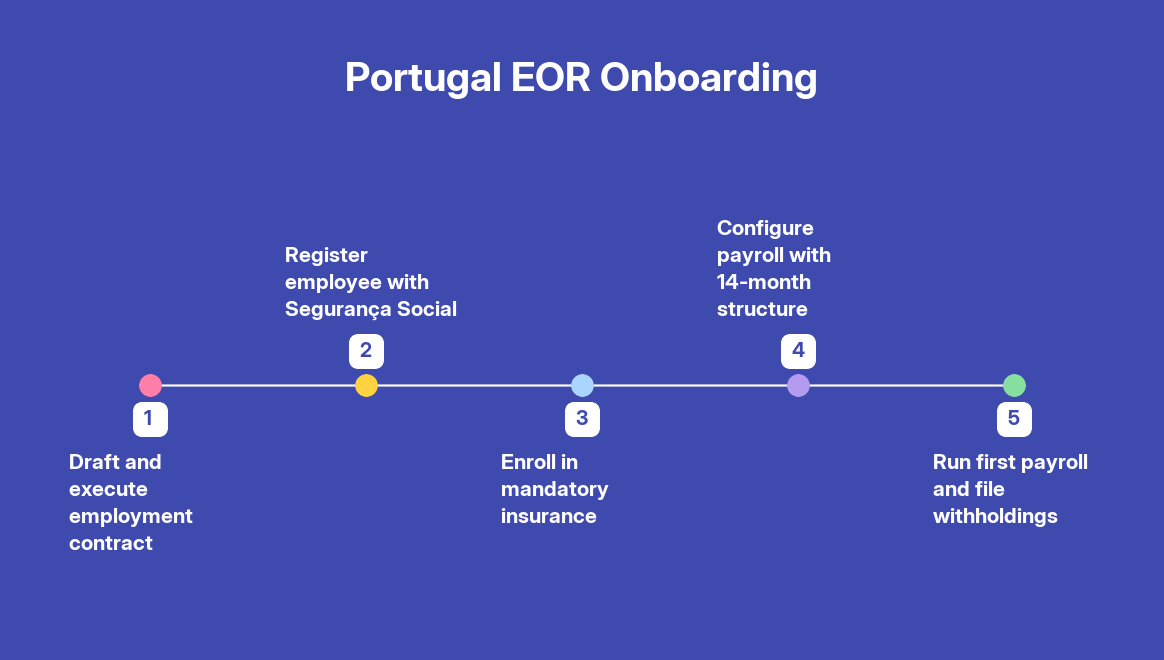
Portuguese employment contracts must be in writing for fixed-term arrangements. The EOR prepares the contract in Portuguese, covering mandatory clauses: workplace location, job description, base salary, working hours, and the applicable collective bargaining agreement if one exists.
The contract must reference the specific CBA governing the sector. Portugal has over 200 active CBAs, and many override statutory minimums on pay, overtime rates, and leave entitlements. A UK e-commerce company hiring a warehouse coordinator in Porto discovered this when the logistics sector CBA added two extra leave days beyond the statutory 22. Your EOR identifies the applicable CBA and builds its terms into the contract.
Social Security and Tax Registration
The EOR registers your employee with Segurança Social, Portugal's social security system, before the start date. The employer contribution rate is set by statute at 23.75% of gross salary. The employee contribution sits at 11%. These rates have been structurally stable and apply across most employment categories.
The EOR also registers for IRS (personal income tax) withholding. Portugal uses a progressive income tax system with rates set annually through the state budget. The EOR calculates monthly withholdings based on the employee's tax bracket, marital status, and number of dependents. The specific rates change with each budget cycle, so the EOR must track updates from the Autoridade Tributária (Tax Authority) each year.
First Payroll Configuration
Payroll in Portugal runs monthly. The EOR configures the 14-payment structure from the outset. Holiday allowance is typically paid before the employee's vacation period. Christmas allowance is paid in December. Some employers split both into 12 monthly installments, which Portuguese law permits if the employee agrees in writing.
The first payroll cycle usually runs within 30 days of the start date. Onboarding through an EOR in Portugal typically completes in 10 to 14 business days from signed contract to active payroll status.
Managing the Ongoing Employment Relationship
Monthly Compliance Obligations
Once the employee is active, the EOR handles recurring compliance tasks. Monthly social security contributions must reach Segurança Social by the 20th of the following month. IRS withholdings follow the same deadline. Late payment triggers penalty interest calculated by the tax authority.
| Obligation | Frequency | Deadline | Responsible Party |
|---|---|---|---|
| Social security contributions | Monthly | 20th of following month | EOR |
| IRS withholding | Monthly | 20th of following month | EOR |
| Holiday allowance | Annual | Before vacation period | EOR |
| Christmas allowance | Annual | December | EOR |
| Work accident insurance | Annual renewal | Policy expiry date | EOR |
| Annual leave tracking | Ongoing | Per Código do Trabalho | EOR |
Work accident insurance is mandatory under Portuguese law. The EOR maintains an active policy with a licensed Portuguese insurer. Coverage must be in place from the first working day. This is not optional or deferrable.
Leave Management and Statutory Entitlements
Portuguese employees receive a statutory minimum of 22 working days of paid annual leave. The applicable CBA may increase this. The EOR tracks accrued leave, approvals, and carryover rules. Unused leave cannot be replaced by payment except upon contract termination.
Sick leave in Portugal is paid through Segurança Social, not the employer, starting from the fourth day of absence. The EOR coordinates the sick leave notification with the employee's medical certificate and the social security system. The reimbursement rate varies by duration of absence, starting at 55% of the reference salary for absences up to 30 days.
Performance and Termination Considerations
You direct the employee's daily work. The EOR manages the legal employment relationship. This split works smoothly when both sides understand the boundaries. You set objectives, conduct reviews, and provide feedback. The EOR handles any formal disciplinary process required under Portuguese law.
Termination in Portugal is heavily regulated. Dismissal without just cause is not permitted for indefinite contracts. The EOR must follow a formal disciplinary procedure that includes written charges, a response period, and a reasoned decision. Severance for fixed-term contracts equals 18 days of base salary plus seniority allowances per year of service for contracts entered into under recent statutory provisions. Confirm the current severance formula with your EOR, as legislative amendments adjust these calculations periodically.
Common Setup Mistakes and How to Avoid Them

Ignoring CBA Applicability
The most frequent setup error is failing to identify the correct CBA. A company hiring a software developer in Lisbon might assume only statutory minimums apply. But if the developer's role falls under an IT sector CBA, minimum pay scales and overtime rules differ. The ACT can inspect and penalize non-compliance with applicable CBAs. Your EOR should confirm CBA applicability in writing before the contract is signed.
Misclassifying the Contract Type
Using a fixed-term contract without a valid objective justification exposes you to automatic reclassification. Portuguese labor courts consistently enforce this rule. The consequence is an indefinite contract with full termination protections retroactive to the start date. A German SaaS company that hired two developers in Porto on 6-month fixed-term contracts without statutory justification faced exactly this outcome after an ACT inspection.
Delaying Social Security Registration
Registration with Segurança Social must happen before the employee's first working day. Late registration triggers penalties and creates gaps in the employee's social security record. Some providers treat this as a post-start administrative task. That approach is non-compliant. Insist on seeing the registration confirmation before your employee begins work.
Watch out: If your EOR registers the employee with Segurança Social after the start date, even by a few days, the employee's accident insurance coverage may have a gap. ACT inspectors check registration dates against employment start dates during audits.
For a broader view of EOR compliance requirements in Portugal, review the legal checklist before finalizing your provider selection.

FAQs
Can I convert a fixed-term EOR contract to an indefinite contract in Portugal?
Yes. The EOR can convert the contract by mutual agreement at any point. Automatic conversion also occurs if the fixed-term contract is renewed beyond its maximum legal duration. Under Portuguese law, fixed-term contracts can be renewed up to three times, with a maximum total duration that depends on the justification type. The trial period does not restart upon conversion. Confirm renewal limits with your EOR before the first renewal window.
What happens if I need to terminate the EOR arrangement mid-contract?
Your master service agreement with the EOR governs provider-side termination. The employee's contract continues under Portuguese labor law regardless of what happens between you and the EOR. If you switch providers, the new EOR typically assumes the employment relationship through a transfer mechanism. The employee's accrued rights, including seniority and leave balance, carry over. A 30-day notice to the outgoing EOR is standard practice, but confirm the exact terms in your agreement.
Does the EOR handle Portuguese data protection obligations for employee data?
Yes. The EOR acts as data controller for employment-related personal data under the GDPR and Portugal's Lei 58/2019. This includes payroll data, health records from sick leave, and tax identification numbers. The EOR must maintain a Record of Processing Activities and respond to employee data access requests within 30 days. Ask your EOR for their GDPR compliance documentation before onboarding begins.
Can employees in Portugal work remotely from another EU country under the EOR arrangement?
Short-term remote work from another EU country is possible but creates social security complications. Under EU Regulation 883/2004, an employee working in another member state for more than 25% of their time may trigger a social security obligation in that country. The EOR must apply for an A1 certificate from Segurança Social to maintain Portuguese social security coverage during temporary cross-border work. Stays exceeding 183 days in a calendar year may also create tax residency obligations in the host country. Coordinate with your EOR before approving any extended cross-border arrangement.
What to Plan for Next
Portugal's labor regulatory environment continues to evolve. The annual state budget adjusts tax brackets, and CBA negotiations periodically reset sector minimums. Your EOR should provide proactive updates on changes that affect your employees' compensation or your compliance obligations.
Build a quarterly review cadence with your EOR covering payroll accuracy, CBA updates, and any upcoming legislative changes. Start by confirming your current contract types, CBA applicability, and social security registration status. These three items form the foundation everything else depends on.
If you are planning your first hire in Portugal and want a walkthrough of costs, compliance steps, and timelines, request a consultation with TeamUp.
Written by the TeamUp editorial team. TeamUp is a people-first EOR and nearshoring partner, helping companies across North America, Europe, the Middle East, and Singapore hire compliantly in 20+ countries.
.svg)


