What Factors Affect Employer of Record Costs in France?

Our guide to EOR costs in France covered the main pricing models, total cost ranges, and how EOR stacks up against subsidiaries. This article goes deeper on a single question: what specific factors push those costs up or down?
France stands apart from most European markets. Its layered social security system, mandatory collective bargaining agreements, and strict termination rules create cost variables that do not exist in simpler jurisdictions. Understanding each variable lets you forecast your actual spend rather than relying on a provider's headline rate.
The sections below break down employer social charges, headcount effects, supplementary benefit requirements, and the hidden cost drivers that catch foreign companies off guard.
Social Charges and Employer Contributions
France's employer social charges rank among the highest in Europe. They form the single largest variable in your total EOR cost.
How the Charges Stack Up
French employers pay contributions to multiple social security branches. These cover health insurance, family allowances, unemployment insurance, retirement pensions, workplace accident insurance, and several smaller levies. The combined employer contribution rate typically exceeds 45% of gross salary. For comparison, employer charges in Germany and most Central European markets run significantly lower.
Each contribution has its own base, ceiling, and rate. Some apply to the full salary. Others cap at the Social Security ceiling, a threshold the government revises annually. The current ceiling figure changes each January. Confirm it on the URSSAF portal before budgeting.
Why the Rate Is Not Fixed
Your actual rate depends on several variables. Industry classification matters. A software company pays a different workplace accident rate than a construction firm. Company size triggers additional contributions. Firms above certain employee thresholds owe extra levies for housing aid and transport subsidies.
The contribution sociale généralisée (CSG) and contribution pour le remboursement de la dette sociale (CRDS) add another layer. These are technically employee-side deductions, but they affect gross-to-net calculations that shape your total cost.
A fintech company in London hiring three engineers in Paris through an EOR discovered that employer charges added roughly €2,800 per month on top of a €6,000 gross salary. That figure exceeded their initial budget by 20% because they had benchmarked against UK employer National Insurance rates.
The EOR's Role in Rate Optimization
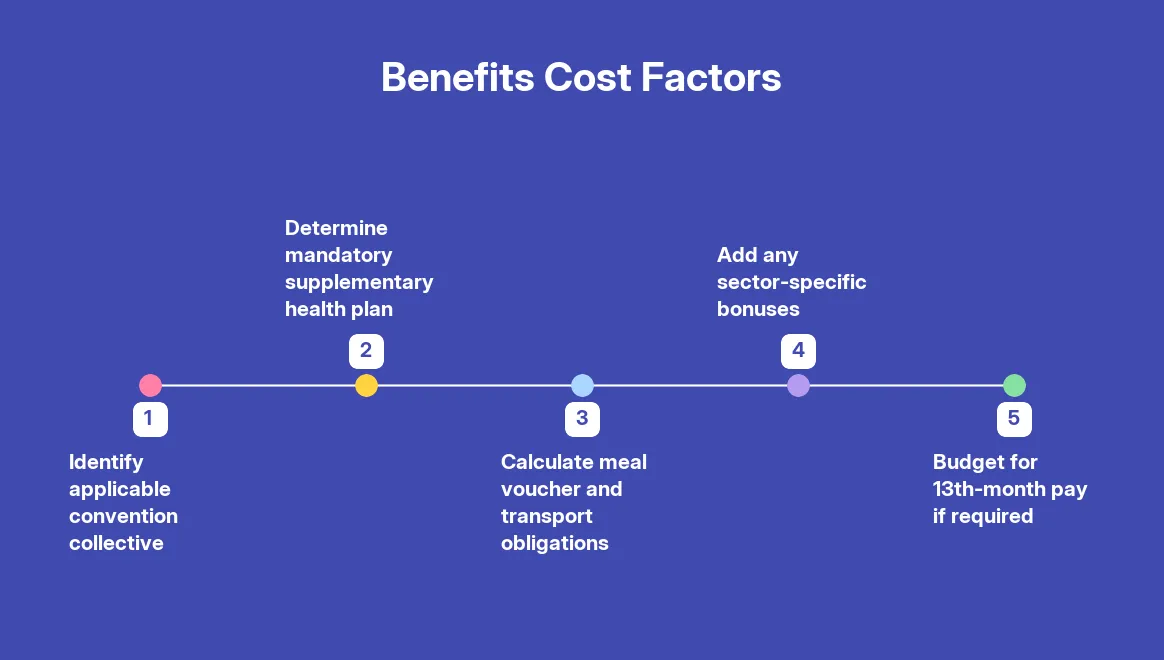
Your EOR provider selects the applicable collective bargaining agreement, known as the convention collective. This choice determines minimum salary floors, mandatory bonuses, and certain contribution rates. Choosing the wrong convention collective inflates costs. A detailed breakdown of EOR fee structures in France explains how providers handle this selection and what it means for your monthly invoice.
Employee Headcount and Contract Complexity
The number of employees you hire through an EOR in France changes your cost profile in ways that go beyond simple volume discounts.
Threshold Effects Under French Law
French labor law imposes obligations at specific headcount thresholds. At 11 employees, you must establish a comité social et économique (CSE). At 50, additional requirements kick in: profit-sharing obligations, a dedicated health and safety committee, and expanded employee representation rights.
Your EOR absorbs these obligations. But the administrative burden increases its costs. Providers typically adjust fees or negotiate custom rates when a client's French headcount approaches these thresholds.
| Factor | 1-5 Employees | 6-10 Employees | 11-49 Employees | 50+ Employees |
|---|---|---|---|---|
| CSE requirement | No | No | Yes | Yes |
| Profit-sharing obligation | No | No | No | Yes |
| Per-employee EOR fee | Standard | Slight discount likely | Custom pricing | Custom pricing |
| Administrative complexity | Low | Low | Medium | High |
| Typical negotiation leverage | Minimal | Minimal | Moderate | Strong |
Contract Type Matters
France distinguishes sharply between the contrat à durée indéterminée (CDI) and the contrat à durée déterminée (CDD). The CDI is the standard open-ended contract. The CDD is a fixed-term contract, and it carries a mandatory end-of-contract bonus called the prime de précarité. This bonus equals 10% of total gross compensation earned during the contract.
That 10% premium makes CDD employees measurably more expensive than CDI employees over short engagements. Some EOR providers pass this cost through directly. Others build it into their service fee. Ask which approach your provider uses before signing.
Part-time contracts add another layer. French law requires specific clauses for part-time workers, including guaranteed minimum weekly hours. The compliance overhead per employee stays roughly the same whether someone works 20 hours or 39 hours per week.
Benefits, Perks, and Supplementary Coverage
Mandatory Supplementary Health Insurance
French law requires every employer to provide a mutuelle, a complementary health insurance plan. The employer must cover at least 50% of the premium. The actual cost depends on the plan's coverage level and the insurer.
Basic mutuelle plans run between €40 and €80 per employee per month for the employer's share. Premium plans with dental, optical, and hospitalization coverage can exceed €120 monthly. Your EOR typically selects a group plan and passes the cost through. Some providers markup the premium. Others negotiate group rates that reduce individual costs as headcount grows.
Transport and Meal Allowances
Employers in France must reimburse 50% of employees' public transport passes. In Paris, the Navigo pass cost makes this a meaningful monthly expense. Outside Paris, the reimbursement drops but does not disappear.
Meal vouchers, called titres-restaurant, are not legally mandatory. But they are so common that most conventions collectives include them. The employer typically covers 50% to 60% of each voucher's face value. For a team of five, this adds a predictable monthly cost that many foreign companies overlook during budgeting.
Sector-Specific Bonuses
Many conventions collectives mandate a 13th-month salary payment. Some require seniority bonuses after specified years of service. The Syntec convention, which covers most IT and consulting roles, includes specific provisions for overtime calculation and minimum salary grids tied to job classification.
A US SaaS company hiring its first product manager in Lyon through an EOR was surprised by a mandatory annual bonus equivalent to one month's salary. The Syntec convention required it. The EOR had disclosed this during onboarding, but the client's finance team had not budgeted for it.
Hidden Cost Drivers Most Companies Miss

Termination Costs
France has no at-will employment. Dismissing a CDI employee requires a valid legal ground, a formal procedure, and statutory severance. The legal minimum severance equals one-quarter of a month's salary per year of service for the first ten years. It increases to one-third per year beyond that.
The procedural requirements alone take weeks. A convocation letter must precede a formal meeting. A waiting period follows. The notice period, set by the convention collective, typically ranges from one to three months for professional-level roles. Your EOR manages this process, but the costs flow through to you.
Watch out: If a French labor court finds a dismissal without valid cause, the employer owes damages on top of statutory severance. These damages follow a scale based on company size and employee tenure, and they can reach several months of salary. Budget for this risk if you plan short-term engagements.
Currency and Payroll Timing
France operates on the euro, which removes FX risk for eurozone-based companies. For US or UK companies, currency fluctuation affects your actual cost month to month. A 5% swing in EUR/USD over a quarter can offset any savings from negotiating a lower EOR fee.
French payroll runs monthly, with specific compliance deadlines for social charge declarations. Late filings trigger penalties from URSSAF. Your EOR handles these deadlines, but delays in funding the payroll account on your side can cascade into compliance issues.
Immigration Sponsorship
Hiring non-EU nationals through an EOR in France adds work permit and visa costs to your total spend. The administrative fees, processing timelines, and legal requirements vary by permit type. Budget three to five months for a standard work authorization process. The EOR's legal fees for managing this process typically run separately from the standard monthly service fee.

FAQs
Does the convention collective affect my EOR cost even if I only hire one person?
Yes. The convention collective applies from the first employee. It determines minimum salary, mandatory bonuses, overtime rules, and certain contribution rates. A single developer hired under the Syntec convention faces different cost obligations than one hired under the commerce convention. Your EOR selects the applicable agreement based on the company's primary business activity in France. Choosing the wrong one can trigger back-pay claims during labor inspections.
Can I reduce costs by hiring employees on CDD contracts instead of CDI?
Not necessarily. CDD contracts carry a mandatory 10% end-of-contract premium paid to the employee. They also face strict legal limits on renewal and duration. French labor courts scrutinize repeated CDD usage. If a court requalifies a CDD as a CDI, you owe back benefits and potentially damages. For engagements longer than 12 months, CDI contracts typically cost less overall despite the open-ended commitment.
Do EOR providers in France charge differently for executives versus standard employees?
Most providers apply higher fees for executive-level hires, known as cadres under French classification. Cadres fall under a separate pension scheme (AGIRC-ARRCO at higher contribution brackets) and carry different notice period requirements. Their supplementary health plans often require enhanced coverage. Expect monthly EOR fees for cadre-level employees to run 15% to 30% above standard rates, depending on the provider's pricing model.
What happens to my costs if French social security rates change mid-contract?
Rate changes take effect immediately. URSSAF publishes updated contribution schedules, typically in January. Your EOR adjusts payroll calculations from the effective date. Most EOR contracts include pass-through clauses that transfer rate changes directly to the client. Review your service agreement for language around statutory cost adjustments. Some providers absorb minor changes within flat-fee models, but significant rate shifts always pass through.
What to Monitor Next
French labor law reform remains active. Proposed changes to unemployment insurance contributions and pension calculations could shift employer costs within the next budget cycle. Track URSSAF circulars and convention collective renegotiations for your sector. If your team in France grows beyond ten employees, start planning for CSE obligations now rather than scrambling at the threshold.
If you need a France-specific cost projection for your team size and contract type, request a detailed estimate from TeamUp.
Written by TeamUp — EOR and people-first hiring across 20+ countries since 2020.
.svg)