How Much Does It Cost to Use an EOR in France?
Employer of record cost in France catches most companies off guard. A US fintech planning to hire two product managers in Paris expected costs roughly comparable to its London hires. The actual employer burden, once French social contributions stacked on top of gross salary, ran closer to 50% above base pay before the EOR's own fee even appeared on the invoice.
France is one of Europe's most expensive countries to employ people. The statutory employer contribution layer is among the highest on the continent. Layer an EOR service fee on top of that, and your total cost per employee can diverge sharply from what you budgeted using US or UK benchmarks.
This article breaks down what drives EOR pricing in France, how fee structures differ between providers, and where the real cost surprises hide. If you are evaluating whether to hire compliantly in France without a local entity or set up your own subsidiary, the math starts here.

What Is an Employer of Record?

An EOR becomes the legal employer of your worker on paper. You direct the employee's daily work, set objectives, and manage output. The EOR handles everything on the employment law side: contracts, payroll, tax withholding, social contributions, and statutory benefits.
The Legal Employer vs. the Directing Company: How the Split Works
The split is clean in principle. The EOR signs the employment contract under local law. It registers with France's social security bodies, files payroll declarations, and pays the employee. Your company signs a service agreement with the EOR and pays it a consolidated invoice.
The employee reports to your managers. They join your Slack, attend your standups, ship your product. The EOR never directs their work. This distinction matters because French labor courts look at who actually controls the work to determine the real employer relationship.
A London-based e-commerce company used an EOR to hire a senior UX designer in Lyon. Onboarding completed in seven business days. The designer started work under a French CDI (contrat à durée indéterminée) held by the EOR, while reporting directly to the London product team.
How an EOR Differs from a PEO, Staffing Agency, or Subsidiary
These four structures look similar from the outside. They are legally distinct. A PEO operates as a co-employer, sharing employment responsibilities with a company that already has its own local entity. A staffing agency supplies temporary workers and typically retains more operational control over them. A subsidiary is your own legal entity in France, with full registration, capital requirements, and ongoing corporate obligations.
An EOR eliminates the need to establish a legal entity in France. That is its core value proposition. EOR arrangements are governed by French employment law because the employee is based in France, regardless of where your company is headquartered.
For companies exploring EOR compliance obligations in France, the regulatory weight falls on the EOR. Your risk sits in choosing one that carries that weight competently.
How EOR Pricing Works: Fee Structures Explained

EOR providers typically charge either a flat monthly fee per employee or a percentage of gross salary. The model your provider uses changes your total cost profile significantly, especially in a high-salary market like France.
Flat Monthly Fee vs. Percentage of Gross Salary: Which Model Is Common?
The flat-fee model charges a fixed amount per employee per month, regardless of the employee's salary level. This structure favors companies hiring senior roles with high base salaries. A percentage model, by contrast, scales the EOR fee with compensation. A 10% fee on a €40,000 annual salary costs less than the same percentage on a €90,000 salary.
EOR fees across Western European markets typically fall between $400 and $700 per employee per month under flat-fee models. Percentage-based models usually range from 7% to 15% of gross salary, depending on the provider and the volume of employees.
A Berlin SaaS company hiring three customer success managers in Marseille under a flat-fee model paid the same EOR fee for each, despite salary differences of €8,000 between the most junior and most senior hire. Under a percentage model, the fee gap would have been roughly €100 per month.
What Is (and Is Not) Included in a Typical EOR Quote?
Most EOR quotes bundle payroll processing, employment contract drafting, statutory benefit enrollment, and basic HR administration. What often sits outside the quoted price matters more.
Items commonly billed separately include:
- Onboarding setup fees for each new hire
- Off-boarding and termination management, especially complex under French labor law
- Visa and work permit sponsorship services
- Benefits administration beyond statutory minimums (mutuelle top-ups, meal vouchers)
- Currency conversion markups embedded in exchange rates
Hidden Costs to Probe Before Signing a Contract
The most overlooked cost in France is the termination layer. French law makes dismissal procedurally complex and expensive. Some EOR providers exclude termination management from their base fee. Others include it but cap the support at a certain number of hours. Ask explicitly what happens when you need to end an employment relationship.
FX markups represent another opaque cost. If your provider invoices in euros but your treasury operates in dollars, the spread between the interbank rate and the rate on your invoice can add 1% to 3% to every payment cycle.
What Factors Affect EOR Costs in France?
| Cost Factor | How It Affects Your EOR Bill |
|---|---|
| Employer social contributions (cotisations patronales) | Add roughly 40-50% on top of gross salary; the single largest cost multiplier |
| Applicable collective bargaining agreement (CCN) | Can mandate additional benefits, higher minimums, or supplementary insurance beyond statutory floor |
| Employee salary level | Higher salaries mean higher absolute contribution amounts; percentage-based EOR fees also scale up |
| Headcount | Per-employee fees may decrease at volume; administrative costs spread across more hires |
| Statutory benefits (leave, health, pension) | Non-negotiable baseline cost included in every French employment relationship |
| Termination provisions | French dismissal procedures add legal and administrative cost; some EORs charge separately |
Mandatory French Employer Social Contributions (Cotisations Patronales)
France has mandatory employer social contributions layered on top of every employee's gross salary. These cotisations patronales fund health insurance, pension schemes, unemployment insurance, family allowances, and workplace accident coverage.
The total employer contribution burden is among the highest in Europe. For a concrete sense of scale: if you budget €60,000 in gross salary, expect the employer contribution layer to push your total employment cost closer to €85,000 to €90,000 before the EOR's service fee. The exact rates shift annually based on government decisions and social security funding targets. Confirm current rates through URSSAF, France's social contribution collection body, before finalizing any hiring budget.
Salary Level, Role Seniority, and Collective Bargaining Agreements (CCNs)
France's convention collective nationale system assigns most industries a binding collective agreement. These CCNs set minimum salaries by role classification, mandatory bonuses (like a 13th-month payment in some sectors), and supplementary benefit requirements.
A Copenhagen healthtech company discovered this firsthand when hiring a clinical data analyst in Paris. The applicable CCN for the technology consulting sector required a supplementary pension contribution and a minimum monthly salary floor that exceeded the company's initial offer by €400. The EOR flagged the gap during onboarding. Without that catch, the contract would have been non-compliant from day one.
Statutory Benefits That Every French Employee Must Receive
French employees are entitled to statutory benefits including paid leave, health insurance, and pension contributions. France follows a 35-hour standard working week under the Code du Travail. Employees receive a minimum of five weeks of paid annual leave.
Beyond leave, employers must enroll every employee in a compulsory supplementary health plan (mutuelle d'entreprise). Transport subsidies for commuting costs are partially mandatory in urban areas. Meal vouchers, while not legally required, are standard enough that omitting them can create recruitment friction.
These costs are not optional line items. They are baked into the total employment cost. Every employer of record operating in France must fund them.
One Employee vs. a Growing Team: How Headcount Changes Your Cost Profile
The per-employee cost of an EOR typically decreases as headcount grows. Most providers offer volume pricing tiers. A company hiring one employee in France might pay the full listed monthly fee. At five employees, the per-head rate often drops by 10% to 20%.
The fixed overhead of managing French compliance, URSSAF filings, and DSN (déclaration sociale nominative) reporting gets amortized across more employees. A US logistics company started with a single operations coordinator in Lille through an EOR. Within 14 months, it had scaled to six employees across three French cities. The EOR fee per employee dropped at the five-employee threshold. The employer social contributions, of course, did not.
Watch out: Volume discounts on EOR fees never reduce French employer social contributions. Those scale linearly with each hire. A 15% discount on the service fee matters far less than you think when cotisations patronales represent the bulk of your cost.
Pros, Cons, and Risks of Using an EOR in France

Choosing an EOR in France is not a simple cost decision. It is a trade-off between speed, control, compliance burden, and long-term cost structure. The right answer depends on your headcount, your timeline, and how long you plan to operate in the French market.
Core Advantages: Speed, Compliance, and No Entity Required
Using an EOR eliminates the need to establish a legal entity in France. Entity setup in France typically takes three to six months, factoring in company registration, bank account opening, social security enrollment, and initial URSSAF declarations. An EOR compresses that timeline to days.
A Singapore-based cybersecurity firm needed a threat intelligence analyst based in Paris for a client engagement starting in three weeks. Entity setup was not an option. The EOR onboarded the analyst in eight business days, issuing a compliant CDI and handling the first payroll cycle within the same month.
Compliance transfer is the second major advantage. The EOR assumes liability for payroll accuracy, contribution filings, and adherence to the applicable CCN.
The Real Downsides: Cost Ceiling, Employee Experience, and Control Gaps
EOR costs in France are typically higher than in lower-cost countries due to France's elevated mandatory employer contributions. Stacking an EOR margin on top of already-heavy cotisations patronales means your total cost per employee will always exceed what you would pay through your own entity, once that entity reaches operational efficiency.
Employee experience can also suffer. Your French hire's employment contract is with the EOR, not with your brand. For some candidates, especially senior ones, this creates friction. They may question job security or feel disconnected from your company culture.
Control gaps appear around benefits customization. The EOR, not you, selects the mutuelle provider and the meal voucher scheme. You can request changes, but the EOR holds the contractual relationship.
Specific Legal and Operational Risks in the French Context
French labor courts scrutinize employment relationships aggressively. If the EOR contract is poorly structured, a court could reclassify the arrangement. The client company could be deemed the real employer, inheriting all associated liabilities. Reviewing compliance requirements for EOR in France before signing any agreement is not optional.
Termination under French law is procedurally rigid. An employee dismissed without following the correct convocation, entretien préalable, and notification steps can bring a wrongful dismissal claim. Some EOR providers lack the French labor law expertise to manage this correctly.
EOR vs. Setting Up a French Subsidiary: A Practical Trade-Off Framework
For one to four employees over a 12-to-18-month horizon, an EOR almost always wins on cost and speed. The breakeven point where entity ownership becomes cheaper typically falls around five to ten employees, depending on salary levels and how long you plan to maintain the French operation.
A Dutch industrial automation company ran both models in parallel. It used an EOR for its first two hires in Lyon while simultaneously incorporating a SAS (société par actions simplifiée). The entity took four months to become operational. By month six, it had migrated both employees from the EOR to its own payroll. For companies testing the French market before committing, this staged approach reduces risk on both sides.
How to Choose and Onboard an EOR in France
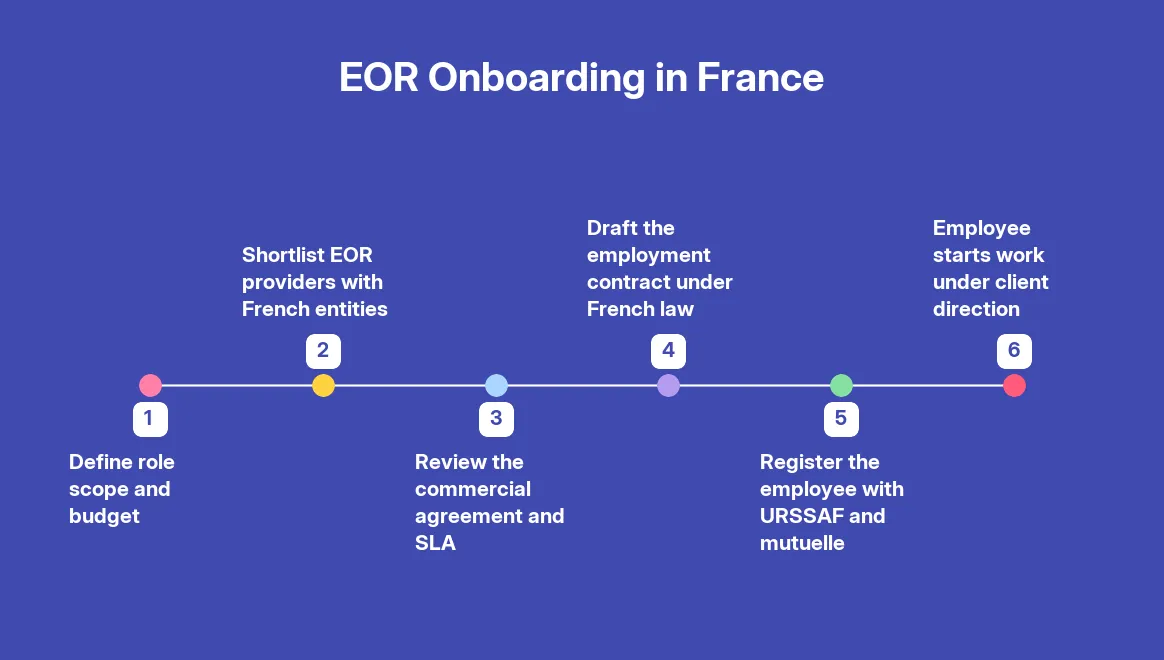
Start with role definition. Pin down the job title, compensation band, and applicable collective bargaining agreement before you contact a single provider. France assigns most roles to a convention collective that dictates minimum salary floors, notice periods, and supplementary benefits. Your EOR needs this classification before it can draft a compliant contract.
During vendor shortlisting, ask three questions that separate strong providers from weak ones. Does the EOR hold its own French entity, or does it subcontract to a local partner? What is the contractual notice period if you want to exit? And does the fee cover mutuelle top-up health insurance administration, or is that billed separately?
Once you select a provider, the commercial agreement governs the relationship between your company and the EOR. The employment contract governs the relationship between the EOR and your employee. These are distinct documents. Review both. A Toronto-based fintech company hiring its first customer success manager in Lyon through an EOR completed the full onboarding cycle in 11 business days. The bottleneck was not paperwork. It was aligning the role classification with the SYNTEC collective agreement, which added three days of back-and-forth.
After contract signing, the EOR registers the employee with URSSAF for social security and enrolls them in a compliant mutuelle plan. The employee then begins work under your day-to-day direction while the EOR handles payroll, tax withholding, and statutory filings. If the employee needs a work visa, the EOR sponsors it through its own French entity. That step can add weeks, so factor immigration timelines into your launch plan.
EOR vs. Subsidiary vs. Contractor: Cost Comparison for France
Choosing an employment model in France is a cost decision wrapped in a compliance decision. Each structure carries different fixed costs, variable costs, and risk profiles. The table below compares them across the dimensions that matter most to a finance team.
| Factor | EOR | French Subsidiary (SAS) | Direct Contractor |
|---|---|---|---|
| Setup time | Days to weeks | Three to six months | Immediate |
| Setup cost | None or minimal | Notarial, legal, and registration fees | None |
| Ongoing monthly cost | EOR fee plus full employer burden | Full employer burden plus entity maintenance | Invoiced rate only |
| Employer social contributions | Included in EOR cost | Borne directly by entity | None (contractor bears own charges) |
| Compliance risk to client | Low (EOR holds liability) | Full (entity is the employer) | High (requalification risk) |
| Exit complexity | Commercial contract termination | Entity wind-down plus employee severance | Contract termination |
| Best for | 1-15 employees, market testing | Long-term, scaled presence | Project-based, truly independent work |
The EOR model eliminates setup cost and compresses time to hire. That advantage is most visible when you need one to five employees and have no certainty about long-term headcount. A subsidiary makes financial sense once your French team reaches a size where the fixed costs of entity maintenance spread across enough employees to beat the per-head EOR fee. The crossover point varies, but most companies see it somewhere between eight and fifteen employees.
The contractor column looks cheapest on paper. No employer contributions. No EOR fee. But French labor courts apply a substance-over-form test. If your contractor works fixed hours, uses your tools, reports to your manager, and has no other clients, a court can requalify that relationship as employment. The consequence is back-payment of all social contributions the "employer" should have made, plus penalties and interest.
Watch out: Requalification in France is retroactive. If a contractor is reclassified after two years, you owe two full years of employer social contributions, not just from the date of the court ruling.
For companies evaluating EOR compliance in France, the contractor path demands careful structuring. If the working relationship looks anything like employment, use an EOR or establish an entity. The cost difference disappears fast once penalties enter the equation.
FAQs
Are EOR fees in France tax-deductible as a business expense for the client company?
The answer depends on your tax residence. For a US-based company, the EOR management fee is generally deductible as an ordinary business expense. Companies in jurisdictions with controlled foreign corporation rules or transfer pricing obligations face more scrutiny. The tax authority may require that the EOR fee reflects arm's-length pricing. Do not rely on your EOR provider for this guidance. Get jurisdiction-specific advice from your own tax advisor before treating the full fee as a deductible expense.
Can an EOR in France hire employees under a fixed-term contract (CDD) rather than an open-ended contract (CDI)?
French law restricts CDD use to enumerated circumstances: replacing an absent employee, handling a temporary spike in activity, or seasonal work. Most EOR providers default to CDI because misusing a CDD exposes the legal employer to requalification as a CDI by the labor courts. That requalification carries damages and limits your ability to end the relationship. Some EOR providers refuse CDD arrangements entirely. Ask about CDD availability during vendor due diligence, and prepare documentation proving the legitimate temporary reason if you pursue one.
What happens to the employment contract if the client company wants to terminate the EOR relationship mid-contract?
Ending the commercial agreement with your EOR does not end the employee's contract. The employee holds rights under French labor law regardless of your business relationship with the provider. Three outcomes are possible. The employee transfers to your own French entity, if you have one. A new EOR takes over the employment contract. Or the EOR makes the employee redundant following French dismissal procedure. That procedure includes mandatory notice periods, potential severance pay calculated on tenure, and possible Works Council consultation. Budget for these costs before initiating an exit.
Is an EOR the right solution if I only need to hire one contractor, not a permanent employee, in France?
A single truly independent contractor may not need an EOR at all. The critical question is whether the working relationship has characteristics of employment. Fixed hours, a single client, subordination to a manager, and use of company tools all point toward employment under French law. If a labor court requalifies the contractor as an employee, you face retroactive social contribution payments plus penalties. Assess the actual working arrangement first. If the role looks like employment, an EOR in France is safer than a misclassified contractor.
How long does it take to onboard an employee in France through an EOR compared to setting up a subsidiary?
EOR onboarding in France typically takes five to fifteen business days once paperwork is complete. Setting up a subsidiary involves notarial steps, INPI registration, URSSAF affiliation, and opening a French bank account. Collectively, that stretches to three to six months before you can legally employ anyone. The EOR timeline advantage narrows if the employee's role requires sector-specific onboarding. Some collective agreements mandate union notification or specific probationary procedures that add days to the process even through an EOR.
Can an EOR in France sponsor work permits for non-EU employees?
Yes, an EOR with its own French entity can sponsor work permits directly. The EOR acts as the legal employer and files the authorization request with the préfecture. Processing times vary by region and permit type. Some categories require a labor market test proving no suitable EU candidate is available, which adds weeks. For roles on France's shortage occupation list, the labor market test is waived. Check your employee's nationality and role against the current shortage list. TeamUp's in-country teams handle work visa sponsorship through owned entities rather than third-party partners.
What happens if the EOR provider goes out of business while employing my team in France?
French labor law protects the employee, not the commercial arrangement. If your EOR ceases operations, the employment contracts do not automatically terminate. Employees retain their rights, including accrued leave, notice periods, and severance entitlements. You would need to either onboard employees onto a new EOR, transfer them to your own entity, or fund a lawful redundancy process. Choosing an EOR with financial stability and transparent ownership structure reduces this risk. Ask prospective providers about their insurance coverage and contingency plans during due diligence.
What to Watch Next
France's labor code evolves through annual social security financing laws. Each year's Loi de Financement de la Sécurité Sociale can adjust employer contribution rates, wage ceilings, and benefit thresholds. Monitor the official publication each December for changes effective January 1.
The EU's proposed directive on platform work may tighten the rules around contractor classification across all member states, including France. If adopted, the directive would create a rebuttable presumption of employment for platform workers. That shift would push more companies toward EOR arrangements rather than direct contractor engagement.
Your concrete next step: audit any existing contractor relationships in France against the current requalification criteria before the directive takes effect. If any relationship resembles employment, start the EOR conversation now rather than after a labor inspection forces the issue.
.svg)