EOR vs Setting Up Your Own Entity in France
An employer of record lets you hire in France without registering a legal entity there. That matters because France layers strict labour protections, mandatory collective bargaining agreements, and high employer social charges on top of every employment relationship. Getting any of these wrong carries real financial penalties.
A Munich fintech company needed two compliance analysts in Paris within three weeks. Setting up a French subsidiary would have taken months. An EOR placed both analysts on compliant contracts in nine days. Twelve months later, the team had grown to six and the company began evaluating whether a local entity made commercial sense.
That decision point is what this article addresses. Whether an EOR or a French entity fits your situation depends on team size, how long you plan to operate in the market, and how much direct control you need over employment terms. The analysis below covers the structural differences, the risks specific to France, the cost variables, and the selection criteria that separate a France-ready EOR from a generalist platform.
What Is an Employer of Record?

Employer of Record Meaning and Definition
An employer of record (EOR) is a third-party organization that becomes the legal employer of your workforce in a target country. The EOR signs employment contracts, runs payroll, remits taxes and social contributions, and carries the legal obligations attached to the employment relationship. Your company directs the employee's daily work. The EOR holds the employment liability.
This tripartite structure separates operational management from legal employment. The client company sets project goals, manages performance, and controls workflow. The EOR handles everything the French state considers an employer's obligation. That split is the defining feature of the model.
A London recruitment agency used this structure to place a senior sales manager in Lyon. The EOR held the employment contract, registered with URSSAF, and applied the correct convention collective for the staffing sector. The agency managed the sales manager's pipeline and targets directly. Within five business days, the employee was onboarded.
How an EOR Works as the Legal Employer in France
French employment contracts must comply with the applicable collective bargaining agreement, known as the convention collective. France assigns these agreements by industry sector, and they govern minimum pay scales, working hours, leave entitlements, and notice periods. An EOR identifies which convention applies and drafts contracts accordingly.
The EOR also registers as the employer with URSSAF, the body that collects social security contributions. This registration is mandatory before any salary payment. Without it, every payroll run is non-compliant.
EOR vs PEO: Why the Distinction Matters in France
A professional employer organization requires your company to already hold a French legal entity. The PEO then co-employs your staff and handles HR administration alongside you. An EOR requires no entity at all. For companies entering France without an existing subsidiary, the EOR is the only viable outsourced employment model. A PEO cannot operate where there is no client entity to co-employ from.
EOR Services Explained: What You Actually Get

Payroll, Social Contributions, and URSSAF Registration
The EOR processes monthly payroll and remits all statutory contributions to URSSAF on your behalf. France levies employer social charges significantly above the employee's gross salary. These charges fund health insurance, pension, unemployment insurance, and several supplementary schemes. Missing a single contribution filing triggers penalties and interest.
Beyond URSSAF, the EOR handles supplementary pension registration with AGIRC-ARRCO. It files the Déclaration Sociale Nominative (DSN), the unified monthly payroll declaration that replaced multiple legacy filings. The DSN reports every employment event, salary detail, and contribution amount to French authorities in a single transmission.
A Toronto e-commerce company hiring three customer support agents in Marseille through an EOR service in France avoided building internal expertise on DSN filing. The EOR submitted all three DSN declarations from the first payroll cycle, each aligned with the applicable retail-sector convention collective.
Employment Contracts and Collective Agreement Compliance
French law requires written employment contracts. The EOR drafts these in French, incorporating all mandatory clauses from the relevant convention collective. Probation periods, classification levels, and salary minima vary by agreement.
| EOR Service Area | What the EOR Handles | What the Client Handles |
|---|---|---|
| Payroll processing | Gross-to-net calculation, DSN filing, payslip generation | Approving salary levels and bonus criteria |
| URSSAF registration | Employer registration, contribution remittance | None |
| Employment contracts | Drafting, convention collective compliance, amendments | Defining role scope and performance terms |
| Leave management | Statutory leave tracking, RTT administration | Approving leave requests |
| Termination | Legal procedure under Code du Travail, severance calculation | Deciding to initiate separation |
Ongoing HR Administration and Works Council Obligations
France requires employers to establish a Comité Social et Économique (CSE) once they cross a headcount threshold. The EOR monitors this threshold across its pooled workforce and manages CSE obligations where triggered. It also handles mandatory annual employee interviews, occupational health registrations, and training contribution payments. These are not optional add-ons. They are legal requirements the EOR absorbs as the legal employer, detailed further in the compliance checklist for French EOR services.
EOR vs Setting Up Your Own Legal Entity in France
| Dimension | EOR Model | Own French Entity (SAS/SARL) |
|---|---|---|
| Legal entity required | No | Yes, registered at Greffe du Tribunal de Commerce |
| Time to first hire | Typically 5 to 15 business days | Several months from incorporation to first payroll |
| URSSAF registration | Handled by EOR | Company registers directly |
| Ongoing compliance | EOR manages DSN, CSE, conventions collectives | Company manages internally or hires staff |
| Direct control over contracts | Limited to role scope and compensation input | Full control over all employment terms |
| Exit complexity | Contract transfer or termination via EOR | Entity liquidation, employee obligations remain |
| Suitable team size | 1 to approximately 20 employees | Larger, long-term operations |
The Entity Setup Process: Greffe, SIREN, and What It Actually Involves
Setting up a legal entity in France means registering with the Greffe du Tribunal de Commerce. You choose a corporate form, typically a SAS or SARL. The Greffe issues your SIREN/SIRET number, which identifies the entity for tax, social security, and commercial purposes. Before hiring, you must separately register with URSSAF, set up a French bank account, and appoint a local representative or director.
The process involves notarized articles of association, capital deposit certification, and publication of a legal notice. Each step has dependencies on the previous one. Delays at any stage push back the entire timeline.
Speed to Hire: EOR Agility vs Entity Registration Timelines
EOR onboarding in France typically completes in 5 to 15 business days. Entity registration takes significantly longer. A Berlin SaaS company that explored both paths for its French expansion found the entity route would have delayed its first hire by over three months. It used an EOR to place two frontend developers in Toulouse within 10 days while the entity process continued in the background.
Ongoing Compliance Obligations Once You Have a French Entity
Once your entity is live, compliance obligations do not pause. The entity must file annual accounts, submit monthly DSN declarations, maintain CSE procedures above the relevant threshold, and apply the correct convention collective. France has strict dismissal procedures under the Code du Travail. Terminating an employee requires documented cause, a formal interview process, and adherence to notice periods set by the applicable collective agreement.
When Each Model Makes Commercial Sense
An EOR fits companies testing the French market with a small team. It also serves companies that need to hire quickly for a project with a defined timeline. An entity makes sense when you plan to build a permanent French operation with a growing headcount. The crossover typically happens when the ongoing monthly EOR fees for a larger team exceed the annualized cost of maintaining your own entity and internal HR function.
Risks of Using an Employer of Record in France

Compliance Dependency: What Happens When Your EOR Gets It Wrong
When you use an EOR, your compliance posture depends entirely on that provider's expertise. If the EOR misapplies a convention collective, your French employees may receive incorrect pay scales, wrong leave entitlements, or non-compliant probation terms. The legal employer bears the liability, but your company absorbs the reputational and operational fallout.
France recognizes over 700 branch-level collective agreements. Selecting the wrong one is not a theoretical risk. A US healthtech company discovered its EOR had classified its Paris-based data scientists under a generic IT services agreement rather than the pharmaceutical industry agreement that matched the company's actual activity. Correcting the error required back-pay adjustments and amended contracts.
Watch out: Convention collective misclassification in France can trigger retroactive salary adjustments covering the entire employment period. The employee can claim the difference for up to three years under French prescription rules.
Control Limitations Over Employment Contracts and Dismissals
The EOR signs the employment contract. You do not. That means you cannot unilaterally amend contract terms, adjust working hours, or restructure roles without the EOR's involvement. France's Code du Travail imposes strict dismissal procedures that the EOR must follow. If you decide an employee is underperforming, the EOR controls the timeline and process for separation.
This creates friction. Decisions you would make in hours as a direct employer can take weeks when routed through an EOR's legal team.
Vendor Lock-In and Employee Transition Risk
Transitioning employees from an EOR to your own entity is not a simple contract swap. French law treats it as a change of employer. The employee must consent. Continuity of tenure, accrued leave, and seniority must transfer. If the employee refuses, you face a potential termination scenario under the EOR's contract, governed by the applicable convention collective's notice and severance rules.
A Stockholm design agency that moved five employees from an EOR to its newly registered SARL spent four months on the transition. Two employees initially declined the transfer, requiring renegotiation of their terms. Reviewing the costs of using an EOR in France alongside entity maintenance costs helped the agency model the transition economics before committing.
Reputational and Relationship Risks With French Employees
French employees value direct employer relationships. Being employed by a third-party entity they have never interacted with can feel impersonal. Senior hires in particular may view an EOR arrangement as a signal that the company is not committed to France long-term. This perception matters in a labour market where talent retention depends partly on employer credibility and the stability signal a direct contract provides.
Companies that compare EOR providers operating in France should evaluate how each provider manages the employee experience, not just the compliance mechanics.
How to Transition from an EOR to Your Own Entity in France
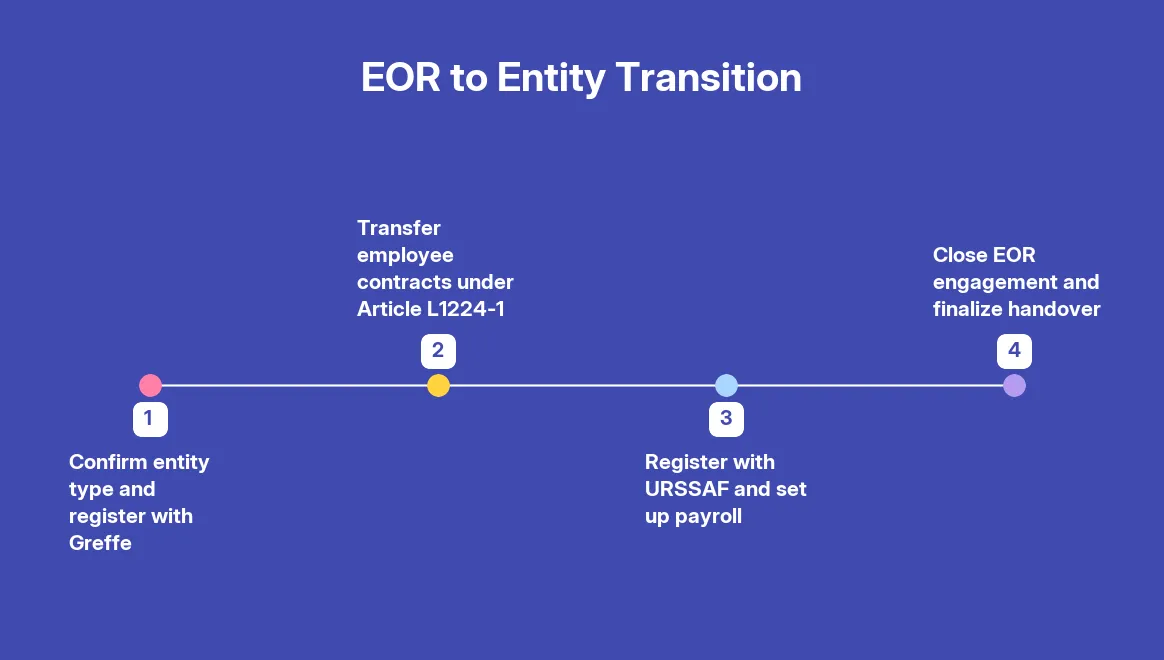
The transition from an employer of record to your own legal entity is not a flip of a switch. It is a structured legal process with distinct phases. Getting it wrong exposes you to dual employment claims and broken contract continuity.
Start by choosing your entity type and registering it with the Greffe du Tribunal de Commerce. You will receive a SIREN/SIRET number. Until that number is active, you cannot employ anyone directly.
Next, address the employee transfer. French law treats this as a change of legal employer. Article L1224-1 of the Code du Travail governs automatic contract transfers when an economic entity changes hands. Your legal counsel must determine whether the transfer falls under this provision or requires individual consent from each employee.
A Stockholm e-commerce company with 7 employees on an EOR in Paris planned its entity setup over 14 weeks. The transfer required separate consultation with each employee. Two employees had collective agreement entitlements that did not align with the new entity's applicable convention collective. Resolving that gap added three weeks.
Once your entity is operational, register with URSSAF for social contributions and establish your own payroll cycle. Only then should you formally terminate the EOR engagement. Overlap periods are common and intentional. Running both structures in parallel for 30 to 60 days prevents gaps in employee coverage.
Watch out: If your EOR operates under one convention collective and your new entity falls under a different one, employees may lose acquired benefits during the transfer. French courts have ruled that transferred employees retain their prior entitlements for at least 15 months after the change of employer.
When Does an EOR Stop Making Sense?
The decision to keep an EOR or build your own entity depends on more than headcount. It depends on permanence, operational complexity, and the cost trajectory as your team grows.
| Decision Factor | EOR Advantage | Own Entity Advantage |
|---|---|---|
| Team size under 10 | Lower fixed overhead, no entity admin | Not cost-effective at this scale |
| Team size above 20 | Per-employee fees compound quickly | Amortized setup cost, lower marginal spend |
| Hiring timeline | Onboarding in days, no registration wait | Weeks or months before first hire |
| Collective agreement control | Limited to EOR's registered IDCC | Full control over applicable convention |
| IP and data governance | Contractual protections only | Direct legal ownership structures |
| Market commitment | Flexible exit, minimal wind-down | Signals long-term presence to clients and talent |
| Complex terminations | Provider capability varies significantly | Full procedural control, direct legal counsel |
A Munich fintech company used an EOR to hire its first 4 compliance analysts in Lyon. After 18 months, the team had grown to 14. The EOR's per-employee fees now exceeded what a dedicated HR manager and local accountant would cost. The company registered a SAS, transferred contracts over a 45-day overlap period, and reduced its ongoing employment administration costs within the first year.
The financial crossover point shifts depending on your industry's collective agreement. Some conventions collectives carry mandatory profit-sharing obligations, supplementary health insurance tiers, and seniority premiums that affect the total cost of employment differently under an EOR versus your own entity.
For companies whose French operations remain exploratory or project-based, an EOR offers the clearest path to compliance without permanent commitment. For companies building a core function in France, entity setup becomes the more defensible long-term choice.
FAQs
Can a foreign company use an EOR in France indefinitely, or does French law require eventual entity setup?
French employment law does not set a time limit on EOR use. The risk sits elsewhere. French tax authorities (DGFIP) may determine that your operations create a permanent establishment (établissement stable) if employees exercise decision-making authority on your behalf. This PE risk exists independently of the EOR structure. It is a tax law threshold, not an employment law one. Companies operating through an EOR beyond 18 to 24 months should commission a PE risk assessment from French tax counsel.
What happens to employees' contracts if we transition from our EOR to our own French entity?
This is not a simple administrative switch. Under Article L1224-1 of the Code du Travail, when an economic entity transfers between legal employers, employee contracts transfer automatically. Employees retain all acquired rights including seniority, accrued leave, and convention collective entitlements. If the transfer does not meet the Article L1224-1 criteria, you must negotiate individual contract novation with each employee. In both scenarios, employee representatives must be informed and consulted. Expect the legal transfer process alone to take four to eight weeks with proper counsel.
Does an EOR cover situations where a French employee needs to be made redundant due to economic reasons?
Economic dismissal (licenciement économique) in France triggers procedures far more complex than individual termination. The employer may be obligated to offer a Contrat de Sécurisation Professionnelle (CSP) to affected employees. Above certain headcount thresholds, a Plan de Sauvegarde de l'Emploi (PSE) becomes mandatory. Not all EOR providers are equipped to manage these procedures. Some contractually exclude economic dismissals from their scope. Confirm this capability explicitly before signing an EOR engagement. Verify whether the provider's fee covers PSE-related advisory costs.
Can an EOR in France employ workers under any collective bargaining agreement, or are there limitations?
EOR providers register under their own sector classification, which assigns a specific IDCC (identifiant de la convention collective). That IDCC may differ from the one that would naturally apply to your industry. The mismatch can affect salary minimums, notice periods, overtime rules, and mandatory bonus structures. For example, an EOR registered under a services-sector convention may not match the Syntec agreement applicable to IT consulting roles. Before engagement, request the EOR's IDCC number and compare its provisions against the convention your employees would receive under direct employment.
Is there a minimum or maximum headcount for which an EOR makes sense in France versus setting up an entity?
No legal minimum exists. The decision is financial and strategic. For teams under 5, an EOR almost always costs less than entity registration, ongoing accountancy, and dedicated local benefits administration. Beyond 15 to 20 employees, the per-person EOR fee often exceeds the amortized cost of running your own entity. But headcount alone is not the full picture. Consider whether your French operations are permanent or project-based. Consider the collective agreement exposure your employees require. A company hiring 8 senior engineers under the Syntec convention faces different obligations than one hiring 8 customer support agents under a general services agreement.
How does an EOR handle French mandatory profit-sharing obligations?
French law requires companies with 50 or more employees to implement a participation scheme distributing a share of profits to employees. The threshold applies to the legal employer. If your EOR employs 50 or more workers across all its clients in France, it may trigger this obligation. Some EOR providers manage participation schemes internally. Others restructure their entities to stay below the threshold. Ask your provider directly whether their French entity currently exceeds or approaches the 50-employee mark, and how they handle the resulting profit-sharing calculation and distribution.
What happens to intellectual property created by employees on an EOR's payroll in France?
Under French law, IP created by an employee does not automatically belong to the employer unless the employment contract contains explicit assignment clauses. This applies equally when the EOR is the legal employer. The EOR's standard contract template may not include IP assignment language tailored to your industry. Software code, designs, patents, and inventions each follow different assignment rules under French IP law. Request a copy of the EOR's standard employment contract before onboarding. Have your own IP counsel review the assignment clauses. If the contract is insufficient, negotiate a rider or supplementary IP agreement signed by the employee.
What to Watch Next
France's labor regulatory environment does not sit still. Ongoing reforms to unemployment insurance, retirement contributions, and CSE consultation thresholds will affect both EOR-managed and directly employed workforces.
Monitor URSSAF's annual updates on employer social contribution rates. These shift with each Finance Law cycle and directly change the cost basis your EOR reports. If your EOR cannot explain how those changes flow through to your monthly invoice, that is a transparency gap worth raising.
For companies currently using an EOR in France, the single most valuable next step is a PE risk review. Engage a French tax advisor to assess whether your current operations, employee roles, and decision-making patterns create permanent establishment exposure. This review typically costs a fraction of the liability it prevents. Companies planning to scale beyond 10 employees in the next 12 months should run this assessment now, while restructuring options remain open.
.svg)