EOR Services in France: What's Actually Included and What to Expect
Our parent guide on EOR vs entity setup in France compared the two hiring models at a structural level. It covered when each option makes sense, the risks involved, and how to transition between them. This article goes deeper on one side of that equation: the actual services an EOR delivers once you sign the contract.
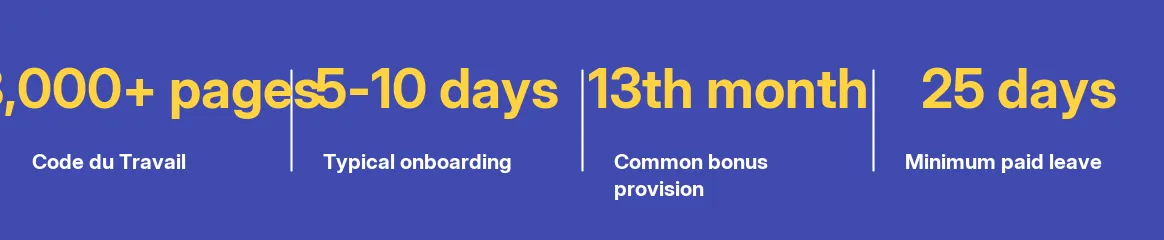
France layers more employment regulation onto employers than most Western European countries. The Code du Travail runs over 3,000 pages. Collective bargaining agreements add sector-specific obligations on top. An EOR absorbs that complexity on your behalf. But what does that mean in practice? This article breaks down each service layer, from contract drafting through offboarding, so you know exactly what you are paying for.
Employment Contracts and Legal Compliance
French labor law requires written employment contracts. The EOR drafts these contracts as the legal employer on record.
CDI vs CDD Contract Structuring
France distinguishes between the contrat à durée indéterminée (CDI) and the contrat à durée déterminée (CDD). The CDI is the open-ended, default employment contract. The CDD is a fixed-term contract with strict renewal limits. French courts treat CDDs with suspicion. Misusing one can trigger automatic reclassification to a CDI.
An EOR determines which contract type fits your hiring scenario. A London fintech hiring a senior data engineer in Paris for an ongoing role would receive a CDI. A Berlin media company bringing on a content producer for a six-month campaign would receive a CDD. The EOR ensures the CDD includes the mandatory end date, renewal terms, and the legally required justification for fixed-term status.
Mandatory Contract Clauses
The Code du Travail prescribes minimum contract content. Every employment contract must specify job title, remuneration, working hours, probation period, and the applicable convention collective (collective bargaining agreement). The convention collective is not optional. It binds every employer in the relevant sector.
An EOR identifies the correct convention collective based on its own registered business activity code (code APE). This matters because the convention collective may mandate higher minimum salaries, longer notice periods, or additional leave days beyond the statutory floor. A US SaaS company hiring its first French employee would not know which of the 700-plus active conventions applies. The EOR handles that classification.
Probation Periods and Renewals
French law caps probation periods based on employee category. For cadres (managers and professionals), the initial probation period is typically four months, renewable once. For non-cadre roles, it is shorter. The applicable convention collective can modify these limits downward but never upward.
The EOR drafts the probation clause and tracks renewal deadlines. Missing a renewal notification deadline means the probation converts to confirmed employment. That mistake removes your ability to end the contract during the trial period without cause.
Payroll Processing and Tax Withholding

French payroll is among the most complex in Europe. A single pay slip can contain 40 to 50 line items.
The Bulletin de Paie
Every French employee receives a monthly bulletin de paie (pay slip). The EOR generates this document in the legally prescribed format. It itemizes gross salary, each social contribution line, income tax withheld, and net pay. French law requires employers to retain pay slips for at least five years. The EOR manages that archive.
Since January 2019, France collects income tax at source through the prélèvement à la source system. The EOR withholds the tax directly from each employee's salary based on the rate communicated by the tax authority. This rate updates automatically. The EOR applies each update without action from you.
Social Contribution Remittance
French employer social charges are among the highest in the EU. They cover health insurance, retirement, unemployment insurance, family allowances, and workplace accident insurance. The EOR calculates and remits these contributions to URSSAF (the social security collection body) on a monthly or quarterly schedule.
For a deeper breakdown of these cost layers, see our guide to EOR costs in France. The total employer cost typically runs 40 to 50 percent above the gross salary, depending on the employee's compensation level and the applicable convention collective.
DSN Reporting
The Déclaration Sociale Nominative (DSN) is France's unified monthly social reporting obligation. Every employer must transmit employee-level data to French authorities by the 5th or 15th of the following month. The DSN replaced multiple legacy declarations. It feeds data to URSSAF, pension funds, and the employment agency simultaneously.
The EOR files the DSN on schedule. A missed or inaccurate DSN submission triggers penalties and can flag the employer for audit. This is operational work that requires French payroll software and familiarity with the reporting schema.
Benefits Administration and Social Security
France mandates a benefits floor that goes well beyond what most countries require.
Statutory Benefits the EOR Must Provide
| Benefit | What the EOR Delivers |
|---|---|
| Paid leave | 25 working days minimum per year, tracked and accrued monthly |
| RTT days | Additional rest days under the 35-hour workweek framework, where applicable |
| Mutuelle | Mandatory complementary health insurance, employer covers at least 50% of premium |
| Prévoyance | Mandatory death and disability coverage for cadre employees |
| Transport | 50% reimbursement of employee's public transit pass |
| Meal vouchers | Common benefit (titres-restaurant), employer funds 50-60% per voucher |
| 13th month | Required by many conventions collectives as an additional month's pay |
The mutuelle (complementary health insurance) deserves particular attention. French law requires every employer to provide group health coverage. The employer must fund at least half the premium. The EOR selects a mutuelle provider, enrolls your employee, and manages claims administration.
Retirement and Pension Contributions
France operates a multi-pillar pension system. The base pension runs through the régime général managed by the CNAV. Complementary pensions flow through AGIRC-ARRCO for all private-sector employees. The EOR registers employees with both systems and remits contributions monthly.
Pension contribution rates are split between employer and employee portions. These rates are set by the relevant authorities and change periodically. The EOR applies the current rates without requiring you to track updates. For companies exploring EOR compliance obligations in France, the pension layer is one of the most audit-sensitive areas.
Day-to-Day HR Support and Offboarding

The EOR relationship extends beyond payroll runs and tax filings. It covers ongoing HR administration.
Leave Management and Working Time
France enforces the 35-hour statutory workweek. Employees working beyond 35 hours accumulate overtime or RTT (réduction du temps de travail) days. The EOR tracks hours, manages leave balances, and ensures overtime pay complies with the applicable convention collective rates.
Sick leave triggers a specific process. The employee provides a medical certificate (arrêt de travail) within 48 hours. The EOR coordinates with the Caisse Primaire d'Assurance Maladie (CPAM) for social security reimbursement and tops up the employee's salary per the convention collective rules. Many conventions require the employer to maintain full or partial salary during illness.
Termination and the Rupture Conventionnelle
Firing an employee in France is procedurally intensive. The EOR manages whichever termination path applies. The most common negotiated exit is the rupture conventionnelle, a mutual termination agreement unique to French law. It requires a formal meeting, a mandatory cooling-off period of 15 calendar days, and approval from the DIRECCTE (now DREETS, the labor inspectorate).
If you later decide to transition from EOR to your own entity in France, the EOR handles the employee transfer process. This includes issuing the certificate of employment, final pay calculation, and portable benefits documentation.
Watch out: Even in a rupture conventionnelle, the employee receives a statutory indemnity calculated on tenure and salary. Skipping the DREETS homologation step makes the entire agreement void, exposing you to wrongful termination claims.
Ongoing Compliance Monitoring
French employment law changes frequently. New decrees, updated convention collective terms, and revised social contribution rates land multiple times per year. The EOR monitors these changes and adjusts contracts, payroll parameters, and benefits accordingly. You receive the output. That is a core part of what your EOR service in France covers.

FAQs
Can I set my own salary levels, or does the convention collective override my offer?
You can offer above the convention collective minimum. You cannot offer below it. The convention collective sets floor salary levels by job classification and seniority. If your offer exceeds the floor, the EOR processes it at your stated amount. If your offer falls below, the EOR flags the gap before the contract goes out. Some conventions also mandate annual salary reviews, which the EOR tracks.
Does the EOR handle French workplace safety obligations?
Yes. French law requires every employer to maintain a Document Unique d'Évaluation des Risques Professionnels (DUERP), a risk assessment document. The EOR prepares and maintains this document. For remote employees, the DUERP covers home office ergonomics and psychosocial risks. The EOR also arranges the mandatory occupational health visit (visite d'information et de prévention) through a registered service de santé au travail.
What happens to employee benefits if I switch EOR providers mid-contract?
The new EOR must maintain equivalent mutuelle and prévoyance coverage without a gap. The portability rules under French law (portabilité des droits) allow departing employees to retain health and disability coverage for up to 12 months after termination. During a provider switch, the outgoing EOR issues a certificate of coverage. The incoming EOR enrolls the employee in its own group plan from day one of the new arrangement.
Can the EOR manage employees across multiple French cities?
Yes. French employment law applies nationally. The EOR does not need separate registrations per city. The transport reimbursement obligation adjusts based on where the employee works, since transit pass costs vary by region. The EOR also handles the Île-de-France-specific versement mobilité contribution if applicable, which funds public transport infrastructure in the Paris region.
What to Watch Next
French labor law reform proposals surface regularly. Recent years have brought changes to retirement age timelines, convention collective mergers, and DSN reporting requirements. If you are hiring your first employee in France through an EOR, lock in the contract structure and benefits package now. Then monitor convention collective updates in your sector quarterly. The EOR handles the operational adjustments, but understanding what changed and why keeps you in control of your French workforce strategy.
If you need a walkthrough of EOR services tailored to your team in France, TeamUp can help. Schedule a consultation.
Written by TeamUp — helping companies hire compliantly across 20+ countries with owned local entities in core markets since 2020.
.svg)