


How to Choose the Best EOR Service for Portugal: Key Criteria and Red Flags

Our guide to EOR providers in Portugal compared the leading services and outlined what each offers at a high level. This article goes deeper on the evaluation itself. Choosing an EOR in Portugal is not a feature-checklist exercise. The Portuguese labor code carries specific obligations around termination, collective bargaining, and mandatory benefits that differ sharply from other Western European markets. A provider that performs well in Germany or Spain may handle Portugal through a local partner with no direct compliance accountability. This guide gives you a structured framework for assessing entity ownership, payroll mechanics, contract flexibility, and pricing transparency before you commit.
Entity Structure and Legal Accountability in Portugal
The single most important question to ask any EOR candidate is whether they hold a direct legal entity in Portugal or route employment through a third-party partner.
Why Entity Ownership Changes the Risk Profile
When an EOR operates through a local partner, your employee's legal employer is a company the EOR does not control. That partner handles tax filings with the Autoridade Tributária, submits social security declarations to Segurança Social, and manages labor disputes. If the partner misfiles or delays, the EOR has limited leverage. Your employee bears the consequences.
A direct entity means the EOR itself appears on the employment contract. It files directly. It answers to Portuguese regulators. This matters most during terminations, which Portuguese courts scrutinize heavily.
Questions That Reveal the Real Structure
Ask specifically: "Is the entity on my employee's contract owned by your company?" Many providers answer with vague language about "local presence." Press further. Request the entity's NIF (tax identification number) and confirm it on the Portuguese commercial registry portal.
A fintech company based in Amsterdam discovered this gap after hiring two engineers through an EOR that claimed Portuguese coverage. The actual employer was a staffing agency in Lisbon with no contractual obligation to the EOR's SLA. When one engineer's contract needed restructuring under Portuguese fixed-term rules, the staffing agency delayed for six weeks. The EOR had no authority to accelerate the process.
Red Flags in Partner-Model Arrangements
Watch for these indicators of a partner-dependent model:
- The EOR cannot name the specific entity that will employ your worker
- Onboarding timelines are quoted as "2 to 4 weeks" without explanation of which steps depend on third parties
- The EOR disclaims liability for payroll errors in its master service agreement
- Benefits administration is described as "coordinated with our local partner" rather than managed directly
Team Up covers Portugal and holds its own compliance accountability in its core markets. That ownership model eliminates the middleman risk that partner-dependent providers carry.
Evaluating Payroll, Benefits, and Compliance Depth
Portugal's payroll system includes employer contributions to the Taxa Social Única (TSU), income tax withholding through progressive brackets, and mandatory benefits that go beyond the EU baseline.
Payroll Mechanics to Verify
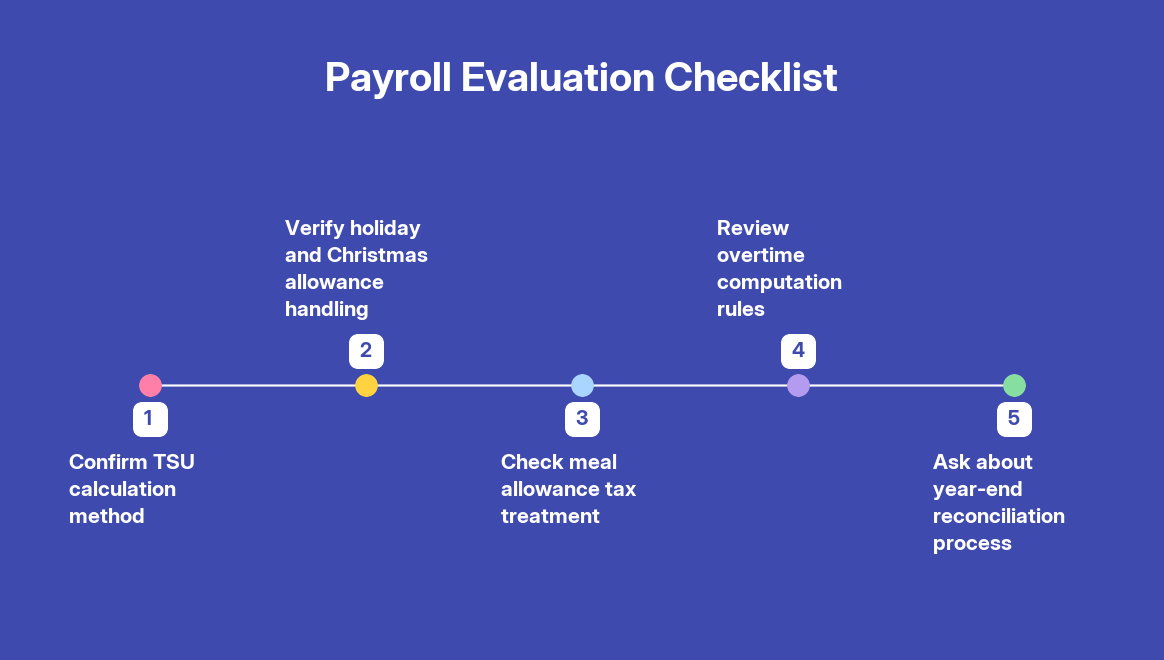
Every Portuguese employee receives a holiday allowance and a Christmas allowance, each equal to one month's base salary. These are not bonuses. They are statutory entitlements under the Código do Trabalho. A competent EOR distributes these in the correct months or prorates them for partial-year employment. Ask how the provider handles prorating for mid-year hires. Get a sample payslip.
Meal allowances in Portugal receive favorable tax treatment up to a threshold set annually by the government. Amounts paid via meal card enjoy a higher exempt limit than cash payments. Confirm whether your EOR offers meal card administration or defaults to taxable cash payments. The difference affects your employee's net income without changing your gross cost.
Benefits Beyond the Statutory Minimum
Portuguese labor law mandates 22 working days of paid annual leave. Many EOR providers stop there. Competitive employers in Lisbon and Porto offer private health insurance, gym subsidies, and flexible work arrangements. Ask whether your EOR can administer supplementary benefits or only manages the legal minimum. For a fuller analysis of when an EOR fits your Portugal hiring strategy, consider the benefit administration scope alongside the compliance layer.
Social Security and Tax Filing Accuracy
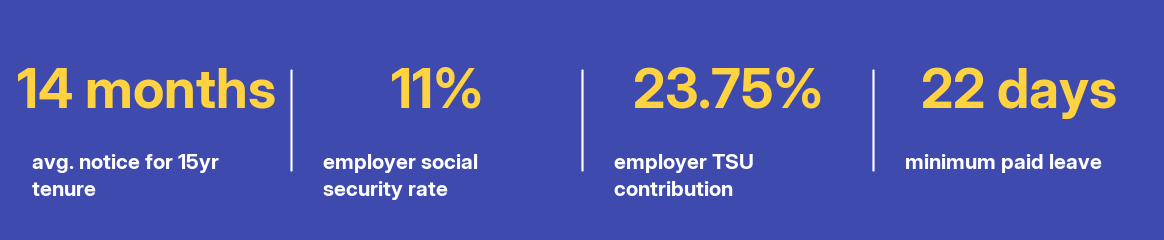
The employer's TSU contribution sits at approximately 23.75% of gross salary. The employee portion is 11%. These rates have been structurally stable, but confirm the current figure with Segurança Social before finalizing cost projections. Your EOR should file monthly declarations through the Segurança Social Directa platform. Ask for confirmation of filing cadence and whether you receive copies of submitted declarations.
Contract Flexibility and Portuguese Labor Law Alignment
Portuguese labor law defaults to open-ended contracts. Fixed-term contracts exist but carry strict renewal limits and justification requirements.
Fixed-Term Contract Constraints
| Contract Feature | Open-Ended | Fixed-Term | Uncertain-Term |
|---|---|---|---|
| Maximum duration | No limit | Up to 2 years (renewals capped) | Tied to event completion |
| Renewal limits | N/A | Up to 3 renewals | No fixed renewal cap |
| Termination complexity | High — cause required | Expires naturally | Expires on event |
| Probation period | Up to 240 days (senior roles) | Proportional to contract length | Proportional |
| Employer preference | Long-term hires | Project-based roles | Replacement or seasonal |
A good EOR advises you on which contract type fits your hiring intent. A weak one defaults to fixed-term contracts because they are easier to exit. That shortcut backfires when Portuguese courts reclassify a repeatedly renewed fixed-term contract as open-ended. The termination protections then apply retroactively.
Termination and Severance Handling
Portugal has some of the strongest employee protections in Europe. Dismissal without just cause is not permitted for open-ended contracts. Severance calculations depend on tenure length, and the formula has changed across legislative periods. Your EOR must apply the correct formula based on when the contract started, not just the current rule.
Ask your EOR to walk you through a hypothetical termination scenario. A provider that cannot explain severance calculations specific to your employee's contract start date is not managing Portuguese compliance at the depth the market requires.
Collective Bargaining Agreement Awareness
Many sectors in Portugal fall under collective bargaining agreements (Convenções Coletivas de Trabalho). These agreements override baseline labor code provisions on pay scales, overtime rates, and leave entitlements. An EOR operating in Portugal must identify whether your employee's role falls under an active CCT. IT roles in Lisbon, for example, may fall under sector-specific agreements that set minimum salary floors above the national minimum.
Pricing Models and Hidden Cost Traps

EOR pricing in Portugal typically follows one of two models: flat monthly fee per employee or percentage of gross salary.
Flat Fee vs. Percentage Model
Flat fees across the market generally range from $400 to $700 per employee per month for Portugal. Percentage-based models charge 10% to 15% of the employee's gross monthly salary. For a senior developer earning €4,500 per month, a 12% model costs €540 monthly. A flat fee at $500 costs less and stays predictable as salaries grow.
Where Hidden Costs Appear
Currency conversion markups are the most common hidden cost. Some providers embed a 1% to 3% spread in the EUR/USD exchange rate. Others charge separately for benefits administration, contract amendments, or offboarding support. Request a full fee schedule before signing. Specifically ask about charges for mid-contract changes, early termination processing, and annual compliance updates.
Employer of record services in Portugal carry employer-side costs beyond the EOR fee itself. TSU contributions, meal allowances, holiday and Christmas allowances, and work accident insurance add roughly 30% to 35% on top of gross salary. Your EOR should provide a total cost-to-company estimate, not just its own fee.
Watch out: Some EOR providers quote monthly fees that exclude Portuguese mandatory insurance (seguro de acidentes de trabalho). This workplace accident insurance is legally required for every employee. If it is missing from your quote, it will appear as an unexpected add-on after contract signing.
If you need a cost breakdown specific to your Portugal hiring plan, Team Up can prepare one based on your team size and role mix. Request an estimate.

FAQs
Can an EOR in Portugal sponsor a work visa for a non-EU employee?
Yes, but only if the EOR holds a direct legal entity in Portugal. The entity must apply through SEF (now AIMA) for the employee's residence permit. Partner-model EORs often lack the legal standing to sponsor directly. Processing times for work permits in Portugal typically run 60 to 90 business days. Budget for this timeline when planning non-EU hires. Ask the EOR for their success rate and average processing duration specifically for Portuguese permits.
What happens if my EOR misclassifies a fixed-term contract in Portugal?
Portuguese labor courts can reclassify an improperly justified fixed-term contract as open-ended. This means full termination protections apply retroactively, including severance obligations calculated from the original start date. The financial exposure grows with tenure. A three-year misclassified contract could generate severance liability equivalent to several months of salary. Your EOR should document the objective justification for every fixed-term contract in writing.
How do I verify that my EOR is filing social security correctly in Portugal?
Request monthly proof of Segurança Social Directa submissions. Every EOR should provide you with the Declaração de Remunerações, which lists declared earnings per employee. Cross-check these against your agreed gross salaries. If your EOR resists sharing these documents, treat it as a serious red flag. Portuguese authorities can audit employer declarations going back five years, and liability falls on the legal employer.
Can I transfer an employee from an EOR to my own entity in Portugal later?
Yes, but the transfer requires ending the EOR contract and issuing a new employment contract from your entity. Portuguese law treats this as a new employment relationship unless structured as a business transfer under TUPE-equivalent rules. Accumulated seniority and benefits may not carry over automatically. Negotiate transfer terms in your EOR master service agreement before the first hire. Some providers charge exit fees or impose notice periods of 60 to 90 days for employee transfers.
What to Prioritize Next
Portugal's labor code will continue evolving. Recent legislative discussions have touched on remote work regulation, platform worker classification, and digital nomad visa refinements. Your EOR evaluation should weight adaptability alongside current compliance. Providers with direct entities and in-country legal teams can respond to regulatory shifts faster than those routing through partners. Start your evaluation by confirming entity ownership, requesting sample payslips with full TSU breakdowns, and asking for a written termination walkthrough. Those three steps filter out most providers that lack the depth Portugal demands.
Written by the Team Up editorial team. Team Up provides employer of record services across 20+ countries, with direct entities in its core markets and in-country teams in Tbilisi, Yerevan, Istanbul, Almaty, and Tashkent.
.svg)


