


When to Use an Employer of Record in Portugal (and When Not To)

Our guide to EOR providers in Portugal compares top providers, costs, onboarding steps, and selection criteria. It also touches briefly on when an EOR is the right model and when it is not. This article goes deeper on that decision.
Choosing the wrong employment model in Portugal creates real costs. Unwinding a premature entity setup burns months and tens of thousands of euros. Staying on an EOR too long when you have 30 employees erodes margins through per-head fees. The question is not whether an EOR works in Portugal. It does. The question is whether it works for your specific headcount, timeline, revenue model, and growth trajectory. This article gives you a framework to decide.
Scenarios Where an EOR Makes Strategic Sense in Portugal
An EOR earns its fee when the alternatives cost more in time, money, or compliance risk. Three scenarios stand out for Portugal.
First Hires and Market Testing
A Chicago-based fintech company wanted two senior product managers in Lisbon to cover European time zones. Setting up a Portuguese entity would have taken months and required upfront legal, accounting, and registration costs. Through an EOR, both employees started within 10 business days. Six months later, the company decided Portugal was not its primary European hub and wound down the engagement without entity liquidation costs.
Portugal's Código do Trabalho (Labour Code) imposes strict rules on employment contracts from day one. Trial periods, mandatory insurance, and social security registration all apply immediately. An EOR absorbs that compliance burden before you have local HR expertise.
Hiring Specialized Talent on a Defined Timeline
Project-based roles fit the EOR model well. Portugal's tech ecosystem produces strong talent in AI, data science, and full-stack development. If you need three engineers for an 18-month product build, an EOR lets you hire them on compliant fixed-term contracts without the overhead of a permanent establishment.
Fixed-term contracts in Portugal are legally capped. The Labour Code limits renewals and total duration. An EOR tracks these limits and converts contracts when required. Missing a renewal deadline can transform a fixed-term contract into a permanent one by operation of law.
Compliance-Heavy Situations
Foreign companies sometimes need to hire a Portuguese national who will work across multiple EU jurisdictions. Social security coordination under EU Regulation 883/2004 determines which country's system applies. An EOR with Portuguese expertise handles the A1 certificate process and ensures contributions go to the right authority. Getting this wrong triggers back-payments and penalties in both countries.
When an EOR Is Not the Right Fit

Not every hiring scenario benefits from an EOR. Some situations actively argue against it.
Large or Growing Teams
EOR fees are per employee, per month. At a small team size, that monthly cost is insignificant compared to entity setup. At 15 or 20 employees, the math shifts. A company paying €400 per employee per month for 20 people spends €96,000 annually on EOR fees alone. Entity setup and ongoing administration in Portugal typically cost less than that once the team is established.
The breakeven point depends on your provider's pricing and your entity costs. But most companies find that somewhere between 10 and 20 employees, owning a local entity becomes cheaper. Choosing the right EOR provider matters here too. A provider with transparent pricing helps you model the crossover point accurately.
When You Need Full Operational Control
An EOR is the legal employer. That means the EOR signs the employment contract, not you. Portugal's Labour Code gives the legal employer specific obligations around working conditions, disciplinary procedures, and termination. You direct the employee's daily work, but certain HR decisions route through the EOR.
If your business model requires direct control over employment terms, benefits design beyond statutory minimums, or complex equity compensation structures tied to local entities, an EOR adds a layer you may not want. This is especially true for companies building Portuguese operations as a core business function rather than a satellite team.
Independent Contractor Relationships
Some roles in Portugal genuinely qualify as independent contractor engagements. Portugal's tax authority distinguishes between dependent and independent work. If the relationship meets independent contractor criteria, using an EOR creates unnecessary cost and legal complexity.
Misclassifying the relationship in either direction carries risk. Treating a true employee as a contractor triggers fines and back-dated social security. Treating a genuine contractor as an employee through an EOR wastes money. A proper classification analysis before choosing any model saves trouble later. TeamUp offers contractor management services for companies navigating this distinction.
The Decision Framework: Entity vs. EOR vs. Contractor
The choice between the three models depends on five concrete variables. This table maps each variable to the model it favors.
| Decision Variable | EOR Favored | Entity Favored | Contractor Favored |
|---|---|---|---|
| Headcount | 1–15 employees | 15+ employees | 1–3 specialists |
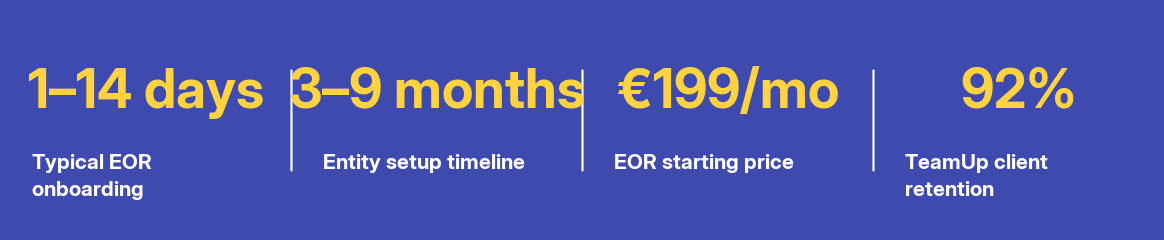
| Time to first hire | Under 14 days | 3–9 months acceptable | Immediate |
| Duration of need | 6–24 months or uncertain | Permanent presence | Project-based, defined scope |
| Operational control | Day-to-day direction sufficient | Full HR and legal control needed | Output-based, no direction |
| Revenue in Portugal | No local revenue | Local revenue or clients | No local revenue |
How Revenue Changes the Calculus
Companies generating revenue in Portugal often need a local entity regardless of headcount. Portuguese tax rules on permanent establishment look at whether your activities in Portugal generate income attributable to the country. An EOR does not create a permanent establishment for the client company in most cases. But if your employees are closing sales, signing contracts, or delivering services to Portuguese customers, the tax authority may assess that you have one anyway.
This is a tax question, not an employment question. An EOR solves employment compliance. It does not shield you from corporate tax obligations if your business activities cross the permanent establishment threshold. Companies in this situation need both tax counsel and an employment solution, and the employment solution may need to be an entity.
The Hybrid Approach
Some companies use both models simultaneously. A US SaaS company with 25 employees in Lisbon might own a Portuguese entity for its core engineering team while using an employer of record in Portugal for two sales hires it is still evaluating. The EOR handles the compliance-heavy, uncertain roles. The entity handles the permanent team.
This approach works when the roles have different risk profiles or timelines. It stops working when the administrative overhead of managing two parallel employment structures exceeds the flexibility benefit.
Transitioning Away from an EOR Without Breaking Compliance
Why Employee Consent Matters
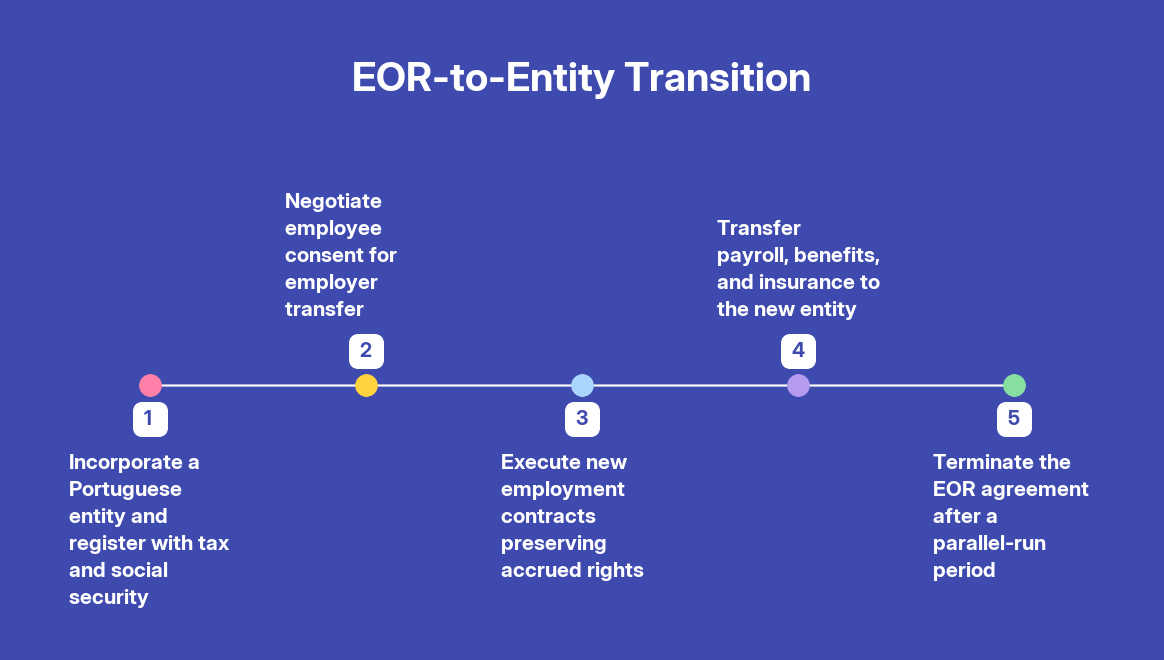
Portuguese labor law protects employees during employer transfers. The Labour Code provisions on business transfers require that employees retain their accrued rights. Seniority, leave balances, and contractual terms carry over. An employee can refuse the transfer under certain conditions.
Your EOR provider should support this transition with documentation. The outgoing EOR provides payroll records, contribution histories, and contract details. The incoming entity needs these to onboard employees without gaps in coverage.
Timing the Transition
Start the entity setup process at least four months before your target transition date. Portuguese entity incorporation itself takes weeks, but tax registration, social security registration, and bank account setup add time. Running the EOR and the entity in parallel for 30 to 60 days ensures no employee experiences a gap in pay or benefits.
Watch out: Terminating an EOR agreement before the new entity is fully registered with Segurança Social (Portuguese social security) creates a gap in employee coverage. Social security contributions must be uninterrupted, and retroactive registration carries penalties.

FAQs
Can I use an EOR in Portugal if my company already has a European entity in another country?
Yes. Having an entity in Germany or the Netherlands does not automatically let you employ someone in Portugal. Each EU country has its own employment law, social security system, and tax registration requirements. You would need to register as an employer in Portugal separately, or use an EOR. The exception is short-term postings under the EU Posted Workers Directive, which have their own notification and compensation rules.
Does an EOR handle Portuguese employee termination, including severance?
The EOR manages the termination process under Portuguese law. Portugal has strict dismissal rules. The Labour Code limits valid grounds for employer-initiated termination. Severance calculations depend on the employee's start date, contract type, and years of service. The EOR calculates and pays severance, handles the mandatory written notice, and files required documentation with authorities. Wrongful dismissal claims are common in Portugal and costly.
What happens to intellectual property created by employees hired through an EOR?
Standard EOR agreements assign IP from the employee to the client company, not to the EOR. Confirm this clause in your EOR service agreement before onboarding. Under Portuguese law, copyright in works created during employment generally belongs to the employer unless the contract states otherwise. Software has specific provisions under the Portuguese Software Protection Act. Your EOR contract and the employee's individual contract should both address IP assignment explicitly.
Can I convert a Portuguese contractor to an EOR employee mid-project?
You can, and sometimes you should. If a contractor relationship starts resembling employment, Portuguese authorities may reclassify it. Signs include fixed working hours, exclusive dedication, and use of your tools and premises. Converting proactively through an EOR avoids retroactive social security assessments. The EOR onboards the individual as a new employee. Prior contractor service does not count toward employment seniority unless both parties agree otherwise.
What to Decide Next
The EOR decision in Portugal is not permanent. It is a staging tool. Use it to enter the market, test team fit, and validate your hiring thesis. Then evaluate quarterly whether the model still matches your headcount and operational needs. Portugal's labor and tax frameworks shift periodically. Track changes to fixed-term contract limits, social security contribution rates, and permanent establishment guidance from the Portuguese tax authority. If your team crosses the 10-to-15 person threshold, start scoping entity setup early rather than reacting after the crossover point.
If you are weighing an EOR against entity setup in Portugal, TeamUp can model both scenarios for your team size. Request a comparison.
Written by TeamUp — EOR, payroll, and compliance in 20+ countries with owned entities where it matters.
.svg)


