


How to Onboard a Portuguese Employee Through an EOR: Complete 2026 Guide

Our parent guide covers the legal compliance checklist for EOR services in Portugal, including entity structure, labour law obligations, and risk mitigation. That article outlines what an EOR must do. This article explains exactly how the onboarding process works, step by step.
Onboarding through an EOR in Portugal involves more than signing a contract and running payroll. Portuguese labour law imposes specific registration deadlines, mandatory insurance coverages, and trial period rules that vary by role seniority. Missing any one of these creates exposure before the employee's first week ends.
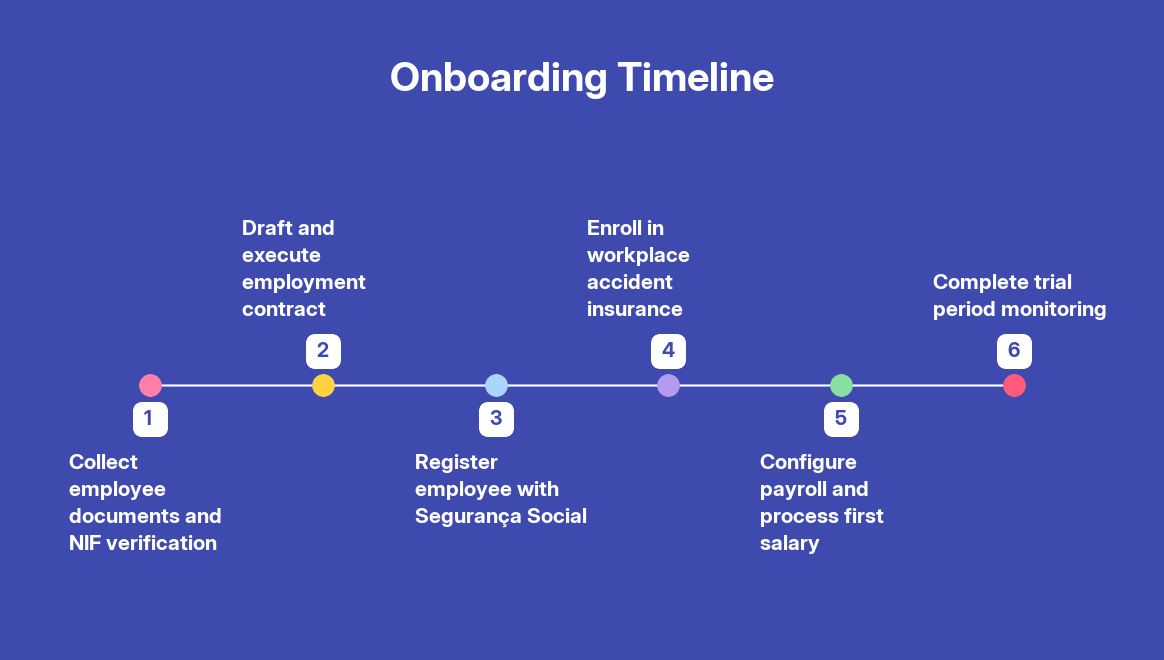
This guide walks through each phase. It covers document collection, Segurança Social registration, contract drafting under the Código do Trabalho, and the first payroll cycle. Every step maps to a concrete deadline or regulatory requirement.
Pre-Onboarding: What You Need Before Day One
Employee Documentation
The EOR needs specific documents from the employee before drafting the employment contract. Portuguese law ties several registration steps to fiscal identification and residency status.
Core documents include:
- Número de Identificação Fiscal (NIF): the Portuguese tax identification number, required for all payroll and tax filings
- Número de Identificação da Segurança Social (NISS): the social security number, needed for Segurança Social registration
- Citizen card or residence permit for identity verification
- IBAN for a Portuguese or SEPA-zone bank account
- Academic and professional certificates relevant to the role
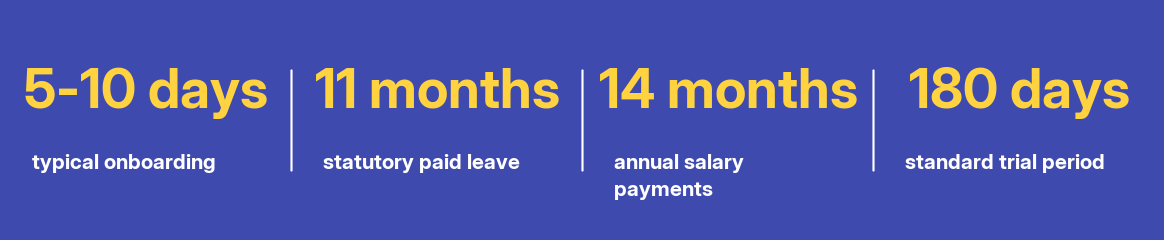
Non-Portuguese nationals who lack a NIF must obtain one through the Autoridade Tributária e Aduaneira. This takes 5 to 15 business days depending on whether a fiscal representative is required. EU/EEA nationals can apply directly. Third-country nationals typically need a fiscal representative until they establish Portuguese residency.
Client-Side Inputs
The client company provides the role specification, compensation structure, and reporting line. These details feed directly into the employment contract. Portuguese contracts must state the workplace location, job category, base salary, and working schedule. Ambiguity in any of these creates legal risk.
A London-based fintech hiring its first product manager in Lisbon through an EOR provided role details on a Monday. The EOR drafted the compliant contract within three business days because the NIF and NISS were already in hand. Without those identifiers, the same process would have taken two additional weeks.
Choosing the Right Contract Type
Portuguese labour law defaults to permanent (open-ended) contracts. Fixed-term contracts are permitted only under specific justifications outlined in the Código do Trabalho. The EOR must classify the engagement correctly. Using a fixed-term contract without valid legal grounds exposes both the EOR and the client to automatic conversion into a permanent contract.
For companies exploring EOR providers in Portugal, contract classification expertise is a critical differentiator. Providers without deep Portuguese labour law knowledge often default to templates that fail local scrutiny.
The Onboarding Sequence: From Contract to First Payroll
Contract Execution
The EOR drafts the employment contract in Portuguese. While bilingual contracts are common practice, the Portuguese-language version holds legal weight in any labour dispute. The contract must specify the trial period duration, which varies by employee category.
| Contract Element | Permanent Contract | Fixed-Term Contract |
|---|---|---|
| Default trial period | 90 days (general), 180 days (complex roles), 240 days (senior management) | 15 days (contracts under 6 months), 30 days (contracts 6+ months) |
| Written requirement | Written form recommended, oral valid | Must be in writing with justification |
| Renewal limits | Not applicable | Maximum 3 renewals, subject to duration cap |
| Termination notice (trial) | No notice under 60 days; 7 days if 60-120 days served | Proportional to contract length |
The trial period distinction matters. A US SaaS company hired a country manager in Porto, assuming the standard 90-day trial applied. The role qualified for the 240-day senior management trial instead. The EOR flagged this during contract drafting, preserving the client's flexibility to assess the hire over a longer period.
Segurança Social Registration
The EOR registers the employee with the Portuguese social security system before the employment start date. Late registration triggers penalties. The employer contribution rate for Segurança Social has historically been 23.75% of gross salary, with the employee contributing 11%. Confirm current rates on the Segurança Social portal before processing.
Registration requires submitting the employee's NISS and employment contract details through the Segurança Social Direta online platform. The EOR handles this as the legal employer of record.
Workplace Accident Insurance
Portuguese law mandates workplace accident insurance for every employee. This is not optional. The EOR must secure a policy with an authorized insurer before the employee's first day of work. Coverage must include accidents during the commute, a requirement specific to Portuguese regulation.
The insurance premium varies by industry risk classification and salary level. The EOR typically maintains umbrella policies that cover onboarded employees immediately. This eliminates the gap risk that occurs when companies arrange policies individually.
Managing Mandatory Benefits and Statutory Obligations
Salary Structure and the 14-Month Pay Cycle
Portugal requires employers to pay employees across 14 monthly installments. Beyond the 12 regular monthly salaries, employees receive a subsídio de férias (holiday allowance) and a subsídio de Natal (Christmas allowance). Each equals one month's base salary.
The holiday allowance must be paid before the employee's annual leave begins. The Christmas allowance must be paid by December. These are statutory obligations under the Código do Trabalho, not discretionary bonuses. The EOR distributes the cost across the year in payroll calculations but must pay the full amounts at the mandated times.
Annual Leave Entitlement
Portuguese employees receive a minimum of 22 business days of paid annual leave per year. New employees in their first calendar year accrue leave at two days per month of service, up to a maximum of 20 days. Full entitlement begins in the following calendar year.
The EOR tracks accruals and ensures leave balances comply with statutory minimums. Unused leave cannot be forfeited unilaterally. Portuguese law restricts carry-over rules, and forced forfeiture exposes the employer to compensation claims.
Withholding and Tax Obligations
The EOR withholds Imposto sobre o Rendimento das Pessoas Singulares (IRS) from monthly salary payments. IRS applies progressive rates. The EOR calculates withholding based on the employee's marital status, dependents, and income bracket using retention tables published annually by the Autoridade Tributária.
Understanding how an EOR operates in Portugal means recognizing that the EOR bears full liability for correct withholding. Errors in IRS calculation create direct tax authority exposure. The EOR also files monthly contribution declarations with Segurança Social, typically due by the 10th of the following month. Payroll deadlines are tight, and the penalties for late submissions accumulate quickly.
For a deeper look at what can go wrong, the guide on EOR risks in Portugal covers misclassification, co-employment exposure, and penalty structures in detail.
Common Onboarding Mistakes and How to Avoid Them

Treating Portugal Like Other EU Markets
Portuguese labour law has distinct characteristics that EU-wide templates miss. The 14-month salary structure catches many first-time employers off guard. So does the mandatory workplace accident insurance requirement, which is employer-funded and must be active before work begins.
A Berlin e-commerce company assumed its standard EU contract template would work for a hire in Lisbon. The template omitted the holiday and Christmas allowances entirely. The EOR rewrote the contract before execution, avoiding what would have become a compensation dispute within six months.
Ignoring Trial Period Nuances
Companies often assume a single trial period duration applies to all roles. It does not. Portuguese law distinguishes between general employees, workers in positions of technical complexity, and senior management. Each category carries a different trial period ceiling. Applying the wrong duration limits your ability to exit the relationship cleanly.
Delaying Segurança Social Registration
Registration must happen before the start date. Not during the first week. Not within 30 days. Before. The EOR submits the registration through the online portal, and the confirmation must be on file when the employee begins work. Late registration is a compliance violation that triggers penalties from the social security authority.
Watch out: Portuguese workplace accident insurance must cover the employee from day one, including their commute. If the policy activates even one day late and an incident occurs, the employer bears unlimited liability for medical costs and compensation.

FAQs
Can a non-Portuguese national be onboarded through an EOR without a residence permit?
EU/EEA nationals can work in Portugal without a residence permit. They need only a NIF and NISS registration. Third-country nationals require a valid residence permit with work authorization before the EOR can legally employ them. The EOR can sponsor certain visa types through its local entity, but the permit must be issued before the employment start date. Processing times vary by nationality and visa category.
What happens if the employee resigns during the trial period?
During the trial period, either party can terminate without cause or compensation. The employee must give no notice if fewer than 60 days have passed. Between 60 and 120 days, 7 days' notice applies. After 120 days, 15 days' notice applies. The EOR processes the final salary, including any accrued leave, within the statutory settlement deadline. No severance is owed during the trial period.
How does the EOR handle mid-year onboarding for the 14-month salary?
The holiday and Christmas allowances are prorated based on months of service in the calendar year. An employee starting in September receives roughly four-twelfths of each allowance for that calendar year. The EOR calculates the proration automatically and pays the holiday allowance before the first leave period. The Christmas allowance is paid by December regardless of start date.
Are there sector-specific collective agreements that affect onboarding terms?
Yes. Portugal has extensive Convenções Coletivas de Trabalho (CCTs) covering sectors like hospitality, construction, retail, and technology services. These agreements can override statutory minimums on salary scales, working hours, and leave entitlements. The EOR must identify the applicable CCT before drafting the contract. Failing to apply the correct collective agreement terms creates underpayment liability, even if the statutory minimum is technically met.
What Comes Next
Portuguese employment law continues evolving. Remote work regulations introduced specific employer obligations around expense reimbursement. Labour inspection activity has intensified in recent years, particularly around contract classification and social security compliance. Companies onboarding their first Portuguese employees through an EOR should request a pre-onboarding compliance briefing that covers the applicable collective agreement, current IRS retention tables, and Segurança Social registration confirmation. That briefing turns a checklist into a functioning employment relationship.
If you are preparing to onboard your first employee in Portugal and want a walkthrough of timelines, costs, and compliance steps specific to your team, request a Portugal onboarding consultation from TeamUp.
Written by TeamUp — EOR and hiring compliance in Portugal since 2020
.svg)


