


EOR Risks in Portugal: How to Identify and Mitigate Them in 2026

Our guide to EOR compliance in Portugal covered the full checklist of legal obligations, from social security registration to payroll tax withholding. This article goes deeper on the risks that surface when something in that checklist breaks down.
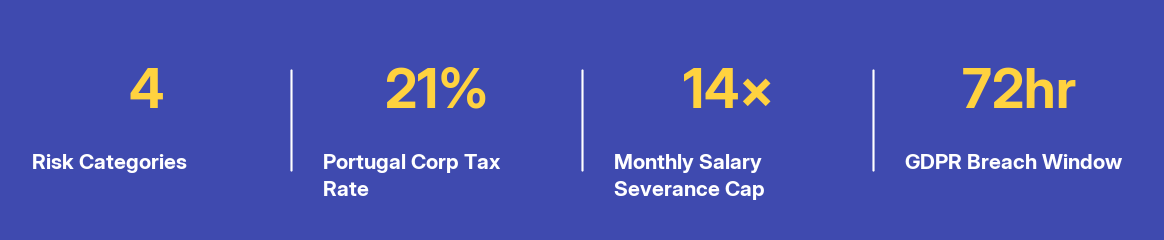
Every EOR arrangement in Portugal carries exposure across tax, employment classification, data protection, and contractual accountability. Some risks are structural. They exist no matter how good the provider is. Others emerge from gaps between what the client assumes and what the EOR actually controls.
This article maps the four highest-impact risk categories, explains the mechanisms that trigger liability, and gives you concrete steps to reduce exposure in each.
Permanent Establishment and Tax Exposure
How PE Risk Arises Through an EOR
Portugal's tax framework follows OECD permanent establishment principles. A foreign company creates a PE when it maintains a fixed place of business or when a dependent agent habitually concludes contracts on its behalf. An EOR arrangement does not automatically shield you from PE risk.
The EOR is the legal employer. But if your Portuguese employee negotiates deals, signs contracts, or commits you to obligations with local customers, Portuguese tax authorities can argue that a dependent agent exists. The employee's functional role matters more than the contractual label.
A fintech company headquartered in London hired a country manager in Lisbon through an EOR in 2024. The manager signed partnership agreements with Portuguese banks. Within eight months, tax authorities opened an inquiry into whether the company had created a PE through that activity.
Concrete Mitigation Steps
Restrict the employee's authority to bind your company contractually. Draft role descriptions that exclude negotiation mandates and signing authority over customer agreements.
Review your EOR service agreement for PE indemnification clauses. Most EOR contracts disclaim PE liability. That means if Portuguese tax authorities assess corporate income tax at Portugal's 21% rate on attributed profits, your company bears the cost.
Request a tax opinion from a Portuguese fiscal advisor before placing senior commercial roles. The cost of a preventive opinion runs far below the cost of a PE assessment. Keep documentation of the employee's reporting lines and decision-making limits current.
One structural safeguard works well: ensure all customer contracts flow through your home-country entity. The Portuguese employee can support the relationship. They should not finalize it.
Worker Misclassification and Employment Status Risks
The Classification Trap in Portugal
Portugal's Código do Trabalho defines employment relationships through substance, not form. If a worker performs tasks under your direction, uses your tools, follows your schedule, and works exclusively for you, Portuguese courts treat that relationship as employment. The label on the contract is secondary.
This matters for EOR clients in two directions. First, converting a former contractor to an EOR employee can trigger back-dated social security claims if authorities determine the contractor relationship was already employment. Second, engaging someone through an EOR but treating them operationally as a contractor creates confusion about who owes what.
Where Liability Lands
Portuguese labor courts apply a presumption of employment when three or more dependency indicators exist. These indicators include fixed working hours, use of company equipment, economic dependence on a single client, and integration into the company's organizational structure.
When onboarding a Portuguese employee through an EOR, the transition from contractor status needs clean documentation. The EOR must register the employment start date with Segurança Social. Any gap or overlap between contractor payments and employment salary creates an audit trail that inspectors follow.
| Risk Factor | Contractor Model | EOR Employment Model |
|---|---|---|
| Social security obligation | Worker self-remits | EOR withholds and remits |
| Termination protection | Limited | Full Código do Trabalho rights |
| Holiday and leave entitlements | None statutory | Minimum 22 working days |
| Misclassification penalty exposure | Client bears full risk | Shifts to EOR, but client retains co-liability for direction |
| Tax withholding | Worker files independently | EOR processes IRS withholding |
The critical point: using an EOR does not eliminate misclassification risk if the underlying relationship was already problematic. Audit your contractor relationships before converting them.
Contractual and Operational Gaps Between Client and EOR
What the Service Agreement Often Misses
Most EOR service agreements cover payroll processing, social security registration, and employment contract drafting. What they leave out creates the real exposure.
Severance calculations under Portuguese law follow a formula tied to length of service. The current statutory framework provides compensation based on a number of days' base salary per year of tenure. Who bears the cost when a termination triggers severance? Many EOR contracts are silent on this, or they pass the obligation through to the client without capping it.
Portuguese fixed-term contracts require written justification for the temporary need. If the EOR issues a fixed-term contract without proper justification and a court converts it to permanent employment, the client faces ongoing obligations neither party budgeted for.
Building a Stronger Agreement
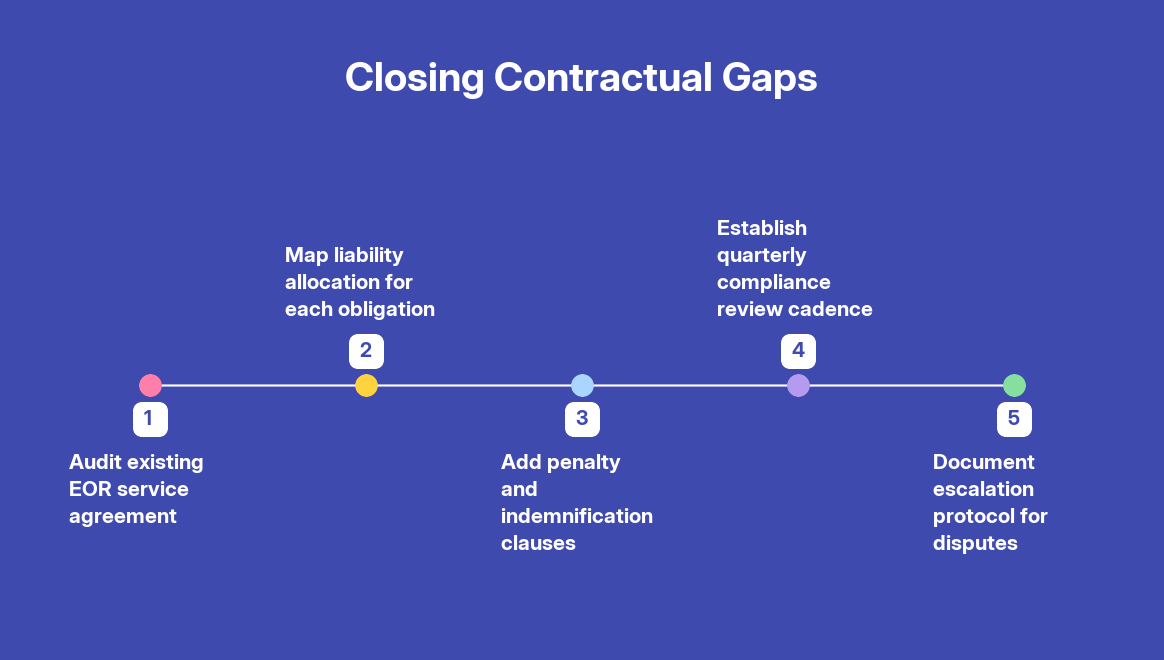
Negotiate three specific clauses into your EOR service agreement. First, a severance cost-sharing mechanism that caps your exposure and clarifies who funds the payment. Second, an audit right allowing you to verify that Segurança Social contributions and IRS withholding reach the correct authorities on time. Third, a transition clause governing what happens if you move from the EOR to your own entity or a different EOR provider in Portugal.
A German e-commerce company discovered during an EOR transition that its provider had been filing social security contributions under an incorrect activity code for eleven months. The error created a EUR 4,200 back-payment obligation. An audit right exercised quarterly would have caught the discrepancy within 90 days.
Watch out: Portuguese employment contracts must reference the applicable collective bargaining agreement (CCT) when one applies to the sector. If your EOR omits the CCT reference and a labor inspector reviews the file, the contract can be deemed non-compliant, triggering mandatory regularization and potential fines.
Data Protection and GDPR Compliance Failures

The EOR as Data Processor
Under the GDPR, the EOR processes employee personal data on your behalf. That makes the EOR a data processor and your company the data controller. This distinction carries real consequences when something goes wrong.
Portugal's data protection authority, the CNPD, enforces the GDPR with sector-specific guidelines. The CNPD has issued guidance on employee monitoring, biometric data collection, and cross-border data transfers that apply directly to EOR arrangements. If your EOR transfers payroll data to servers outside the EU without adequate safeguards, you share enforcement exposure.
Companies hiring through an EOR in Portugal must verify the data processing agreement covers every category of employee data the EOR handles. This includes salary data, tax identification numbers, health information for social security, and bank account details.
Practical Data Safeguards
Require your EOR to confirm where employee data is stored and processed. Ask for the specific data center locations. If any processing occurs outside the EEA, confirm that Standard Contractual Clauses or an adequacy decision covers the transfer.
Review the EOR's breach notification process. The GDPR requires notification to the supervisory authority within 72 hours of becoming aware of a personal data breach. Your service agreement should require the EOR to notify you within 24 hours so you have time to assess and report.
Limit data access to what the EOR genuinely needs. Sharing performance reviews, internal communications, or strategic documents with the EOR creates unnecessary data exposure. The EOR needs employment data. It does not need operational intelligence.

FAQs
Can Portuguese tax authorities pierce the EOR structure to assess my company directly?
Yes. If your employee in Portugal exercises decision-making authority that binds your company, tax authorities can attribute a permanent establishment regardless of the EOR arrangement. The OECD Model Tax Convention's dependent agent rules apply. Portugal's double tax treaties may offer relief, but only if the treaty with your home jurisdiction contains a specific PE carve-out for EOR-like arrangements. Most do not address EOR structures explicitly.
What happens if my EOR provider in Portugal becomes insolvent?
Employee claims for unpaid wages and social security contributions enjoy statutory priority under Portuguese insolvency law. The Fundo de Garantia Salarial covers unpaid wages up to a cap. Your exposure depends on your service agreement. Without a transition clause, you may need to onboard employees under a new EOR or your own entity within days to avoid abandonment claims. Negotiate an escrow mechanism for at least one month's payroll.
Does switching from a contractor arrangement to EOR employment reset the worker's tenure?
Not automatically. If Portuguese authorities determine the contractor relationship was a disguised employment arrangement, the worker's tenure may be back-dated to the original engagement start. This affects severance calculations, holiday accruals, and seniority-based rights. Document the genuine change in working conditions at the point of conversion, and ensure the EOR's employment contract reflects the new start date with a clear written acknowledgment from the worker.
Are there sector-specific risks that increase EOR exposure in Portugal?
Construction, temporary staffing, and hospitality face heightened scrutiny from the Autoridade para as Condições do Trabalho. These sectors have higher inspection rates and stricter documentation requirements. If your EOR places workers in these industries, verify that the applicable collective bargaining agreement is referenced correctly and that sector-specific health and safety obligations are addressed in the employment contract. Missing these elements draws enforcement attention faster.
What to Monitor Going Forward
Portugal's labor inspection authority has increased enforcement activity across remote and cross-border employment arrangements. The government's digital reporting requirements for employers continue to expand. Stay current with CNPD enforcement actions, as GDPR penalties in Portugal have risen in both frequency and size.
Review your EOR service agreement annually against regulatory changes. Confirm that your provider updates employment contracts when collective bargaining agreements are renegotiated. And if you plan to scale beyond three or four employees in Portugal, model the cost comparison between continued EOR use and establishing your own entity.
If you need a compliance risk assessment for your EOR arrangement in Portugal, Team Up can walk through it with you. Request a consultation.
Written by Team Up — a people-first EOR partner with owned entities across Europe, the Caucasus, Central Asia, Turkey, and India, supporting 200+ businesses since 2020.
.svg)


