How an Employer of Record Handles Work Permits and Visas in France
Our parent guide to work permits and immigration via EOR in France covered the broad framework: what an EOR does, how it compares to a PEO or entity, and the general onboarding sequence for non-EU hires. This child article goes deeper into the mechanics.
You will learn exactly how France's immigration system recognizes an EOR as a sponsoring employer. You will see each procedural step, the specific documents the EOR prepares, and the failure points that delay permits by weeks. The article also compares EOR-sponsored applications against direct entity sponsorship on timeline, cost, and compliance exposure. If you are hiring your first non-EU employee in France through an employer of record, this is the operational detail that matters.

The EOR's Legal Standing in France's Immigration Framework

Why French Law Requires a Local Employer
France's Code du travail ties every work authorization to a specific employer registered with URSSAF and holding a SIRET number. The Direction Régionale de l'Économie, de l'Emploi, du Travail et des Solidarités (DREETS) evaluates applications based on the sponsoring employer's compliance history. An overseas company without a French entity cannot file an authorization request. This is the structural gap an EOR fills.
The EOR acts as the legal employer on the authorization application. It signs the employment contract under French labor law. It commits to paying the employee on French payroll, withholding social contributions, and meeting collective agreement obligations. DREETS treats this EOR entity the same way it treats any other French employer.
The Opposability of the Employment Situation (OTE)
For most non-EU nationals, France applies a labor market test. DREETS checks whether the position could be filled by a candidate already authorized to work in France. The EOR submits the job posting to France Travail (the national employment agency) and waits for the prescribed period before proceeding.
Certain occupations appear on regional or national shortage lists. These bypass the labor market test entirely. The EOR identifies whether the role qualifies under the relevant préfecture's shortage list before filing. A senior DevOps engineer in Île-de-France, for example, may qualify under the IT shortage category. That single determination can cut weeks from the timeline.
OFII and the Employer Tax
Once DREETS approves the authorization, the Office Français de l'Immigration et de l'Intégration (OFII) collects an employer tax. The EOR pays this tax directly. The amount varies based on the employee's salary level and the contract duration. OFII then validates the visa and issues the medical convocation for the arriving employee. The EOR tracks each milestone because a missed OFII step blocks the residence permit.
Step-by-Step: From Job Offer to Work Authorization
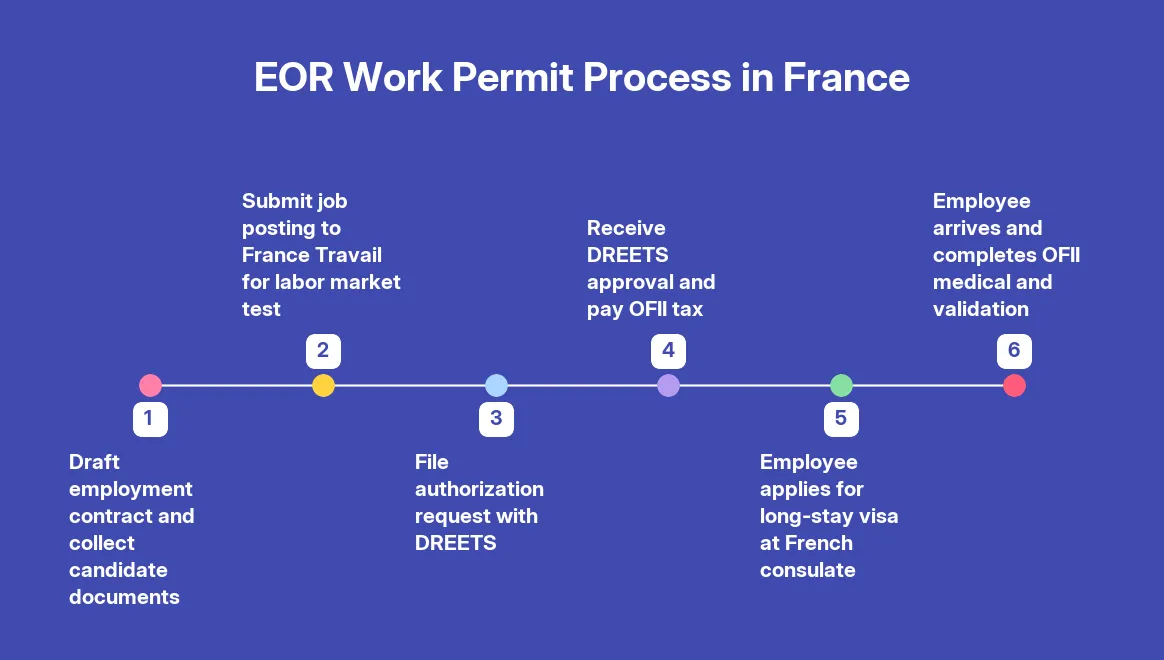
Pre-Filing: Building the Dossier
The EOR begins before any government filing. It drafts a contrat de travail compliant with the applicable convention collective. It collects the candidate's passport, diplomas (translated by a sworn translator), and professional references. It prepares the Cerfa form specific to the permit category.
A critical pre-filing task is diploma equivalency. France requires that foreign qualifications be assessed for certain regulated professions. The EOR coordinates with ENIC-NARIC France when needed. Missing this step triggers a rejection from DREETS.
Filing with DREETS and Managing the Review
The EOR submits the complete dossier to the DREETS unit in the département where the employee will work. Review timelines vary by region. Paris (DREETS Île-de-France) typically processes faster than smaller préfectures due to higher staffing levels.
DREETS may request supplementary documents. The EOR monitors the dossier and responds within the administrative deadline. A delayed response restarts the review clock. When evaluating an EOR partner for France, ask how they handle DREETS follow-ups and what their average response time is.
Post-Approval: Visa and Arrival
After DREETS issues the authorization, the employee applies for a visa de long séjour valant titre de séjour (VLS-TS) at the French consulate in their home country. Consular processing takes two to four weeks in most cases. The EOR provides the employee with the approved authorization and the employment contract for the consular interview.
Upon arrival in France, the employee must validate the VLS-TS online within three months. The EOR guides the employee through the OFII medical examination and the online validation on the ANEF portal. Only after validation can the employee begin working legally. The EOR does not activate payroll until this step clears.
Where the Process Breaks Down and How to Prevent It
Incomplete Dossiers and Translation Errors
The most common delay is an incomplete initial filing. DREETS returns dossiers missing a single required document. Sworn translations that do not meet French standards trigger the same result. The EOR maintains a checklist tailored to each permit category and each regional DREETS office.
A fintech company based in Berlin hired a Brazilian product manager for its Paris operations through an EOR in 2024. The initial filing was rejected because the diploma translation lacked the sworn translator's stamp required by the Île-de-France DREETS. The correction added three weeks to the timeline. Pre-filing document review by the EOR prevents this.
Labor Market Test Timing
The France Travail job posting must run for a minimum period before DREETS accepts the filing. If the EOR submits the authorization request before this period ends, DREETS rejects it outright. The EOR tracks posting dates and aligns the filing window accordingly.
Watch out: Regional shortage lists change periodically. A role that bypassed the labor market test last year may require a full posting this year. The EOR must verify the current list with the relevant DREETS before every filing, not rely on prior approvals.
Gaps Between Permit Expiry and Renewal
Renewal applications must be filed before the current permit expires. France's préfectures issue a récépissé (receipt) that extends the right to work while the renewal is processed. If the employee misses the renewal window, they lose work authorization. The EOR calendars every permit expiry date and initiates renewal filings at least 90 days in advance. This prevents the compliance gap that French labor authorities actively enforce.
EOR Sponsorship vs. Direct Entity Sponsorship: A Practical Comparison
Choosing between an EOR and establishing your own entity in France affects the immigration process at every stage. The table below isolates the operational differences.
| Factor | EOR Sponsorship | Direct Entity Sponsorship |
|---|---|---|
| Filing entity | EOR's French entity (existing SIRET) | Your newly registered entity |
| Setup time before first filing | None (entity already registered) | 3 to 6 months for entity incorporation |
| DREETS compliance history | EOR's established track record | New entity with no filing history |
| OFII tax payment | EOR handles directly | Your entity pays directly |
| Ongoing permit renewals | EOR calendars and files | Your HR or external counsel files |
| Payroll integration | EOR runs payroll from day one | You build payroll infrastructure first |
| Risk if entity closes | EOR transfers or terminates compliantly | Employee loses sponsoring employer |
A Dutch SaaS company hiring three engineers in Lyon compared both paths. Setting up a French SAS would have taken four months before the first permit filing could begin. Through an EOR, the first DREETS submission happened within two weeks of signing the service agreement. Total time from decision to employee start date was under four months.
The tradeoff is control. With your own entity, you manage the relationship with DREETS directly. Through an EOR, you rely on the provider's process. For companies hiring fewer than ten employees in France, the EOR path eliminates months of setup without sacrificing compliance quality. For companies scaling to larger French teams, the entity path may justify its upfront cost over time.

FAQs
Can an EOR sponsor an Intra-Company Transfer (ICT) permit in France?
No. The ICT permit under the EU ICT Directive requires a pre-existing employment relationship between the employee and a group entity outside France. An EOR is not part of the client's corporate group. It sponsors standard work permits, Passeport Talent categories, and salaried worker authorizations. If you need an ICT transfer, you need either a French subsidiary or a branch office registered as part of your corporate structure.
What happens if DREETS rejects the work authorization application?
The EOR reviews the rejection grounds and determines whether a corrected resubmission is viable. Common grounds include insufficient proof that the labor market test was conducted properly or missing documents. The EOR can file a recours gracieux (administrative appeal) with DREETS within two months of the rejection. If the appeal fails, a recours contentieux before the administrative tribunal is the next step, though this is rare in practice.
Does the employee's family receive work authorization through the EOR's sponsorship?
Accompanying family members apply for their own VLS-TS through the family reunification procedure. The EOR's sponsorship covers the principal employee only. Spouses of Passeport Talent holders receive a visa mention "vie privée et familiale," which includes work authorization without a separate employer sponsor. The EOR typically advises on family visa categories but does not file on behalf of dependents.
How does the EOR handle permit renewals when the employee changes roles?
A role change within the same EOR employment does not automatically require a new work authorization. If the new role falls within the same occupational category and salary bracket, the existing permit remains valid. If the role changes substantially, such as moving from engineering to sales management, the EOR files a new authorization request with DREETS before the change takes effect. The employee continues working under the existing permit until DREETS rules on the new application.
What to Watch Next
France's immigration system is under active legislative discussion. Proposed reforms to the Passeport Talent categories and shortage list criteria could change filing strategies within the next legislative cycle. Monitor DREETS and OFII announcements quarterly. If you are preparing to hire non-EU talent in France, start the dossier preparation now. Permit timelines compress when the EOR has documents ready before the labor market test period begins. Building that lead time is the single most effective way to avoid delays.
If you are hiring non-EU talent in France and need an EOR with hands-on immigration support, talk to Team Up about your timeline.
Written by Team Up — EOR, payroll, and immigration support across 20+ countries with owned entities in core markets.
.svg)