How to Choose an Employer of Record Partner in France: Key Criteria to Evaluate
Our parent guide on work permits and immigration via EOR in France covered the mechanics of hiring foreign nationals, onboarding steps, and cost structures. This child article goes deeper on one critical decision: how to evaluate an EOR partner before committing.
France is one of the most regulated labor markets in Europe. The wrong EOR partner does not just create friction. It creates legal exposure. Missed social security contributions trigger penalties from URSSAF. Poorly drafted employment contracts violate the Code du travail. Inadequate knowledge of collective bargaining agreements leaves your employees undercompensated.
This article breaks the evaluation into four distinct dimensions. Each section covers criteria you can test during vendor selection, with specific questions to ask and red flags to watch.
Entity Structure and Legal Presence in France
An EOR's legal structure in France determines its ability to employ workers compliantly. This is not a background detail. It shapes every payroll run, every contract clause, and every immigration filing.
Owned Entity vs. Partner Network
Some EOR providers operate through their own French legal entity, typically a société par actions simplifiée (SAS) or société à responsabilité limitée (SARL). Others subcontract to local partners. The distinction matters for three reasons.
First, an owned entity gives the EOR direct control over employment contracts and payroll submissions. Partner networks introduce a middleman who may not share your provider's service standards. Second, URSSAF holds the employing entity directly responsible for social contribution filings. If the local partner makes errors, your employees bear the consequences. Third, work permit sponsorship for non-EU nationals requires the employing entity to file with the préfecture. A subcontracted partner may lack the standing or experience to sponsor effectively.
When evaluating providers, ask for the entity's SIRET number. Verify it on the INSEE database. This takes five minutes and confirms whether the EOR actually operates a registered French entity.
Registration with French Authorities
A legitimate French employer must register with several bodies beyond basic company formation. These include URSSAF for social security contributions, the caisse de retraite for supplementary pensions, and the relevant OPCO for vocational training levies. If the EOR cannot confirm active registrations with each, they cannot legally process payroll.
For companies also considering EOR compliance requirements in France, this registration check is the baseline. Everything else builds on it.
French Labor Law Expertise and Compliance Depth

France does not operate on a single labor code alone. The Code du travail sets the floor. Collective bargaining agreements, known as conventions collectives, often raise it.
Collective Bargaining Agreement Application
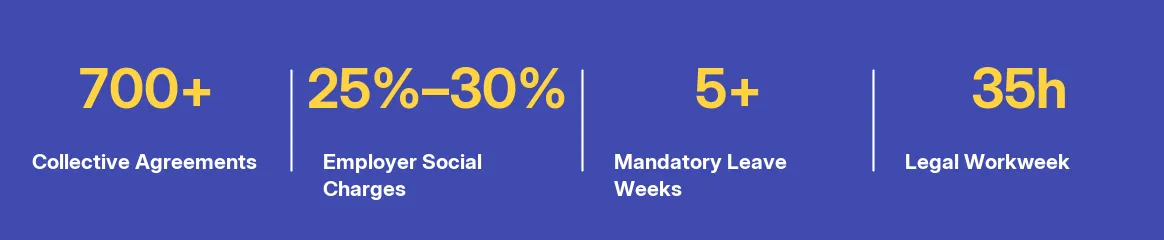
France has over 700 active collective bargaining agreements. Each one is tied to a sector identified by a code NAF (Nomenclature d'Activités Française). The EOR must correctly identify which convention collective applies to your employee's role.
This is not cosmetic. The applicable agreement determines minimum salary grids, mandatory bonuses, notice periods, and supplementary health insurance requirements. A software developer employed under the Syntec convention faces different salary minimums than one classified under a general services agreement.
Ask the EOR how they determine which convention collective applies. Ask what happens if the classification is disputed. A provider without a clear process here will cost you in back-pay claims or labor tribunal proceedings.
Employee Protections and Dismissal Rules
France's dismissal framework is among the strictest in Europe. An employer must demonstrate cause réelle et sérieuse for any termination. The process involves a formal pre-dismissal meeting, a mandatory waiting period, and a written notification letter with specific legal language.
A competent EOR knows the Barème Macron, which sets indemnity ranges based on tenure. They also know when those ranges do not apply, such as cases involving discrimination or harassment.
The question to ask is direct: how many French terminations has the EOR processed in the last twelve months? A provider that hesitates or gives a vague answer likely lacks the operational depth to manage French exits without litigation risk. Understanding how an EOR handles work permits and visas in France matters equally when offboarding foreign employees whose residence status depends on employment.
Payroll Accuracy and Social Security Administration
French payroll is not a spreadsheet exercise. The bulletin de paie contains dozens of line items, each tied to a specific statutory or conventional obligation. Getting it right requires systems built for French-specific complexity.
Social Contribution Breakdown
French employer social charges typically run between 25% and 30% of gross salary. These cover health insurance, retirement, unemployment, family allowances, and several smaller levies. The exact rate varies by salary level, convention collective, and employee category (cadre vs. non-cadre).
| Evaluation Criterion | Strong EOR Signal | Red Flag |
|---|---|---|
| Payroll line items | Full bulletin de paie with 30+ lines | Simplified payslip missing mandatory items |
| URSSAF filing | Monthly DSN submission confirmed | Manual or quarterly filing |
| Cadre classification | Proactive assessment at onboarding | No mention of cadre/non-cadre distinction |
| Mutuelle coverage | Convention-specific plan in place | Generic health plan not meeting sector minimums |
| Prélèvement à la source | Integrated with DGFIP rate feeds | Manual income tax calculation |
The Déclaration Sociale Nominative (DSN) is the monthly digital filing that replaced most legacy social declarations. Every EOR operating in France must submit the DSN by the 5th or 15th of the following month, depending on entity size. Ask your EOR for a sample DSN submission timeline. If they cannot produce one, they are not running French payroll at scale.
Supplementary Benefits Administration
French law mandates employer-funded supplementary health insurance, called mutuelle. The minimum employer contribution is 50% of the premium. Many convention collectives set higher floors or require specific coverage levels.
A capable EOR also administers prévoyance, the mandatory death and disability insurance for cadre employees. This obligation comes from the 1947 ANI convention for cadres. Missing it exposes both the EOR and the client to employee claims.
For companies building compliant employment structures in France, benefits administration is where many providers quietly fall short.
Contract Flexibility and Exit Provisions
Your relationship with the EOR matters as much as the employee's relationship with French labor law. The commercial contract between you and your EOR provider governs what happens when things change.

Lock-In Periods and Notice Terms
Some EOR providers require 12-month minimum commitments. Others operate month-to-month. Neither is inherently better. What matters is clarity.
Ask whether the commercial contract separates the EOR service term from the employee's employment contract. In France, the employment relationship survives the commercial agreement. If you switch EOR providers, the employee does not lose their job. They transfer. A good EOR has a documented transfer protocol for this scenario.
Liability and Indemnification
The commercial agreement should specify who bears liability for compliance failures. If the EOR files late with URSSAF and incurs a penalty, does that cost fall on you or them? If an employee brings a claim at the conseil de prud'hommes, who funds the defense?
Strong EOR contracts allocate compliance liability to the EOR for obligations within their control. Weak contracts push risk back to the client through broad indemnification clauses. Read the liability section carefully. If necessary, have a French employment lawyer review it before signing.
Watch out: Some EOR contracts include a clause making the client liable for social contribution shortfalls caused by incorrect information provided by the client. This sounds reasonable until you realize the EOR, not you, determines which convention collective applies and which contribution rates to use. Make sure liability follows control.

FAQs
What happens to my employees if I switch EOR providers in France?
French labor law protects employees during employer changes through Article L1224-1 of the Code du travail. Employment contracts transfer automatically when the employing entity changes. The new EOR inherits existing terms, accrued leave, and seniority. Your employees do not face a gap in employment. The outgoing EOR must provide complete payroll records and a certificat de travail. The transition typically takes four to six weeks when both providers cooperate.
Can an EOR in France sponsor work permits for non-EU employees?
Yes, provided the EOR holds an active French entity registered with the préfecture. The EOR files the work permit application as the legal employer. Processing times for non-EU work authorizations vary by nationality and role classification. Some categories, like the passeport talent for highly skilled workers, follow faster tracks. The EOR must demonstrate that the salary meets minimum thresholds set by the relevant convention collective and immigration regulations.
How do I verify that an EOR is correctly applying my employees' convention collective?
Request the code NAF assigned to the EOR's French entity and cross-reference it against the applicable convention collective. Then ask the EOR for the specific salary grid they apply to your employee's role and seniority level. Compare this against the published minimums on Legifrance. If the EOR uses a generic convention rather than a sector-specific one, your employee may receive lower benefits and weaker protections than they are legally entitled to.
What is the typical EOR fee structure for France, and what should be included?
EOR fees for France generally follow a per-employee-per-month model. Pricing varies by provider and service scope. A complete fee should cover payroll processing, DSN filing, mutuelle and prévoyance administration, employment contract drafting, and HR advisory. Watch for hidden charges on items like contract amendments, employee terminations, or annual regulatory updates. Some providers charge separately for work permit sponsorship. Ask for a complete fee schedule before signing, not just the headline monthly rate.
What to Evaluate Next
French labor regulation does not stand still. New collective bargaining agreements are negotiated regularly. URSSAF adjusts contribution brackets. The DSN filing format evolves with each software update cycle. Your EOR evaluation should not be a one-time exercise.
Build a 12-month review into your commercial agreement. Audit DSN filings quarterly. Verify convention collective application annually as roles change. The providers worth keeping are the ones who welcome that scrutiny.
If you are evaluating EOR providers for France and need a compliance-focused comparison for your team, request a consultation with Team Up.
Written by the Team Up editorial team. Team Up is a people-first EOR and nearshoring partner helping startups, agencies, and enterprises across North America, Europe, the Middle East, and Singapore hire proven talent across 20+ countries.
.svg)