10 Strategic benefits of using Employer of Record (EOR) services in Georgia: 2026 guide

Introduction
Hiring abroad isn’t the wild west anymore, unless you’re doing it wrong.
Georgia has quietly become the hiring hub of the Caucasus: low taxes, stable laws, English-speaking talent, and a time zone that actually works with Europe and the U.S.
It’s where fast-growing companies are quietly building remote teams without the spreadsheets, sleepless nights, or lawyers named “Giorgi” on retainer.
Here’s the play: instead of setting up your own Georgian entity (and collecting paperwork like it’s a new hobby), you hire through an Employer of Record (EOR). That means your team works for you, but is legally employed by Team Up in Georgia.
We handle payroll, contracts, benefits, taxes, the whole “please don’t audit us” package, while you focus on building your product.
In this guide, we’re unpacking the 10 biggest advantages of using an EOR in Georgia to expand globally, what it saves, what it protects, and why it’s the smartest move you’ll make in 2026.
What does an EOR do in Georgia?
So, what does an Employer of Record (EOR) actually do in Georgia?
Think of it as the difference between managing a team and managing a mountain of paperwork. An EOR is the legal employer under Georgian labor law, on paper, your people work for us. In reality, they report to you, follow your roadmap, and build your product.
You keep control of the work; we carry the legal and administrative weight.
Here’s what that means in practice:
- Legally compliant, bilingual employment contracts. Every contract is drafted in Georgian and English, referencing the Labor Code of Georgia and civil IP transfer clauses—so your ownership is protected locally.
- Payroll and tax filing with the Revenue Service. Georgia runs on a 20% income tax and 2% employer pension contribution. We handle the monthly filings, pay slips, and payments in GEL, so your finance team never has to touch a Georgian tax portal.
- Mandatory pension contributions. Both employer and employee pay 2%, automatically processed and reported.
- Paid leave, public holidays, and benefits administration. Georgia mandates 24 paid vacation days, 17 public holidays, and maternity coverage—your EOR keeps it all compliant without you tracking calendars in a foreign language.
- Immigration and residency support. With Georgia’s 365-day visa-free entry for over 90 countries, foreign hires can relocate easily. We secure residence permits and register them with local authorities.
So while your team works like they’re fully yours, they are legally employed, paid, and protected inside Georgia’s system. That’s what keeps you safe from fines, tax surprises, and the classic “contractor who turns out to be an employee” disaster.

The 10 strategic benefits of using an Employer of Record services in Georgia
If you’ve ever tried to open a company in a new country, you know the pain: paperwork that multiplies overnight, government portals that look like they were coded in 1998, and accountants who swear “it’s easy” right before sending you a 12-page PDF in Georgian.
Here’s the thing, Georgia doesn’t have that problem.
It’s one of the few places where bureaucracy still takes coffee breaks.
You can register a company in a few days, sure. But if you want to hire fast, without learning the tax code or hunting for a translator at 10 p.m., you go through an Employer of Record (EOR).
Team Up hires your people legally in Georgia, handles payroll, taxes, benefits, immigration, and compliance, and you just get your team. No red tape, no fake contractors, no “hope this is legal” moments.
Let’s break down what that actually gets you.
1. Hire in Days with Employer of Record (EOR) Services in Georgia
Registering a company in Georgia can take several weeks, including translations, tax registration, and banking.
You test a market, spin up a local team, or pilot delivery, before your competitors finish notarizing their Power of Attorney.
With Team Up, you can onboard employees in a matter of days through our registered Georgian entity.
2. Ensure Full Compliance with Labor Laws in Georgia
Georgia’s labor law is short, clear, and absolutely enforced.
It says: pay taxes monthly, register payroll properly, don’t fake contractor relationships, and contribute 2% to the pension fund.
Miss that, and you’re on the hook for back taxes, penalties, and possibly an awkward audit.
Your EOR does all of it, contracts in Georgian and English, filings to the Revenue Service, pension reports, public holiday tracking, everything.
You get an Employer of Record compliance in Georgia without learning a new alphabet.
3. Simplify Tax Reporting with EOR Payroll Services in Georgia
Georgia requires monthly reporting of income tax (20%) and pension contributions (2% employer + 2% employee).
Team Up handles all calculations, submissions, and GEL-denominated salary payments while you receive a single invoice in EUR or USD.
Your team gets accurate local payslips; your finance department gets predictability.
4. Reduce Overhead and Cut Expansion Costs with a Local EOR Partner
Here’s what it really costs to “do it properly” on your own:
Company registration, translations, POA certification, a local accountant, and about 10 forms that all have to be stamped, yes, stamped.
You’re out roughly €1,000 upfront and another €400+ every month just to stay compliant.
The Employer of Record cost in Georgia with Team Up is €199 per employee. That covers payroll, taxes, compliance, benefits, and HR admin.
No setup fee, no accountant invoices, no trips to the Justice House.
Until you’ve got 20+ employees sitting in Tbilisi, the math says EOR wins.
5.Protect Your IP and Legal Rights with Employer of Record Contracts
If you’re hiring “contractors” in Georgia, here’s the ugly truth, under Georgian civil law, you probably don’t own their output.
No local contract = no enforceable IP transfer.
Every EOR contract through Team Up includes a bilingual employment agreement with Georgian jurisdiction and explicit IP clauses.
Translation: the code, design, or data your team creates belongs to you. Legally. End of story.
6. Access Skilled Talent Across the Caucasus with a Trusted EOR Provider
Tbilisi isn’t a buzzword city, it’s where great engineers quietly build global products.
Georgia produces thousands of STEM grads each year, most with solid English and international project experience.
Devs here work in React, Python, .NET, Node, AWS, the same stacks your team already uses.
And because the cost of living hasn’t gone Berlin-level yet, salaries sit around 40–60% lower than in Western Europe.
You’re not “offshoring.” You’re hiring smart from the top-tier global talent pool.

7. Offer Competitive Employee Benefits through EOR Services in Georgia
Georgia’s labor law gives employees 24 paid vacation days, 17 public holidays, and a mandatory pension plan.
Add state-covered maternity leave, optional private health insurance, and even gym perks, Team Up builds all that into your EOR package.
So your Georgian employees get the benefits they expect from a serious employer, and you never have to Google “is Orthodox Christmas a paid holiday?” (Answer: yes. January 7.)

8. Streamline Work Permits and Immigration via a Regional EOR Partner
Georgia’s visa policy is famously chill. Citizens of 90+ countries can live and work here visa-free for up to a year.
If someone stays longer, your EOR files for a residence permit, directly tied to their employment contract.
No sponsorship letters, no embassy trips, no “leave the country to re-enter” nonsense.
That’s why Georgia’s full of developers, with Employer of Record work visa in Georgia, from Ukraine, Turkey, and the EU who never left after their “remote work month.”

9. Lower legal and financial exposure
Misclassifying a full-time dev as a “freelancer” might save you money today, until the Georgian Revenue Service sends a letter.
Back taxes, fines, and a very awkward phone call follow.
Your EOR carries that legal liability. We’re the registered employer, handling every filing, pension payment, and labor report.
You get clean records, valid contracts, and zero exposure.
That’s what “compliance as a service” should actually mean.
10. Scalable expansion across the Caucasus
Once you’re up and running here, expanding to Armenia or Azerbaijan is just another contract, not another company.
Team Up already runs local entities across the region, so your compliance framework scales with you.
One partner. One invoice. Multiple markets.
It’s why teams use Georgia as their base of operations for the whole Caucasus, stable, low-tax, and strategically placed between Europe and Asia.
Why Georgia over other EOR markets?
Every country promises to be “the next global hiring hub.” Georgia quietly is.
It’s not just cheaper labor or time zone overlap, it’s the full package: low taxes, liberal labor laws, easy foreign currency movement, political neutrality, and a genuinely pro-business government. For companies that need a stable, compliant base of operations between Europe and Asia, Georgia isn’t the alternative market, it’s the strategic one.
1. Lower taxes that stay simple
Georgia runs on one of the most transparent tax systems in the region.
- Corporate tax: 15%, paid only when profits are distributed—not while they’re reinvested.
- Income tax: 20% flat rate, withheld at source.
- Pension contributions: 2% from the employer, 2% from the employee, automatically processed.
This means no complicated deductions, no sliding brackets, and no hidden levies. Payroll reporting happens monthly through a fully digital Revenue Service portal, and compliance takes hours, not days.
For companies used to European or North American red tape, Georgia’s simplicity feels like a feature, not a loophole.
2. Liberal employment rules that favor growth
Georgia’s labor code is short, clear, and designed for flexibility. Employers and employees can define most terms contractually, hours, benefits, performance clauses, without rigid state intervention.
You can hire or downsize legally without the months-long procedures common in EU markets. Probation periods, notice rules, and terminations are all codified but straightforward. This gives international teams the freedom to scale operations without triggering legal uncertainty.
An Employer of Record (EOR) service provider in Georgia manages all of this, issuing bilingual contracts under Georgian law, registering taxes, and tracking statutory benefits, so you stay compliant without adding legal overhead.
3. Easy Foreign Currency Operations
One of Georgia’s biggest advantages is how seamlessly it handles international transactions.
The country’s banking system allows free conversion between GEL, EUR, and USD, with no foreign exchange restrictions or repatriation limits. You can send or receive payments abroad without central bank approval or capital controls.
That makes payroll, invoicing, and profit transfers effortless for foreign entities. TeamUp’s EOR framework leverages this system to pay local employees in GEL while billing global clients in their preferred currency—fast, compliant, and transparent.
4. EU adjacency without the EU bureaucracy

Georgia sits at the intersection of Europe and Asia, just a short flight from Berlin, Dubai, and Istanbul. It operates in a European time zone, trades under free agreements with both the EU and China, and uses International Financial Reporting Standards (IFRS) for accounting.
But unlike the EU, Georgia’s business environment is refreshingly lean. There’s no complex labor court system, no restrictive hiring quotas, and no excessive licensing. You get access to European proximity and culture without the regulatory drag.
For global employers, this means faster market entry, easier compliance, and a hiring base that scales regionally across the Caucasus.
5. Political stability and a pro-business climate
Georgia has ranked consistently high in the World Bank’s Ease of Doing Business Index, placing ahead of most of Eastern Europe in recent years. Its government openly courts foreign investment, particularly in technology, finance, and remote work sectors.
The legal system is predictable, anti-corruption measures are strong, and international arbitration is accessible through local courts. That stability—combined with a liberal visa regime and a free flow of digital talent—has turned Georgia into a genuine hub for remote-first companies.
6. Strategic Neutrality in a Volatile Region
Unlike many emerging markets, Georgia maintains diplomatic neutrality and economic openness. It trades freely with both Western and Asian partners, hosts multiple free industrial zones, and avoids political entanglements that complicate business.
This neutrality makes it one of the most reliable environments for global teams operating across the Caucasus and Eastern Europe. For companies diversifying operations away from the EU or post-sanctions regions, Georgia offers a secure, stable alternative.
How to choose the right Employer of Record companies in Georgia
Not every EOR that says they operate in Georgia actually does. Some run everything from another continent, subcontracting to local agencies and calling it “coverage.” That might work, until a tax audit or a payroll error proves otherwise.
If you’re hiring in Georgia, the difference between a good EOR and a risky one comes down to one thing: real presence. Here’s how to choose a partner that keeps your team compliant, protected, and properly employed under Georgian law.
1. Pick an EOR with a registered Georgian entity
Start with the basics: your Employer of Record should be legally registered in Georgia.
Without a local entity, they can’t issue valid Georgian employment contracts, pay taxes directly to the Revenue Service, or represent you in compliance matters.
A registered Georgian EOR, like Team Up, handles employment through its own licensed entity, ensuring:
- Legal employment under Georgian labor law
- Payroll and tax filings submitted locally
- Pension and benefit contributions processed in-country
- Enforceable IP and confidentiality clauses recognized by Georgian courts
If your provider can’t show you their Georgian registration, they’re not an EOR, they’re an intermediary.
2. Confirm bilingual contracts and real local HR support
Georgia’s labor code requires employment contracts to be in Georgian, or in another language both parties fully understand. That means your contracts should be bilingual, reviewed by local counsel, and explicitly compliant with the Labor Code of Georgia.
Beyond paperwork, look for an EOR with in-country HR staff, people who can assist your employees directly in Georgian and English. They’ll handle local onboarding, benefits, and HR support, which builds trust and prevents miscommunication.
If a provider’s “local HR support” means a chatbot or a call center in another time zone, it’s not local.
3. Avoid “global EORs” without physical presence in Georgia
Large global EOR platforms often operate on paper but outsource compliance to small accounting firms or legal contractors in Georgia. That’s not the same as having their own entity or team here.
When this happens, you lose visibility, local accountability, and legal control. A missed filing or noncompliant contract could easily fall through the cracks, and the liability still lands on you.
Ask these three questions before signing with any EOR provider:
- Do you have a legally registered entity in Georgia?
- Are your employment contracts drafted and signed locally in Georgian and English?
- Can my employees access HR support on the ground in Georgia?
If the answer to any of those is “no,” keep looking.
The Team Up difference
Team Up was built in Georgia, not just for it. We operate our own local entity, issue bilingual employment contracts, run payroll directly through the Georgian Revenue Service, and support your team with real HR professionals in Tbilisi.
That’s what ensures compliance you can prove, and teams that feel fully supported where they actually work.
When choosing an Employer of Record company in Georgia, go with one that’s truly in Georgia. The difference isn’t small. It’s legal.
Conclusion
Georgia gives global companies what most markets overcomplicate, speed, savings, and legal clarity.
It’s a country built for business, where hiring internationally doesn’t require learning a new legal system or setting up an entity just to pay your first employee.
Using an Employer of Record here isn’t just a shortcut; it’s a strategy.
It lets you build a compliant, fully integrated team in a matter of days without the overhead, the risk, or the bureaucracy that usually comes with global expansion.
Team Up helps companies hire in Georgia legally, fast, and at local cost.
If you’re ready to expand into the Caucasus region, start with a Team Up EOR consultation
Your team deserves a partner that knows the market as well as the law, and that’s exactly what Team Up was built for.
Frequently asked questions
1. What is an Employer of Record (EOR) in Georgia?
An Employer of Record (EOR) in Georgia is a local company, like TeamUp, that legally employs your team on your behalf. The EOR manages payroll, taxes, benefits, and compliance under Georgian labor law while you handle daily work and performance. It’s the easiest way for global companies to hire in Georgia without opening a local entity.
2. How do employer of record services in Georgia work?
With employer of record services in Georgia, you select your candidate, and TeamUp hires them under our Georgian legal entity. We take care of payroll, tax filings, contracts, and benefits while ensuring compliance with the Labor Code of Georgia. You pay one monthly invoice in EUR or USD, and your employee is legally hired, paid, and protected.
3. What are the benefits of using an Employer of Record in Georgia?
The biggest benefits of using an Employer of Record in Georgia include:
- Hiring in days, not weeks
- Compliance with Georgian labor law
- Simple payroll and taxes
- Low overhead and no setup fees
- Local IP protection and bilingual contracts
- Full access to Georgia’s skilled tech and finance talent pool
4. How much does it cost to use an Employer of Record in Georgia?
The Employer of Record cost in Georgia starts at €199 per employee per month with TeamUp. This fee covers payroll, benefits, taxes, and full HR administration. Compared to setting up your own entity, which costs €1,000+ upfront and around €425 per month in admin fees, the EOR model remains far more cost-effective.
5. Is hiring through an EOR in Georgia legal and compliant?
Yes. Hiring through an EOR in Georgia is fully compliant with the country’s labor and tax laws. The EOR acts as the legal employer, registers payroll with the Georgian Revenue Service, and ensures all pension and tax contributions are filed correctly. This eliminates misclassification risk and protects your business from fines or back taxes.
6. Can an Employer of Record in Georgia help with foreign employees?
Absolutely. TeamUp’s EOR services in Georgia handle residence permits and tax registration for foreign hires. Citizens from 90+ countries can live and work in Georgia visa-free for up to a year, and your EOR manages the transition to a long-term residence permit if needed.
7. Why choose Georgia over other EOR markets?
Georgia stands out for its low taxes (20% income, 15% corporate), simple regulations, and political stability. It offers EU adjacency without EU bureaucracy and has a skilled, English-speaking workforce. For global companies, it’s a balanced mix of European standards and emerging-market affordability.
8. How do I choose the best EOR company in Georgia?
Look for an Employer of Record company in Georgia that:
- Operates its own registered Georgian entity
- Issues bilingual (Georgian + English) contracts
- Offers local HR and compliance support Avoid “global” providers that outsource Georgian operations—they can’t guarantee compliance or employee protection. TeamUp is fully registered and staffed locally in Tbilisi.
9. What industries use EOR services in Georgia most often?
EOR services in Georgia are popular among tech startups, SaaS companies, financial service providers, and customer support centers. The country’s developer talent, multilingual workforce, and low employer tax rates make it ideal for remote-first teams expanding into the Caucasus.
10. How do I get started with an Employer of Record in Georgia?
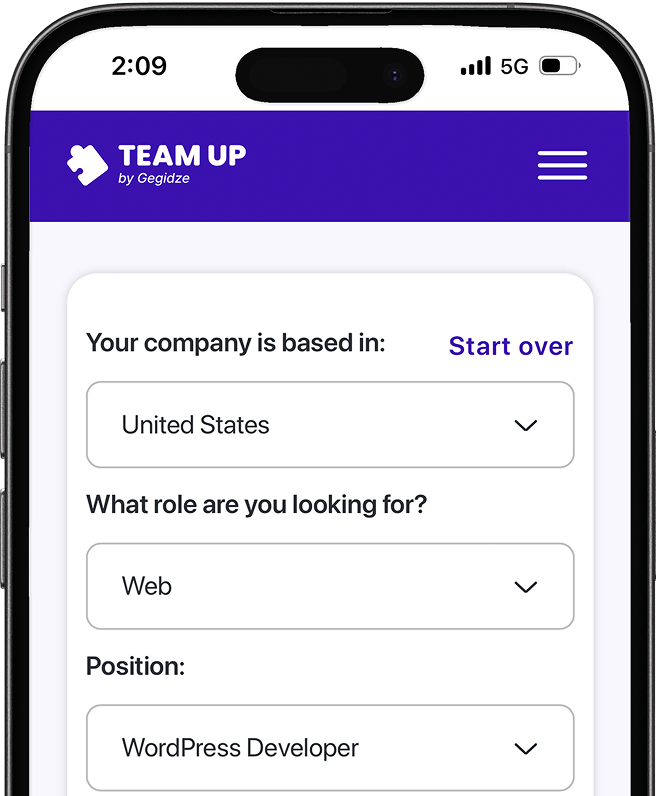
Getting started is simple. Contact TeamUp, choose the role you want to fill, and we handle everything else—from contracts to payroll setup. Within a few days, your new employee is legally hired, paid, and ready to work under Georgian law.
.svg)