What Is a PEO? Understanding Professional Employer Organizations in Georgia

Introduction
If you’re searching for what is a PEO in Georgia, you’re not doing it for fun.
You’re trying to hire in Georgia.Or you already did, and now payroll is turning into a monthly anxiety ritual.
PEO gets marketed as the easy button.
“Outsource HR.”
“Get payroll handled.”
“Stay compliant.”
Some of that is true.
But only if your setup matches what a PEO is designed for. In Georgia, that “only if” matters more than people admit.
Because here’s the uncomfortable truth.
A PEO can reduce admin. It cannot remove your legal responsibility in Georgia.
So before you sign anything, you need to understand what you are buying.

What Is a PEO in Georgia?
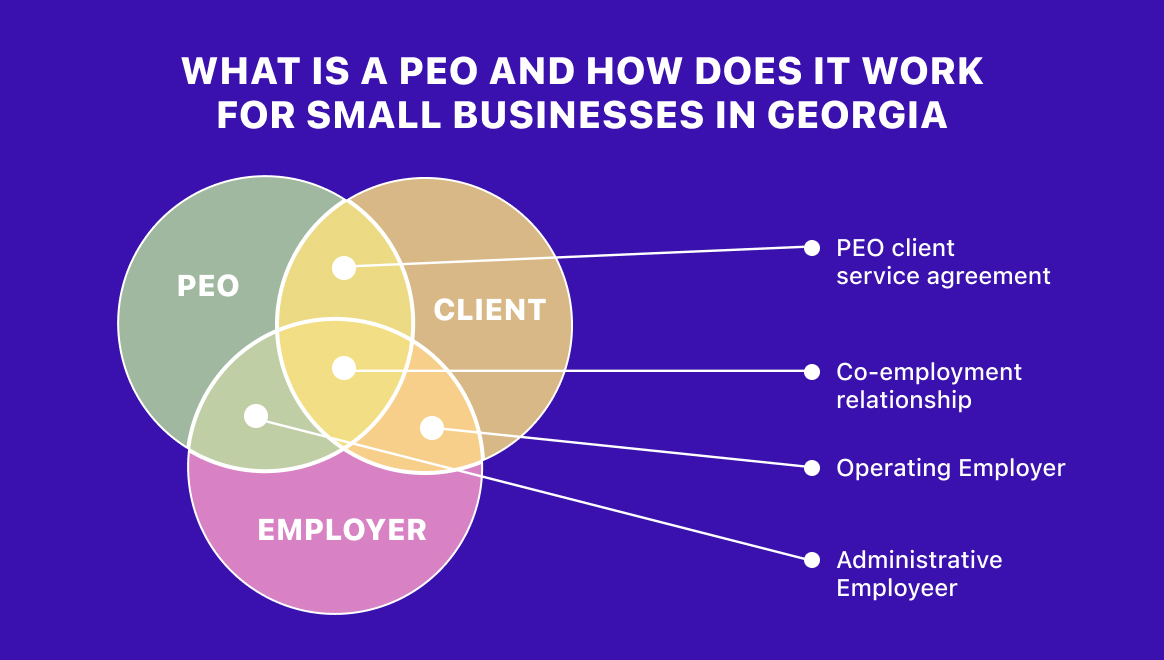
A Professional Employer Organisation (PEO) is an HR and payroll partner that enters a co-employment relationship with your company.
Co-employment means two things happen at the same time:
- Your company remains the employer in Georgia.
- The PEO supports HR functions, payroll administration, and often benefits coordination.
That’s the model.
A PEO is not the legal employer “instead of you.”
It’s not an entity substitute.
It’s not a way to hire in Georgia without registering locally.
If you do not have a Georgian legal entity, a PEO is not your solution. You’re looking for an EOR.
If that distinction is fuzzy in your head, that’s normal. A lot of vendors blur it on purpose.
We don’t.
What Does PEO Stand for in HR?
PEO stands for Professional Employer Organisation.
In HR terms, it typically means:
- A co-employment structure
- Shared employment responsibilities between your company and the PEO
- Operational support across payroll, HR admin, compliance guidance, and benefits
In plain terms, it means:“You keep the company and liability. They help you run the HR machine.”
That is also why PEO is common in markets where the company already exists locally. It’s not an entry strategy. It’s an operating strategy.
The First Question to Ask the PEO Service Providers
Can a PEO hire employees in Georgia if I don’t have an entity?
No.
If you want to hire in Georgia without opening a company, a PEO cannot do that legally.
That’s what an Employer of Record (EOR) is for.
A PEO supports your entity.
An EOR replaces the need for your entity.

How a Professional Employer Organisation Works in Georgia
Let’s make this concrete.
A typical PEO setup in Georgia looks like this:
Step 1. You have a Georgian entity
Usually, an LLC.
Registered locally. Tax registrations are active. A local bank account has been set up. Accounting in place.
Step 2. You hire employees through your entity
Your company signs employment contracts.
Your company is the employer on record.
Your company is responsible for labour compliance.
Step 3. You sign a PEO services agreement
This is where the PEO comes in to administer parts of HR and payroll. The agreement defines who does what.
Step 4. Payroll and HR run through the PEO’s process
The PEO can handle payroll calculations, payslips, reporting, and HR admin.
But this does not change the legal chain.
In Georgia, authorities and courts look at the registered employer first.That is your entity.
So a PEO can help you operate more cleanly.
It cannot make you invisible.
Who Is Responsible for What?
The accountability split that people ignore
If you want to avoid surprises, you need to understand the split between:
- Operational execution
- Legal accountability
Here’s the practical breakdown most founders wish someone told them earlier.
You are responsible for:
- Having a legal entity and staying in good standing
- Correct employment classification
- Compliant employment contracts and policies
- Proper terminations and documentation
- Correct payroll tax remittance and filings, even if delegated
- Anything that becomes a legal dispute
The PEO is responsible for:
- Payroll processing workflows
- Calculations, payslips, reporting
- HR administration support
- Benefits coordination when offered
- Process documentation and HR routines
This is why “PEO reduces admin” can be true.
And “PEO removes risk” is usually false.
What Services a PEO Provides in Georgia
Most PEO packages in Georgia fall into a few predictable buckets. Here’s what you should expect. And what you should verify before you sign.
1. Payroll administration
This usually includes:
- Monthly payroll runs
- Gross-to-net calculations
- Payslip generation
- Tax and pension calculation support
- Monthly reporting formats your finance team can use
2. HR administration
Common scope:
- Employee onboarding paperwork
- Leave and absence tracking
- HR documentation templates
- Policy support for PTO, remote work, and discipline processes
3. Benefits coordination
Some PEOs help you:
- Source private health insurance
- Set up gym memberships or perks
- Administer reimbursements or allowances
Important detail. Georgia does not force employers to provide the same kind of mandatory benefit stack you see in many EU markets. That means benefits are often a retention tool, not a legal requirement. The PEO may help you run them, but you still choose the offer.
4. Compliance support
This is the vaguest part in most sales pitches, so be careful.
“Compliance support” usually means:
- Keeping you informed about standard HR requirements
- Helping you align payroll processes with local rules
- Providing templates and guidance
It does not mean:
- Taking on legal employer liability
- Defending you in disputes as the employer
- Making misclassification risk disappear
If a provider implies that, ask them to put it in writing. Watch what happens.
PEO Payroll in Georgia. What It Covers and What It Doesn’t
This is where people get burned.
Because payroll is not just “sending salaries.”Payroll is a compliance system.
In Georgia, payroll typically involves:
- Income tax withholding
- Pension contributions (when applicable)
- Monthly reporting and filings
- Accurate payslips
- Correct treatment of bonuses, reimbursements, and termination payouts
A PEO can run the system for you. But your entity remains responsible for the outcome.
So the right question is not “do they do payroll.”The right question is “what happens when something goes wrong.”
Examples that happen in real life:
- A contractor is treated like an employee. Tax exposure appears later.
- A termination is handled casually. The employee disputes it.
- A bonus is paid without a proper structure. Payroll reporting becomes messy.
- Someone relocates or changes residency. Documentation gaps show up during banking or audits.
A good PEO reduces mistakes. It does not give you a legal shield.
The Legal Reality. When a PEO Is Allowed in Georgia
This is the clean rule.
A PEO in Georgia makes sense only when:
- You already have a Georgian entity
- You plan to run ongoing employment through that entity
- You want HR and payroll support, not legal employer substitution
- You can still handle or oversee legal responsibility
A PEO becomes a bad fit when:
- You do not have a Georgian entity
- You want to hire quickly and test the market
- You want to avoid local filings and employer exposure
- You want one invoice and a clean employer structure without building infrastructure
That second list is exactly why EOR exists.
PEO vs Employer of Record (EOR) in Georgia. The Core Difference
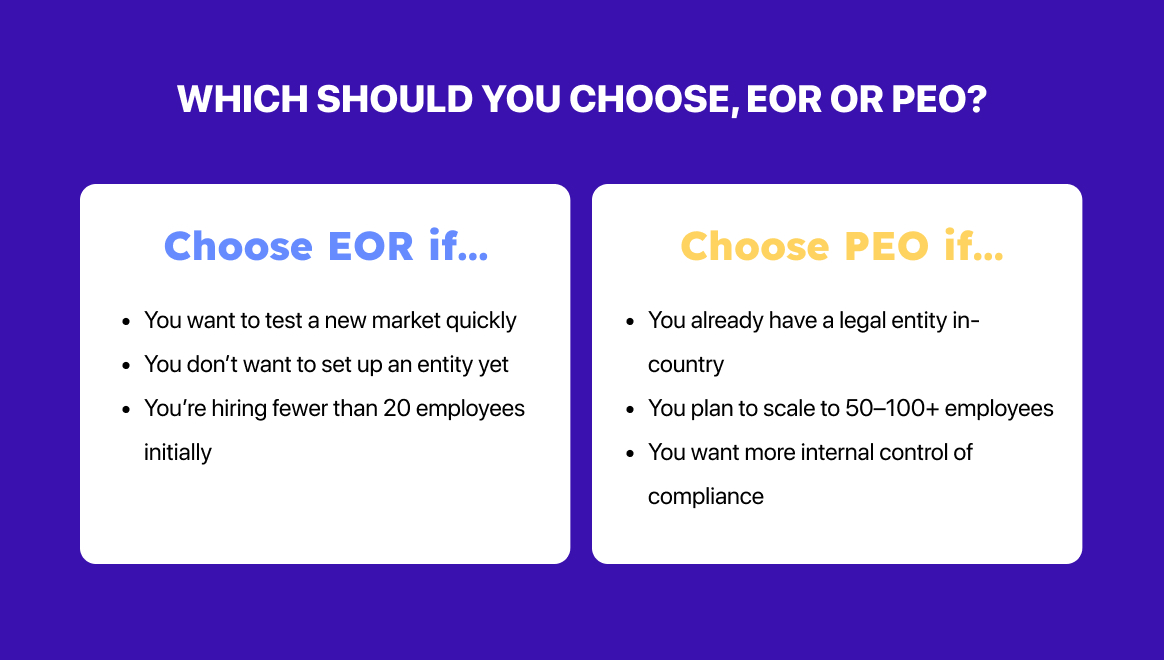
This is the part people think they understand. They usually don’t.
Most bad hiring decisions in Georgia happen right here. Not because the laws are complex, but because the models get blurred.
So let’s draw a hard line.
The one question that decides everything
Before definitions, before pricing, before vendor demos, answer this:
Do you already have a registered legal entity in Georgia?
That single fact determines whether PEO is even an option.
Not a preference.
Not a strategy choice.
A legal gate.
What a PEO actually is in Georgia
A PEO works only if you already operate locally.
With a PEO:
- Your Georgian entity hires the employee
- Your Georgian entity signs the employment contract
- Your Georgian entity is the legal employer
- Your Georgian entity is liable for labour law, tax, and disputes
The PEO:
- Runs payroll workflows
- Administers HR processes
- Helps with benefits
- Provides compliance support
But it does not replace you.
In Georgia, a PEO is an operating layer, not a legal shield.
If something goes wrong. Misclassification. Wrong termination. Payroll issue. The authorities don’t call the PEO. They call the registered employer.
That’s you.
What an Employer of Record (EOR) actually is in Georgia
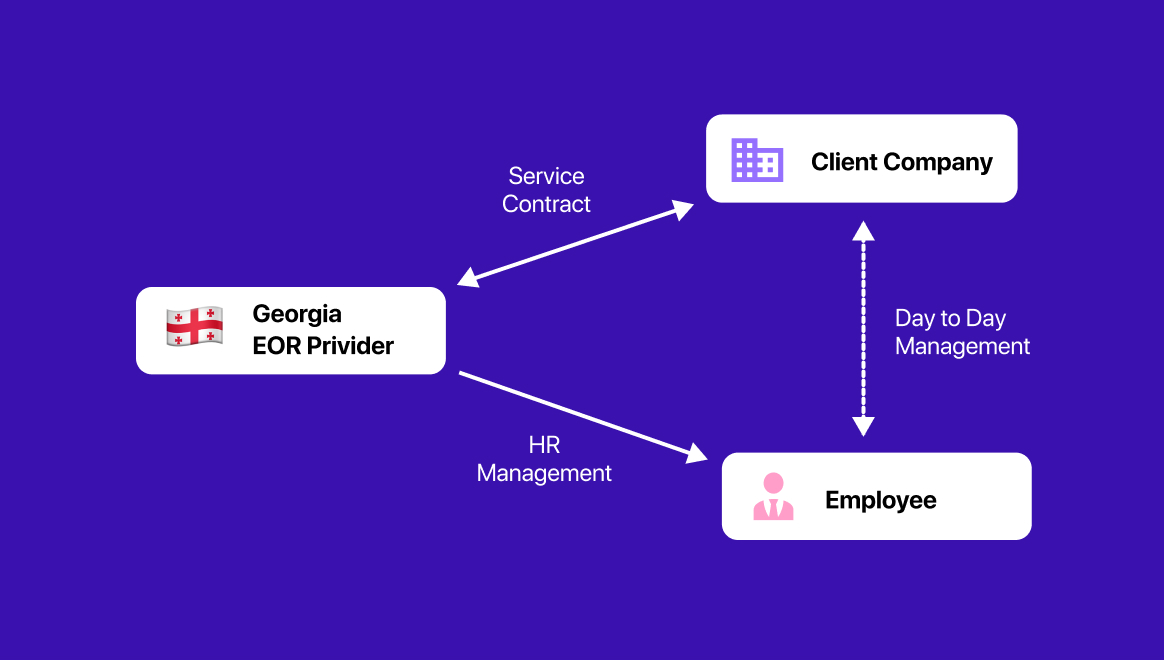
An Employer of Record service in Georgia is fundamentally different.
With an EOR:
- You do not need a Georgian entity
- The EOR hires the employee under its own Georgian entity
- The EOR signs the employment contract
- The EOR is the legal employer
- The EOR carries labour law and payroll compliance
You:
- Manage the employee’s day-to-day work
- Set goals, tasks, and performance expectations
- Pay one monthly invoice
This model exists for one reason.
To let companies hire in Georgia without taking on local legal risk.
That’s not a workaround.
That’s the design.
The legal difference in plain terms
Here’s the part LinkedIn posts avoid saying out loud.
A PEO assumes you are ready to be an employer in Georgia.
An EOR assumes you are not.
That’s it.
PEO = “Help me operate my Georgian company better.”
EOR = “Let me hire in Georgia without becoming a Georgian employer.”
Trying to use a PEO when you actually need an EOR doesn’t make you efficient.It makes you exposed.
Why this matters more in Georgia than people expect
Georgia is business-friendly.
It is not casual about employment relationships.
The Georgian Revenue Service and labour inspectors care about:
- Who signed the contract
- Who pays the salary
- Who controls the work
- Who is registered as an employer
If those don’t line up cleanly, you don’t get a warning.You get questions.
PEO setups often fail early-stage companies because they assume the company side is already mature. In Georgia, maturity means:
- Entity registration
- Tax registration
- Accounting
- Payroll discipline
- Proper termination procedures
If you don’t have those yet, a PEO adds process on top of fragility.
An EOR removes the fragility entirely.
Side-by-side. No marketing spin
PEO in Georgia
- Requires a local entity
- You are the legal employer
- You carry compliance risk
- Best for established local operations
- HR and payroll support only
EOR in Georgia
- No local entity required
- EOR is the legal employer
- Compliance risk shifts away from you
- Built for market entry and early scaling
- Full employment structure included
Same country.Completely different risk profiles.
The mistake companies keep making
They hear “PEO is cheaper” and stop thinking.
On paper, yes.
In reality, PEO assumes you already pay for:
- Accountants
- Legal advisors
- Entity maintenance
- Payroll oversight
- Internal HR discipline
If you don’t, those costs don’t disappear. They just show up later. Usually, during audits, disputes, or funding rounds.
EOR looks more expensive because the cost is visible.PEO looks cheaper because the risk is hidden.
Hidden risk is still risk.
Where Team Up fits in this decision
Team Up exists because most small businesses using PEO to start hiring in Georgia are not ready to be Georgian employers yet. And they shouldn’t be forced to pretend they are.
As a regional Employer of Record partner, we:
- Employ your team legally in Georgia
- Handle payroll, contracts, taxes, and compliance
- Remove entity and employer risk
- Let you focus on building, not fixing
When you’re ready to open a Georgian entity and consider a PEO, the transition is clean. No rewrites. No rehiring. No mess.
That’s not anti-PEO.
That’s using the right tool at the right time.
That’s where most people finally stop guessing.
PEO vs Your Team: Who Handles What on a Bad Day?
PEO marketing loves talking about “shared responsibility.
That’s not a roadmap. That’s a holiday card.
The real question every founder, CFO, and HR lead should ask is:
When things break, who gets the phone call? Who pays the fine? Who gets pulled into a labour dispute?
Let’s break this down in reality.
Payroll Administration
PEO handles
- Running payroll on schedule
- Calculating gross-to-net salaries
- Generating payslips and payroll reports
- Withholding taxes and contributions if arrangements allow
Your team owns
- Salary structure decisions
- Changes mid-month (bonuses, role changes)
- Compliance when contracts are wrong
- Paying the right person on the right date every month
Here’s the pain point.
If the payroll run looks clean but the contract doesn’t match the payment terms, the tax office doesn’t say “talk to the PEO.”
They say, “Tell me why your entity paid this way.”
PEO may process, but your company is on the hook unless your legal model shifts to Employer of Record.
That’s the difference between execution and accountability.
Benefits Administration
PEOs can manage the mechanics of benefits.
They often provide:
- Enrollment and renewals
- Access to group plans
- Coordination with insurers
That sounds great until someone leaves and you have:
- Unpaid claims
- Miscommunication on coverage termination
- Delays in statutory filings
PEO handles the admin.
You decide the scope and terms.
If benefits were just “nice to have,” nobody would fight about COBRA, retirement payouts, or insurance lapses.
In Georgia, benefits shape termination packages and legal costs, sometimes more than salary itself.
PEOs don’t own that risk. They manage paperwork.
Tax Filing and Compliance
This is where most founders think PEO fixes things.
PEOs provide:
- Payroll tax calculations
- Filing assistance
- Reporting routines
That’s true. But here’s the catch.
Most tax issues aren’t about missing numbers.
They’re about structural mistakes like:
- Treating reimbursements as salary
- Misclassifying contractors vs employees
- Failing to report bonuses correctly
- Ignoring residency changes
PEO can file for you, but they cannot fix structural misclassification that existed before onboarding.
And in an audit, the first line of liability is the entity owner, your company.
Compliance reports don’t protect you from fines.
Consistent legal structure does.
HR Management
PEOs can help you with:
- Onboarding paperwork
- Leave tracking
- Policy templates
But they don’t make decisions about:
- Who gets hired
- Why was terminated
- Performance reviews
- Promotions
- Disciplinary actions
Your internal team owns people decisions.
And in many Georgia labour disputes, the context behind HR decisions matters more than the HR form used.
A PEO can keep your paperwork neat.
You still get pulled into the meeting if someone files a claim.
Benefits of Using a PEO (When It Actually Makes Sense)

A PEO is not magic, but in the right setup, it absolutely adds value.
Here’s what actually holds up under scrutiny:
1. Streamlined HR and Payroll Foundation
If you’ve already committed to Georgia legally, PEO gives you a system.
Not unlimited flexibility, process clarity.
Good PEOs build routines that reduce:
- Manual mistakes
- Last-minute fire drills
- Orphaned payslips and gaps in records
This matters in compliance checks.
2. Access to Structured Benefits
PEOs often pool client employees to get better rates and broader options.
In markets where benefits are messy or costly, this works well.
But beware:
Access doesn’t mean ownership. You still decide benefit levels and how changes affect pay or termination terms.
3. Standardised Compliance Playbooks
PEOs bring playbooks. That means documented routines for:
- Payroll cycles
- Reporting deadlines
- HR policy templates
- Compliance checklists
Playbooks help reduce screwing up basic stuff. They don’t replace strategic legal advice, but they keep your operations from being chaotic.
4. A Real HR “Safety Net” (If You Use It)
This is the part most founders overlook.
A PEO doesn’t reduce risk by hiding it.
It reduces risk by making your processes predictable.
Predictability shows up when:
- Auditors ask for consistent records
- Employees escalate disputes
- Taxes get reviewed
- Benefits get audited
That’s where clean documentation keeps you out of trouble.
Common PEO Misconceptions People Repeat on LinkedIn
Let’s clear up a few myths that waste time.
Myth: “PEO lets you hire without a local entity”
Nope. Not in Georgia. Not anywhere. A PEO requires that your entity exist first.
If you don’t have a registered company, PEO isn’t even on the table.
That’s why Employer of Record exists.
Myth: “PEO takes liability off your plate”
Not in a way that matters legally. In Georgia, compliance liability stays with the legal employer, your entity.
PEO handles admin, not legal blame.
Myth: “PEO and EOR are basically the same thing”
They look similar on spreadsheets.
They feel very different in compliance.
They behave completely differently when something breaks.
PEO keeps the legal buck with you. EOR takes it on.
A Practical Decision Checklist (No Fluff)
Before you choose a PEO in Georgia, answer these honestly:
Do you already have a local entity?
Yes → keep reading
No → stop here and consider EOR
Are you planning stable, ongoing operations?
Yes → PEO can fit
No → EOR or hiring via contractor may be safer
Do you have someone in finance/legal reviewing the employment structure monthly?
Yes → PEO might help
No → You need EOR or build internal capability first
Is your team bigger than 10–15 and still growing?
Yes → PEO payoff increases
No → Early stage means EOR is likely cheaper legally
If you clicked “No” more than once above, PEO is probably not your first choice.
Where Team Up Actually Fits
Let’s be blunt.
Most companies do not need a PEO when they start remote hiring in Georgia.
They need legal compliance, clean payroll, and a partner that takes liability off their shoulders, not a process accelerator layered on infrastructure they don’t yet own.
That’s exactly why Team Up operates as a regional Employer of Record partner:
- No entity setup required
- Full legal employer coverage
- Compliant payroll built in
- Clean contracts and compliance guardrails
- One predictable invoice
Your team avoids the early-stage compliance mistakes that ruin startups.
Later, if you decide Georgia is a strategic hub and you build a local entity, switching to a PEO-supported model becomes a smooth upgrade, not a scramble.
That’s deliberate growth, not guesswork.
Frequently Asked Questions
1. What is a PEO in Georgia?
A PEO in Georgia is a Professional Employer Organisation that provides payroll and HR administration through a co-employment model. Your company must already have a registered Georgian legal entity. The PEO supports HR operations, but your company remains the legal employer and carries compliance responsibility.
2. What does PEO stand for in HR and payroll?
PEO stands for Professional Employer Organisation. In HR and payroll, it refers to a company that manages administrative employment functions such as payroll processing, tax calculations, and benefits administration, while the client company remains the employer of record.
3. Can a PEO hire employees in Georgia without a local entity?
No. A PEO cannot hire employees in Georgia unless your company already has a registered local entity. If you want to hire in Georgia without opening a company, you need an Employer of Record (EOR), not a PEO.
4. What is the difference between PEO and Employer of Record (EOR) in Georgia?
The core difference is legal responsibility.
With a PEO, your company is the legal employer and must have a Georgian entity.
With an EOR, the EOR is the legal employer, and you can hire in Georgia without setting up a local entity. EOR shifts employment compliance and payroll liability away from your company.
5. Is PEO payroll in Georgia fully compliant?
PEO payroll in Georgia can be compliant if your underlying company structure and contracts are correct. The PEO processes payroll and filings, but your company remains responsible for classification, contract terms, and tax accuracy. Compliance risk does not transfer to the PEO.
6. What services do PEO companies provide in Georgia?
PEO services in Georgia typically include payroll processing, payslip generation, HR administration, leave tracking, and benefits coordination. PEOs do not provide legal employer substitution, entity setup, or compliance liability coverage.
7. Is a PEO cheaper than an Employer of Record in Georgia?
A PEO may appear cheaper on paper, but only if you already maintain a Georgian entity, accounting, legal support, and HR oversight. An EOR often costs more per employee but removes entity setup, payroll liability, and compliance risk. Cost comparisons should include risk and admin time, not just fees.
8. When does a PEO make sense for companies in Georgia?
A PEO makes sense when your company already operates in Georgia, plans long-term employment, and wants to streamline HR and payroll operations. It is best suited for established teams rather than market entry or early hiring.
9. When should you use an Employer of Record instead of a PEO?
You should use an Employer of Record in Georgia if you do not have a local entity, want to hire quickly, are testing the market, or want clear compliance ownership. EOR is designed for early-stage expansion and risk control.
10. Can companies switch from EOR to PEO later in Georgia?
Yes. Many companies start with an EOR in Georgia and later transition to a local entity and PEO model once operations stabilise. Starting with EOR avoids early compliance mistakes and makes the eventual transition cleaner and lower risk.
.svg)