


PEO services for small businesses in Georgia: What you should know
Introduction
Running a small business in Georgia is its own sport. You hire. You manage payroll. You figure out leave rules. You watch the Revenue Service website freeze right when you need it. And all of that is happening while you are supposed to focus on growth. That is why PEO services for small businesses in Georgia keep popping up in conversations. They promise structure. They promise predictable payroll. They promise you do not have to learn every HR rule the hard way.
Before you jump in, here is the truth that shapes everything.
A PEO works only if your company already has a legal entity in Georgia.
If you do not have one, you cannot use a PEO model. You need an Employer of Record (EOR). That is the model that lets foreign companies hire in Georgia without risk, without setting up a local branch, and without touching payroll filings.
This guide will walk through what a PEO is, how the co-employment model works, how it compares to EOR, and when small businesses in Georgia should choose one over the other. We will also cover PEO payroll, benefits, compliance rules, tax responsibilities, cost structures, and the real risks small teams face when they try to manage this alone.
What Is a PEO and How Does It Work for Small Businesses in Georgia
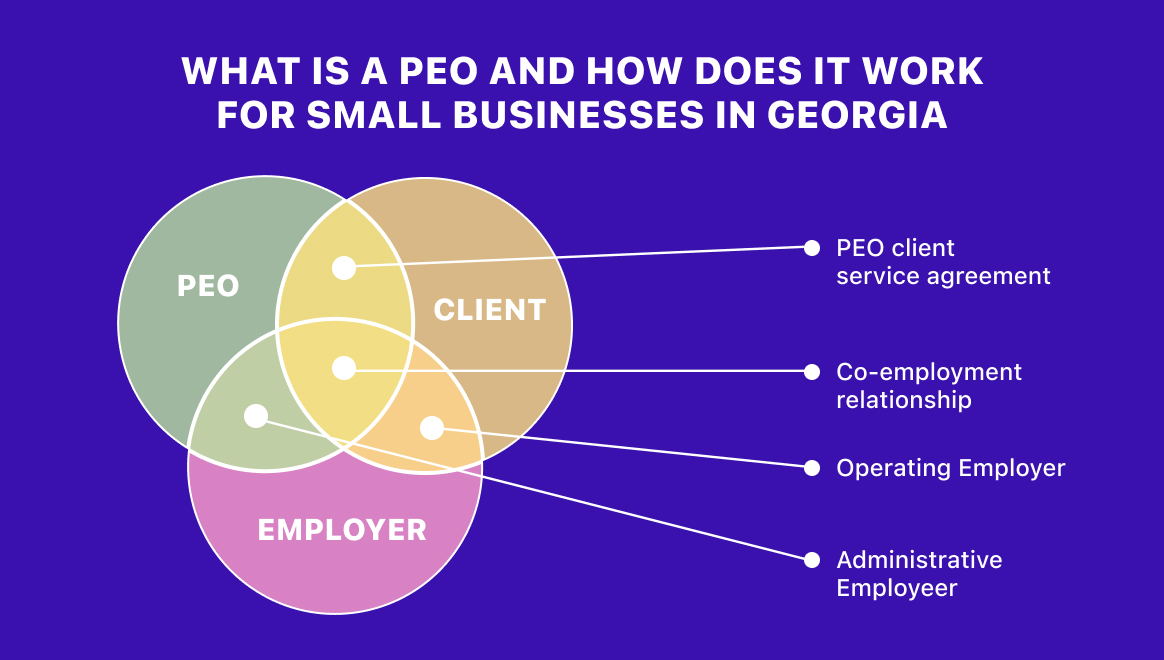
A PEO, short for Professional Employer Organisation, is a company that shares employer responsibilities with your business.
This is the co-employment model, where the PEO becomes the administrative employer, and you remain the operational employer.
This means the PEO manages HR tasks. You manage the work.
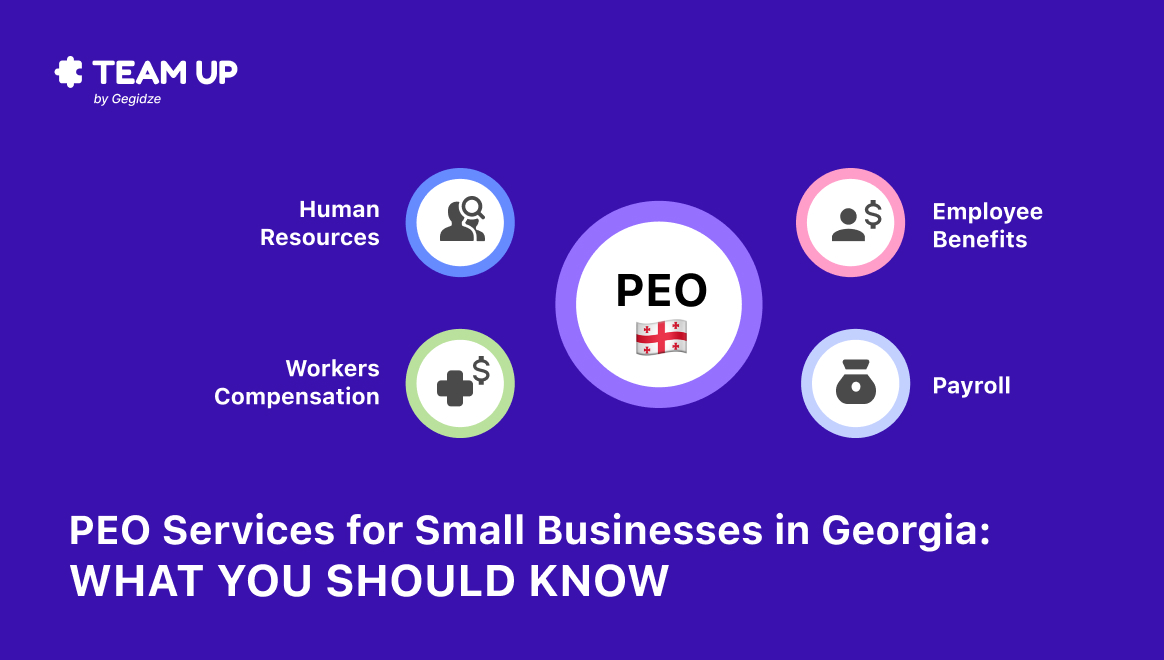
PEO services typically include:
- Payroll processing and compliance calculations
- Monthly tax withholding and reporting
- Employee benefits administration
- HR documentation and onboarding
- Workers comp style coverage
- Risk management support
- Policy creation and legal templates
- Record keeping for audits
Why this matters
Small companies in Georgia often rely on spreadsheets and hope. That is fine for month one. Then someone gets sick leave. Someone asks for a payslip. Or someone wants to know how the pension rule applies to their contract. A PEO makes sure those questions do not turn into compliance problems.
Important distinction
A PEO does not legally employ your workers in Georgia.
You do.
Your Georgian entity stays responsible for taxes, compliance, and legal exposure. The PEO handles the admin work around it.

How the Co-employment Model Actually Works
Co-employment is not the same as outsourcing. It is not the same as hiring a payroll clerk. It is a legal structure where both parties share responsibilities in different areas.
You handle:
- Hiring decisions
- Daily work, management, performance
- Scheduling and reporting
- Compensation strategy
The PEO handles:
- Processing payroll in full compliance
- Ensuring tax withholding accuracy
- Drafting or updating compliant policies
- Providing HR guidance and documentation
- Managing benefits enrollment and contributions
This structure is popular among small businesses because it gives them a big company's HR infrastructure without paying for a full HR department.
But it only applies when a company already exists in Georgia. Suppose you are a foreign business hiring talent here without a local entity. The co-employment model does not apply. That is where the EOR vs PEO difference becomes critical.
Why Small Businesses in Georgia Turn to PEO Services
A PEO solves real pain points for small teams that want professional HR without building it from scratch. The benefits are practical and immediate.
1. HR and Administrative Relief
Small businesses run lean. That sounds heroic until payroll mistakes show up. A PEO takes the bureaucratic parts off your hands, including onboarding, probation documentation, contracts, and payroll.
This reduces founder burnout and removes HR guesswork.
2. Payroll Accuracy and Compliance
PEO payroll services reduce the risk of miscalculations that trigger audits or penalties. A PEO ensures:
- Correct tax withholding
- Timely monthly filings
- Proper pension contributions
- Accurate paid leave tracking
- Statutory compliance
This is one of the most searched areas. because people want to know “PEO payroll meaning” and how it differs from normal payroll. The short version. PEO payroll reduces risk and centralises compliance.
3. Better Employee Benefits
A PEO can negotiate benefits packages that would normally be out of reach for a five or ten-person company.
Small businesses gain access to:
- Group health insurance
- Wellness perks
- Retirement structures
- Local benefit programs
This helps retain talent in a competitive hiring market like Tbilisi.
4. Lower Operational Costs
Hiring an internal HR specialist is expensive.
Building HR systems from scratch is slow.
Getting payroll wrong is even more expensive.
A PEO can cut these costs by managing the entire HR lifecycle under one predictable fee model.
5. Risk Reduction
Non-compliance is not a theoretical risk. It is a monthly risk.
A PEO shields small businesses from:
- Incorrect tax filings
- Outdated contracts
- Wrong termination procedures
- Benefit miscalculations
- Classification mistakes
This is where companies save the most money long term.
The Limitation Nobody Tells Small Businesses About
Here is the part that matters most for companies hiring in Georgia.
A PEO cannot become the employer.
A PEO cannot legally hire people on your behalf.
A PEO cannot solve the problem of “I want to hire, but I do not have a Georgian entity.”
If that is your situation, the only compliant model is an Employer of Record.
An EOR becomes the legal employer in Georgia, handles payroll, contracts, taxes, benefits, compliance, and HR infrastructure. You manage the employee like your own. Team Up specialises in exactly this setup across Georgia, Armenia, and Azerbaijan.
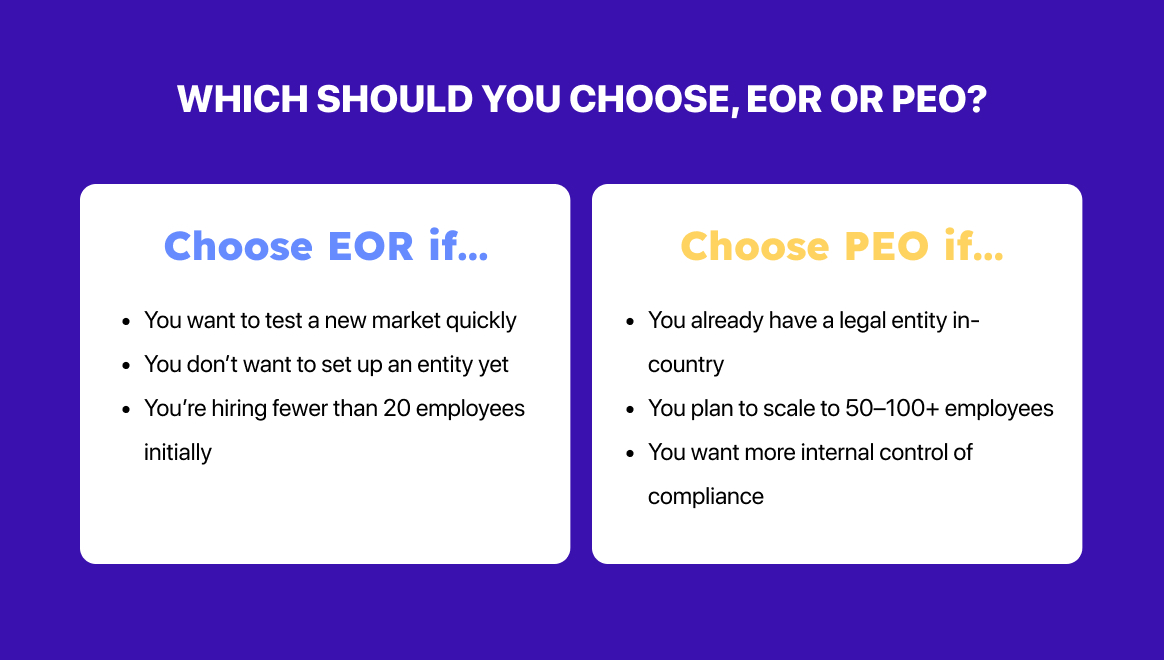
PEO vs EOR for Small Businesses in Georgia: A Clean Comparison
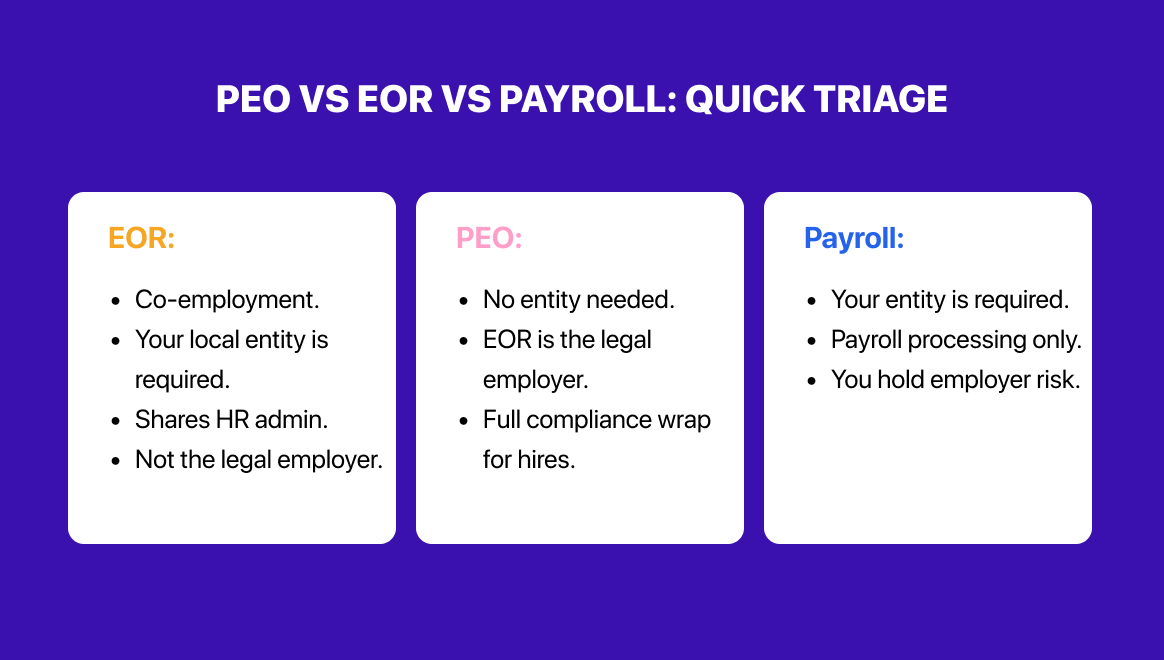
PEO and EOR get grouped together online, but legally, they are not even close.
PEO (Professional Employer Organisation)
- Requires a Georgian legal entity
- You remain the legal employer
- Shared employment model
- PEO handles HR administration
- You carry compliance exposure
- Works best for companies with 10+ employees already operating in the country
EOR (Employer of Record)
- Does not require a local entity
- EOR becomes the legal employer
- Full compliance coverage
- Clean payroll, benefits, HR support
- Zero tax or legal risk for the foreign company
- Ideal for small businesses hiring their first Georgian employees
EOR in Georgia is the safe, fast model for small companies expanding into Georgia without bureaucracy.
PEO is the model for local companies that want HR support but do not want to hire internal HR staff.
PEO Payroll in Georgia: What “Full Compliance” Actually Means
If you ask five small business owners what “PEO payroll” means, you’ll get five different answers. Payroll is not just sending salaries. It’s the entire chain of compliance attached to each payment. And in Georgia, that chain is very clear, very structured, and not something you want to improvise.
Here’s what PEO payroll services actually cover:
1. Monthly Income Tax Withholding
Georgia uses a flat 20% personal income tax. A PEO handles:
- Calculating monthly tax obligations
- Withholding them correctly
- Filing and reporting to the Revenue Service
Small businesses often underestimate how easy it is to file one month late — and how fast penalties add up.
2. Pension Contributions
Georgia’s pension system applies differently depending on the employee’s age and residency status. A PEO ensures:
- 2% employee contribution
- 2% employer contribution
- Correct classification for employees exempt from the program
Get this wrong, and you’re either overpaying or non-compliant.
3. Paid Leave Tracking
A PEO tracks:
- Annual leave
- Sick leave
- Maternity leave
- Public holidays
Miscalculations are one of the biggest triggers for disputes with employees.
4. Statutory Payroll Reporting
This includes:
- Generating Georgian-format payslips
- Monthly tax declarations
- Year-end payroll reporting
- Audit-ready documentation
A PEO essentially prevents administrative chaos.
5. Correct Treatment of Contractors vs Employees
Many small businesses mistakenly classify full-time workers as contractors. A PEO ensures classifications follow Georgian labour rules, avoiding fines and potential back taxes.
PEO Pricing Models: PEPM vs Percentage of Payroll
PEO pricing is surprisingly similar worldwide, but the implications hit differently for small companies in Georgia.
Most PEOs use one of two models:
1. Per Employee Per Month (PEPM)
Predictable. Straightforward. Cleaner for budgeting.
For example:
- You pay fixed price per employee per month
- Fees do not change based on salaries
- Best for stable headcount and predictable financial planning
This model works well for small Georgian businesses that want transparency and no surprises.
2. Percentage of Payroll
This is where things inflate quickly.
A PEO charges a percentage of your total monthly payroll, usually 2–12%.
If your payroll is 40,000 GEL and your PEO charges 8%, that’s 3,200 GEL per month in fees alone.
This model can make sense for:
- Seasonal companies with fluctuating payroll
- Teams whose payroll decreases during slow months
But for most small businesses, percentage-based pricing becomes expensive fast.
Hidden Costs PEOs Don’t Advertise
Here’s the part most guides avoid because it scares buyers away. PEOs often have fees sitting quietly under the surface.
1. Setup Fees
Some PEOs charge a few hundred to a few thousand dollars just to onboard you.
2. Administrative Add-Ons
Examples:
- Employee record corrections
- Extra reports
- Mid-cycle payroll adjustments
These costs accumulate.
3. Benefits Markups
Some PEOs mark up insurance premiums without telling you.
This is extremely common in percentage-based pricing models.
4. Contract Minimums
A few providers enforce:
- Minimum monthly spend
- Minimum employee count
- Long contract terms
Small businesses rarely notice these details until they’re locked in.
The message: Always request a full breakdown. If it isn’t transparent, it isn’t worth your money.
When a PEO Is a Strong Choice for Small Businesses in Georgia
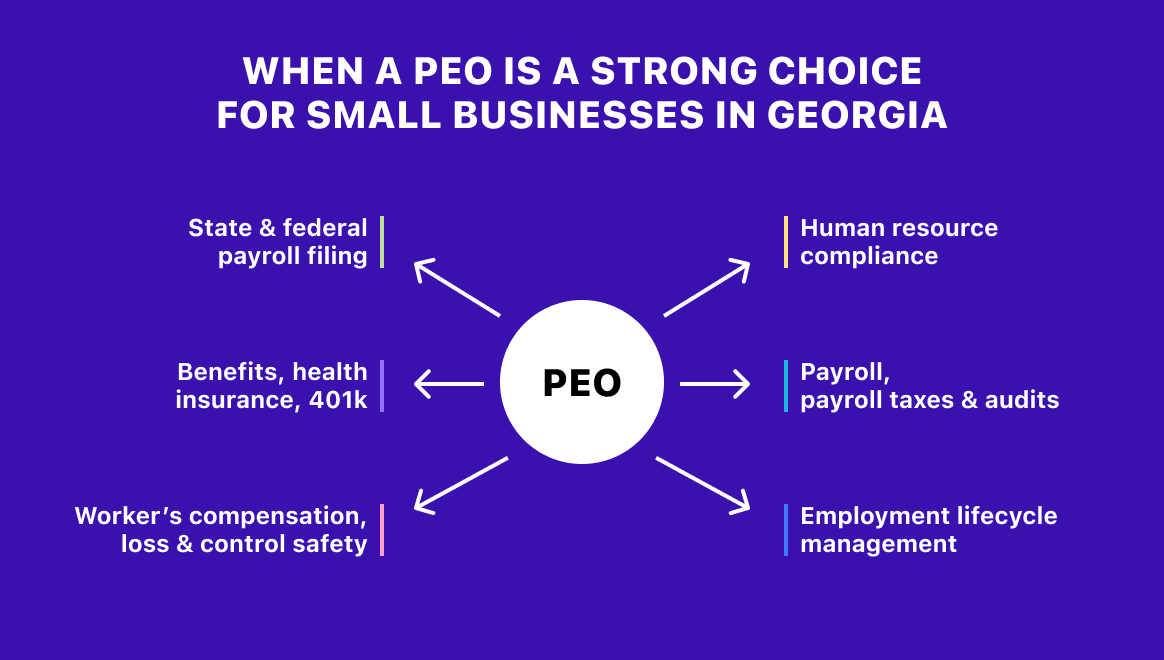
A PEO can be powerful when the conditions are right.
A PEO is the right model if:
1. You Already Have a Georgian Entity
This is non-negotiable.
No entity = PEO is impossible.
2. You Have a Growing Team
Once you pass 10+ employees, HR work becomes a real operational burden.
A PEO becomes cheaper than hiring an internal HR manager.
3. You Need Strong Compliance Support
If you’ve struggled with:
- Payroll errors
- Leave tracking
- Policy creation
- HR documentation
A PEO stabilises everything.
4. You Want Better Benefits to Stay Competitive
If you want to retain qualified talent in Tbilisi or Batumi, better health insurance and structured benefits matter.
5. You Want Predictable HR Costs
A PEO gives small businesses big-company HR infrastructure without big-company headcount.
In these scenarios, a PEO helps you scale cleanly.
When a PEO Becomes a Liability
A PEO is not always the hero in the story.
A PEO becomes a problem when:
1. You Don’t Have a Georgian Entity
This is the biggest mistake foreign companies make.
A PEO cannot legally employ people for you.
If you try to use one anyway, you risk misclassification and tax violations.
2. You Only Need 1–3 Employees
PEO fees are often too high for very small teams.
The EOR services model is cheaper, cleaner, and faster.
3. You Want to Hire Quickly
PEO setups take time because they sit on top of your existing entity.
An EOR can hire in days.
4. You Don’t Want Payroll Liability
Under a PEO, you are still the legal employer.
If anything goes wrong, the Revenue Service comes to you, not the PEO.
5. You Want to Expand Beyond Georgia
A PEO model does not scale across borders.
An EOR model does, which matters in the Caucasus region.
This is why small businesses often start by searching “PEO vs Employer of Record” and end up choosing EOR services in Georgia instead.
How to Choose the Right PEO in Georgia
If you already operate a Georgian company and want a PEO, here’s what to evaluate:
1. Compliance Experience in Georgia
Do they actually understand:
- Georgian labour law
- Georgian payroll cycles
- Pension rules
- Local reporting formats
Global providers rarely do.
2. Transparent Pricing
Avoid PEOs that:
- Cannot provide a full line-item breakdown
- Avoid explaining percentage-based fees
- Hide benefit markups
3. Benefits Access
Ask what your employees get.
Ask if plans are local or generic.
Ask if premiums are marked up.
4. HR Technology
Look for:
- Localised paystub formats
- Self-service portals
- Clean onboarding workflows
5. Contract Flexibility
Short-term contracts are ideal for small businesses.
Avoid long lock-in periods.
6. Risk Coverage
Ask specific questions:
- Who handles tax errors?
- Who corrects payroll mistakes?
- Who manages compliance updates?
If the answer is “you,” walk away.
Final Guidance: When PEO Makes Sense, and When Team Up Is the Better Fit
PEOs are helpful.
They make HR cleaner.
They reduce admin.
They give small businesses the structure they usually cannot build alone.
But a PEO is not the right model for companies hiring in Georgia without an entity. It is not the right model for small teams scaling internationally.
And it is not the right model for businesses that want zero compliance exposure.
That is where Team Up operates.
As the leading Employer of Record across the Caucasus region, Team Up gives small businesses exactly what the PEO model cannot:
- Legal employment without a Georgian entity
- Fully compliant payroll and tax handling
- IP protection through enforceable local contracts
- One monthly invoice instead of fragmented HR operations
- Faster onboarding, faster scaling, zero guesswork
If you want HR admin support and you already run a Georgian company, a PEO can help you stay organised.
If you want to hire in Georgia without carrying risk, Team Up is the safer, simpler, more scalable solution.
FAQ
1. What are PEO services for small businesses in Georgia?
PEO services for small businesses in Georgia are HR outsourcing solutions where a Professional Employer Organization manages payroll, benefits, compliance, and HR admin. You stay the operational employer. The PEO handles HR tasks that small teams cannot manage efficiently in-house.
2. What is the difference between a PEO and an Employer of Record (EOR) in Georgia?
A PEO requires your business to have a Georgian legal entity and uses a co-employment model. An Employer of Record becomes the legal employer in Georgia, handles contracts, payroll, and compliance, and lets you hire without opening an entity. Many companies searching “PEO vs EOR” realize EOR is the correct model for cross-border hiring.
3. How does PEO payroll work in Georgia?
PEO payroll services handle income tax withholding, pension contributions, compliance reporting, leave tracking, and payslip generation. It ensures full compliance with Georgian tax and labor laws and eliminates payroll errors — a key reason people search for “PEO payroll meaning.”
4. Do I need a Georgian company to use PEO services?
Yes. A PEO cannot legally employ workers for you in Georgia. PEO services only apply if you have a registered Georgian entity. If you don’t, you must use an EOR to hire legally in Georgia.
5. Are PEO services cost-effective for small businesses?
PEO services can be cost-effective for small businesses with 10+ employees who already operate a Georgian entity. Fees typically follow per-employee-per-month (PEPM) or percentage-of-payroll pricing. Companies with only 1–3 employees usually save more with an EOR model.
6. What does a PEO mean in HR and payroll?
In HR, a PEO (Professional Employer Organisation) shares employer responsibilities with your business. In payroll, a PEO handles tax withholding, statutory filings, pension contributions, and employee records. Searches like “PEO meaning in payroll” and “what does PEO stand for in HR” point to this same definition.
7. What services does a PEO provide in Georgia?
A Georgia-ready PEO typically offers:
- Payroll processing
- HR admin
- Benefits administration
- Compliance guidance
- Employee onboarding
- Risk management. These services support small businesses that lack internal HR infrastructure.
8. Is a PEO or EOR better for hiring remote employees in Georgia?
If you do not have a Georgian entity, an EOR is the only compliant choice. If you do have an entity and want to outsource HR operations, a PEO works. Searches for “EOR vs PEO” or “PEO vs Employer of Record” usually lead small businesses toward EOR when hiring their first remote employees.
9. What are the hidden costs of PEO services?
Hidden PEO costs often include setup fees, administrative add-ons, benefits markups, minimum contract requirements, and additional reporting charges. Always request full cost transparency before signing a contract.
10. How do I choose the best PEO service provider in Georgia?
Look for:
- Georgia-specific compliance expertise
- Transparent pricing (avoid unclear percentage-based fees)
- Strong payroll technology
- Scalable HR support
- Clear responsibility for tax filings and errors
If you want to hire in Georgia without opening a local entity, choose an EOR provider like Team Up instead of a PEO.
.svg)


