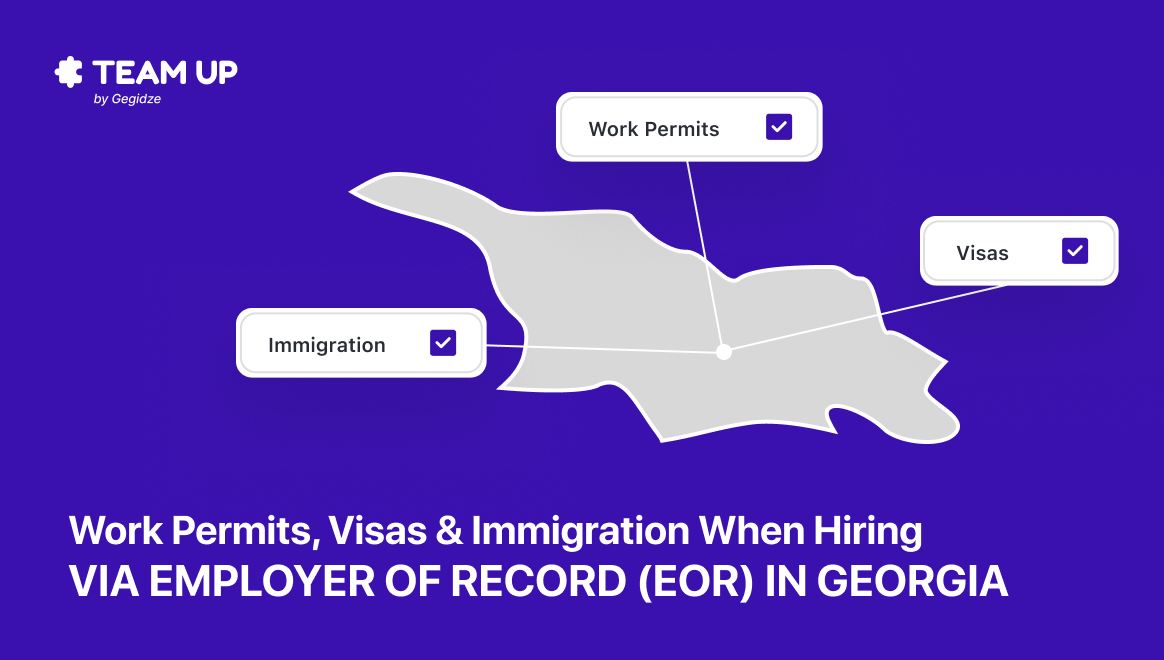
Work permits, visas & immigration when hiring via Employer of Record (EOR) in Georgia
Introduction
Hiring in Georgia is easy until you bring immigration into it.
Suddenly, you’re asking questions like:
- “Do I need a visa to hire someone in Tbilisi?”
- “Can my employee live there on a tourist stamp?”
- “Who’s supposed to file the paperwork, again?”
Here’s the short version: Georgia is one of the most flexible countries in the world for remote work and business relocation. But “flexible” doesn’t mean “lawless.”
If you’re hiring foreign talent, relocating a team member, or even just onboarding someone already living in Georgia, immigration compliance still matters. A lot.
This is where the Employer of Record (EOR) model makes your life easier.
An EOR in Georgia lets you:
Hire legally without opening a local entity
Avoid visa and work permit errors
Onboard foreign or local employees fast
Stay 100% compliant with labor and immigration law
In this guide, we’ll break down exactly how work permits, visas, and immigration work when hiring through an EOR in Georgia with zero fluff and no law firm invoices required.
Let’s make this easy.
Immigration in Georgia: Quick overview

Here’s the first thing you should know about Georgia: the government actually wants you here.
Not in a gimmicky “digital nomad paradise” way. In a real, policy-backed, startup-friendly way.
More than 90 nationalities can enter Georgia visa-free for up to 365 days, yes, an entire year without needing a single document beyond their passport. That includes citizens of the US, UK, EU, Canada, Australia, and most of Latin America and Southeast Asia.
So technically, your new hire could fly into Tbilisi tomorrow, open their laptop, and start working. No visa run. No permit. No questions asked.
But here’s where things get slightly more real:
If someone’s staying in Georgia long-term, especially as an employee under a formal contract, immigration law does start to apply.
That’s where residence permits come into play. They’re required for:
- Foreign nationals who stay beyond 365 days
- People relocating families or dependents
- Employees are being hired locally on a contract
- Anyone who wants to open a local bank account or register with tax authorities
The good news?
Georgia’s immigration process is simpler than most, and when you’re hiring through an Employer of Record (EOR), you don’t have to figure it out yourself.
The EOR handles all of it: legal employment, tax registration, residency paperwork, and immigration tracking. So you can hire talent in Georgia without crossing legal lines or trying to explain a tourist visa to a labor inspector.
Understanding Georgia’s visa-free policy (365 days)
Georgia’s visa policy is the kind of thing that sounds fake until you check it twice.
90+ countries. 365 days. No visa required.
No embassy visits. No consulate appointments. No “apply in advance” drama.
If your employee holds a passport from the US, UK, EU, Canada, Australia, or most Latin American and Asian countries, they can live and work remotely from Georgia for a full year, hassle-free.
But here’s what that really means (and doesn’t mean):
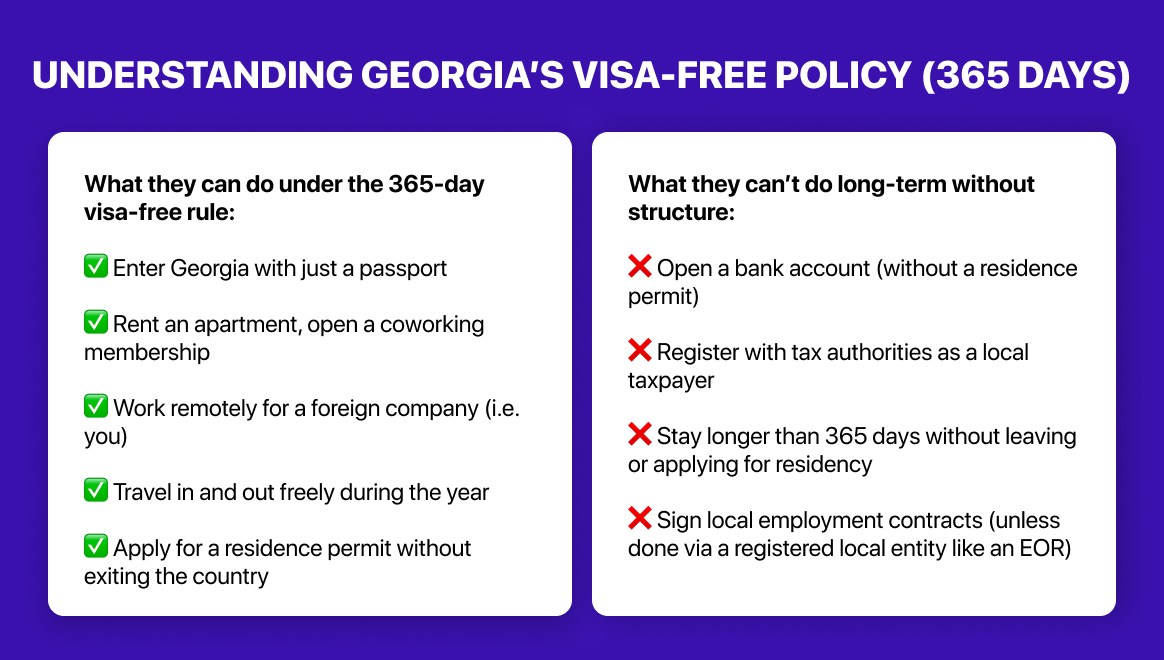
What they can do under the 365-day visa-free rule:
- Enter Georgia with just a passport
- Rent an apartment, open a coworking membership
- Work remotely for a foreign company (i.e. you)
- Travel in and out freely during the year
- Apply for a residence permit without exiting the country
What they can’t do long-term without structure:
- Open a bank account (without a residence permit)
- Register with tax authorities as a local taxpayer
- Stay longer than 365 days without leaving or applying for residency
- Sign local employment contracts (unless done via a registered local entity like an EOR)
That’s where things start to blur.
If your contractor or employee is living in Georgia and working full-time for your company, local authorities might consider that “employment on Georgian soil.”
And that opens the door to questions about taxes, social contributions, and compliance.
Which is why many companies choose an Employer of Record in Georgia, so that long-term stays, remote work, and employment contracts are all handled legally and transparently, no guesswork involved.
Visa-free doesn’t mean responsibility-free. And if your team plans to stick around, you’ll want to do things right from day one.
Work permits & residence permits in Georgia: What's the difference?
Let’s clear this up once and for all:
Georgia doesn’t use classic “work permits” the way most countries do.
There’s no employer sponsorship system. No job offer pre-approvals. No bureaucratic limbo while your employee waits for a green light just to enter the country.
Instead, Georgia handles employment-based immigration through residence permits.
Yes, really.
That means if you’re hiring foreign nationals to live and work in Georgia, whether they’re your full-time developer, remote project manager, or relocated sales lead, what they need is a residence permit tied to employment, not a standalone work visa.
So, what exactly is a residence permit in Georgia?
A residence permit is a legal document that allows a non-citizen to:
- Live in Georgia long-term (beyond the 365-day visa-free period)
- Work legally under a Georgian employment contract
- Access healthcare, banking, and local services
- Avoid visa runs or legal grey zones
There are different types (study, family reunification, investment), but for employees hired via an EOR, the relevant type is the “residence permit based on labor activities.”
It’s typically valid for 1 to 5 years and can be renewed from inside the country.
And what about “work permits”?
They’re not part of Georgia’s immigration system.
There’s no “pre-authorization to work” like you’d find in Germany, the UAE, or the US.
In Georgia, the right to work comes with the residence permit itself—once that’s issued, your employee is fully legal to work under a Georgian employment contract.
So if you're Googling “how to get a work permit in Georgia,”
The real answer is: you get a residence permit instead.
How does this work with an EOR?
If you’re hiring through an Employer of Record in Georgia, here’s how it plays out:
- Your employee enters Georgia (visa-free) if they qualify, no paperwork needed upfront.
- The EOR signs a legal employment contract on your behalf, in full compliance with Georgian labor law.
- The EOR helps the employee apply for a residence permit, with that contract as the legal basis.
- The employee gets registered with the Georgian tax, pension, and social security authorities.
- They’re now fully legal to work and live in Georgia, no company setup required on your end.
And yes, the EOR also tracks expiration dates, renewals, and any compliance issues tied to that residence permit.
What documents are typically required?
Here’s what the employee will need for their permit application:
- A valid passport
- A signed Georgian employment contract
- A recent passport-size photo
- Proof of address in Georgia (rental agreement or utility bill)
- Application fee (~210 GEL for 30-day processing; faster options available)
All of this is handled either by the EOR or with the EOR’s suppor, so the employee doesn’t have to figure it out alone.
What if the employee is already in Georgia?
No problem. Georgia allows applicants to apply for their residence permit from inside the country, as long as they’re still within their legal visa-free period.
This means you can hire people who are already in Georgia and onboard them through your EOR without forcing them to leave or restart the process from abroad.
Hiring locals vs foreigners: Compliance differences
If you're remote hiring in Georgia, who you hire changes how you hire.
Hiring a Georgian citizen? Easy. No immigration steps, no permit applications, no red tape.
You can sign a local employment contract through your Employer of Record (EOR), run payroll in GEL, register them with the tax office, and you’re done.
Hiring a foreigner? Still doable. But you’re playing with a different rulebook.
Let’s break down how hiring locals and foreigners differs when it comes to compliance in Georgia, and how your EOR keeps everything above board.
Hiring Georgian nationals
Here’s what happens when your new hire is a Georgian citizen:
- No visa or residence permit required
- Employment contract must be compliant with Georgian labor law (language, clauses, benefits)
- Employee is registered with the Revenue Service, Pension Fund, and Social Security
- Payroll is run in local currency (GEL), with taxes and contributions deducted at source
Your EOR in Georgia handles all of this. Fast, clean, and fully legal.
Hiring foreign nationals
This is where things get layered. If your hire isn’t a Georgian citizen and plans to live in Georgia, you need to consider:
- Immigration status (Are they on a tourist stay? Visa-free? Already residing?)
- Residence permit application (Required for long-term employment)
- Contract structure (Must align with labor law + support permit application)
- Registration with local authorities (Tax ID, social fund, pension)
With foreigners, even if they’re in Georgia on a 365-day visa-free entry, you still can’t skip legal employment steps. Once they’re working full-time for your company and living in the country, they need to be legally employed under a Georgian entity, which is exactly what your EOR provides.
Why does this matter?
Because misclassifying foreign hires, or skipping permit applications, can lead to:
- Tax violations
- Invalid contracts
- Fines from labor inspectors
- Even deportation for the employee
And yes, all of that has happened before.
EOR = built-in compliance for both cases
Whether you're hiring locals or relocating foreign talent, your EOR makes sure:
- Contracts are compliant
- Payroll is clean
- Immigration status is legal
- You’re never caught off guard by an audit
In short: locals are plug-and-play.
Foreigners need a few more legal steps.
But with the right EOR partner, you never feel the difference.
Step-by-step: How an EOR manages immigration & visas
Hiring internationally sounds fun, until someone brings up visa paperwork.
That’s why smart companies use an Employer of Record (EOR) in Georgia. Because the second you add immigration to the mix, every small misstep can cost you time, money, or legal standing.
Here’s how a qualified EOR makes the entire process smoother than a glass of Georgian wine:
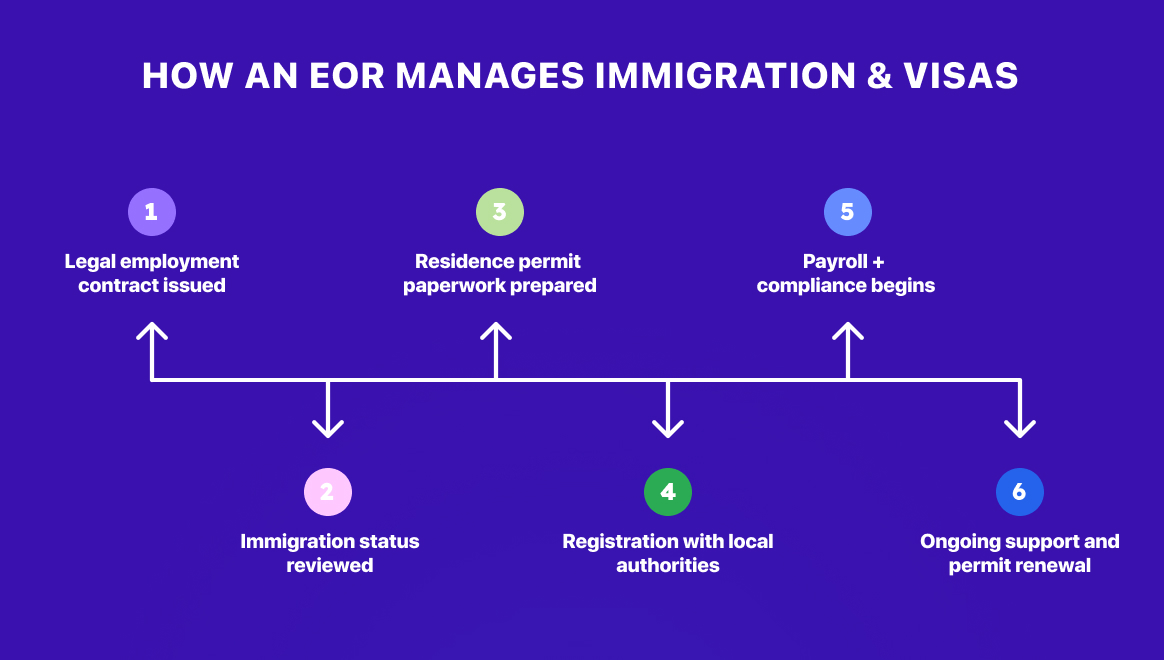
Step 1: Legal employment contract issued
The EOR drafts and signs a compliant employment contract with your new hire.
- Dual language (Georgian + English)
- Structured around Georgian labor law
- Includes job title, salary in GEL, probation, benefits, and IP protection
This contract becomes the foundation for the residence permit application, no generic templates here.
Step 2: Immigration status reviewed
Your EOR reviews your employee’s entry status:
- Are they in Georgia already (visa-free)?
- Are they planning to relocate?
- Do they need help applying for a residence permit?
No guessing, no Googling. They check eligibility and make a plan.
Step 3: Residence permit paperwork prepared
The EOR collects the required documentation:
- Passport scan
- Signed employment contract
- Address confirmation in Georgia (rental or utility bill)
- Application form + photo
Then they guide the employee through the online or in-person application process.
Standard processing takes about 30 days, with expedited options available (10-day or 20-day turnaround).
Step 4: Registration with local authorities
Once the residence permit is issued, the EOR registers the employee for:
- Personal Tax Number (TIN)
- Social Security
- Pension Fund
- This unlocks access to healthcare, banking, and ensures legal tax contributions.
Step 5: Payroll + compliance begins
The employee is now officially on payroll.
Your EOR handles:
- Monthly salary payment in GEL
- Income tax withholding (20%)
- Social security contributions
- Payslip generation and tax reporting
- Compliance tracking for audits or renewals
Step 6: Ongoing support and permit renewal
Most residence permits are valid for 1 year (extendable).
Your EOR monitors expiry dates, starts renewals early, and ensures zero gaps in legal status.
They also update employment contracts if the role or compensation changes.
Legal risks of mishandling immigration & visas in Georgia
Georgia makes hiring easy, but not lawless.
Yes, it’s flexible. Yes, it’s business-friendly. But if you cut corners on immigration or try to wing it without understanding the rules, the consequences hit fast and hard. And if you’re hiring international talent to live in Georgia, you can’t afford to get this wrong.
Here’s what happens when companies treat immigration like an afterthought.
Misclassifying employees as freelancers

You hire someone full-time, manage their hours, give them tasks, and include them in your Slack.
But you call them a “contractor” and skip the legal employment route.
In Georgia, that’s misclassification.
It opens you up to:
- Audits from tax authorities
- Retroactive fines and social fund penalties
- Legal claims from the contractor (yes, they can sue)
- Even risk to IP ownership if the contract isn’t valid under labor law
Hiring foreigners on tourist status
They enter Georgia visa-free. Great. You sign a remote contract and think you’re in the clear.
Wrong.
If they live and work in Georgia long-term without a residence permit, they’re:
- Violating immigration law
- Not registered with the tax system
- At risk of being deported or fined
- Exposing your company to cross-border tax compliance issues
Tourist stays aren’t a legal basis for employment. Not in Georgia. Not anywhere.
Skipping formal tax registration
No TIN? No social security registration? No payroll tax deductions?
That’s not a smart lean team; it’s a liability.
Penalties may include:
- Fines for every unregistered employee
- Employer blacklisting from future local hires
- Delays in future work permit processing for your team
Why this matters for your company
If you’re hiring in Georgia to save money or move fast, that’s fair.
But legal non-compliance doesn’t just hit your ops team. It hits your entire business:
- Your fundraising (no investor wants legal risk)
- Your reputation (non-compliance spreads fast in the remote world)
- Your team morale (no one likes an employment mess)
- Your bottom line (fines in GEL still cost real dollars)
Pros & cons: Direct immigration handling vs using an EOR
Let’s say you’re expanding into Georgia.
You’ve found a brilliant candidate in Tbilisi, or maybe you want to relocate someone there.
Now you’re choosing between two paths:
Option A: Handle immigration, employment, and compliance yourself.
Option B: Use an Employer of Record (EOR) to do it for you.
Here’s what that decision actually looks like when you strip away the buzzwords.
| Factor | Direct Handling (DIY) | Using an EOR in Georgia |
| Legal entity required | Yes — must register a local company | No entity required |
| Visa and residence permit support | You're responsible or need to hire local counsel | EOR manages everything, including documentation |
| Employment contracts | Must be drafted and translated in compliance with labor law | Provided by EOR, fully compliant and bilingual |
| Tax registration and payroll setup | Handled manually, requires deep local knowledge | Fully managed and automated by the EOR |
| Government filings and renewals | You stay on top of them or face fines | Monitored and filed by the EOR |
| Onboarding speed | Slow, often 1 to 3 months depending on setup | Fast, typically under 2 weeks |
| Compliance risk | High, missteps can trigger fines or employee misclassification | Low, EOR assumes legal responsibility |
| Control over HR/legal ops | Full control, but also full liability | Less direct control, but streamlined and secure |
| Scalability | Complex and expensive as you grow | Scales instantly without new legal setup |
| Total cost | High upfront and ongoing admin/legal costs | Predictable monthly fee with no surprise penalties |
So, when does direct handling make sense?
You might go that route if:
- You’re setting up a large physical office or long-term presence in Georgia
- You need total ownership of HR, tax, and legal infrastructure
- You already have in-house legal and finance teams who know local law
But if you’re building a distributed team, hiring a few key people, or testing a new market, an EOR is the smarter move.
No entity, no delays, no immigration headaches. Just clean, legal hiring on your terms.
What skills and roles can you easily hire via EOR in Georgia?

Let’s get one thing straight: Georgia isn’t just a great place to open a bottle of Saperavi and admire the mountains. It’s also one of the most overlooked talent hubs in Eastern Europe.
You’re not hiring here as a favor to the region; you’re hiring here because the talent is sharp, available, and surprisingly affordable.
With an Employer of Record (EOR) in Georgia, you can tap directly into this market without setting up a local entity, battling tax bureaucracy, or worrying about misclassification. You get fully compliant employment and full access to the kind of professionals who can actually move your business forward.
So, who’s in the talent pool?
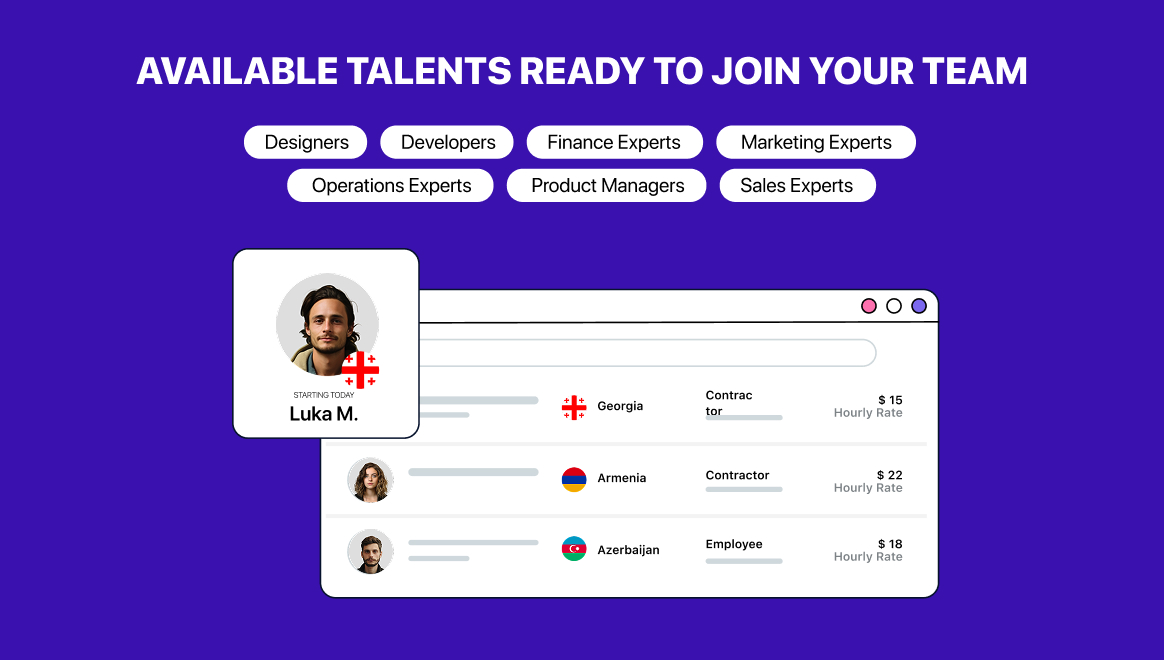
These are the roles international companies are hiring through EORs right now:
Tech & Engineering
- Frontend Developers (React, Angular, Vue)
- Backend Developers (Node.js, Python, Java, PHP)
- Mobile Developers (iOS, Android, Flutter)
- DevOps & Infrastructure Engineers
- QA Engineers (Manual + Automation)
- Data Scientists and Analysts
Creative & Product
- UX/UI Designers
- Product Designers
- Content Creators
- Video Editors and Animators
Operations & Business
- Project Managers
- Product Owners
- Virtual Assistants
- HR & Talent Coordinators
Sales & Support
- Sales Development Reps (English-speaking)
- Account Managers
- Bilingual Customer Support (EN/RU, EN/DE)
Finance & Admin
- Accountants familiar with EU/US standards
- Bookkeepers and Payroll Specialists
- Executive Assistants
Why hire them via EOR instead of freelancing platforms?
Because these aren’t short-term gig workers.
They’re long-term, committed professionals looking for stability, not just side projects. And hiring them through an EOR gives you:
- Legally protected contracts
- IP ownership
- Clean tax reporting
- Access to benefits like healthcare and paid leave
Which means you’re not just hiring fast, you’re hiring right.
If you're scaling up and tired of juggling contractors and patchy compliance, this is the easiest way to hire and manage a remote team that actually feels like a team.
And Georgia? It's where you’ll find the talent pool you didn’t know you needed.
EOR checklist: Immigration & compliance
Hiring in Georgia through an Employer of Record (EOR) isn’t just a shortcut; it’s a system. One that removes the guesswork, clears the legal minefield, and gets your employee fully operational without the usual visa drama.
But even with an EOR doing the heavy lifting, you still need to know what’s being handled.
The compliance checklist for EOR services in Georgia lays out every critical compliance box your EOR should be checking, no fluff, no filler.
Immigration & Work Authorization
- Assess the employee’s nationality and entry status (visa-free, residence permit, etc.)
- Guide foreign employees through the residence permit application
- Handle all required documentation: passport, contract, proof of address, photos
- Submit a residence permit application and track the processing status
- Renew permits before expiry; monitor for legal changes
Legal employment setup
- Draft and issue bilingual employment contract (Georgian + English)
- Align job role, salary, and terms with Georgian labor law
- Register the employee as a legal worker in Georgia
- Ensure correct classification: employee vs contractor
Tax & Payroll registration
- Register the employee with the Georgian Revenue Service
- Set up Tax ID number (TIN)
- Enroll in the social security and pension fund
- Withhold and pay the correct monthly taxes and contributions
- Provide compliant payslips and handle end-of-year tax reporting
Benefits & Labor Law Compliance
- Track and administer mandatory benefits (vacation, sick leave, parental leave)
- Maintain health and accident insurance registrations if required
- Enforce working hours, overtime rules, and rest day policies
- Include all necessary IP, confidentiality, and non-compete clauses in contracts
Recordkeeping & Audit Readiness
- Maintain secure records of:
- Contracts
- Immigration documents
- Payroll submissions
- Tax filings
- Be prepared for labor inspections or audits from local authorities
If your EOR can’t tick every box above, you’re not fully covered.
And in international hiring, “almost compliant” is the same as “legally exposed.”
The right EOR in Georgia doesn’t just move fast—they move precisely.
So you get the team you want, without any legal hangovers.
Conclusion
Georgia isn’t just a great place to find top talent; it’s a smart strategic move.
You get a visa-friendly country, competitive salaries, a highly skilled workforce, and fast onboarding timelines. But if you try to navigate the local laws, immigration process, and payroll systems without support, things get messy fast.
That’s where an Employer of Record (EOR) changes the game.
You avoid:
- Entity setup delays
- Risky freelancer arrangements
- Residency permit confusion
- Tax and compliance headaches
You get:
- A legal, compliant structure to hire locals or relocate foreign talent
- All contracts, taxes, and benefits are handled correctly
- A streamlined hiring process that protects your business and your people
In short?
If you're serious about building a global team and you want to do it right, an EOR isn’t a nice-to-have. It’s essential.
Team Up has already helped dozens of companies scale into Georgia legally, quickly, and confidently. We’re not here to slow you down; we’re here to make sure you move fast without breaking the law.
Ready to hire in Georgia without the red tape?
Let’s talk. We'll handle the paperwork, so you can focus on your team.

.svg)