Guide to the top 5 trends in Employer of Record services in Eastern Europe for 2026
Introduction
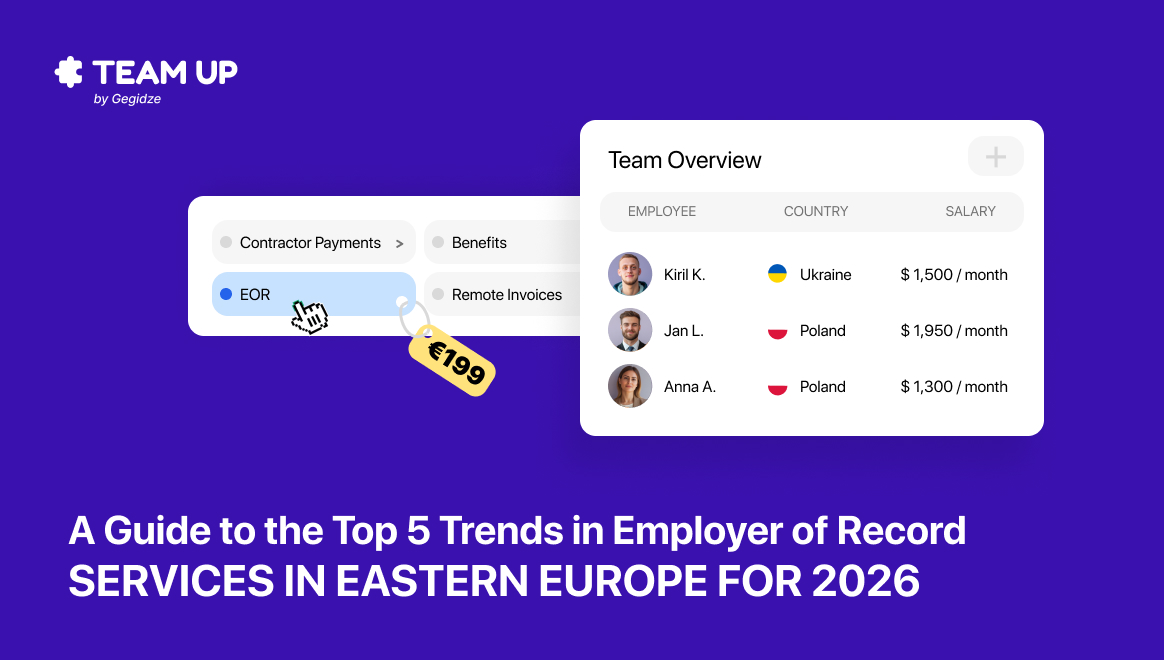
An Employer of Record hires employees on your behalf and carries the full legal responsibility.
You manage the work.
The EOR handles local compliance, employment contracts, and payroll taxes.
Hiring in Eastern Europe without an EOR increases the risk of fines, misclassification, tax violations, and worker claims.
These issues are common when companies hire before understanding the rules in each country.
An EOR removes that risk and gives you a clean, compliant structure from day one.
This guide walks through the top trends shaping Employer of Record services in Eastern Europe for 2026
The goal is simple: help you hire safely, quickly, and with full confidence across multiple countries.
Why Eastern Europe is becoming a major EOR hub in 2026
Eastern Europe is attracting more global companies every year.
It offers talent density, competitive salaries, and large multilingual workforces.
EOR adoption is rising because companies want the benefits of hiring in the region without building legal entities in each country.
Large multilingual workforce
English proficiency is high.
German, Russian, French, and Turkish are common in many markets.
This makes the region ideal for support, operations, and engineering teams.
Strong technical and operational talent
Eastern Europe has mature talent in:
- Engineering (Software Development, R&D)
- QA (Quality Assurance & Testing)
- Cybersecurity (IT Security, Compliance)
- Finance (Accounting, Financial Planning & Analysis, Treasury)
- Operations (Logistics, Supply Chain Management, Internal Process Optimization)
- Customer Support (Multilingual Service, Technical Support)
Competitive and sustainable salaries
Costs are lower than in Western Europe and more predictable than in emerging markets with volatile currencies.
Faster onboarding with an EOR
Companies skip entity setup and onboard employees through compliant local contracts in days, not months.
Avoiding complex multi-entity setups
Operating in Poland, Romania, Bulgaria, the Baltics, and the Balkans requires separate registrations.
Most companies want the talent without the administrative overhead.

Trend #1: Companies are moving away from contractors
Countries across Eastern Europe are tightening enforcement around worker classification.
If someone works like an employee, regulators expect them to be employed, not contracted.
Labor inspections are becoming more frequent
Authorities now check how companies structure their workforce.
Contractor misuse often results in back taxes and penalties.
Contractors create IP and data risks
Freelancer contracts often fail to meet local legal standards.
EOR employment provides enforceable IP assignment and stronger data protection.
Payroll predictability matters
Contractor payments vary by bank, platform, and currency.
EOR payroll removes irregularities and ensures that payroll taxes are handled correctly.
Talent prefers proper employment
Workers want stability and benefits.
Contract roles are losing appeal across the region.
Trend #2: EOR is now the fastest hiring route in Eastern Europe
Foreign employees need compliant contracts for residency and permit applications. Contractors do not qualify.
Direct hiring slows onboarding
Without a local entity, companies face delays registering tax IDs, payroll accounts, and reporting systems.
EOR contracts and payroll setup are immediate
The EOR already has the legal infrastructure. Employees can start in days instead of weeks or months.
Foreign specialists prefer EOR-supported relocation
A clean employment structure speeds up immigration processes and reduces documentation issues.
Administrative bottlenecks shift to the EOR
Team Up handles contracts, registrations, tax setup, and required filings.
Trend #3: Companies Want Transparent EOR Costs in Eastern Europe

Companies want predictable billing, not fees that increase every time someone receives a raise.
Monthly invoices must be simple
One invoice.
Clear salary.
Clear taxes.
Clear employer contributions.
Companies want a visible cost breakdown
When reviewing an Employer of Record (EOR) in Eastern Europe invoice, these four elements must be clearly itemized to ensure transparency, compliance, and accurate budgeting.
- Salary: This is the employee's Gross Monthly Salary. It should be clearly stated before any deductions (employee taxes, contributions). This line ensures you are tracking the agreed-upon compensation.
- Payroll Taxes: This must be a detailed breakdown of all mandatory Employer and Employee contributions remitted to the local authorities. This typically includes:
- Employer Contributions (e.g., social tax, health insurance premiums).
- Employee Withholdings (e.g., Personal Income Tax (PIT), mandatory pension contributions). This line is crucial for verifying legal compliance in the EOR country.
- Benefits: This itemizes the specific costs associated with administering statutory and voluntary benefits, such as:
- Mandatory Statutory Benefits (e.g., state health insurance portion, if applicable).
- Voluntary Enhanced Benefits (e.g., premium private health insurance or supplemental pension plans you choose to offer).
- EOR Fee: This is the fixed, flat-rate administrative charge you pay the EOR provider for managing the entire compliance, payroll, and HR framework. This fee should be consistent month-to-month, providing the budgetary predictability that variable percentage models lack.
CFOs reject hidden charges
Opacity slows down approvals. Transparency increases trust.
Local compliance demands accurate tax mapping
Each country has different requirements for payroll taxes and social contributions. The EOR needs to apply them correctly to prevent future penalties.
Trend #4: EOR providers are becoming full people-ops partners

Companies expect EOR providers to handle local laptop delivery, replacement, and asset tracking.
This removes cross-border shipping delays and reduces internal admin.
Workspace options matter
Teams in Eastern Europe often prefer hybrid setups. EOR providers support this by offering coworking access and WFH stipends that match local norms.
Health insurance and benefits require local administration
Each country has its own expectations for private insurance, leave rules, and statutory benefits. EOR providers manage these, so companies stay compliant and competitive.
HR support reduces internal workload
Leave questions. Attendance. Local policy guidance. EOR teams handle daily HR tasks that would otherwise fall on internal staff who don’t know local rules.
Compliance-aligned documentation protects the company
Probation, performance, and termination documentation must match local labor law. EOR providers prepare the correct documents so companies avoid disputes.
Full onboarding and offboarding are handled by the EOR
This includes contract creation, payroll setup, final payments, and required filings.
Companies stay focused on work instead of navigating local employment processes.
Trend #5: Regional Expansion Is Driving EOR Adoption
It connects Western Europe, Central Asia, and parts of the Middle East. Companies use it as a base for cross-regional operations.
Multilingual talent is easy to build
English, German, Polish, Russian, Romanian, Turkish, and Balkan languages are widely available. This allows companies to serve multiple markets without adding multiple entities.
Strong engineering and operations talent
The region has deep experience in engineering, QA, DevOps, support, finance, and shared service roles. Many companies build entire teams here, not just isolated positions.
Better timezone coverage for global teams
Eastern Europe overlaps well with both Western Europe and Asia. This makes it ideal for teams that need extended hours or follow-the-sun support.
EOR removes multi-entity complexity
Without EOR, expansion means registering separate entities in each country. With EOR, companies hire across the region through one partner.
What Companies Want Most from EOR Services in Eastern Europe

Companies want a hiring model that removes risk and simplifies operations across multiple countries.
They look for:
- Predictable Hiring: Ensures the client can onboard talent within days, bypassing the months-long legal entity setup required for traditional expansion. This delivers speed to market.
- Local Compliance Certainty: Guarantees that all employment practices, from contracts to tax filings, adhere strictly to the specific, complex local labor laws. This provides legal assurance.
- No Legal Surprises: Acts as the legal firewall, preventing client exposure to common risks like misclassification fines, wrongful termination claims, and tax penalties. This ensures risk mitigation.
- Transparent Costs: Offers flat-rate pricing with no hidden fees, allowing CFOs and finance managers to accurately budget for global payroll and expansion. This drives financial predictability.
- Strong HR Support: Provides localized expertise, administering competitive benefits, handling day-to-day HR queries, and guiding compliance on statutory leave. This ensures talent retention.
- Reduced Risk Exposure: Achieves the ultimate goal: the complete transfer of legal employment liability from the client company to the EOR. This is the core value transfer.
Team Up delivers this by handling compliance, payroll taxes, employment contracts, and ongoing HR support. Companies stay in control of work while TeamUp carries the legal burden.

How to choose the right Employer of Record provider in Eastern Europe
Choosing the correct Employer of Record (EOR) partner is a critical decision that determines the speed, cost, and legal safety of your expansion into Eastern Europe. With diverse labor laws and tax regimes across countries like Poland, Romania, and the Baltics, a generic provider simply won't suffice.
Use this checklist to thoroughly vet potential EOR providers and ensure they meet the high standards required for protected, multi-country hiring in the region:
| Evaluation Area | Key Action / Verification Point | Strategic Value |
| Local Expertise & Compliance | Verify that the provider has strong local compliance expertise across all targeted Eastern European countries, including knowledge of current social tax rates and labor code amendments. | Mitigates Risk: Guarantees adherence to mandatory local regulations. |
| Contractual Integrity | Check whether employment contracts follow local labor rules and include compliant terms regarding probation, termination, and IP assignment. | Ensures Enforceability: Protects your business from contract invalidation and employee litigation. |
| Pricing & Transparency | Confirm that the pricing model is transparent with a fixed monthly fee. Reject percentage-based fees, which lead to volatile costs. | Drives Predictability: Allows CFOs and finance managers to accurately budget and control costs. |
| Benefits Administration | Ensure the provider can administer both statutory and voluntary benefits (e.g., private health insurance) according to country-specific standards. | Attracts Talent: Ensures your compensation package is competitive and legally compliant. |
| Immigration & Mobility | Review whether the EOR actively supports immigration for foreign specialists, including managing work permits and visa applications. | Secures Talent: Speeds up the legal relocation process for cross-border hires. |
| Legal Structure | Check that the provider operates a registered legal entity in each country they cover (avoiding risky third-party subcontractors). | Guarantees Accountability: Ensures direct control over payroll and compliance processes. |
| Platform Reliability | Assess whether the platform manages onboarding and payroll reliably with documented compliance workflows and secure data handling. | Creates Efficiency: Ensures timely, error-free administration and data security for global operations. |
By prioritizing these verification steps, you convert a potential compliance headache into a strategic, protected expansion route.
Final takeaway: Eastern Europe’s EOR market is accelerating fast
Eastern Europe is becoming a global hiring hub.
Talent pool is deep. Salaries are sustainable. English levels are high.
At the same time, compliance requirements are getting stricter.
Companies want speed and safety in the same solution.
That’s why EOR has become the default hiring model across the region.
TeamUp provides the cleanest, safest hiring structure for Eastern Europe.
You manage your team.
We handle the compliance, payroll taxes, contracts, and HR processes.
One system. No friction.
Team Up makes hiring across Eastern Europe simple and fully compliant.
.svg)