


What Is a PEO? Understanding Professional Employer Organizations in Uzbekistan
Introduction
If you're searching for what is a PEO in Uzbekistan, you already know you’re not dealing with a simple hiring market. Uzbekistan is growing fast. The tech ecosystem is maturing.
The government is modernising tax and labour systems. And companies entering the country quickly realise that “just hiring a few people” comes with more paperwork, more oversight, and more rules than expected.
This is the moment when founders start googling PEO.Because on the surface, PEO looks like the magic button.
“Let someone else run HR.”
“Let someone else handle payroll.”
“Stay compliant without the hassle.”
That would be nice.It’s not how Uzbekistan works.
A PEO in Uzbekistan is not a compliance shield.
It’s not a shortcut around entity registration.
And it’s definitely not a way for a foreign company to hire without becoming a legal employer.
A PEO is a support tool, one that only works after you already have the legal infrastructure to hire properly in Uzbekistan. And if you don’t have that yet, or you’re not ready to commit, you’re looking for an EOR instead.
You won’t hear this from every provider.But you should, because the consequences of misunderstanding this model can get expensive very fast.
Let’s walk through the real structure. The real risks. And the real scenarios where PEO can either help or quietly derail your expansion.

What Is a PEO?
A Professional Employer Organisation (PEO) in Uzbekistan is a company that takes over parts of your HR and payroll operations, but not your employer responsibilities.
The distinction matters more here than in most markets.
In Uzbekistan, a PEO:
- Does not employ people on your behalf
- Does not remove your labour law liability
- Does not sign employment contracts
- Does not replace an entity
- Does not protect you from audits
A PEO works only when your company already has a registered legal entity in Uzbekistan.
That means:
- You’re registered with the tax authorities
- You’re registered with the Social Fund
- You maintain local accounting
- You comply with Uzbekistan’s Labour Code
Once those foundations are in place, a PEO can step in and streamline HR operations. Without them, the entire model collapses.
This is the part foreign founders usually underestimate.
They assume “PEO manages HR, so PEO handles compliance.”
No, the employer does.
And in Uzbekistan, the employer of record carries everything from contract validity to tax accuracy to termination risk.
If your goal is to hire without forming a local entity, the correct model is EOR, which Team Up provides region-wide.

What Does PEO Mean in HR and Payroll?
The biggest misunderstanding around PEO comes from thinking it’s a hiring solution. It’s not. It’s an operational solution, and only for companies that are already fully set up in Uzbekistan.
Let’s break it down cleanly.
In HR, PEO means:
- Handling employee files
- Preparing onboarding documents
- Tracking leave
- Managing routine HR paperwork
- Keeping everything tidy enough for an audit
Uzbekistan is documentation-heavy. Missing signatures, mismatched dates, incorrect job descriptions, any of these can all cause real legal problems later. A PEO helps keep the paperwork aligned, but the employer is always you.
In payroll, PEO means:
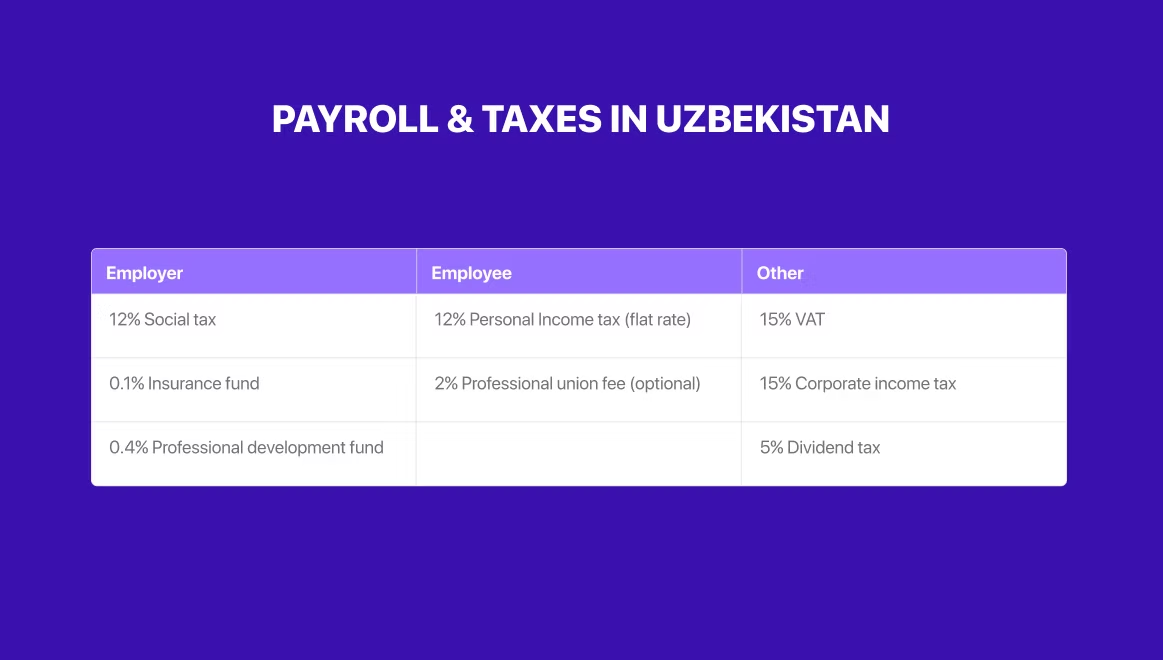
- Calculating salaries
- Managing income tax and social contributions
- Creating legally formatted payslips
- Preparing monthly reports
Payroll in Uzbekistan isn’t complicated because of complexity; it’s complicated because of precision. A single wrong number in a salary report can trigger reconciliation issues months later.
A PEO handles the execution.
You handle the consequences if something is wrong.
That’s the line most founders don’t see until an inspector points at the dotted line with your company’s name on it.
How a Professional Employer Organisation Works in Uzbekistan
To understand whether PEO fits your hiring plan, you need to see the operational sequence, not the marketing promise. Uzbekistan is not a country where “trying things” with the hiring structure goes unnoticed.
Here’s the real workflow.
Step 1: You establish a legal entity in Uzbekistan
This includes:
- Legal registration
- Tax ID
- Social Fund registration
- Local accounting
- A legal address
Until this is done, you cannot legally employ anyone. And you cannot legally use a PEO.
Step 2: Your entity hires employees directly
Your company signs the contract.
Your company is listed everywhere as the employer.
Your company is responsible for compliance with the Uzbek Labour Code.
This includes:
- Working hours
- Overtime
- Leave rules
- Sick pay
- Notice periods
- Termination documentation
Step 3: You engage a PEO
Only at this point can a PEO come in.
Not before.
A PEO handles:
- Payroll processing
- Routine HR documents
- Leave and attendance tracking
- Benefit administration
- Reporting workflows
This takes work off your plate, but not responsibility.
Step 4: You remain liable for everything
A PEO cannot:
- Sign contracts
- Represent you in disputes
- Take responsibility for payroll errors
- Absorb legal liability
- Manage terminations on your behalf
Every compliance obligation funnels back to you, the legal employer.
That’s why PEO is a great operational tool for companies that have already made a long-term commitment to Uzbekistan.
It’s not a shortcut.
It’s an optimisation.
PEO vs Your Team: Who Actually Handles What in Uzbekistan?
This is the part that saves founders from the wrong model choice. Because the line between “handled by PEO” and “handled by employer” is not blurry in Uzbekistan. It is sharp.
Let’s map it clearly.
Payroll Administration
PEO handles:
- Monthly calculations
- Payslips
- Applying correct tax rates
- Social contribution calculations
- Monthly reporting prep
Employer must still handle:
- Correct employment contracts
- Compensation structure decisions
- Salary changes and documentation
- Classification accuracy
- Responding to tax authority questions
- Remediating payroll mistakes
In Uzbekistan, payroll errors don’t disappear quietly.
They re-emerge during Social Fund audits, and penalties attach to the employer, not the PEO.
Benefits Administration
Typical benefits include:
- Health insurance
- Meal allowances
- Transport allowances
- Workspace and equipment provisions
A PEO coordinates documentation.
You decide the structure, and carry the legal consequences.
Once a benefit appears in a contract or policy in Uzbekistan, employees can enforce it. Removing it requires proper legal steps.
Tax Filing and Compliance
PEO supports calculations and reporting.
The employer signs off and carries the risk.
This includes:
- Income tax withholding
- Pension contributions
- Social Fund reporting
- Late filing penalties
- Documentation checks
Uzbek authorities review employer-side filings.
Not PEO-side filings.
HR Management
PEO helps with:
- Onboarding documents
- Standardised HR forms
- Leave balances
- Absence documentation
Employer handles:
- Performance
- Promotions
- Demotions
- Disciplinary actions
- Terminations
Termination in Uzbekistan requires:
- Correct reasoning
- Documentation trail
- Notice procedures
- Potential severance
A PEO cannot protect you if these steps are mismanaged.
PEO vs EOR: The Core Difference in Uzbekistan
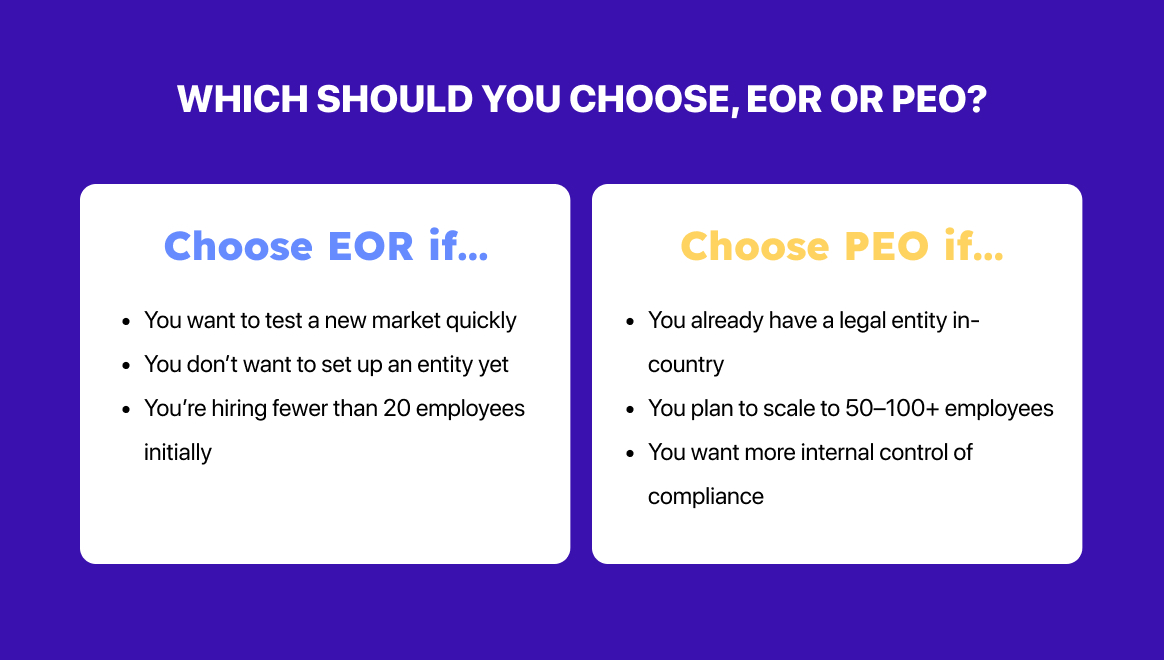
This decision is simpler than people make it.
It just isn’t comfortable.
Ask yourself one question, honestly:
Are you ready to be the legal employer in Uzbekistan today?
If yes, PEO might fit.
If not, PEO will create problems you didn’t plan for.
How PEO works in Uzbekistan
With a PEO:
- Your Uzbek entity is the employer of record
- Your entity signs employment contracts
- Your entity registers employees with the Social Fund
- Your entity files and corrects tax reports
- Your entity answers to labour inspectors
- Your entity carries termination and severance risk
The PEO:
- Runs payroll
- Keeps HR documentation organised
- Supports reporting workflows
That’s it.
PEO supports employment.
It does not assume employment.
How EOR works in Uzbekistan
With an Employer of Record in Uzbekistan:
- You do not need a local entity
- The EOR is the legal employer
- The EOR signs the contract
- The EOR runs payroll and taxes
- The EOR manages Social Fund registration
- The EOR holds compliance and labour law liability

You:
- Manage the employee’s work
- Set goals, priorities, and deliverables
- Stay focused on operations, not bureaucracy
This is why an EOR provider exists in Uzbekistan.
Because becoming an employer here is not just a checkbox. It’s a legal position with consequences.
Benefits of Using a PEO in Uzbekistan (When It Actually Makes Sense)
PEO is not wrong. It’s just often premature.
When the conditions are right, it genuinely helps.
1. Operational order in a documentation-heavy system
Uzbekistan’s labour environment rewards structure.
A PEO brings:
- Consistent HR files
- Standardised payroll cycles
- Predictable reporting
- Fewer “one-off” decisions
This matters once your headcount grows and internal chaos starts creeping in.
2. Reduced internal workload
Payroll and HR administration in Uzbekistan is not hard because it’s complex. It’s hard because it’s unforgiving.
A PEO removes:
- Monthly payroll prep
- Repetitive reporting
- Leave balance tracking
- Manual payslip handling
That saves time for teams that already operate locally.
3. Fewer avoidable compliance mistakes
Most penalties don’t come from fraud.
They come from sloppiness.
A PEO helps prevent:
- Missing documents
- Incorrect payroll timing
- Inconsistent records
- Misaligned employee files
Not because they “take liability,” but because they impose process.
4. Better employee experience
Uzbek employees value stability.
Late payroll, unclear benefits, or inconsistent documentation erodes trust fast.
A PEO helps ensure:
- On-time payments
- Clear documentation
- Consistent communication
This becomes important once you’re hiring competitively.
The honest limitation
None of these benefits matter if you don’t already have an entity.
If you’re still testing the market.
If you’re hiring your first one or two people.
If you’re unsure how long you’ll operate in Uzbekistan.
Then, PEO adds complexity instead of reducing it.
Misconceptions Companies Repeat About PEO in Uzbekistan
These are the mistakes that quietly turn into expensive cleanups.
“PEO lets us hire without setting up a company”
No.
If there is no local employer, there is nothing for a PEO to “co-employ” with.
That model is EOR, not PEO.
“PEO handles compliance”
PEO handles the process.
Compliance belongs to the employer.
If something goes wrong:
- Authorities contact the employer
- Audits target the employer
- Fines attach to the employer
Not the PEO.
“PEO is cheaper than EOR”
Only if you ignore:
- Entity registration
- Accounting costs
- Legal oversight
- HR capacity
- Compliance exposure
- Time spent fixing issues
EOR replaces all of that with one structure.
PEO assumes you already have it.
“We’ll start with PEO and adjust later”
This only works if you already have an entity.
Otherwise, you end up with:
- Contract rewrites
- Employee migrations
- Reporting corrections
- Legal cleanup
EOR → PEO is clean.
PEO → fix everything → compliant structure is not.
Decision Checklist: What is a Professional Employer Organization
No theory. Just reality.
PEO in Uzbekistan makes sense if:
- You already have a registered local entity
- You plan long-term operations
- You understand Uzbek labour law basics
- You can handle employer liability
- You want to streamline HR and payroll
If this describes you, PEO can be a solid operational layer.
PEO does not make sense if:
- You do not have a local entity
- You’re hiring your first employees
- You want speed without bureaucracy
- You want to avoid compliance exposure
- You’re testing Uzbekistan as a market
In these cases, PEO is the wrong tool.
EOR services are the correct ones.
Where Team Up Fits. Cleanly.
Team Up’s role is not to push PEO or EOR.
It’s to stop companies from choosing the wrong model at the wrong time.
In Uzbekistan, that usually means:
- Starting with EOR to hire compliantly without an entity
- Avoiding premature employer obligations
- Keeping payroll, tax, and labour risk off your balance sheet
- Giving you time to validate the market
When operations grow, and an entity makes sense, we help you transition.
Quietly. Cleanly. Without disrupting employees.
No drama.
No rewrites.
No compliance surprises.
Because expanding into Uzbekistan should feel controlled, not fragile.
Frequently Asked Questions
1. What is a PEO in Uzbekistan, in practical terms?
A PEO in Uzbekistan is an operational partner that helps you run payroll and HR administration after you have already set up a local legal entity. The PEO does not employ your staff. Your Uzbek company remains the employer of record, signs contracts, registers employees with the Social Fund, and carries full responsibility for labor law compliance, tax filings, and employment disputes.
In practice, this means a PEO reduces admin workload but does not reduce employer risk.
2. What does PEO actually handle versus what stays with the employer in Uzbekistan?
A PEO typically handles payroll calculations, payslip generation, HR documentation, leave tracking, and reporting workflows. The employer still controls employment contracts, salary structures, bonuses, job titles, terminations, and legal compliance.
If payroll data is incorrect, contracts are misaligned, or terminations are mishandled, Uzbek authorities hold the employer, not the PEO, accountable.
3. Can a foreign company use a PEO in Uzbekistan without opening a local entity?
No. Uzbekistan does not allow PEOs to employ workers on behalf of foreign companies. A PEO can only operate once your company has a registered Uzbek legal entity, tax ID, Social Fund registration, and local accounting.
If you want to hire in Uzbekistan without opening a company, the only compliant option is an Employer of Record (EOR).
4. How does PEO payroll work in Uzbekistan step by step?
PEO payroll in Uzbekistan starts with employment contracts signed by your local entity. The PEO then calculates monthly salaries, income tax, pension and social contributions, prepares payslips, and supports monthly reporting.
However, the employer must ensure contract terms match payroll data. Any discrepancy discovered during audits or Social Fund reviews is corrected by the employer, not the PEO.
5. Is PEO payroll in Uzbekistan considered legally compliant?
PEO payroll can be compliant only if the employer’s structure is compliant. The PEO executes payroll, but it does not take legal responsibility for errors. If salary components are misclassified, benefits are undocumented, or reports are inaccurate, the employer faces penalties and retroactive corrections.
Compliance depends on employer discipline, not the PEO brand.
6. What is the real difference between PEO and Employer of Record (EOR) in Uzbekistan?
The difference is who is legally responsible. With a PEO, your company is the employer and holds all labor, tax, and compliance risk. With an EOR, the EOR becomes the legal employer, signs contracts, runs payroll, manages Social Fund registration, and assumes compliance liability.
PEO is an operational support model. EOR is a legal employment model.
7. When does using a PEO actually make sense in Uzbekistan?
A PEO makes sense when your company already has a registered Uzbek entity, plans long-term operations, employs a growing local team, and has internal legal or HR oversight. At that stage, PEOs help reduce administrative friction and standardise processes.
For first hires or market testing, PEO usually creates unnecessary complexity.
8. Why do companies often choose PEO too early in Uzbekistan?
Most companies choose PEO early because it sounds cheaper and simpler than EOR. In reality, PEO assumes you are ready to be a local employer. When companies discover they still need entity setup, accounting, compliance management, and legal oversight, the “cheap” model becomes expensive.
This mistake is common among fast-moving startups.
9. What risks do companies face if they misuse a PEO in Uzbekistan?
Misusing a PEO can lead to misclassification, invalid employment contracts, unpaid social contributions, and audit penalties. Uzbekistan’s authorities focus on employer-side compliance, not vendor explanations.
If your structure is wrong, the PEO cannot shield you from consequences.
10. Can companies start with EOR and move to PEO later in Uzbekistan?
Yes, and this is often the cleanest path. Many companies hire through an EOR first, validate the market, build a team, then register a local entity and transition to a PEO. This avoids early compliance risk and keeps operations flexible while the business model is still evolving.
.svg)


