Employer of Record Costs in the Netherlands 2026: Full Pricing Breakdown
Our guide to Employer of Record services in the Netherlands covered the EOR model end to end. It explained how the structure works, how it compares to entity setup, and what hiring looks like in practice. Costs got a section, but not the depth they deserve.
This article breaks down Dutch EOR pricing in detail. You will learn what shapes the monthly fee, where hidden charges appear, and how to calculate the real per-employee cost before signing a contract. The Netherlands carries employer obligations that push total employment costs well above gross salary. Understanding those layers matters before you commit to any provider. If you are also weighing provider selection criteria, the companion piece on choosing the best EOR provider in the Netherlands covers that angle.
What Drives EOR Pricing in the Netherlands

Statutory Employer Contributions
The Netherlands imposes employer-side social security contributions that are among the highest in Western Europe. Dutch employers pay into several mandatory schemes. These include the Zorgverzekeringswet (ZVW) healthcare contribution, unemployment insurance (WW/AWf), and disability insurance (WIA/WAO). The combined employer burden typically adds 20% or more on top of gross salary, depending on the employee's earnings and the applicable sector classification.
Sector classification matters more than most companies expect. The Dutch tax authority (Belastingdienst) assigns each employer a sector code. That code determines the differentiated WW premium rate. An EOR operating across multiple industries may carry a blended sectoral rate. Ask your provider which sector code applies to your employees.
Mandatory Benefits Beyond Contributions
Dutch employment law requires the 8% holiday allowance (vakantiegeld). This is not optional. Every employee receives it, usually paid out in May. The cost sits on top of gross salary and on top of social contributions.
Pension obligations add another layer. The Netherlands has extensive mandatory industry pension funds (bedrijfstakpensioenfondsen). If your employee's role falls under a sector with a mandatory pension fund, the EOR must enroll them. Employer pension contributions vary by fund but commonly run 5% to 15% of pensionable salary. Not every role triggers mandatory pension enrollment. But many do, and skipping it creates legal exposure.
A fintech company based in London hired two Dutch compliance analysts through an EOR in 2024. Their initial budget assumed gross salary plus an EOR management fee. The actual cost ran 34% above gross once holiday allowance, pension contributions, and social insurance loaded in. That gap is standard for the Netherlands. Plan for it from the start.
The 30% Ruling and Its Cost Impact
The 30% ruling allows qualifying foreign employees to receive up to 30% of their salary tax-free. When an employee qualifies, the EOR structures compensation accordingly. This reduces the employee's taxable income but does not directly lower employer costs. The employer still pays social contributions on the full salary. Some EOR providers charge an administration fee for managing the 30% ruling application and ongoing compliance. Factor that into your pricing comparison.
Fixed Fees vs. Percentage-Based Models
EOR providers in the Netherlands use one of two pricing structures. Understanding the difference prevents overpaying as salaries rise.
| Feature | Fixed Monthly Fee | Percentage of Salary |
|---|---|---|
| Typical range | €399–€699/month per employee | 10%–20% of gross monthly salary |
| Cost predictability | High — same fee regardless of salary | Low — scales with compensation |
| Better for | Senior hires earning above €6,000/month | Junior hires earning below €3,500/month |
| Risk | Overpaying for low-salary roles | Costs spike with raises or bonuses |
| Transparency | Easier to audit | Harder to separate from statutory costs |
When Fixed Fees Win
Fixed-fee models favor companies hiring experienced professionals. A Dutch senior software engineer earning €7,500 per month gross would cost €399–€699 in EOR management fees under a fixed model. Under a 15% percentage model, the same employee would generate €1,125 per month in EOR fees alone. The gap widens with every salary increase.
When Percentage Models Make Sense
Percentage pricing works for companies hiring at lower salary bands. A customer support specialist earning €2,800 gross per month would cost €280–€560 under a percentage model. That can undercut the fixed-fee floor. The breakeven point typically falls around €4,000 monthly gross. Above that threshold, fixed fees almost always cost less.
TeamUp's employer of record services start at €199 per employee per month in its core markets. For companies comparing EOR costs across multiple countries, that baseline helps anchor regional budget planning.
Hidden Costs That Inflate Your Total Spend
Setup and Onboarding Charges
Some providers charge a one-time setup fee per employee. This covers contract drafting, benefits enrollment, and payroll system configuration. Setup fees range from €300 to €1,500 depending on the provider. Others fold setup costs into the first month's management fee. Ask whether setup is included or billed separately before signing.
Onboarding timelines also carry cost implications. A provider that takes four weeks to onboard a Dutch employee delays your revenue by a month. One that completes onboarding in five to ten business days gets your hire productive faster. The speed difference has a dollar value even if it never appears on an invoice.
Currency Conversion and FX Margins
If you pay your EOR in USD or GBP while your Dutch employees receive euros, currency conversion applies. Some providers embed a 1% to 3% margin in the exchange rate. Others charge a flat conversion fee. On a €6,000 monthly salary, a 2% embedded FX margin costs €120 per month. Over twelve months, that adds €1,440 per employee. This cost rarely appears as a separate line item.
Offboarding and Termination Expenses
Dutch dismissal law is protective. Terminating an employee in the Netherlands typically requires either UWV approval or a court dissolution through the kantonrechter. The transition payment (transitievergoeding) is mandatory for most dismissals. It equals one-third of a monthly salary per year of service. Some EOR providers charge a separate offboarding administration fee on top of the statutory transition payment. Others include it in their standard pricing.
Watch out: Some EOR contracts make you responsible for the full transition payment but do not disclose the provider's offboarding administration fee until termination begins. Review the termination clause before you sign, not when you need to exit.
A US e-commerce company discovered this in 2023. They hired three Dutch warehouse coordinators through an EOR. When they restructured after nine months, the transition payments alone cost roughly €7,500. The EOR's offboarding fee added another €2,000 per employee. Total separation cost: nearly €28,500 for three hires. That figure was contractually permissible but never discussed during onboarding.
How to Estimate Your True Per-Employee Cost
Building the Cost Stack
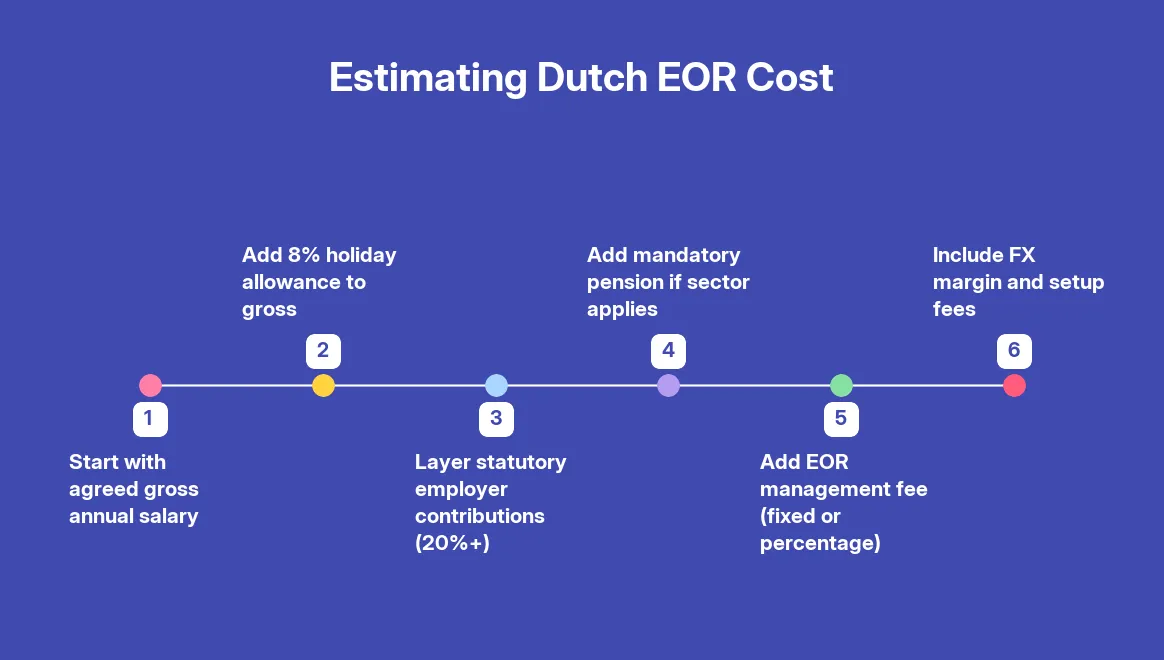
Start with the gross annual salary. Add the 8% holiday allowance. That gives you the adjusted gross. Then layer employer social security contributions. The Belastingdienst publishes current premium rates each January. Apply the rates for your employee's salary band and sector.
Check whether a mandatory industry pension fund applies. If yes, add the employer's share of the pension contribution. The pension fund's own documentation specifies the rate.
Adding the EOR Layer
Place the EOR management fee on top of the statutory cost stack. If using a fixed-fee provider, add the flat monthly amount. If using a percentage model, calculate it against gross salary before statutory additions.
Then add any recurring charges. These include FX conversion margins, payroll processing fees, benefits administration surcharges, and annual compliance review fees. Request a full fee schedule from every provider you evaluate.
A Practical Benchmark
For a Dutch employee earning €60,000 gross annually, the total employer cost before EOR fees typically lands between €78,000 and €84,000. Adding an EOR management fee of €500 per month brings the annual total to roughly €84,000 to €90,000. That represents a 40% to 50% premium above the gross salary number. The premium is not unusual for the Netherlands. It reflects genuine statutory obligations, not provider markup.

FAQs
Does the EOR management fee include Dutch payroll tax filing?
Most providers include monthly payroll tax filing (loonaangifte) in their standard management fee. Some charge separately for year-end wage statements (jaaropgave) or corrections to prior filings. Ask whether the fee covers both regular and corrective filings. Providers that charge per correction create unpredictable costs if your headcount or compensation structure changes mid-year.
Can I negotiate EOR pricing for a team of five or more in the Netherlands?
Volume discounts are common. Most providers offer reduced per-employee fees at five, ten, and twenty-five employee thresholds. A five-person team typically qualifies for a 10% to 15% reduction on the management fee. Negotiate before signing. Discounts rarely apply retroactively, and some providers lock pricing tiers for twelve months at a time.
What happens to my costs if the Dutch government raises social security contribution rates?
EOR providers pass statutory cost increases through to you. Your management fee stays fixed, but the underlying employer contributions adjust annually based on Belastingdienst publications. A rate increase of even 0.5% across multiple contribution categories can add €400 to €800 per employee per year. Budget a 2% to 3% annual escalation buffer for statutory costs.
Are benefits like Dutch commuting allowances included in the EOR fee?
The tax-free commuting allowance (reiskostenvergoeding) is a common Dutch benefit but not legally mandatory. Some EOR providers include it in their standard employment package. Others treat it as an optional add-on with a separate administration charge. If your competitors offer it, your Dutch hires will expect it. Confirm whether the allowance amount and its administration fall inside or outside your management fee.
What to Watch Next
Dutch social security premiums reset every January. The 30% ruling eligibility criteria have tightened in recent years, and further changes remain possible. Build your 2026 Dutch hiring budget with a buffer above today's quoted EOR fees. Request a full fee schedule from any provider you shortlist. Compare not just the headline management fee but the complete cost stack: statutory contributions, pension, holiday allowance, FX margin, and offboarding terms. That comparison reveals your actual per-employee cost.
If you need a country-specific cost breakdown for hiring in the Netherlands, TeamUp can prepare one for your team size and salary band. Request an estimate.
Written by Team Up — People-first EOR and workforce solutions across 20+ countries.
.svg)