When an Employer of Record Is Not the Right Choice for the Netherlands
An EOR removes the burden of setting up a Dutch legal entity. For small teams or market-entry hires, the model works well. Our guide to EOR providers in the Netherlands covered how to compare services, pricing structures, and provider transitions. This article goes deeper on the scenarios where an EOR stops being the right tool.
Not every company should stay on the EOR model indefinitely. Dutch employment law, works council thresholds, intellectual property concerns, and team size all create inflection points. Some companies reach them in months. Others never do. Knowing where those lines fall prevents you from overpaying for a structure you have outgrown or, worse, using one that creates legal risk you did not anticipate.
Scale Thresholds That Shift the Math
The Per-Employee Cost Ceiling
EOR pricing in the Netherlands typically runs between €400 and €700 per employee per month. That range reflects the Dutch labor complexity premium. At five employees, you pay €2,000 to €3,500 monthly in EOR management fees alone.
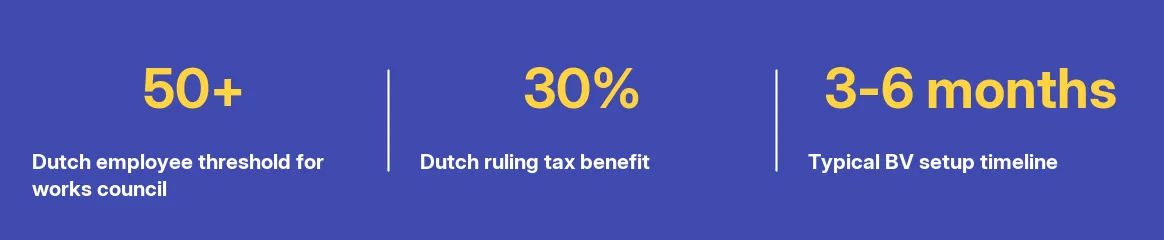
At 15 employees, the annual EOR management cost reaches €72,000 to €126,000. A Dutch Besloten Vennootschap (BV) costs roughly €20,000 to €40,000 to establish. Annual maintenance runs €15,000 to €30,000 for accounting, payroll administration, and compliance. The crossover point arrives faster than most companies expect.
A London-based fintech started with 3 engineers in Amsterdam through an EOR. Eighteen months later, the team grew to 14. The CFO calculated that entity formation plus a local payroll provider would save over €50,000 annually. They began the transition process in Q3 and completed it within four months.
Works Council Obligations
Dutch law requires a works council (ondernemingsraad) when you employ 50 or more people in the Netherlands. This threshold applies per enterprise, not per entity. Under an EOR arrangement, your employees sit on the EOR's payroll. They count toward the EOR's headcount, not yours.
That creates ambiguity. The EOR may already have a works council covering all its employed workers. Your team might be swept into governance structures you did not design. Dutch courts have addressed co-employment questions, and the outcomes are not always predictable.
If you want direct control over employee representation and workplace governance, your own entity gives you that. The EOR model introduces a third party into decisions that affect your team's working conditions.
Regulatory and Structural Limitations of the EOR Model

Intellectual Property Exposure
Dutch IP law assigns copyright to the creator by default under the Auteurswet. Employment contracts can transfer those rights to the employer. The question is: who is the employer?
Under an EOR arrangement, the legal employer is the EOR provider. Your employment agreements assign IP to the EOR, which then sub-assigns those rights to you through the client services agreement. That chain of assignment works in most cases. It breaks down in disputes.
A patent filing, a contested copyright claim, or a merger due diligence process will scrutinize the chain of title. Acquirers and investors routinely flag EOR-held IP assignments as a risk factor. If your Dutch team builds core product, this matters.
The 30% Ruling Complication
The Dutch 30% ruling allows qualifying foreign employees to receive up to 30% of their salary tax-free for a limited period. The ruling is tied to the employer and the employee. When the legal employer is an EOR, the EOR must apply for the ruling.
Switching EOR providers or transitioning to your own entity mid-ruling creates complications. The tax authority (Belastingdienst) treats a change of employer as a new situation. The employee may lose months of remaining benefit or need to reapply entirely. This is a concrete cost that compounds over the ruling's duration.
Watch out: If an employee's 30% ruling is tied to the EOR as employer, transitioning that employee to your own Dutch BV requires a fresh application to the Belastingdienst. The remaining term may be shortened or denied altogether.
Collective Bargaining Agreements
Several Dutch sectors mandate collective labor agreements (CAOs). The applicable CAO depends on the employer's industry classification, not the client's. An EOR registered as a staffing or HR services company may fall under a different CAO than your actual industry.
This mismatch can mean different salary scales, holiday allowance rates, pension obligations, and notice periods. Your employees might receive terms that do not match your internal equity framework. Aligning Dutch compensation with the rest of your global team becomes harder when a CAO you did not choose governs the baseline.
Alternative Employment Models for the Netherlands
Not every departure from an EOR means incorporating a BV. The Dutch market offers several structures, each suited to different scenarios.
| Model | Best For | Setup Time | Ongoing Cost Range |
|---|---|---|---|
| Own BV | 10+ employees, long-term presence | 3-6 months | €15,000-€30,000/year admin |
| Branch office | Short-term projects, no separate legal personality | 4-8 weeks | Lower than BV, limited flexibility |
| PEO co-employment | Existing entity needing HR outsourcing | 2-4 weeks | Per-employee fee, lower than EOR |
| Independent contractors | Specialized project work, no subordination | Days | Per-project, plus compliance review |
A co-employment PEO model keeps payroll administration outsourced while you retain direct employer status. This works when you have a Dutch entity but lack the internal HR capacity to manage Dutch labor law compliance.
Contractor engagement carries its own risks in the Netherlands. The Dutch government's enforcement framework for false self-employment (schijnzelfstandigheid) has been tightening. The Belastingdienst resumed active enforcement, and reclassification penalties fall on the hiring party. Companies using contractors in the Netherlands need careful classification review before proceeding.
For companies hiring across multiple markets, the right model may differ by country. A BV in the Netherlands paired with EOR coverage in a neighboring market creates a hybrid structure. Many mid-stage companies operate exactly this way.
How to Evaluate Whether to Transition Away from an EOR
Running the Financial Comparison
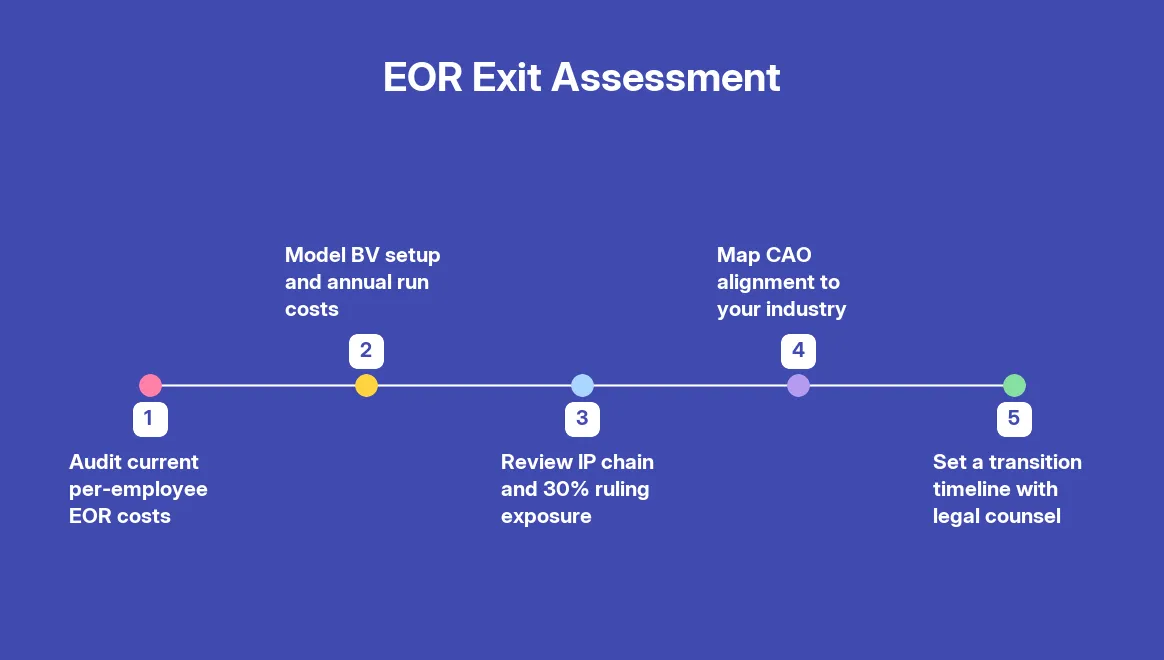
Start with your current monthly EOR spend. Multiply by 12 and project forward three years. Then model entity costs: incorporation fees, registered office, local accounting firm, payroll software, and a Dutch employment law advisor on retainer.
Include the hidden costs. A BV requires a local director or UBO registration. Annual corporate income tax filings add complexity. VAT registration may be necessary depending on your activities. The EOR absorbs all of this today.
The breakeven calculation changes when you factor in the 30% ruling risk, CAO mismatches, and IP chain exposure. Those are not line items on an invoice. They are contingent liabilities that surface during fundraising, M&A, or regulatory audits.
The Timing Question
Transitioning mid-year creates payroll complications. Dutch employees accrue holiday allowance (vakantiegeld) throughout the year, typically paid in May. Transitioning before May means settling that accrual with the EOR. Transitioning after May means the new entity starts clean.
Employment contracts transfer under Dutch law when an economic unit changes hands. The rules around overgang van onderneming (transfer of undertaking) may apply. Employees keep their existing terms. Get Dutch employment counsel involved early. The legal framework protects employees, not employers, during transitions.

FAQs
Can I keep some employees on the EOR while moving others to my own BV?
Yes. A hybrid model is common during transitions. You might move senior engineers to the BV for IP protection while keeping a support team member on the EOR. Each employee needs individual consent under Dutch law. The EOR contract should specify minimum headcount requirements. Some EOR providers charge higher per-employee fees when your headcount drops below a threshold.
Does the Dutch tax authority treat EOR employment differently from direct employment?
The Belastingdienst treats the EOR as the employer for wage tax purposes. Payroll taxes, social security contributions, and income tax withholding flow through the EOR's loonheffingennummer. For most tax purposes, this works identically to direct employment. The distinction surfaces with the 30% ruling, transfer pricing, and corporate deductibility of management fees paid to the EOR entity.
What happens to employee pension rights during a transition from EOR to own entity?
Dutch pension obligations depend on the applicable CAO and the pension fund. If the EOR participates in a sector pension fund like ABP or PFZW, your employees have accrued rights there. Your BV may fall under a different fund. Accrued rights stay with the original fund. Future contributions go to the new fund. Employees must be informed in writing before the transition, and any gap in coverage creates personal liability for the employer.
Is a Dutch branch office a viable middle ground between an EOR and a full BV?
A branch office (bijkantoor) does not have separate legal personality. The parent company remains fully liable for Dutch obligations. Branch offices work for defined-scope activities. They register with the KvK (Chamber of Commerce) and receive a Dutch tax ID. The downside: you cannot limit liability, and Dutch corporate governance requirements still apply. For most companies planning long-term presence, the BV structure offers cleaner separation and better positioning for Dutch grants and incentives.
What to Watch Next
The Dutch government continues tightening rules around labor market intermediaries and false self-employment. Pending legislation on platform work and the classification of employment relationships will reshape how EOR providers operate in the Netherlands. Companies currently on an EOR should monitor these developments quarterly. Start your financial comparison now, even if transition is 12 months away. The companies that plan ahead avoid the compliance scramble that follows regulatory changes.
If you are weighing the EOR-to-entity transition in the Netherlands and want a cost comparison tailored to your team size, request an estimate from TeamUp.
Written by TeamUp — EOR, PEO, and payroll across 20+ countries with owned entities in core markets.
.svg)