Employer of Record (EOR) in the Netherlands 2026: The Complete Hiring Guide
Your company just closed a Series B and the CTO wants two senior data engineers based in Amsterdam. You have no Dutch entity. Dutch employment law is dense. And the board wants those hires productive within a month. An employer of record in the Netherlands solves that equation without the 3-to-9-month timeline of incorporating a BV.
The Netherlands ranks among Europe's most regulated labor markets. Employment contracts fall under the Dutch Civil Code (Burgerlijk Wetboek). Dismissal requires approval from the UWV or a court. Mandatory holiday allowance, statutory vacation days, and social security obligations create a compliance surface that foreign companies underestimate.
This guide covers the mechanics, costs, risks, and strategic logic of using an EOR to hire in the Netherlands. It is written for finance leaders, HR directors, and founders evaluating whether an EOR is the right vehicle for their Dutch workforce plans.

What Is an Employer of Record (EOR)?

Employer of Record Meaning and Definition
An employer of record is a third-party organization that becomes the legal employer of your workers in a target country. The EOR signs the employment contract. It runs payroll. It withholds and remits taxes. It manages statutory benefits.
You retain full operational control. You assign work, set targets, and manage day-to-day performance. The EOR handles the legal and administrative employment relationship on your behalf. This split lets companies hire compliantly without setting up a local entity in countries where they lack corporate presence.
In the Dutch context, the EOR registers as the employer with the Belastingdienst (Dutch Tax and Customs Administration). It issues contracts governed by the Burgerlijk Wetboek. It administers mandatory entitlements like vakantiegeld (holiday allowance of at least 8% of gross annual salary) and the statutory minimum of 20 vacation days per year.
How EOR Differs from a PEO in the Netherlands
A Professional Employer Organization (PEO) operates under a co-employment model. The client company must already have a legal entity in the country. The PEO shares employer responsibilities but does not replace the client as the legal employer.
An EOR replaces the need for an entity entirely. The EOR is the sole legal employer. This distinction matters in the Netherlands because Dutch labor authorities assess employer obligations against the entity on the employment contract. If you use a PEO arrangement, your Dutch BV still bears primary liability.
For companies without a Dutch entity, the EOR is the only compliant path short of incorporation. For companies with an existing BV that want to outsource HR administration, a PEO may be the better fit.
Record of Employment: What It Means for Dutch Workers
Dutch workers encounter the term "record of employment" in a different sense. It refers to the documented employment history that establishes entitlements. Pension accrual, transition payment eligibility, and dismissal protection all depend on continuous service records.
When an EOR employs a worker, that employment history sits with the EOR entity. If you later transition the employee to your own Dutch entity, the transfer triggers obligations. Dutch law requires a transition payment (transitievergoeding) upon most dismissals. That calculation draws on the worker's service record. Managing that record accurately from day one protects both employer and employee.
How EOR Services Work in the Netherlands

The EOR Operational Workflow: From Hire to Payroll
A London-based fintech company hired its first Dutch compliance analyst through an EOR in 7 business days. The analyst was onboarded, contracted, and added to Dutch payroll before the company had even begun researching BV incorporation requirements.
The workflow follows a predictable sequence:
- The client selects the candidate and agrees on compensation
- The EOR drafts an employment contract compliant with the Burgerlijk Wetboek
- The EOR registers the employee with the Belastingdienst and applicable social insurance authorities
- Monthly payroll runs, with the EOR withholding income tax and social security contributions
- The EOR remits employer contributions, administers benefits, and files periodic declarations
For non-EU candidates, the EOR also manages the work permit process. Non-EU workers generally require a TWV (work permit) or a GVVA (combined residence and work permit). The EOR, as the legal employer, is the applicant of record.
Dutch Registration and Compliance Obligations the EOR Manages
The Netherlands requires every employer to register with the Belastingdienst. That registration triggers obligations for wage tax withholding, social security contributions, and periodic reporting.
The EOR also manages industry-specific requirements. Many Dutch sectors operate under a collective labour agreement (CAO). If a CAO applies to your employee's role, the EOR must comply with its terms. CAO provisions can override statutory minimums on salary, notice periods, and benefits.
The 30% ruling is a Dutch tax incentive for qualifying international employees. It allows employers to pay up to 30% of the employee's salary as a tax-free allowance. The EOR handles the application. Eligibility thresholds change annually, so confirm current requirements with the Belastingdienst before structuring compensation.
Employment Contracts, Probationary Periods, and Mandatory Benefits Under Dutch Law
Dutch employment contracts come in two forms: fixed-term and indefinite. Probationary periods are legally capped. A one-month probation applies to contracts shorter than two years. Two months is the maximum for indefinite contracts.
The statutory benefits layer is substantial:
- 20 vacation days per year (based on a 40-hour week), with many employers offering 25
- Holiday allowance (vakantiegeld) of at least 8% of gross annual salary, typically paid in May
- Sick pay obligations requiring the employer to continue paying salary during illness
- Pension enrollment, often mandatory depending on the sector or applicable CAO
The Netherlands reviews and adjusts its statutory minimum wage twice per year, in January and July. The EOR updates payroll calculations accordingly.
EOR vs. Dutch Entity Setup: Key Differences
| Dimension | EOR Model | Dutch Entity (BV) |
|---|---|---|
| Time to first hire | 5-10 business days | 3-9 months (incorporation + registration) |
| Legal employer | The EOR entity | Your own BV |
| Compliance ownership | EOR manages payroll, tax, benefits | You manage directly or outsource |
| Upfront cost | Monthly service fee per employee | Incorporation fees, notary, capital deposit |
| Dismissal liability | EOR handles UWV/court process | Your BV bears full liability |
| Scalability | Add or reduce headcount flexibly | Fixed overhead regardless of team size |
| Long-term cost at scale | Higher per-employee cost at 15+ heads | Lower marginal cost once entity is running |
A Toronto SaaS company used an EOR to hire 4 customer success managers in Rotterdam. Eighteen months later, with the team at 12, the company incorporated a BV and transitioned employees. The EOR phase gave them operational proof before committing to permanent infrastructure.
When the EOR Path Makes More Sense
The EOR model outperforms entity setup in specific scenarios. Companies hiring fewer than 10 employees in the Netherlands rarely justify the overhead of a BV. Entity setup requires notarial deed execution, Chamber of Commerce registration, and Belastingdienst onboarding. That process takes months.
The EOR eliminates that lead time. It also removes the need for a local managing director, a Dutch bank account, and ongoing corporate compliance filings.
When Entity Setup Wins
At scale, the math shifts. A company with 20 or more Dutch employees carries significant monthly EOR fees that may exceed the fixed cost of running a BV. The break-even point depends on your EOR provider's fee structure, your salary levels, and whether you need services beyond payroll.
Companies with a long-term strategic commitment to the Dutch market often plan a phased approach. Start with the EOR. Validate the market. Then incorporate when headcount and revenue justify it.
Employer of Record Costs in the Netherlands

What Drives EOR Pricing: Fee Structures Explained
EOR providers use two dominant pricing models. The first is a flat monthly fee per employee. The second is a percentage of the employee's gross salary. Some providers blend both.
The flat-fee model is more predictable. The percentage model scales with compensation, which means your cost rises as you hire senior employees. A Berlin-based e-commerce company paying a flat fee per employee found its monthly EOR cost remained stable even after promoting its Dutch marketing lead. Under a percentage model, that promotion would have increased the EOR fee.
Total Employment Cost vs. EOR Service Fee
The EOR service fee is only one component. The total cost of employing someone in the Netherlands includes gross salary, employer social security contributions, vakantiegeld (8% minimum), pension contributions where applicable, and any CAO-mandated benefits.
Employer social security contributions in the Netherlands are significant. The Belastingdienst publishes updated rates and ceilings each year. Your EOR should provide a full cost breakdown before you extend an offer. Do not confuse the EOR service fee with total employment cost. They are distinct line items.
Watch out: Some EOR providers quote only their service fee, not the total employer burden. In the Netherlands, mandatory costs like vakantiegeld, social security, and pension can add 25-40% on top of gross salary. Always request a fully loaded cost estimate.
When EOR Cost Outweighs Setting Up a Dutch Entity
The crossover depends on headcount and timeline. For a team of 3 hired through an EOR, the monthly fees are almost certainly lower than maintaining a BV with its accounting, compliance, and management overhead.
At 15 to 20 employees, the calculus shifts. The fixed costs of a BV are spread across more heads. The EOR's per-employee fee becomes the larger expense. Most companies reach this inflection point between 12 and 20 employees, depending on salary levels and the specific provider's pricing.
The transition itself carries cost. Dutch law requires a transition payment upon most dismissals. Moving employees from the EOR entity to your new BV involves terminating the EOR contract and issuing a new one. Structure the transition carefully to avoid triggering unnecessary separation costs.
How to Hire Through an EOR in the Netherlands
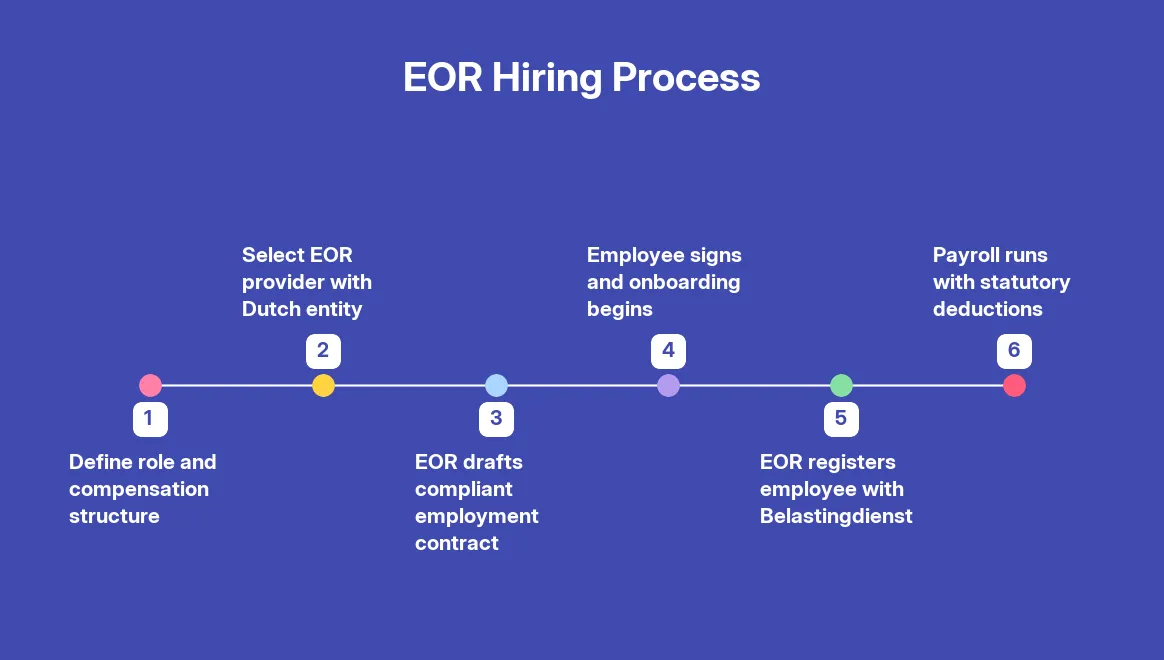
The process starts before you speak to a provider. Define the role, seniority level, and target compensation. Dutch candidates expect clarity on holiday allowance, pension participation, and contract type. Having these details ready cuts back-and-forth during the drafting phase.
Your EOR drafts an employment contract under the Dutch Civil Code. The contract must specify working hours, salary, probationary period terms, and applicable collective labor agreements. Dutch law caps probationary periods at one to two months depending on contract duration. A fixed-term contract under six months cannot include a probation clause at all.
A Copenhagen fintech company hired two compliance analysts in Amsterdam through an EOR in 12 business days. The EOR handled Belastingdienst registration, pension enrollment, and the first payroll cycle. Within four months the team had grown to five.
Once the employee signs, the EOR registers them with the Dutch Tax and Customs Administration. This triggers wage tax withholding and social security contribution obligations. The EOR runs payroll monthly, remitting income tax and social contributions on schedule. Your employee receives a net salary with a compliant pay slip.
For non-EU hires, the EOR handles the combined permit application. The EOR must be the sponsoring employer listed on the permit. This adds processing time but removes the immigration burden from your side entirely.
Choosing the Right EOR Provider for the Netherlands
Selecting a provider for the Dutch market involves more than comparing monthly fees. The Netherlands has layered compliance requirements that separate capable providers from those simply reselling access through local partners.
| Selection Criterion | What to Verify | Why It Matters |
|---|---|---|
| Legal entity type | Own Dutch BV vs. partner network | Direct entity means the provider controls compliance and liability |
| CAO expertise | Track record with sector-specific agreements | Wrong CAO application triggers joint liability for back pay |
| Pension administration | Named pension fund or insurer | Dutch employees expect pension; gaps create recruitment disadvantage |
| 30% ruling capability | Prior successful applications filed | Administrative errors lose the tax benefit permanently |
| Benefits scope | Health, travel, WFH allowances | Dutch market norms exceed statutory minimums |
| Transition support | Entity setup migration path | Clean offboarding prevents duplicate transition payments |
A provider with a direct Dutch entity controls the employment relationship end to end. Partner-network models introduce a third party between you and your employee. That third party holds the employment contract and makes payroll decisions you cannot directly oversee.
Ask about contractor classification practices. The Netherlands enforces strict rules around false self-employment. The Dutch tax authority has intensified enforcement since the DBA Act replaced the older VAR system. If your workforce includes both employees and independent contractors, your provider should have clear classification protocols for both.
A Toronto-based e-commerce company evaluated three EOR providers for its first Dutch hire. Two used local staffing partners. One operated its own entity with in-house Dutch HR and legal teams. The company chose the owned-entity provider. Six months later, when the team grew to four, the provider handled a CAO reclassification without service interruption.
Consider workspace and equipment provisioning as part of the evaluation. Dutch employees working remotely have a legal right to request home office arrangements. Providers that can supply equipment and workspace access alongside employment services reduce your operational overhead.
FAQs
Is using an EOR legal in the Netherlands?
EOR arrangements are legal in the Netherlands. The critical distinction is between a true employer of record and an unlicensed staffing intermediary. The Dutch Allocation of Workers by Intermediaries Act (WAADI) regulates labor intermediation. If an EOR places workers under client direction without proper WAADI registration, Dutch authorities may reclassify the arrangement as illegal labor supply. This exposes both parties to fines and potential criminal liability. Verify that your EOR either holds WAADI registration or structures the employment relationship to fall outside the Act's scope.
How long does it take to hire an employee in the Netherlands through an EOR?
For EU or EEA nationals, onboarding through an EOR typically takes 5 to 15 business days. Non-EU hires take longer. The combined permit (GVVA) application goes through both the IND and UWV. The EOR must be listed as the sponsoring employer on the permit. This means the permit is tied to the EOR's legal entity. If you later move the employee to your own Dutch BV, a new permit application may be required. That resets processing timelines from scratch.
Do I need a Dutch legal entity if I use an EOR?
No. The EOR's Dutch entity serves as the legal employer. One exception exists that many companies overlook. If your employee has authority to conclude contracts on behalf of your foreign company in the Netherlands, the Dutch tax authority may determine that a permanent establishment exists. A PE determination triggers corporate income tax obligations regardless of the EOR arrangement. Structure the employee's role to avoid contract-signing authority if PE avoidance is your goal.
Can an EOR help with the Dutch 30% ruling for international hires?
A qualifying EOR can apply for the 30% ruling because it is the legal employer. The application must be submitted within a limited window after the employee's first Dutch workday. If the EOR misses this deadline, the tax advantage is permanently lost for that employment relationship. This is a provider-specific operational risk. Ask your EOR about their 30% ruling application timeline during onboarding. Late submission cannot be remedied retroactively.
What Dutch employment laws must an EOR comply with, and what happens if they don't?
The EOR must comply with the Dutch Civil Code, applicable collective labor agreements, minimum wage rules, holiday allowance requirements, and dismissal protection law. If the EOR incorrectly applies a CAO that covers the employee's sector, both the EOR and your company can face joint liability. Dutch courts have upheld claims for back pay, pension arrears, and penalties against client companies even when the EOR held the employment contract. Your EOR agreement cannot fully shield you from CAO compliance failures.
What is the difference between an EOR and a PEO in the Netherlands?
An EOR becomes the sole legal employer. A PEO shares employment responsibilities through co-employment. Dutch employment law does not recognize co-employment as a formal legal structure. If the Dutch tax authority or labor inspectorate reviews a PEO arrangement, it may reclassify it as a WAADI-regulated staffing relationship. This reclassification creates compliance exposure including mandatory WAADI registration, SNA certification requirements, and potential penalties. A true EOR structure avoids this recharacterization risk entirely.
Can I use an EOR in the Netherlands for staff augmentation projects?
Yes, but the engagement structure matters. If augmented staff work under your direct daily supervision at your premises, the arrangement may fall under temporary agency work rules rather than standard employment. Temporary agency work in the Netherlands triggers the ABU or NBBU collective labor agreement after a specified period. Your EOR must track assignment durations and apply the correct CAO phase system. Misclassifying augmented staff as regular employees when they function as agency workers creates back-pay liability for both parties.
What to Watch Next
The Dutch government continues tightening enforcement around false self-employment under the DBA Act framework. Businesses relying on contractor arrangements alongside EOR employees should monitor updates from the Belastingdienst on classification criteria.
The Netherlands is also implementing the EU Pay Transparency Directive. Once effective, employers including EOR entities must disclose salary ranges in job postings and provide pay gap reporting. Your EOR should already be preparing internal processes for this obligation.
One concrete step: request your EOR provider's WAADI registration status and CAO compliance audit trail before your next renewal. These two documents reveal more about provider quality than any sales presentation.
.svg)