How to Switch Employer of Record Providers in the Netherlands: A Step-by-Step Guide
Our guide to EOR providers in the Netherlands covers how to compare services, evaluate costs, and decide whether an EOR fits your Dutch hiring strategy. This article goes deeper on one specific scenario: what happens when you need to switch EOR providers or move from direct employment to an EOR model in the Netherlands.
The Dutch labor framework creates transition complexities that do not exist in most other markets. Collective labor agreements (CAOs), the chain liability system for payroll taxes, and strict rules around consecutive fixed-term contracts all shape how you plan a provider switch. Getting the sequence wrong can trigger automatic permanent contracts or expose your company to back-tax claims. The sections below walk through the legal groundwork, the migration process, employee communication, and compliance risks unique to the Netherlands.

Planning the Transition: Legal and Contractual Groundwork
Review Your Current EOR Contract Terms
Start with the exit clause. Most EOR agreements specify a notice period ranging from 30 to 90 days. Some providers impose early-termination fees if you leave before a minimum commitment period. Others retain the right to continue billing through the employee's contractual notice period under Dutch law. Pull the contract and map every obligation before notifying anyone.
Pay attention to intellectual property assignment clauses. Under Dutch law, IP created during employment belongs to the employer. But "employer" in an EOR arrangement means the EOR entity. Confirm that your current provider has a clean, executed IP assignment back to your company. If that clause is missing or ambiguous, resolve it before you leave.
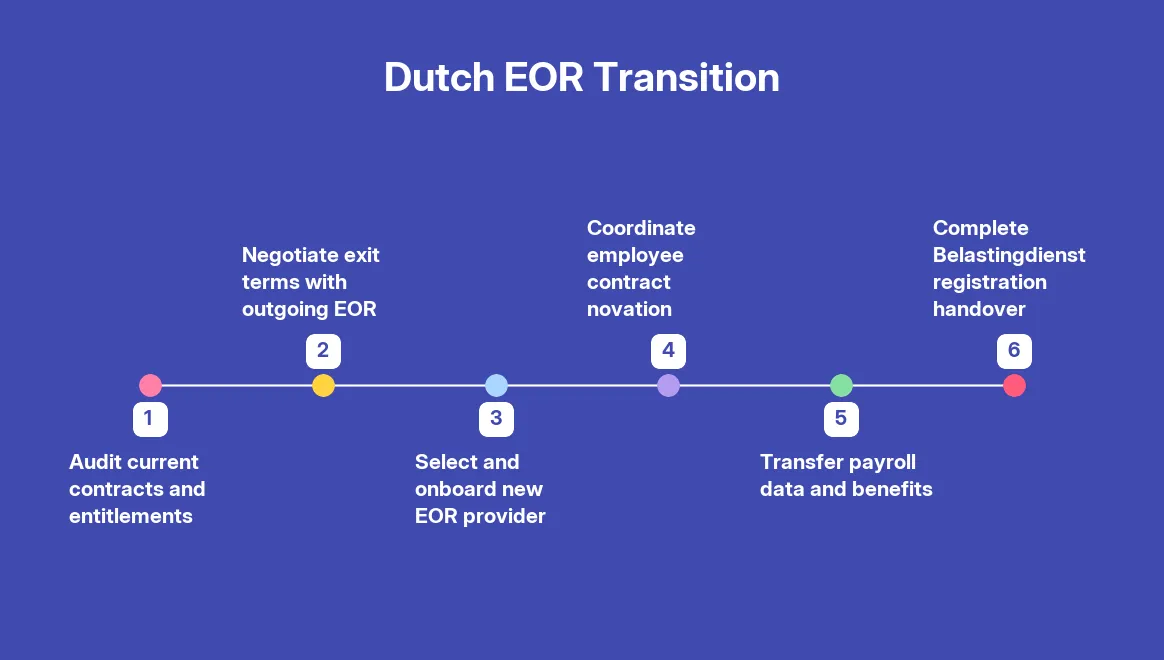
Audit Employee Contracts and Entitlements
Dutch employment law requires employers to provide written statements of terms within one month of the start date. Your current EOR holds these contracts. Request copies of every active employment agreement, including any amendments or addenda signed during the relationship.
Check accrued entitlements carefully. Dutch employees build up vakantiegeld (holiday allowance) at 8% of gross annual salary. They also accrue unused vacation days. These liabilities transfer with the employee. Your new provider needs exact figures.
If any employee is on their second or third fixed-term contract, the ketenregeling (chain regulation) under the Dutch Civil Code becomes critical. Three consecutive fixed-term contracts, or contracts spanning more than 36 months, automatically convert to permanent employment. A provider switch that resets the contract chain does not reset this clock unless there is a gap of more than six months between contracts.
Map Applicable Collective Agreements
The Netherlands has more than 30 generally binding CAOs across sectors. If your employees fall under one, the new EOR must apply the same CAO terms. Switching providers does not allow you to downgrade pension contributions, supplementary leave, or sector-specific allowances. Identify the applicable CAO before you begin negotiations with a new provider.
Step-by-Step Process for Switching EOR Providers
Coordinating the Handover
A typical transition in the Netherlands takes 8 to 12 weeks from decision to completion. The timeline stretches if employees hold permanent contracts, because Dutch dismissal rules require either mutual termination agreements or UWV approval.
The most common approach is novation. The outgoing EOR, the incoming EOR, and each employee sign a trilateral agreement. The employee's contract transfers to the new entity with identical terms. No termination occurs. No severance triggers. This preserves continuity for chain regulation purposes.
A London-based fintech company moved five Dutch sales employees from one EOR to another in 2024. The novation process took nine weeks. The longest delay was reconciling pension contributions under the sector CAO, which required the outgoing provider to issue final pension statements before the new provider could enroll employees with the same pension fund.
Payroll and Tax Registration
The incoming EOR must register with the Belastingdienst (Dutch Tax and Customs Administration) as the new withholding agent. Wage tax declarations shift to the new entity's loonheffingennummer (payroll tax number). The outgoing EOR files a final wage tax return covering the transfer period.
Social security contributions through UWV follow the same logic. The new EOR assumes responsibility for reporting and remitting premiums. Any gap in registration creates a compliance exposure. The Belastingdienst can hold both the outgoing and incoming entities liable for unpaid wage tax during the transition window.
Managing Employee Experience During the Transition
Communication Timing and Legal Requirements
Dutch employees have the right to be informed about changes to their employment conditions. Under the Wet transparante en voorspelbare arbeidsvoorwaarden (Transparent and Predictable Working Conditions Act), employers must notify employees of material changes in writing.
Tell employees early. A common mistake is treating the EOR switch as a back-office operation. Dutch works councils (ondernemingsraden) have advisory rights on matters affecting employment terms. If your team exceeds 50 employees in the Netherlands, the works council must be consulted. Even below that threshold, early communication prevents unnecessary friction.
Benefits Continuity
The biggest employee concern during a provider switch is benefits disruption. Focus on three areas.
- Pension enrollment gap: Dutch pension funds require employer registration before contributions begin. A gap between the outgoing and incoming EOR's enrollment can leave employees temporarily without pension accrual.
- Health insurance: The Netherlands mandates basic health insurance through private insurers, paid by employees. But many EORs offer supplementary group health plans. Confirm whether the new provider offers comparable supplementary coverage.
- Company car or mobility allowance: If employees receive a lease car, the contract sits with the EOR entity. Transferring a lease mid-term often incurs early termination fees from the leasing company.
One approach that reduces disruption is aligning the switch date with the calendar year. Pension funds and insurers process annual enrollment changes more smoothly than mid-year transfers.
If you are still evaluating whether an EOR is the right structure for your Dutch team, our article on when an EOR is not the right choice for the Netherlands covers the scenarios where direct entity setup or a PEO model fits better.
Compliance Risks Specific to a Dutch EOR Transition

Chain Liability for Wage Tax
The Netherlands operates a ketenaansprakelijkheid (chain liability) system. If the outgoing EOR fails to remit final wage taxes, the Belastingdienst can pursue the client company and the incoming EOR for the shortfall. Protect yourself by requesting a verklaring betalingsgedrag (clean payment conduct declaration) from the outgoing EOR before finalizing the transition.
This declaration confirms the outgoing provider is current on all tax obligations. Without it, your company carries residual liability. The Belastingdienst issues these declarations within a few business days upon request.
Transition Regulation and Employee Protections
If the switch qualifies as a overgang van onderneming (transfer of undertaking) under Dutch law, all employee rights transfer automatically. Terms cannot be reduced. This typically applies when the EOR change accompanies a broader operational shift. Even when it does not technically qualify, best practice is to match all existing terms exactly.
Companies hiring across multiple European markets often coordinate EOR transitions simultaneously. A US SaaS company that managed teams in both the Netherlands and Turkey found that the Dutch transition took nearly twice as long due to works council requirements and pension fund processing. Planning country-specific timelines prevents bottlenecks.
Data Protection Under GDPR
Employee data transfers between EOR entities fall under GDPR. Both the outgoing and incoming EOR must document a lawful basis for processing. Execute a data processing agreement with the new provider before any employee records move. The Dutch Data Protection Authority (Autoriteit Persoonsgegevens) actively enforces GDPR violations, and fines scale with company revenue.
Watch out: The outgoing EOR retains certain employee records for the Dutch statutory retention period of seven years for payroll data. Confirm in writing which records the outgoing provider will retain, which will transfer, and who bears data controller responsibility during the overlap period.

FAQs
Can I switch EOR providers mid-contract without employee consent?
No. Dutch law requires employee consent for novation. The employee must agree to terminate the existing contract with the outgoing EOR and enter a new one with the incoming provider. If an employee refuses, you face a stalemate. The outgoing EOR remains the legal employer until the contract ends naturally or both parties reach a mutual termination agreement. Forcing a unilateral change risks an unfair dismissal claim at the kantonrechter (subdistrict court).
What happens to accrued vacation days during the switch?
Accrued but unused statutory vacation days (four times the weekly working hours per year under the Dutch Civil Code) must transfer to the new EOR. The outgoing provider calculates the balance. The incoming provider inherits the obligation. If the outgoing EOR pays out the balance instead, confirm with the employee in writing. Employees can dispute a forced payout of statutory days, as Dutch law protects the right to actually take leave.
Do I need a new 30% ruling approval when switching EOR providers?
The 30% ruling (fiscal facility for inbound expatriates) ties to both the employee and the employer. When the employer entity changes, the employee must file a new application with the Belastingdienst within four months of the switch. The ruling does not automatically transfer. Missing this deadline can result in losing the remaining benefit period. Plan the application before the transition date, not after.
How do I handle a transition if employees are on sick leave?
Dutch sick leave rules create a specific complication. Employers must continue paying at least 70% of salary for up to 104 weeks during illness. The outgoing EOR carries this obligation. If you novate the contract, the incoming EOR inherits the reintegration obligations and remaining salary cost. Some incoming providers refuse to accept employees on long-term sick leave due to the financial exposure. Negotiate this point explicitly during provider selection, or delay the transition for affected employees.
What to Watch Next
The Dutch government continues to tighten rules around flexible employment. Proposed reforms to the ketenregeling and agency work regulations could change how EOR contract transfers work in 2026 and beyond. Monitor updates from the Ministry of Social Affairs and Employment. If you are planning a transition in the coming months, lock in your timeline now while current rules still apply. Build your pension fund and CAO audit into the project plan from day one. These two items consistently cause the longest delays.
If you need a compliant transition plan for your Dutch team, TeamUp can walk you through the timeline and handover steps. Schedule a consultation.
Written by the TeamUp Editorial Team TeamUp helps startups, agencies, and enterprises hire compliantly across 20+ countries through employer of record services, with owned entities in core markets and in-country teams that handle compliance directly.
.svg)