EOR Providers in the Netherlands: Comparing the Top 5 Companies
- What Is an Employer of Record?
- Top EOR Companies Operating in the Netherlands
- How to Compare EOR Services for the Netherlands
- EOR Costs and Pricing in the Netherlands
- How to Switch to an EOR or Transition Between Providers in the Netherlands
- When an EOR Is Not the Right Choice for the Netherlands
- FAQs
- What to Watch Next
EOR providers in the Netherlands let companies hire Dutch talent without registering a local entity. That matters when speed counts. A Toronto fintech company needed two compliance analysts in Amsterdam within three weeks. Setting up a Dutch BV would have taken months. Through an EOR, both analysts had signed contracts and started onboarding within 12 business days.
The Dutch employment framework is one of Europe's most protective. Dismissal procedures, collective labor agreements, and strict contractor classification rules create real compliance exposure for foreign employers. Choosing the wrong EOR provider does not just cost money. It creates legal risk that follows you.
This article compares five EOR companies operating in the Netherlands across compliance depth, pricing structure, and Dutch-specific capabilities. It covers how to evaluate them, what drives cost variation, and where the real risks sit.

What Is an Employer of Record?

An EOR is the legal employer of your workers in the Netherlands. You direct their daily tasks. The EOR handles everything that Dutch law demands from an employer.
The Three-Party EOR Structure Explained
Three contracts hold the arrangement together. The EOR signs an employment agreement with the worker under Dutch Civil Code requirements. The client company signs a service agreement with the EOR. The worker performs their role under the client's operational direction.
The EOR registers with Dutch tax and social insurance authorities. It runs payroll, withholds income tax, and remits social security contributions. It administers vacation accrual, sick leave obligations, and pension enrollment where applicable.
The client controls the work. The EOR carries the employer obligations. This split is what allows a company in Singapore or Chicago to hire compliantly in the Netherlands without a local BV or branch office.
EOR vs PEO: Key Differences for the Netherlands
A Professional Employer Organization (PEO) requires you to already have a Dutch entity. The PEO co-employs your workers alongside your company. You share employer liability.
An EOR eliminates the entity requirement entirely. The EOR is the sole legal employer. You bear no direct employer liability under Dutch labor law. That distinction matters in the Netherlands because Dutch dismissal law assigns obligations to the legal employer, not the company directing the work.
A London e-commerce brand with six customer support agents in Rotterdam used a PEO arrangement after establishing a Dutch branch. A competing brand without a Dutch presence hired a similar team through an EOR and was operational three months faster.
Why the Netherlands Makes EOR Arrangements Attractive
The Netherlands enforces employee protections that foreign companies rarely anticipate. Dutch law mandates specific dismissal procedures. Redundancy rights are codified. Employees receive a minimum of 20 vacation days per year by statute. Most employers offer 25.
The two-pillar employment framework adds another layer. Individual contracts sit alongside collective labor agreements (CAOs), which apply automatically in certain sectors. An EOR with Dutch expertise handles both layers without requiring your team to learn Dutch employment law from scratch.
Top EOR Companies Operating in the Netherlands

Picking a provider starts with knowing what Dutch compliance actually demands.
What to Look for Before Comparing Providers
The Netherlands is not a plug-and-play market. CAO obligations vary by industry. Dismissal requires either employee consent, a UWV permit, or a court order. Sick pay obligations can extend up to 104 weeks. Any EOR operating here must demonstrate specific Dutch legal capability, not just broad European coverage.
Before comparing features, confirm three things. Does the provider draft contracts compliant with the Dutch Civil Code? Does it track applicable CAOs for your industry? Can it manage the 104-week sick leave reintegration process?
A Munich SaaS company hired four engineers in the Netherlands through an EOR that lacked CAO tracking. Six months later, the company faced back-pay claims when the applicable CAO required higher salary minimums than the contracts specified. The provider absorbed the cost, but the disruption took weeks to resolve.
Provider Profiles: Five Companies at a Glance
Five categories of EOR provider serve the Dutch market. Global platform providers like Deel and Remote offer broad country coverage and self-service dashboards. Regional specialists like Team Up bring owned-entity depth and hands-on support in specific geographies. Enterprise-grade providers like G-P and Velocity Global target large organizations with complex multi-country needs. Boutique Dutch providers focus exclusively on the Netherlands with deep local knowledge. Payroll-first platforms like Papaya Global lead with payroll analytics and layer EOR on top.
Each model carries trade-offs. Global platforms prioritize scale over local depth. Regional specialists prioritize compliance accuracy in their core markets. Team Up, for example, operates direct legal entities across 20+ countries and maintains in-country offices in five cities, delivering the kind of hands-on compliance management that platform-only providers struggle to match.
How Each Provider Handles Dutch Employment Law Compliance
The real differentiator is how each provider handles Dutch-specific obligations. Contract drafting under the Dutch Civil Code is table stakes. The harder questions involve CAO compliance, dismissal procedure management, and benefits administration.
Providers with local legal teams in the Netherlands typically handle UWV applications and court-based dismissal proceedings in-house. Others outsource to Dutch law firms, adding cost and response time. Ask whether the provider's Dutch employment contracts have been reviewed by a Netherlands-based labor lawyer in the past 12 months.
Onboarding timelines range from 5 to 15 business days depending on the provider and contract complexity. Providers that handle payroll and compliance directly without subcontracting tend to onboard faster.
How to Compare EOR Services for the Netherlands
| Evaluation Criteria | What It Means in the Netherlands | Questions to Ask |
|---|---|---|
| CAO compliance | Automatic application of sector-specific collective agreements | Does the provider track CAO updates for my industry? |
| Dismissal handling | UWV permits, court proceedings, transition payments | Who manages the dismissal process end-to-end? |
| Sick leave management | Up to 104 weeks of employer obligations | Does the provider handle reintegration planning? |
| Contract compliance | Dutch Civil Code requirements for employment agreements | Are contracts drafted by a Dutch labor lawyer? |
| Benefits administration | Pension, vacation allowance, 30% ruling support | Which benefits are bundled vs. add-on? |
| Data protection | GDPR obligations as employer and data processor | Where is employee data stored and processed? |
Dutch-Specific Compliance Criteria You Cannot Ignore
The Netherlands operates a two-pillar employment law framework. Individual contracts must meet Dutch Civil Code standards. CAOs overlay additional requirements in many sectors, from minimum pay scales to mandatory training budgets.
Any evaluation starts with CAO coverage. Some EOR providers monitor CAO applicability automatically. Others rely on the client to flag relevant agreements. The difference determines whether your Dutch employees receive their legally mandated compensation.
A Stockholm recruitment agency discovered its EOR provider had not applied the applicable CAO for temporary staffing workers. The agency owed retroactive holiday allowance for eight employees covering a 14-month period. The total adjustment exceeded three months of EOR fees.
Service Scope: Payroll, Benefits, and Onboarding Depth
Dutch payroll involves more than salary disbursement. Employers must withhold wage tax, remit social insurance premiums, and calculate the 8% holiday allowance that Dutch law requires. Pension enrollment varies by sector and CAO.
Evaluate whether the provider bundles pension administration or charges separately. Some providers include the 30% ruling application process for qualifying expat employees. Others treat it as an add-on. The 30% ruling can reduce an employee's taxable income significantly, making it a material benefit for attracting international talent to the Netherlands.
Evaluating Technology, Support, and Scalability
Platform quality matters less than local knowledge in the Netherlands. A polished dashboard means little if the provider cannot explain Dutch transition payment calculations or manage a UWV dismissal application.
Test responsiveness before signing. Ask the provider to walk through a hypothetical termination scenario under Dutch law. A competent provider will reference the transition payment formula, the UWV or sub-district court route, and the reflection principle for collective redundancy. A weak provider will give generic answers.
Scalability depends on your growth plan. If you expect to hire more than 15 employees in the Netherlands within 18 months, ask whether the provider supports migration to your own Dutch entity when the time comes.
EOR Costs and Pricing in the Netherlands

EOR pricing in the Netherlands reflects the complexity of Dutch employment law.
How EOR Pricing Models Are Structured
Two models dominate. The flat fee per employee per month charges a fixed amount regardless of salary level. The percentage-of-salary model scales with compensation. Each has implications.
Flat-fee models favor companies hiring senior or highly paid employees. A product director earning well above average costs the same EOR fee as a junior analyst. Percentage models favor companies hiring at lower salary bands but penalize you as compensation grows.
EOR fees across the region typically fall between $300 and $700 per employee per month for the Netherlands. The range widens based on contract type, benefits complexity, and whether the provider includes pension and 30% ruling administration.
What Drives Cost Variation in the Dutch Market
Dutch employment law creates cost drivers that do not exist in simpler markets. The statutory holiday allowance of 8% of annual salary is an employer obligation. Pension contributions, where mandated by a CAO, add another layer. Sick leave reserves must account for up to 104 weeks of continued pay.
Some providers build these statutory costs into a bundled rate. Others itemize them. A Lisbon digital agency comparing two EOR providers for the same three Dutch hires found a 22% price difference. The cheaper quote excluded pension administration and 30% ruling support, both of which the agency needed.
Hidden Costs and One-Time Fees to Ask About
Setup fees, offboarding fees, and contract amendment charges appear in the fine print. Terminating a Dutch employee triggers a transition payment obligation. Some providers pass this cost through directly. Others absorb it into the monthly fee at a higher rate.
Ask about currency conversion markups. If you pay in USD or GBP but Dutch payroll runs in EUR, the FX spread matters. Some providers embed a margin into the conversion rate without disclosing it separately. Request the provider's FX policy in writing before signing.
How to Switch to an EOR or Transition Between Providers in the Netherlands
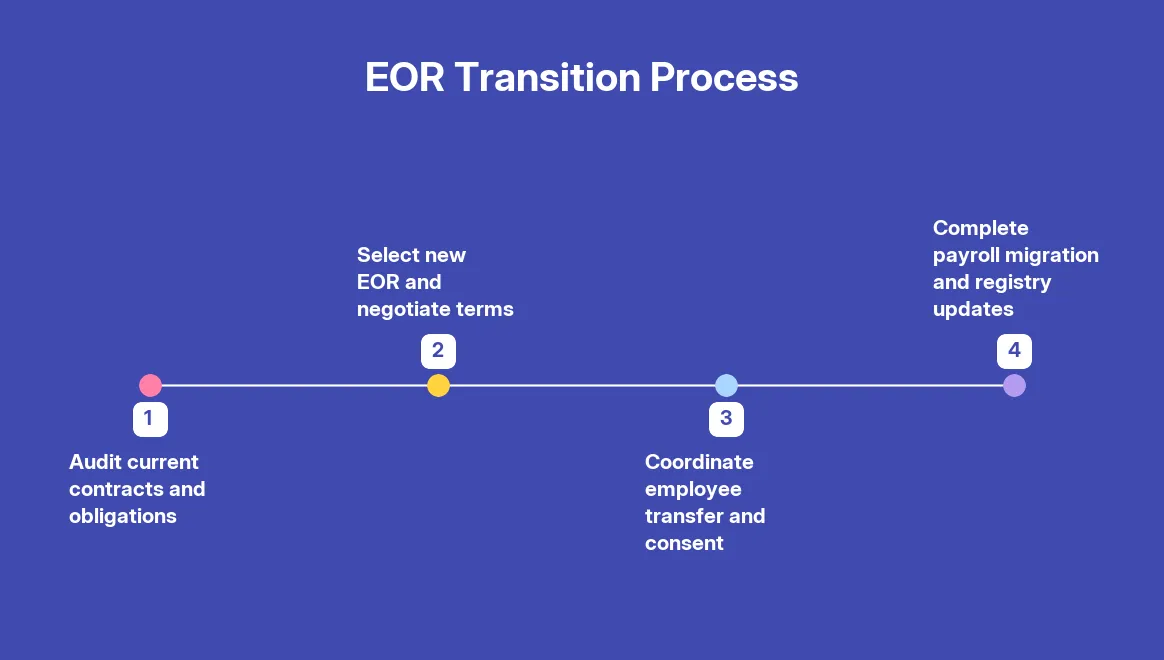
The transition itself is where most companies underestimate the work. Whether you are moving from a local entity to an EOR or switching between providers, Dutch employment law creates transfer obligations that do not exist in many other markets.
Start by auditing every active employment contract. Dutch contracts often contain provisions tied to collective labor agreements, or CAOs. These provisions carry over to the new employer. Your incoming EOR must honor them. A London fintech company moving three Dutch sales managers from a local BV to an EOR discovered that their CAO-linked bonus structure required the new provider to match accrued entitlements. The transition took 14 business days instead of the expected 5.
Employee consent is the second friction point. Dutch employees must agree to the transfer of their employment relationship. If the transfer qualifies as a business transfer under the Dutch Civil Code, employee terms transfer automatically. But the employee can still object. Plan for individual conversations, not a mass announcement.
Payroll migration requires coordination with the Belastingdienst. The outgoing employer files final wage tax returns. The incoming EOR registers as the new withholding agent. Any gap between these filings creates compliance exposure. The safest approach is aligning the transition date with a payroll period boundary, typically the first of a calendar month.
Benefit continuity needs attention too. Pension accruals, health insurance enrollments, and any company-specific local benefits must transfer without interruption. Dutch employees expect no gap in coverage. If you are evaluating providers for this kind of transition, a detailed guide on employer of record arrangements in the Netherlands covers the contractual framework in full.
Watch out: If your outgoing EOR delays final payroll filings, your employees may receive incorrect annual income statements (jaaropgave). This creates personal tax filing problems for each employee and reputational damage you will hear about months later.
When an EOR Is Not the Right Choice for the Netherlands
Not every Dutch hiring scenario calls for an EOR. The model has structural limits. Recognizing them early saves money and prevents compliance surprises.
| Scenario | EOR Fit | Better Alternative |
|---|---|---|
| First 1-5 hires, no Dutch entity | Strong fit | — |
| 20+ employees, long-term presence | Weakening fit | Local BV registration |
| Hiring independent contractors | Not applicable | Contractor management |
| Client already holds a Dutch entity | Redundant | PEO or co-employment model |
| Highly regulated sector (banking, healthcare) | Limited fit | Sector-specific staffing license |
| Temporary project team, under 12 months | Strong fit | — |
The cost crossover matters. Once your Dutch headcount exceeds roughly 15 to 20 employees, the cumulative per-employee EOR fees often exceed the annualized cost of maintaining a small BV with outsourced payroll. A Munich e-commerce company reached that threshold after 18 months and transitioned 22 employees from their EOR to a newly registered Dutch BV. Their annual employment administration costs dropped by approximately 30%.
Regulated industries present a different problem. Dutch financial services firms operating under De Nederlandsche Bank supervision face requirements that some EOR structures cannot satisfy. The supervisory framework may require the licensed entity to directly employ certain staff categories. An EOR sitting between the regulated entity and the employee can create a compliance gap that no amount of contractual language resolves.
For companies using staff augmentation to test a Dutch market entry before committing, an EOR remains the fastest compliant path. But plan the exit from day one. Knowing when to graduate from an EOR to a local entity is as important as choosing the right provider.
FAQs
Can a foreign company hire employees in the Netherlands without a local legal entity?
Yes. An EOR provider serves as the legal employer, eliminating the need for entity registration. The edge case to watch is permanent establishment risk. If the Dutch tax authorities determine that your employees are creating a fixed place of business or habitually concluding contracts on your behalf, they may treat your company as having a taxable presence. The EOR employment structure does not automatically shield you from this determination. Ask your EOR how they monitor and mitigate PE exposure for each client engagement.
What is the difference between an EOR and a PEO in the Netherlands?
An EOR is the sole legal employer of your Dutch workers. A PEO operates as a co-employer alongside your own entity. The critical distinction: a US-headquartered company with no Dutch registration cannot legally use a PEO model. Co-employment requires the client to hold its own employer status in the Netherlands. If you lack a Dutch BV or branch registration, only the EOR model works. Companies sometimes confuse the two and discover mid-negotiation that the PEO provider requires them to first incorporate locally.
Is it legal to use an employer of record in the Netherlands?
It is legal. Dutch law permits third-party employment arrangements. The nuance is that some EOR contracts may fall under the Dutch temporary staffing framework (uitzendbureau regulations). If the contract is structured so the EOR deploys workers to client premises under client direction, phased equal-pay obligations under the ABU or NBBU collective agreements can apply. After a defined period, the employee gains entitlement to the same pay and conditions as comparable direct hires. Ask your EOR whether their contract structure triggers these phased obligations.
What is the best employer of record for the Netherlands if I am hiring fewer than five employees?
For small headcounts, flat-fee pricing models protect you from disproportionate costs. Some providers charge a percentage of salary, which can exceed €800 per month for a single senior hire. At that rate, two employees already cost more than a flat-fee provider charging €400 to €600 per employee. Before signing, check whether the provider imposes a minimum monthly platform fee regardless of headcount. Some contracts include a floor of €1,500 to €2,500 per month, making the effective per-employee cost punishing at one or two hires. Negotiate the minimum fee down or choose a provider that waives it below five employees.
What happens to my Dutch employees if my EOR provider goes out of business or exits the Netherlands market?
Dutch employment law protects the employee, not the business arrangement. If the EOR ceases operations and the situation qualifies as a transfer of undertaking under Dutch Civil Code provisions, employment contracts may transfer automatically to the acquiring or successor entity. If no successor exists, employees face redundancy procedures with full statutory protections including transition payments. The risk for you as the client company is that Dutch courts may look through the EOR structure and attribute employer obligations directly to you. This typically takes 4 to 8 weeks to resolve. Have a contingency clause in your EOR agreement that addresses provider exit scenarios.
How long does it take to onboard an employee through an EOR in the Netherlands?
Most EOR providers complete Dutch onboarding in 5 to 10 business days from signed employment contract to first payroll run. The timeline stretches if the employee is a non-EU national requiring a work permit or residence permit through the IND. Highly Skilled Migrant permits, one of the most common pathways, typically take 2 to 4 weeks for IND processing after submission. Factor in an additional week for BSN registration at the municipality. A realistic timeline for a non-EU hire is 4 to 6 weeks from contract signature to compliant first payroll.
Can I convert EOR employees to my own Dutch entity later?
Yes, and this is a common growth path. The conversion requires terminating the employment relationship with the EOR and establishing a new contract under your BV. Dutch law requires that employees retain their accrued rights, including tenure-based protections. If structured as a transfer of undertaking, terms carry over automatically. The gap risk is pension. Your BV's pension scheme may differ from the EOR's arrangement, creating a potential shortfall in accrued benefits. Negotiate a transition timeline of at least 30 days and confirm pension portability with both the outgoing EOR provider and your new pension administrator before initiating the switch.
What to Watch Next
The Dutch government is tightening rules on employment intermediaries. Proposed legislation aims to clarify when staffing arrangements create direct employment obligations for client companies. If enacted, this could change how EOR contracts are structured for the Netherlands.
The broader push to distinguish genuine self-employment from disguised employment continues under the DBA enforcement framework. The Belastingdienst has signaled increased audit activity in this area. Companies using both EOR employees and independent contractors in the Netherlands should review their contractor classifications now, not after an inquiry arrives.
Your concrete next step: request written confirmation from your EOR provider that their Dutch contract structure does not trigger uitzendbureau classification. If they cannot provide that confirmation with specificity, that tells you something about their Dutch market depth.
.svg)