


Armenia Work Permits & Visas: Employer Guide to Types & Sponsorship
TL;DR
Hiring talent in Armenia is exciting, until you hit the wall of visas, work permits, and bureaucratic hoops. If you’re an employer planning to hire or relocate staff to Armenia, understanding the country’s work visa requirements and sponsorship process is non-negotiable.
This comprehensive guide will walk you through Armenia’s work permit rules, how to sponsor foreign employees, and how an Employer of Record (EOR) can simplify the entire process. We’ll also compare Armenia’s immigration steps with neighboring Georgia and Azerbaijan, so you know what to expect in the region.
Let’s dive in with zero fluff (and maybe a dash of wit) to make Armenian work permits easy.
Quick Navigation
- TL;DR
- Hiring Local vs. Foreign Talent in Armenia: What’s the Difference?
- Armenia Work Visa & Residence Permit Rules for Foreign Employees
- Types of Work Permits and Visas in Armenia
- Work Visa Sponsorship in Armenia: Process and Requirements
- Step-by-step: How to Sponsor a Foreign Employee in Armenia (Through an EOR)
- How an Employer of Record (EOR) Simplifies Immigration and Compliance in Armenia
- Onboarding Your Team: Next Steps After the Visa
- Frequently Asked Questions
Hiring Local vs. Foreign Talent in Armenia: What’s the Difference?
When it comes to compliance, hiring a local Armenian employee vs. a foreign national is two very different ballgames:
- Local Armenian Hires: If you hire an Armenian citizen or permanent resident, no work visa or permit is needed. You simply onboard them according to local labor law, an employment contract in Armenian, registration with tax authorities, and payroll contributions. There’s no immigration paperwork involved, which makes local hires straightforward. You still must follow all Armenian employment laws (contracts, minimum wage, taxes, etc.), but you won’t be dealing with visas or residence permits.
- Foreign Hires: If you hire a foreign national who will live and work in Armenia, immigration compliance kicks in. The employee will typically need a work permit and a residence permit to legally work in Armenia. This means additional steps: sponsoring their work authorization, tracking visa status, and ensuring they remain compliant with immigration rules. Essentially, you’re dealing with everything a local hire requires, plus a layer of visa and permit administration.

Armenia Work Visa & Residence Permit Rules for Foreign Employees
Armenia requires work authorization for most foreign employees. Unlike Georgia (which lets many foreigners stay for a year visa-free), Armenia’s standard visa-free period is up to 180 days in a year for nationals of many countries.
In other words, travelers from the U.S., EU, UK, and several other countries can enter Armenia without a visa (or on an e-visa) and remain for up to 6 months in a 12-month period. However, a visa-free entry or a tourist visa alone does not entitle a person to legally work in Armenia. If a foreigner intends to work (not just visit), they must go a step further and obtain a work permit and related residency status.
Here are the key rules to know about Armenia’s work visas and permits:
Requirements for a Work Permit in Armenia
To legally hire foreign nationals in Armenia, employers must meet defined regulatory requirements, and prospective employees must satisfy eligibility criteria. These rules exist to protect the local labor market and ensure full compliance with Armenian employment law.
Employer registration
The employer must be registered with the Migration and Citizenship Service through the official online portal, workpermit.am, in order to initiate the work permit application process.
Job offer
A formal job offer from an Armenian employer is required. The offer must clearly outline the role, salary, and key employment terms.
Employee qualifications
The foreign national must have the relevant education, skills, and professional experience necessary for the position being offered.
Required documentation
The application must include the employee’s passport, proof of qualifications, two photographs, and confirmation of payment of applicable government fees.
Armenia Residence Permit
Armenia uses an integrated work permit and residence permit system. A foreign employee will usually get a temporary residence permit (often a plastic residence card) once their work permit is approved. The residence permit allows them to live in Armenia beyond the initial visa-free period and is tied to the duration of their employment. Think of the work permit as approval to take the job, and the residence permit as the document that lets them stay in-country for that job.
Validity and exemptions
Work permits (and the accompanying temporary residence) are typically valid for up to one year at a time. They can be renewed annually as long as the employment continues.
Armenia currently has no quotas on foreign workers, but authorities do require proof that a local worker couldn’t easily fill the position. After about four continuous years on temporary permits, a worker may become eligible for permanent residency (often possible after 5 years of residence).
Some foreigners don’t need a work permit due to international agreements. The major example is citizens of EAEU member states (Russia, Belarus, Kazakhstan, Kyrgyzstan) – they can work in Armenia without a work permit. Additionally, certain high-level roles may be exempt; for instance, a foreigner appointed as the CEO of an Armenian company may not require a permit but still needs a residence status.
Even in exemption cases, employers usually must register the hire on the workpermit.am portal for record-keeping. Always double-check if an exemption applies, but assume most non-EAEU hires will go through the standard process.
Visa Types in Armenia

For foreign employees, Armenia typically issues a multi-entry work visa valid up to one year (often labeled as a long-term entry visa for work).
Many hires will enter on this visa or even on a tourist visa and then convert to a residence permit in-country.
Important: A tourist or e-visa can be converted to a work authorization without leaving Armenia; the employer just needs to initiate the work permit process via the official platform, and once approved, the employee can get their temporary residence card inside Armenia.
That means, unlike some countries, you can hire someone who is already in Armenia on a visit, they won’t necessarily have to fly out to get a work visa stamp, as long as the paperwork is done correctly.
Armenia provides several work visa options to accommodate different employment scenarios for foreign nationals. Each visa type is structured around the expected length of stay and the nature of the employment relationship, with specific eligibility criteria and application requirements.
| Visa type | Description |
| Temporary work permit | Intended for foreign nationals planning to work in Armenia for a short, defined period, usually up to one year. This option is commonly used for project-based roles, temporary assignments, or fixed-term contracts. |
| Long-term residency visa for employment | Designed for professionals who plan to live and work in Armenia for an extended duration, typically longer than one year. Applicants must show evidence of ongoing or long-term employment with an Armenian employer. |
Each category aligns with different hiring needs, allowing employers to select the most appropriate option based on contract length and workforce planning.
In short, foreign employees in Armenia need two things: a work permit (employer’s green light to hire a foreigner) and a residence permit (employee’s permission to live/work in Armenia). These are handled together in a streamlined process, with many steps digitized on the government’s workpermit.am portal.
Skip any of these requirements, and both employer and employee face penalties, fines in the hundreds of dollars, and potential deportation or bans for the worker. Immigration compliance is serious business, but as we’ll see, Armenia’s system is fairly clear once you break it down.
Types of Work Permits and Visas in Armenia
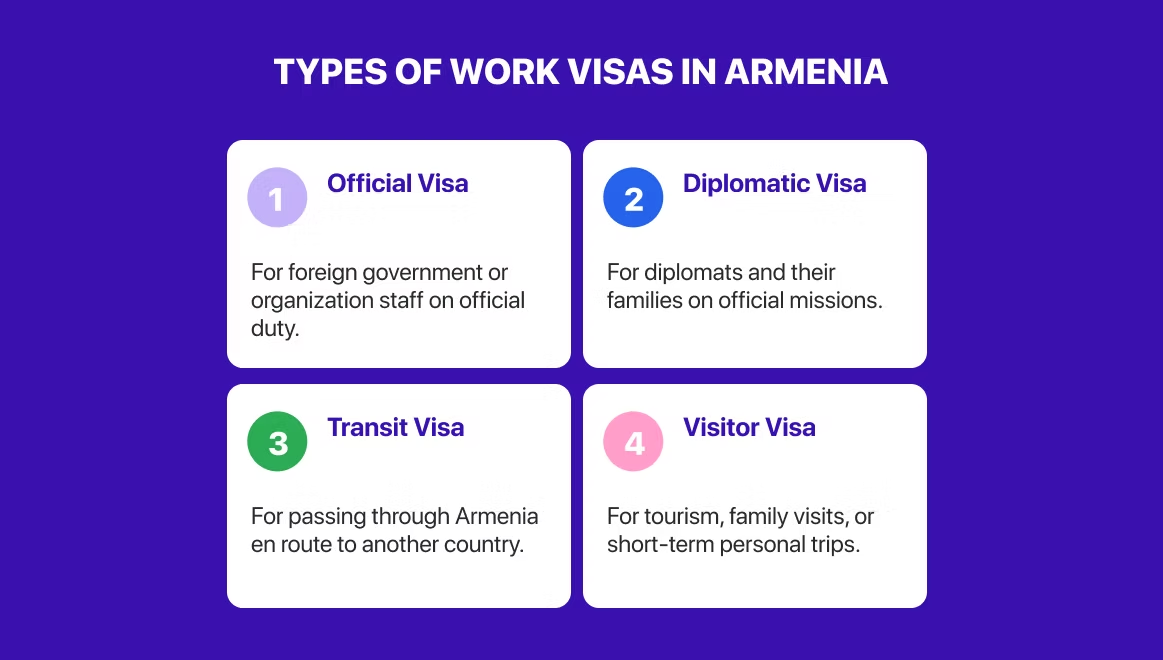
Armenia keeps employment-based immigration relatively simple. There are only a few main permit and visa paths you’ll encounter when hiring foreign talent, and most hires follow the same core route with variations based on duration and status.
Primary Work Permit and Visa Options
1. Temporary Work Permit (1 Year)
This is the standard work authorization for most foreign employees in Armenia.
Key characteristics:
- Employer-sponsored
- Issued for a specific role and employer
- Valid for up to 1 year
- Typically paired with a temporary residence permit
- Allows the employee to live and work in Armenia during the permit period
Best for:
- Fixed-term roles
- New hires testing the Armenian market
- Initial employment before long-term plans are confirmed
Renewals:
- Renewable annually
- Can be renewed for up to 4 consecutive years
- After multiple renewals, the employee may qualify for permanent residence
2. Long-term Employment Residence (Path to Permanent Residence)
Armenia does not issue a separate “long-term work visa” at the start. Instead, long-term status is reached progressively.
How it works:
- The employee starts with a 1-year temporary work permit
- After accumulating five years of temporary residency, they may apply for:
- Permanent Residence Permit
- In some cases, citizenship
Why this matters for employers:
- Ideal for core team members or long-term hires
- Permanent residence allows a 5-year residence period
- Eliminates the need for annual work permit renewals
- Reduces administrative burden for both employer and employee
Supporting long-term employees through this transition can significantly improve retention and stability.
3. Short-term Visas for Work-related Activities
For very short assignments, a full work permit may not always be practical.
Typical scenarios:
- Short projects (1–3 months)
- Temporary assignments
- Internal visits or setup work
Available options:
- Entry or business visas:
- Up to 120 days
- Extendable by 60 days
Important considerations:
- Armenia does not have a clearly labeled “90-day work visa.”
- If the individual is formally employed and on payroll, a work permit is still the safer option
- Using a visitor visa while performing employment activities carries risk
Comparison note:
- Unlike Azerbaijan, Armenia does not have a clearly defined short-term work visa category
4. Exempt Categories (No Work Permit Required)
Certain foreign nationals are exempt from work permit requirements, though residence registration may still apply.
Common exemptions include:
- Citizens of EAEU member states
- Foreign investors
- Directors of branches or representative offices
- Certain intra-company transferees
- Diplomatic staff
- NGO and international organization workers
Key points:
- No labor market test required
- Residence permits may still be necessary for long stays
- Eligibility depends on nationality and role
Because exemptions are role-specific, it’s best to confirm eligibility with legal counsel or an EOR before hiring.
5. “Digital Nomads” and Remote Workers
Armenia does not offer a formal digital nomad visa.
However, many remote workers legally stay in Armenia by:
- Registering as sole proprietors
- Obtaining an Armenian tax ID
- Paying taxes as self-employed individuals
Important distinction for employers:
- This route is not employer-sponsored
- It applies to independent freelancers, not employees
- Hiring someone full-time still requires:
- A local employer entity, or
- An Employer of Record (EOR) to sponsor a work permit and payroll
If a candidate suggests freelancing instead of employment, be cautious. Full-time work without proper employment status creates compliance risks.
Quick Comparison Table
| Category | Typical Duration | Employer-Sponsored | Best Use Case |
| Temporary Work Permit | 1 year (renewable) | Yes | Standard employment |
| Long-Term / Permanent Residence | After 5 years | Initially yes | Core, long-term hires |
| Short-Term Entry / Business Visa | 90–120 days | No | Short projects, visits |
| Exempt Categories | Varies | No | EAEU citizens, investors |
| Self-Employed / Remote | Ongoing | No | Freelancers, nomads |
Key Takeaway
Most foreign hires in Armenia follow a simple path:
- Start with a 1-year work permit + temporary residence
- Renew annually as needed
- Transition to permanent residence for long-term employees
Armenia’s system is streamlined. You’re not juggling dozens of visa types, just managing duration and renewals based on the role and long-term plans.
Next, the logical step is understanding how employers actually apply for and manage these permits in practice.
Work Visa Sponsorship in Armenia: Process and Requirements
Sponsoring a foreign employee’s work visa in Armenia is a structured, multi-step process involving both the employer and the employee.
The good news is that most steps are now handled online through the unified workpermit.am platform.
Below is a clear breakdown of:
- Who needs a work permit
- Employer sponsorship requirements
- Key compliance obligations during the process
Who Needs a Work Permit (and Who Doesn’t)
As a general rule, most foreign nationals require a work permit before starting employment in Armenia.
The application must be submitted by the employer. Individuals cannot apply on their own.
Exempt from Work Permit Requirements
The following categories typically do not require a work permit, though registration or residence permits may still apply:
EAEU nationals
- Citizens of Russia, Belarus, Kazakhstan, and Kyrgyzstan
- Can work in Armenia without a work permit
- Must still be registered in the electronic system
- Employers usually need to report the hire through a simplified procedure
Certain high-level roles or special cases
- Founders of Armenian companies
- Executive directors appointed as part of foreign direct investment
- Some humanitarian workers, diplomats, or individuals covered by special agreements
- These individuals usually apply directly for residence permits
Short-term business travelers
- Visitors attending meetings, trainings, or short assignments
- Typically, enter on a business visa or visa-free entry
- Important caution: if the person is on payroll or performing productive work under an Armenian contract, a work permit is strongly recommended
Rule of thumb: If the person is non-EAEU and will be on an Armenian payroll, assume a work permit is required.
Employer Sponsorship Requirements
To sponsor a work permit, the employer must have a legal presence in Armenia.
Accepted Sponsorship Options
An employer must be one of the following:
- Your own Armenian entity
- A registered company or branch
- Fully compliant and operational
- An Employer of Record (EOR)
- A locally registered Armenian company
- Acts as the legal employer on paper
- Sponsors the work permit on your behalf
If you do not have a local entity, you cannot sponsor a work permit directly.
This is where an EOR becomes essential.
Employer Eligibility Checklist
To qualify as a sponsor, the employer must:
- Be legally registered in Armenia
- Be in good standing with tax and regulatory authorities
- Have no outstanding compliance violations
- Be actively operating (inactive or shell entities may be rejected)
Authorities may review the company’s compliance history before approving a foreign hire.
Government Fees (Typical)
| Item | Approximate Cost |
| Work permit | AMD 25,000 (≈ $50) |
| Temporary residence card | AMD 105,000 (≈ $220) |
These fees are usually paid by the employer.
Job Offer and Salary Requirements
To sponsor a foreign employee, the employer must provide:
- A legitimate job offer
- A role that complies with Armenian labor law
- Salary that meets at least the national minimum wage
Key points:
- Armenia does not impose a special minimum salary threshold for foreign workers
- Unlike some countries, there is no inflated expat salary requirement
- Wages should still be realistic and competitive, especially for skilled professionals
While not explicitly stated in law, migration officers may assess whether the role and compensation make sense for a foreign hire.
Labor Market Test (Justifying the Hire)
In many cases, Armenian authorities require evidence that the role could not easily be filled locally.
How this works in practice:
- The vacancy is posted through the workpermit.am system
- The position may be visible to local job seekers or the labor office
- After approximately 5 working days, if no suitable local candidate is identified, the employer may proceed
This step is often procedural, but it is a critical compliance requirement.
Post-approval Employment Obligations
Once the work permit and residence permit are approved:
- The employer must sign the official employment contract within 15 business days
- The contract must match the terms used in the permit application
- Failure to formalize employment within this window can invalidate the permit
In short, you cannot:
- Obtain a permit and delay hiring
- Change the role materially after approval
- Leave the permit unused
The permit is granted specifically for that job and employer.
Step-by-step: How to Sponsor a Foreign Employee in Armenia (Through an EOR)
Below is the typical end-to-end process for hiring a foreign employee in Armenia using an Employer of Record (EOR).
If you were hiring through your own Armenian entity, the steps would be the same. Just mentally replace “EOR” with “your company”.
Step 1: Engage an EOR and Define the Role
First, you partner with a reputable Armenia-based EOR and clearly define the role you want to fill.
What happens at this stage:
- You provide:
- Job title and description
- Required qualifications
- Salary offer
- The EOR registers the vacancy on workpermit.am
- This triggers the labor market test
Labor market test basics:
- The role is listed for a few working days
- Authorities check whether a suitable local candidate is readily available
- In most skilled or specialized roles, this is a formality
You can already be in contact with your chosen candidate during this time. Officially, the system is confirming that local talent is not being bypassed.
Step 2: EOR Prepares Sponsorship Documents

While the job posting and labor market test are running, the EOR prepares all employer-side documentation.
EOR responsibilities include:
- Providing:
- Company registration certificates
- Tax ID
- Proof of legal and tax compliance
- Demonstrating that the employing entity is:
- Properly registered
- Active
- In good standing with authorities
- Drafting a conditional employment contract or offer letter
- Employment is subject to a work permit and residence approval
- Includes role, salary, and employment terms
Since the EOR is the legal employer, all company documentation comes from them.
Step 3: Candidate Gathers Personal Documents
At the same time, the foreign employee prepares their personal documentation.
Typical employee documents include:
- Passport copy
- Passport-sized photographs
- CV and/or educational certificates
- Police clearance certificate from the country of recent residence
- Medical certificate or proof of health insurance (if required)
Important notes:
- Documents may need to be:
- Translated into Armenian
- Notarized or apostilled
- The EOR guides the candidate on:
- Exact document list
- Required formats
- Translation and legalization rules
This step is critical. Missing or incorrectly prepared documents are the most common cause of delays.
Step 4: Submitting the Work Permit Application
Once the labor market test period ends and no local candidate is identified, the EOR submits the official application.
Submission details:
- Filed electronically through workpermit.am
- Sent to the Migration and Citizenship Service
Includes:
- Employer documents (from the EOR)
- Employee personal documents
Security review:
- Armenian authorities (police and National Security Service) review the application
- They have 5 business days to raise objections
- If no red flags appear, the application proceeds automatically
In most legitimate cases, this stage passes without issue.
Step 5: Work Permit Approval and Entry Visa (If Required)
Once approved, the work permit is typically issued within 10–15 business days.
Next steps depend on where the employee is located:
- If the employee is outside Armenia:
- They apply for an Armenian entry or work visa (if required)
- Work permit approval supports the visa application
- Many nationalities are visa-free or eligible for e-visas
- If the employee is already in Armenia:
- No exit is required
- The process continues in-country
Key principle: The work permit (employer authorization) comes first. The residence permit (individual authorization) comes second.
Step 6: Temporary Residence Permit Issuance
After the work permit is approved, the employee applies for a temporary residence permit based on employment.
What the EOR handles:
- Submitting:
- Work permit approval
- Employment contract
- Employee documents
Coordinating with the Migration Service
- Employee actions may include:
- Visiting the immigration office
- Providing biometrics (photo, fingerprints)
- Presenting original documents
Processing time:
- Typically 2–4 weeks
- Often faster for straightforward cases
Once approved, the employee receives a Temporary Residence Card, usually valid for 1 year, aligned with the work permit.
Step 7: Employee Onboarding and Payroll Compliance

With the residence card issued, the employee can legally live and work in Armenia.
EOR onboarding includes:
- Registering the employee with:
- Armenian tax authorities
- Social security systems
- Enrolling in:
- Mandatory health insurance
- Pension schemes
- Signing the official employment contract in Armenian
- Must be completed within 15 business days
From this point:
- The employee starts work
- You manage day-to-day responsibilities
- The EOR manages:
- Payroll
- Tax payments
- Monthly reporting
- Ongoing compliance
Step 8: Renewals, Monitoring, and Long-Term Planning
Work permits and residence permits are time-bound.
Ongoing EOR responsibilities:
- Tracking permit expiration dates
- Initiating renewals 1–2 months in advance
- Collecting updated documents if needed
Long-term options:
- Annual renewals (up to 4 consecutive years)
- Transition to permanent residence after 5 years
If employment ends:
- The EOR notifies authorities
- The work permit is formally canceled
- Compliance remains intact
Why Using an EOR Matters
Throughout this process, the EOR:
- Coordinates between you, the employee, and the government
- Prevents missed deadlines and documentation errors
- Shields you from direct interaction with immigration authorities
Without an EOR, you would need:
- Your own Armenian entity
- Local HR and legal expertise
- Ongoing coordination with government systems
An EOR turns a complex immigration and employment workflow into a managed service, letting you focus on the role and the person, not the bureaucracy.
How an Employer of Record (EOR) Simplifies Immigration and Compliance in Armenia
If all the talk of work permits, translations, and registrations feels overwhelming, that reaction is completely normal. This complexity is exactly why the Employer of Record (EOR) model has become so popular for companies expanding internationally.
An EOR in Armenia takes over the legal and administrative side of employment. You focus on the employee’s work. The EOR handles everything else.
Here’s how an EOR makes hiring foreign talent in Armenia significantly easier.
Local Entity and Work Permit Sponsorship
An EOR is already a fully established local company in Armenia.
That means:
- You don’t need to set up your own subsidiary
- You avoid months of entity registration and legal setup
- You don’t need to learn Armenian corporate law just to hire one person
The EOR’s Armenian entity becomes the legal employer of record for your hire. As the local employer, the EOR can sponsor the work permit and residence permit on your behalf.
In practical terms, the EOR acts as the “host company” in Armenia and takes on the bureaucratic burden for you.
Expert Navigation of Work Permits and Immigration Rules
Experienced EOR service providers employ local immigration specialists who deal with Armenian work permits daily.
They understand:
- How to use the workpermit.am platform efficiently
- Which documents need translation, notarization, or apostille
- The practical expectations of migration officers
- The common mistakes that cause delays or rejections
Instead of learning immigration law through trial and error, the EOR applies proven processes. For example, they ensure police clearance certificates or medical documents are obtained early, rather than scrambling at the last minute.
This expertise dramatically reduces risk and processing time.
Compliance and Legal Risk Management
When the EOR is the official employer, it assumes responsibility for employment compliance under Armenian law.
This includes:
- Issuing labor-code-compliant employment contracts
- Withholding and paying income taxes correctly
- Paying social contributions on time
- Ensuring the employee’s immigration status remains valid
This structure significantly reduces your legal exposure. You don’t need to worry about misclassification, missed filings, or compliance gaps. Those risks sit with the EOR.
That said, quality matters. Not all EORs are equal. Due diligence is essential. For standards to expect, see Legal and Compliance Checklist for EOR Services in Armenia (EOR-03).
Payroll and Benefits Administration

An EOR is not just an immigration intermediary. It effectively functions as your local HR and payroll department in Armenia.
EOR payroll services typically include:
- Monthly payroll processing
- Salary payments in Armenian drams (or USD if structured)
- Payslip issuance
- Income tax withholding
- Social security and pension contributions
- Mandatory insurance administration
This is often referred to as EOR payrolling, meaning the EOR runs payroll for employees it legally employs on your behalf.
From monthly calculations to annual reporting, payroll is handled end to end.
Simplified Multi-country Hiring
Many EOR providers operate across multiple countries, which is especially useful if Armenia is only one part of your expansion strategy.
Instead of learning new rules for every market, you can use:
- A global employer of record service
- A consistent operational model across regions
For example, the same EOR platform might support remote hiring in Armenia, Georgia, Turkey, India, or MENA countries. Whether you’re exploring employer of record services in India or expanding across emerging hubs, the experience remains consistent.
This international EOR approach saves time, reduces fragmentation, and supports scalable growth.
Faster Onboarding and Easier Changes
Because EORs already have systems, registrations, and processes in place, onboarding is fast.
Instead of:
- Setting up bank relationships
- Registering with tax authorities
- Coordinating with local payroll vendors
The EOR can often onboard a new employee in days.
The same applies to changes:
- Salary adjustments
- Contract updates
- Role changes
- Terminations
The EOR guides each step according to Armenian labor law, including notice periods and severance rules where applicable. In effect, the EOR acts as a compliance concierge throughout the entire employee lifecycle.
Why Companies Choose the EOR Model
These benefits explain why companies from the United States to the UAE rely on EOR providers when expanding abroad.
Whether you are:
- A US employer of record hiring in Armenia
- A startup entering its first international market
- A scale-up building distributed teams across regions
The EOR model offers a fast, compliant, and low-risk path forward.
Top EOR providers go beyond permits and payroll. They also support employee benefits, insurance, and even workspace arrangements.
At its core, an EOR gives you something invaluable: peace of mind.
Local experts take care of your people, while you focus on growing your business.
Onboarding Your Team: Next Steps After the Visa
Securing the work permit and visa is a major milestone – but it’s not the finish line. Once your foreign employee is legally cleared to work in Armenia, you’ll want to integrate them smoothly into your operations. If you’ve used an EOR, they will assist not only in hiring but also in onboarding and managing the employee going forward. This includes setting up their payroll, confirming they understand local workplace norms, and handling any employment changes or questions that arise.
Remember, when an EOR is involved, your role as the day-to-day manager doesn’t change – you assign tasks, include the person in your team meetings, and make them feel part of the company culture. The EOR handles the behind-the-scenes HR tasks. Good communication is key: ensure the employee knows who to contact for HR matters (usually an account manager at the EOR) versus project matters (that’s you).
To maximize success, treat the EOR like a partner. They can often provide guidance on things like customary employee benefits or perks in Armenia, advice on local holidays and time off, and performance management within legal boundaries. Essentially, leverage their local expertise to become a better “boss” for your new remote employee.
Frequently Asked Questions
Do foreign employees need a separate work permit and a residence permit?
No. Since 2022, Armenia has used an integrated system. The work permit and the Temporary Residence Card (TRC) are issued as a single document. Once an employer's application is approved through the workpermit.am portal, the employee receives a plastic card that serves as both their legal authorization to work and their proof of residence.
Which nationalities are exempt from work permits?
- EAEU Citizens: Citizens of Russia, Belarus, Kazakhstan, and Kyrgyzstan do not need a work permit to work in Armenia due to the Treaty on the Eurasian Economic Union. They (and their families) only need to register their stay online.
- Special Categories: High-level executives (CEOs/Founders), highly qualified specialists in IT or natural sciences, and certain accredited journalists or lecturers may also be exempt.
Can a foreign company sponsor a work permit?
No. To sponsor a work permit directly, the employer must be a locally registered Armenian legal entity. If a foreign company wants to hire in Armenia without setting up an office, they typically use an Employer of Record (EOR) service to act as the legal employer.
What is the "Labor Market Test"?
Before hiring a foreigner, the employer must usually post the vacancy on the unified electronic platform. The Ministry of Labor and Social Affairs reviews the vacancy to see if there are qualified Armenian citizens available for the role. If no suitable local candidate is found within a specific timeframe (usually 5–15 days), the employer is cleared to hire the foreign national.
How long does the entire process take?
You should plan for 60 to 90 days total. While the official government processing time is roughly 30 business days, the time needed for document preparation, notarized translations, and potential administrative backlogs often doubles that window.
What must be included in the employment contract?
To be valid for a work permit, the contract must be:
- Written in both Armenian and English (or another language the employee understands).
- Compliant with Article 84 of the Armenian Labor Code.
- Specifically, the salary, which must be paid in Armenian Dram (AMD) via bank transfer.
What are the main employer obligations after hiring?
- Tax Withholding: The employer must withhold income tax and social security contributions monthly.
- Reporting: Any changes in the employee’s status or termination of the contract must be reported to the Migration Service immediately.
- Renewal: The TRC/Work Permit is valid for one year. Renewal applications should be submitted at least 30 days before expiration.
What major changes are taking effect on August 1, 2026?
A new reform is set to change several key procedures:
- Work Entry Visa: A specific "work entry visa" (up to 120 days) will be introduced for those coming specifically for employment.
- Quota System: The government will set annual limits on the number of work-based residence permits issued.
- Strict Timelines: Employment contracts must be signed within 15 working days after receiving residence status, or the permit may be revoked.
.svg)


