


Local vs Global Employer of Record (EOR) in Egypt: A Comprehensive Guide
TL;DR
The expansion of multinational corporations into the Egyptian market represents a strategic intersection of high-growth potential and complex regulatory navigation. As Egypt modernizes its economic framework, most notably through the transition from Labor Law No. 12 of 2003 to the landmark reforms of Labor Law No. 14 of 2025, the demand for sophisticated employment solutions has escalated.
For organizations seeking to tap into the Egyptian talent pool without the immediate overhead of a local subsidiary, the Employer of Record (EOR) model has become the standard vehicle for market entry. However, the efficacy of this model depends entirely on the choice between a local EOR and a global EOR platform.
This choice is not merely an administrative preference but a fundamental governance decision that dictates legal liability, fiscal predictability, and the long-term viability of the workforce in North Africa.
Quick Navigation
- TL;DR
- The Structural Evolution of Employment Law in Egypt
- The Definitional Framework: EOR vs. PEO vs. Payroll Outsourcing
- The Local vs. Global EOR Dichotomy
- Detailed Analysis of Labor Law No. 14 (2025 Reforms)
- The Financial Architecture of Egyptian Payroll
- Mandatory and Supplemental Employee Benefits
- The Regulatory Environment for Foreign Labor
- Onboarding, Probation, and Performance Governance
- Termination, Severance, and Dispute Resolution
- Establishing a Local Subsidiary: The GAFI Pathway
- Strategic Risk Management and Future Outlook
- Frequently asked questions
The Structural Evolution of Employment Law in Egypt
Egypt’s labor landscape is defined by its rigorous protection of worker rights and its deeply entrenched bureaucratic processes. The primary legislative pillar for decades has been Labor Law No. 12 of 2003, which established the baseline for employment contracts, working hours, and termination protocols.
However, the introduction of Law No. 14 of 2025, effective September 1, 2025, signals a paradigm shift toward aligning domestic regulations with international labor standards while formalizing modern work patterns such as remote and flexible arrangements.
The 2025 reforms represent one of the most comprehensive updates to the country’s employment legislation in decades. These changes strengthen worker protections, clarify rules around maternity and paternity rights, and modernize the proof of employment relationships.
For companies utilizing employer of record services, this transition necessitates a partner with an acute understanding of the timing and enforcement of these new provisions, as compliance failures in Egypt often lead to significant financial penalties and legal entanglements in specialized labor courts.
The Role of the Employer of Record
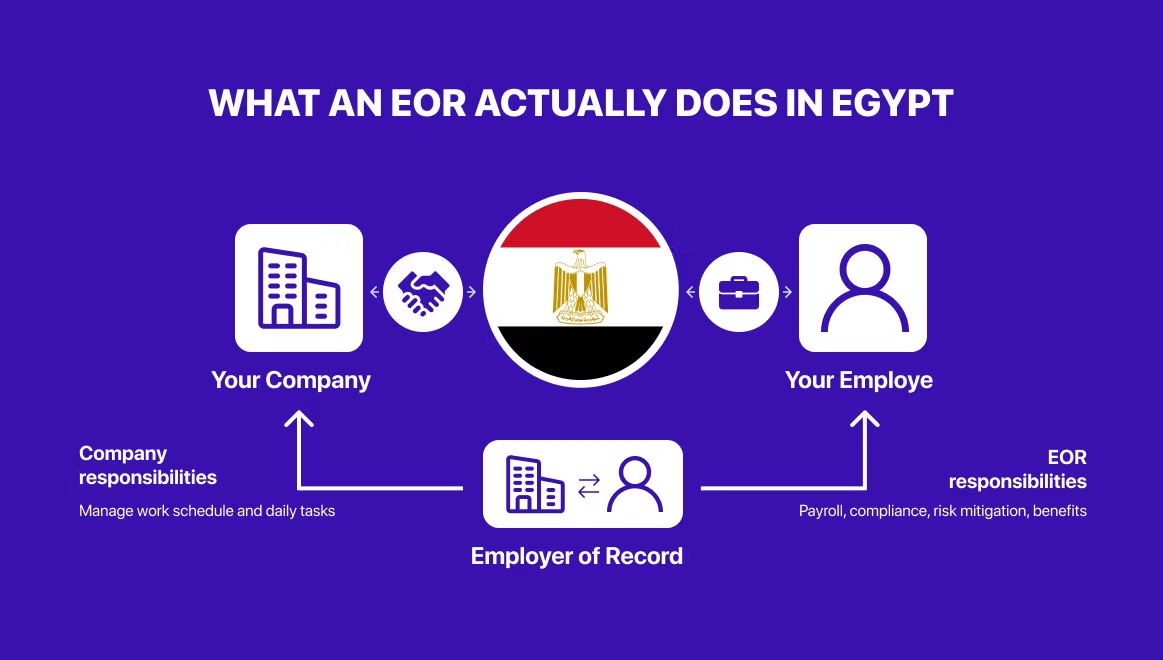
An Employer of Record (EOR) is a third-party organization that legally employs workers on behalf of another company, serving as the employer on paper while the client company maintains operational management. In the Egyptian context, the EOR assumes the burden of:
- Drafting and filing tripartite Arabic-language employment contracts.
- Registering employees with the Social Insurance Organization (SIO).
- Calculating and withholding progressive income taxes.
- Disbursing salaries in Egyptian Pounds (EGP) via local banking systems.
- Managing statutory benefits, including profit sharing and vocational training levies.
This model allows for faster market entry, often enabling a company to hire within 1 to 10 business days, compared to the 3 to 8 weeks required to set up a local entity.

The Definitional Framework: EOR vs. PEO vs. Payroll Outsourcing

Understanding the differences between various employment models is critical for foreign investors. In many Western markets, a Professional Employer Organization (PEO) operates on a co-employment basis, where both the service provider and the client company share legal responsibility. However, Egypt does not effectively support the PEO model for foreign companies without a local legal entity.
| Model | Legal Employer | Liability | Requirement for Local Entity |
| Employer of Record (EOR) | The EOR Provider | The EOR Provider | No |
| PEO (Co-employment) | Joint (Client & Provider) | Shared | Yes |
| Payroll Outsourcing | The Client Company | The Client Company | Yes |
| Independent Contractor | The Individual (Self-employed) | High Misclassification Risk | No |
Payroll outsourcing in Egypt is only a viable option for companies that have already established a local branch or subsidiary through GAFI, as a legal entity is required to register for tax and social insurance numbers.
For companies without this presence, attempts to use "contractor" models frequently fail legal audits, as Egyptian labor courts are predisposed to reclassify any relationship involving fixed hours, equipment provision, or direct supervision as a full-time employment relationship.
The Local vs. Global EOR Dichotomy

The global expansion market is currently divided between two distinct EOR delivery models: the local "owned-entity" provider and the global "aggregator" platform. This distinction is the most critical factor in determining the quality of compliance and the transparency of the liability chain.
Local EOR: The Owned-Entity Model
A local EOR provider, such as Team Up, operates directly within the Egyptian legal system with its own registered entity. This model creates a direct line of accountability. When a contract is signed, the entity named as the employer is the same entity that will defend the company during an audit by the Ministry of Labor or a dispute in a labor court.
Advantages of the Local Model:
- Direct Accountability: There is no "abstraction layer" or middleman. Resolution for payroll errors or legal edge cases is faster because the provider has in-country legal and HR teams.
- Cost Predictability: Local providers typically charge flat monthly fees per employee (e.g., EGP-denominated or fixed currency rates), which prevents the "platform tax" that occurs when fees are calculated as a percentage of a growing salary.
- Nuanced Compliance: Local providers are often the first to implement shifts in enforcement trends, such as the specific nuances of the 2025 Labor Law reforms or changes in the Social Insurance Organization's monthly filing requirements.
Global EOR: The Aggregator Model
Global EOR services, often marketed as international employer of record platforms, provide a unified dashboard for hiring in 100+ countries. However, in many jurisdictions, including Egypt, these platforms may not own a local entity. Instead, they subcontract the employment to a local partner.
Risks of the Global Aggregator Model:
- Fragmented Liability: If a payroll error occurs or a wrongful dismissal claim is filed, the global platform may point to the local partner, while the partner points back to the platform, leaving the client caught in the middle.
- Compliance "Hallucinations": Global platforms often rely on standardized, templated contracts. While these may appear compliant, they often lack the specific Arabic phrasing or tripartite filing rigor required by Egyptian authorities, making them "compliant in theory but weak in practice".
- Hidden Costs: Many global models include percentage-based pricing, FX markups, or additional fees for benefits administration and contract changes that can significantly inflate the total cost of ownership over a multi-year period.
Detailed Analysis of Labor Law No. 14 (2025 Reforms)

The implementation of the New Labor Law No. 14 in September 2025 introduces critical changes that every international employer of record must account for. This law seeks to modernize the workplace while significantly expanding leave entitlements and worker protections.
Expansion of Parental and Family Leave
The 2025 law represents a major leap forward for gender equality and family support in the Egyptian workforce.
| Leave Type | Old Law (No. 12 of 2003) | New Law (No. 14 of 2025) |
| Maternity Leave | 90 days | 120 days |
| Eligibility Tenure | 10 months of service | No minimum tenure |
| Frequency | 2 times per service | 3 times per service |
| Paternity Leave | Not provided | 1 day (paid) |
| Unpaid Childcare | 2 years (max 2 times) | 2 years (max 3 times) |
The abolition of the minimum service requirement for maternity leave means that an EOR must be prepared to manage leave requests for new hires immediately. Furthermore, the new law prohibits requiring pregnant employees to work overtime and mandates a one-hour reduction in daily working hours starting from the sixth month of pregnancy.
Recognition of Modern Work Patterns
Article 14 of the new law explicitly recognizes remote work, job sharing, and flexible hours. This is particularly relevant for global employer of record services that often facilitate remote teams for tech companies in the US or Europe. The law dictates that the "same rules" apply to these patterns as traditional relationships, meaning remote workers are entitled to the same social insurance, health coverage, and labor court protections as office-based staff.
Termination Governance and Labor Courts
The 2025 law introduces specialized labor courts, effective October 1, to accelerate the resolution of employment disputes. For indefinite-term contracts, the notice period is standardized at three months, regardless of tenure. This is a departure from the 2003 law, which allowed for a two-month notice period for employees with less than ten years of service.
Furthermore, the law clarifies that unlawful termination obligates the employer to pay compensation equal to at least two months' wages per year of service. This high cost of exit underscores the need for an EOR that follows due process, documenting all disciplinary actions and performance management steps in accordance with the Egyptian labor code to avoid reinstatement orders or massive settlement fees.
The Financial Architecture of Egyptian Payroll
Managing payroll in Egypt through an EOR requires a deep understanding of the local currency (EGP), progressive taxation, and the annually increasing caps for social insurance.
Mandatory Currency and Payment Regulations
Under Egyptian law, all employees must be paid in EGP through local payroll systems. While international companies may be tempted to pay in USD or EUR to protect employees from currency devaluation, this is legally categorized as informal employment if taxes and social insurance are not withheld in the local currency.
A compliant EOR will process the gross salary in EGP, handle the necessary withholdings, and provide an Arabic-language payslip, which is a mandatory legal document.
Personal Income Tax (PIT) Structure
Egypt operates a highly progressive tax system. For 2025 and 2026, the tax brackets are structured to exempt lower-income earners while applying higher rates to top-tier talent.
| Annual Net Taxable Income (EGP) | Tax Rate |
| 0 – 40,000 | 0% |
| 40,001 – 55,000 | 10% |
| 55,001 – 70,000 | 15% |
| 70,001 – 200,000 | 20% |
| 200,001 – 400,000 | 22.5% |
| 400,001 – 1,200,000 | 25% |
| Above 1,200,000 | 27.5% |
Employers are responsible for withholding PIT monthly and remitting it by the 15th of the following month using Form 4. Failure to comply can result in penalties of up to 80% of the unpaid tax amount.
Social Insurance Law No. 148 of 2019
Social insurance is the most dynamic component of the Egyptian payroll. The 2019 law mandates a 15% annual increase in the minimum and maximum wage caps for contributions from 2020 to 2027 to account for inflation and economic shifts.
| Effective Date | Minimum Monthly Cap (EGP) | Maximum Monthly Cap (EGP) |
| January 1, 2024 | 2,000 | 12,600 |
| January 1, 2025 | 2,300 | 14,500 |
| January 1, 2026 | 2,700 | 16,700 |
| January 1, 2027 | 3,200 | 19,300 |
Contribution Rates:
- Employer Share: 18.75% of the insurable wage.
- Employee Share: 11% of the insurable wage.
- Managers/Board Members: 21% flat rate (as they are considered employers).
These contributions fund the public pension system, unemployment benefits (up to 16-28 weeks at 60% of pay), and work injury insurance.
Mandatory and Supplemental Employee Benefits
Beyond salary, Egyptian labor law mandates a range of benefits that an EOR must administer correctly to ensure parity with the local market.
Profit Sharing: The 10% Statutory Requirement
Under Article 41 of the Companies Law, employees in Egypt are entitled to a share of the company's annual net profits. This must be at least 10% of distributable profits, but it is capped at the total amount of the company's annual wage bill. While this is technically a corporate requirement, an EOR must help foreign clients structure "phantom" profit-sharing or performance bonuses to remain competitive and compliant with the spirit of the law.
Annual Leave and Public Holidays
Egyptian leave entitlements are generous and increase based on seniority and age.
- Standard Annual Leave: 21 working days after six months of service.
- Senior/Age-based Leave: 30 working days for employees with 10+ years of service or those over 50 years of age.
- Pilgrimage Leave: A one-time, 30-day fully paid leave for employees with 5+ years of service for religious pilgrimage.
- Public Holidays: Egypt observes approximately 14 national holidays annually. Work performed on these days must be compensated at 200% to 300% of the normal wage.
The 13th-Month Salary and Bonuses
While not legally mandated, the 13th-month salary is a standard custom in Egypt, often paid in December. Furthermore, the New Labor Law No. 14 mandates an annual increment of at least 3% of the insurable wage, ensuring that salaries keep pace with the rising social insurance caps.
The Regulatory Environment for Foreign Labor
Hiring foreign nationals through an EOR in Egypt is governed by strict quotas and complex visa processes. Egypt generally limits the employment of foreigners to 10% of the total workforce of an establishment.
Work Permits and Security Clearances
Obtaining a work visa for an expatriate involves proving that the specific skills are not available in the local Egyptian market.
- Process: The employer (EOR) must apply to the Ministry of Manpower.
- Security Clearance: Foreigners must undergo a security review, which can take 2 to 4 weeks.
- Fees and Penalties: Fees for work permits vary, but the penalty for employing a foreigner without a valid permit can reach up to USD 2,000 per violation under the 2025 reforms.
The Migrant and Refugee Labor Dynamic
Egypt hosts a significant population of refugees and migrants, primarily from Sudan and Syria. However, the legal framework treats refugees as foreign nationals, making it difficult for them to access the formal labor market due to high permit costs and delayed residency renewals. This often leads to their inclusion in the informal sector, creating a dynamic where EORs can play a critical role in formalizing this workforce for international NGOs or socially responsible businesses.
Onboarding, Probation, and Performance Governance
The onboarding process in Egypt is legally heavy, requiring physical documentation and specific language protocols.
The Triplicate Arabic Contract
Every employment contract must be written in Arabic. While an English translation can be provided for the client's records, only the Arabic version is legally binding in an Egyptian court.
- The Triplicate Rule: One copy for the employee, one for the employer (the EOR), and one filed with the Social Insurance Office.
- Documentation: Employees must provide proof of identity, residency, and a social insurance number during onboarding.
Probation Periods
Egyptian law allows a maximum probation period of three months. This is non-renewable. If an employee is terminated during probation, they must still receive their accrued wages, but they are generally not entitled to severance or notice pay. A local EOR ensures that termination during probation is documented in writing to avoid future "unlawful dismissal" claims.
Working Hours and Ramadan Adjustments
The standard workweek is 48 hours (8 hours per day, 6 days per week).
Overtime Rates:
- Daytime: 135% of the regular rate.
- Nighttime (10 PM – 6 AM): 170% of the regular rate.
- Holidays/Rest Days: 200% of the regular rate.
Ramadan Context: During the holy month of Ramadan, it is conventional (though not explicitly mandated for all in the 2025 law) to reduce working hours for Muslim employees by one to two hours daily to accommodate fasting. A top-tier EOR will help the client navigate these cultural expectations to maintain high retention rates.
Termination, Severance, and Dispute Resolution
Terminations in Egypt are highly regulated and represent the single largest legal risk for foreign employers. "At-will" employment does not exist; every dismissal must be justified by specific causes outlined in the labor code, such as serious misconduct, fraud, or poor performance (duly documented over time).
Notice Periods and Severance
Under the 2025 law, the notice period for indefinite contracts is three months. For economic redundancies, severance pay is calculated as one month's wage for each of the first five years of service and 1.5 months' wage for subsequent years. If a court finds a termination was without cause, the minimum compensation is two months' full salary for each year of service.
The Role of the Emergency Relief Fund (ER Fund)
Employers with over 30 employees must contribute 1% of the employees' wages to the Emergency Relief Fund. This fund provides financial assistance to workers if their employer ceases operations or enters bankruptcy. An EOR handles these contributions as part of the monthly payroll cycle, ensuring the company remains in the government's "good standing".
Establishing a Local Subsidiary: The GAFI Pathway
For companies that plan to hire more than 15-20 employees or intend to engage in local commercial activities (like selling goods), setting up a local entity may become necessary. The General Authority for Investment and Free Zones (GAFI) acts as the "one-stop shop" for this process.
Step-by-Step LLC Incorporation
The Limited Liability Company (LLC) is the most common structure for foreign investors because it allows for 100% foreign ownership.
| Step | Action | Timeframe | Estimated Cost (EGP) |
| 1 | Reserve Trade Name & Non-confusion Certificate | 2 – 3 Days | 114 |
| 2 | Draft & Notarize Articles of Association | 1 – 2 Weeks | 0.025% of capital (min 10) |
| 3 | Obtain Security Clearances (for foreigners) | 2 – 4 Weeks | Included in professional fees |
| 4 | GAFI Approval & Commercial Registry | 3 – 5 Days | 63.25 |
| 5 | Tax Card & Social Insurance Registration | 2 – 7 Days | Minimal government fees |
Minimum Capital: While there is no fixed minimum for an LLC (often set at EGP 5,000 as a formality), a Joint Stock Company (JSC) requires EGP 250,000.
The Hidden Costs of Entity Management
While incorporation fees are relatively low (ranging from EGP 5,000 to 15,000 in government charges), the operational costs of a local subsidiary are significant. A foreign firm must hire a resident manager (mandatory for LLCs), maintain a physical office address, and employ local accountants and lawyers to handle the monthly tax and social insurance filings. By contrast, an EOR service fee is a fraction of this administrative overhead, making it the preferred choice for testing the Egyptian market or supporting remote tech teams.
Strategic Risk Management and Future Outlook
The decision between a local and global EOR in Egypt is ultimately a question of risk tolerance and long-term vision.
Liability Shielding and Data Privacy
An EOR provides a layer of legal protection by assuming the role of the statutory employer. This shields the parent company from direct exposure to the Egyptian labor courts. However, this shield only holds if the EOR is directly accountable. Global aggregator models that use third-party subcontractors often have "blurry" responsibility chains during audits, which can lead to risk "flowing back" to the client company.
Furthermore, Egypt has local data privacy requirements for employee records. A local EOR with in-country servers and an understanding of Egyptian privacy laws is better positioned to protect employee data than a global platform that may store information in a central cloud outside of Egyptian jurisdiction.
Conclusion: Navigating the 2026 Landscape
As Egypt approaches 2026, the complexity of its labor market will continue to increase. The 15% annual rise in social insurance caps, the full implementation of the specialized labor courts, and the stricter enforcement of the 2025 Labor Law reforms mean that "hands-off" global platforms may struggle to keep up with local nuances.
Actionable Recommendations for Foreign Firms:
- Choose an "Owned-Entity" EOR: Ensure the provider has a direct license in Egypt to guarantee a clear liability chain.
- Audit Contracts for Law 14 Compliance: Confirm that contracts reflect the 120-day maternity leave and the new 3% mandatory increment.
- Insist on EGP Transparency: Avoid USD/Wise payment models that bypass local tax registration and create misclassification risks.
- Leverage Local Expertise for Offboarding: Never terminate an Egyptian employee without consulting local legal counsel or the EOR's HR experts to avoid the massive costs of unlawful dismissal.
Egypt offers a skilled, youthful Talent Pool and a strategic location in the MENA region. By partnering with a local EOR that combines international service standards with deep Egyptian regulatory mastery, businesses can scale their operations with confidence, knowing their most valuable assets, their people, are employed safely, compliantly, and sustainably.
Frequently asked questions
1. What is the biggest compliance change in Egypt for 2026?
The full implementation of the New Labor Law (No. 14 of 2025).
- The Mandate: Contracts must now be in writing and drafted in four copies (Employer, Employee, Social Insurance Office, and Ministry of Labor).
- Remote Work Recognition: For the first time, Egyptian law explicitly recognizes "new work patterns," including remote and flexible work.
- Updated Notice Periods: The standard resignation notice period has increased to 3 months (up from 2 months).
- Maternity Leave: Paid maternity leave has increased to 4 months (up from 3 months).
2. Why are global EORs facing higher risks in Egypt in 2026?
Egyptian authorities have tightened the "Foreign Work Permit Decree" and reporting obligations.
- The Aggregator Risk: Many global platforms do not own an entity in Egypt; they subcontract to a local accounting firm. This "middleman" model can cause delays in filing the mandatory annual employee data statement required every January.
- Language Priority: Contracts must be in Arabic. While bilingual versions are allowed, in a 2026 labor dispute, only the Arabic text is legally binding. Global EORs using generic translated templates often fail to capture the specific nuances of the 2025 reform.
3. How does the 2026 Social Insurance cap affect payroll?
Egypt uses a unified social insurance system with caps that increase by 15% annually until 2027.
- 2026 Caps: The maximum insurable wage has risen to EGP 16,700 per month (up from EGP 14,500 in 2025).
- Contribution Rates: * Employer Share:18.75% of the insurable wage.
- Employee Share:11% (deducted from gross).
- Health Insurance: Employers pay an additional 3.25% (uncapped) for the Universal Health Insurance system.
4. Local vs. Global EOR Pricing: Where are the hidden costs?
- Local EOR (e.g., Team Up): Typically uses a flat-rate model (around €199/month). This is predictable and usually includes the cost of filing with the National Organization for Social Insurance (NOSI).
- Global EOR: Often charges 10–15% of gross pay or high flat fees ($599+). In 2026, as the Egyptian government raises minimum wages and salary benchmarks for tech roles rise, these percentage-based fees become a significant "growth tax."
5. Can I hire foreigners (expats) in Egypt via an EOR?
Yes, but it is strictly regulated.
- The 1:9 Ratio: Generally, for every 1 foreign employee, a company must employ 9 Egyptian nationals.
- New 2026 Scrutiny: The government has introduced tougher oversight on foreign work permits. A Local EOR with physical legal representation is better equipped to handle the Ministry of Manpower's manual verification processes than a global digital platform.
6. Termination in Egypt: How strict is the "Just Cause" rule?
Termination "at will" does not exist in Egypt.
- The Process: Under Law 14 of 2025, termination without a "just cause" (like gross misconduct or professional incompetence) is extremely difficult and usually results in the employer paying at least 2 months' salary for every year of service.
- Local Mastery: Local EORs provide "on-the-ground" HR specialists who can manage the mandatory Labor Court mediation processes. Global EORs often struggle with these offline, physical legal requirements.
.svg)


