


Azerbaijan Work Permits & Visas: Employer Guide to Types & Sponsorship
TL;DR
Expanding your team into emerging markets like Azerbaijan can unlock new talent pools, but it also means navigating local work permit and visa regulations. If you’re a decision-maker planning to hire internationally (whether your HQ is in the USA or you’ve used employer of record services in India, Turkey, or other MENA markets), understanding Azerbaijan’s process is critical.
This guide breaks down the types of visas and work permits in Azerbaijan, how the sponsorship process works with and without a local entity, and how an Employer of Record (EOR) can simplify hiring foreign employees. We’ll also compare Azerbaijan’s policies with neighboring Georgia and Armenia, so you get a regional perspective. The tone here is sharp, honest, and practical, founder-level clarity with no fluff – so you know exactly what to expect and how to proceed.
Quick Navigation
- TL;DR
- Work Permit and Visa Types in Azerbaijan for Foreign Workers
- Visa Sponsorship in Azerbaijan: With vs. Without a Local Entity
- Hiring Local Azerbaijani Talent vs. Foreign Talent
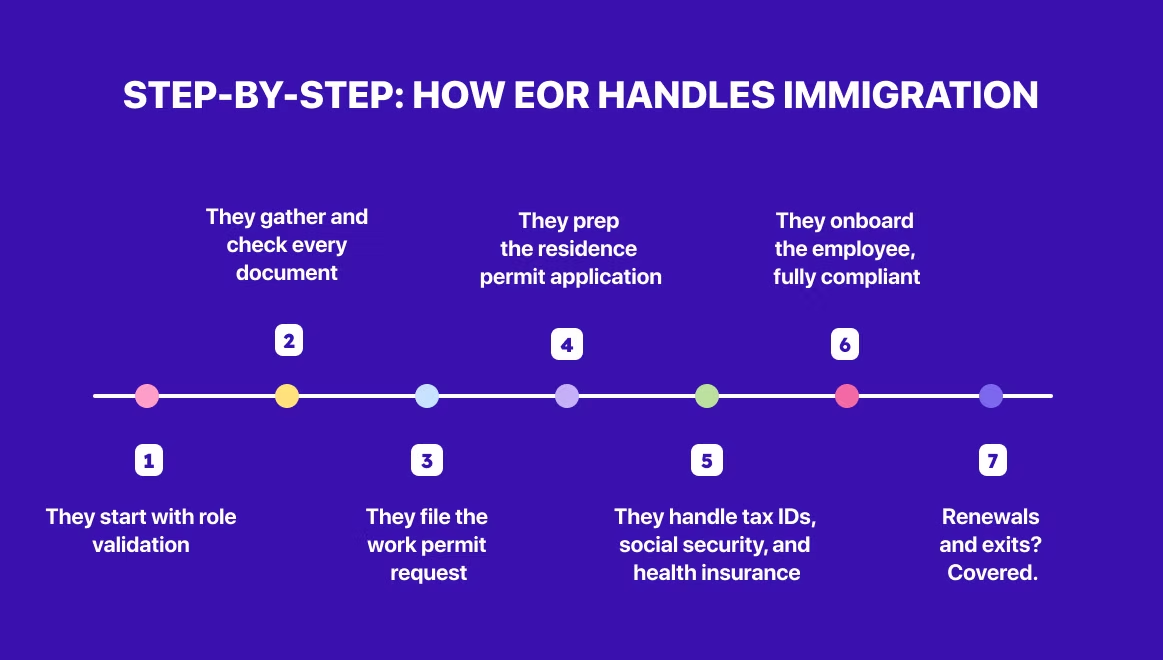
- Step-by-Step: How an EOR Sponsors a Foreign Employee in Azerbaijan
- EOR vs. Direct Hiring in Azerbaijan
- Final Thoughts
- Frequently Asked Questions
Work Permit and Visa Types in Azerbaijan for Foreign Workers
Azerbaijan has a clear and strict approach to foreign employment. While the country offers multiple visa categories for entry, none of them allow a foreign national to work without additional authorization.
If you plan to hire non-citizens in Azerbaijan, understanding this distinction is critical.

Azerbaijan’s Visa Categories (Entry Only)
Azerbaijan issues several types of visas for foreign nationals, including:
- Tourist visas
- Transit visas
- Business visas
- Diplomatic visas
- Official visas
These visas allow entry and short stays for specific purposes.
Important: None of these visa types grant the right to work or earn income in Azerbaijan.
Even if someone enters Azerbaijan on a business or tourist visa, they cannot begin employment until a work permit is approved.
Mandatory Requirement: Work Permit + Temporary Residence Permit
To legally work in Azerbaijan, a foreign national must have both:
- A work permit. Authorizes employment.
- A temporary residence permit. Allows legal stay during employment.
These permits are linked and typically applied for as part of the same employment authorization process.
Key rules to understand:
- Both permits are mandatory for foreign workers
- There are virtually no shortcuts or exceptions
- Even short-term assignments (e.g. a 2-month project) require prior approval
- Working on a tourist or business visa is not allowed
Azerbaijan enforces this strictly.
Initial Duration and Renewals
| Permit | Initial validity | Renewal |
| Work permit | 1 year | Renewable annually |
| Temporary residence permit | Matches work permit | Renewable annually |
Additional notes:
- Renewals must be filed before expiration
- After two years of continuous temporary residence, a foreign worker may become eligible to apply for permanent residence
- For most hires, annual renewal is the standard path
An Employer of Record (EOR) typically tracks deadlines and manages renewals to prevent lapses in status.
Entry Visa vs. Work Authorization
Even after a work permit is approved, entry rules still apply.
What this means in practice:
- Many nationalities require an employment entry visa
- The visa is obtained from an Azerbaijani embassy or consulate
- The work permit approval is used as supporting documentation
Unlike countries with broad visa-free regimes, Azerbaijan maintains stricter entry controls.
Critical rule: No work can begin until:
- The work permit is approved, and
- The individual has entered Azerbaijan on the correct status
An EOR usually coordinates this step once the State Migration Service issues the permit approval.
Documentation and Labor Market Test

The Azerbaijani work permit application is document-heavy and closely reviewed.
Employee Documents (Typical)
- Passport (valid at least 6 months beyond planned arrival)
- CV or employment history
- Proof of qualifications (diplomas, certificates)
- Medical certificate confirming freedom from specific diseases (e.g. HIV, Hepatitis)
Document formalities:
- Translations into Azerbaijani are required
- Notarization or apostille is often mandatory
- Foreign diplomas must be apostilled
Employer Documents and Justification
The employer must submit:
- Sponsorship documents
- A formal justification explaining why a local candidate cannot fill the role
This functions as a labor market test.
What authorities expect:
- Evidence that local recruitment was attempted
- Proof that the foreign hire has specialized or unique skills
Failure to sufficiently justify the hire is a common reason for rejection.
As with Armenia, Azerbaijan expects employers to show that foreign hiring is necessary, not merely convenient.
Processing Time and Planning
Official timeline:
- Approximately 20 working days (about 4 weeks) after submission
Reality on the ground:
- Processing often takes 6–8 weeks
- Delays are common if:
- Documents are incomplete
- Clarifications are requested
- Quotas are near capacity
- Any document is incorrectly filed
One missing or misformatted document can reset the timeline.
Practical Planning Guidance
To avoid delays:
- Start the process 2–3 months before the intended start date
- Ensure all documents are prepared correctly the first time
- Use local expertise to manage filings and follow-ups
Local specialists understand:
- Which documents must be originals
- Which can be electronic
- How to communicate with the State Migration Service
- How to keep applications moving without unnecessary resets
Visa Sponsorship in Azerbaijan: With vs. Without a Local Entity
One of the first and most important questions when hiring foreign workers in Azerbaijan is:
Who will act as the legal sponsor for the work permit?
Under Azerbaijani law, only a legal entity registered in Azerbaijan can sponsor a foreign national’s work permit. There are only two valid options:
- Your own Azerbaijani entity (subsidiary, branch, or representative office), or
- A third-party Employer of Record (EOR) that already has a licensed local entity
There are no shortcuts.
Below is how each option works in practice.
Option 1: Sponsorship Through Your Own Azerbaijani Entity
If your company already has a registered entity in Azerbaijan, you can sponsor work permits directly.
What the Local Entity Must Handle
Your Azerbaijani entity, as the employer, is responsible for:
- Submitting the work permit application to the State Migration Service
- Filing quota requests for foreign labor
- Providing all sponsor-side documentation
- Paying government fees
- Registering the employee at a local address
- Enrolling the employee in mandatory social insurance programs
In short, the entity carries the full compliance burden.
The Labor Migration Quota System (Critical Point)
Azerbaijan operates an annual foreign labor quota system.
How it works:
- Each year, the government sets quotas by industry
- Employers must declare anticipated foreign hiring needs in advance
- Authorities approve a maximum number of foreign workers per employer and sector
Why this matters:
- If your industry quota is exhausted, no new work permits will be approved, regardless of candidate quality
- Quotas reset annually, so timing is crucial
- Delayed or missed quota filings are a common and costly mistake
It’s entirely possible to have:
- A compliant entity
- A strong candidate
- And still be blocked due to quota exhaustion
Additional Restrictions
Local entities must also ensure:
- The specific job role is eligible for foreign workers
- Some sectors or roles may be restricted if not considered in demand locally
Practical Reality
This route is workable only if you have:
- An experienced local HR and legal team
- Familiarity with Azerbaijani migration bureaucracy
- Strong internal compliance processes
Mistakes. Even small ones (missing a quota report or filing an incorrect document) can lead to:
- Rejections
- Delays
- Fines
Option 2: Sponsorship Without a Local Entity (Using an EOR)
If you do not have a registered Azerbaijani entity, you cannot sponsor a work permit yourself.
There are:
- No freelance visas
- No contractor shortcuts
- No alternative sponsorship paths
A foreign worker must be employed by an Azerbaijani legal entity.
This is where an Employer of Record (EOR) in Azerbaijan comes in.
How an EOR Works in Azerbaijan
An EOR is a company that:
- Already has a registered Azerbaijani entity
- Is licensed to employ local and foreign staff
- Acts as the legal employer of record
In this model:
- The EOR sponsors the work permit
- The EOR issues the employment contract
- The EOR runs payroll and pays taxes
- You manage the employee’s day-to-day work
Legally, the employee is on the EOR’s payroll. Operationally, they work for you.
Why Companies Use an EOR
Using an EOR allows you to:
- Hire foreign employees without setting up a subsidiary
- Avoid the labor migration quota headaches
- Move faster and with less risk
- Delegate all bureaucracy to local specialists
Experienced EORs:
- Plan quota usage in advance across multiple clients
- Know how to justify foreign hires properly
- Prepare documents exactly as expected by the State Migration Service
- Handle notarized translations, apostilles, and formatting requirements
- Avoid common pitfalls that cause rejections or resets
In short, the EOR absorbs the complexity.
Practical Tip
Even companies with a local entity sometimes choose to use an EOR:
- For speed
- For risk reduction
- For one-off or small teams
- To avoid building internal immigration expertise
But for companies without an Azerbaijani presence, an EOR is not optional. It is the only compliant path to hiring foreign workers.
Hiring Local Azerbaijani Talent vs. Foreign Talent
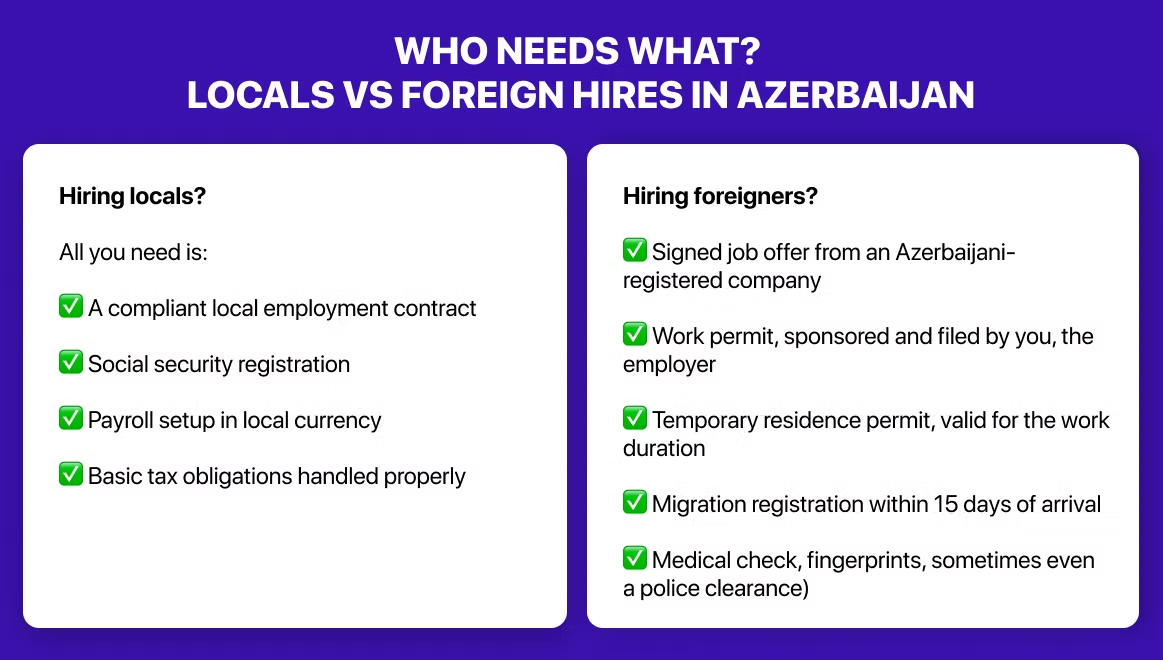
When building a team in Azerbaijan, one of the first strategic choices is whether to hire local Azerbaijani citizens or foreign nationals. The difference is significant. Not in labor law standards, but in immigration complexity, timing, and risk.
Here’s how the two paths compare in practice.
Hiring Local Azerbaijani Citizens
From an immigration standpoint, hiring Azerbaijani nationals is as simple as it gets.
Immigration Requirements
- No work permit required
- No visa required
- No quota restrictions
- No government approval needed
Local citizens can be employed immediately under Azerbaijani labor law.
Employment Process (With or Without an EOR)
If you hire locally, the process is standard employment onboarding:
- Verify national ID
- Sign an Azerbaijani-language employment contract
- Register the employee for:
- Taxes
- Social insurance
- Enroll in payroll
If you use an EOR for local hires, the EOR simply handles these steps on your behalf.
There is zero immigration paperwork involved.
Speed and Predictability
- Local hires can usually start immediately
- No dependency on migration authorities
- No uncertainty around approvals
This makes local hiring ideal when speed is critical.
Compliance Still Applies
Even though immigration is simple, labor law compliance still matters:
- Probation periods
- Minimum wage rules
- Overtime regulations
- Termination and notice requirements
Whether you hire directly or via an EOR, these rules apply equally.
Hiring Foreign Nationals
Hiring foreign talent in Azerbaijan is much more structured and time-sensitive.
Immigration Requirements
Foreign employees must have:
- A work permit
- A temporary residence permit
Both must be approved before employment begins.
There are no shortcuts.
Timing and Lead Time
- Immigration processing takes weeks or months
- Start dates depend entirely on permit approval
- Offers are not guaranteed until the government approves
Compared to local hires, this introduces:
- Delays
- Uncertainty
- Planning risk
Administrative Overhead and Risk
Foreign hiring requires:
- Government fees
- Extensive documentation
- Translations and apostilles
- Labor market justification
- Possible quota limitations
There is also a real risk of rejection if:
- Documentation is incomplete
- The role cannot be justified
- Quotas are exhausted
This is why many companies use an EOR for foreign hires.
Role of an EOR for Foreign Hires
An EOR typically:
- Manages the entire immigration process
- Prepares and submits applications
- Communicates with authorities
- Handles re-submissions if needed
- Advises on contingencies
For example:
- If a permit is delayed, the EOR may advise whether the person can work remotely from abroad temporarily
- If documents are missing, the EOR coordinates fixes quickly
In short, the EOR de-risks foreign hiring.
Payroll and Compensation Differences

Foreign hires often involve:
- Expat-related benefits (relocation, housing, etc.)
- Mandatory payroll in Azerbaijani Manats
- Local tax withholding and social contributions
An EOR runs compliant payroll for both local and foreign hires, including:
- Salary payments
- Payslips
- Tax filings
- Social security contributions
For local hires, payroll is simpler. For foreign hires, payroll is tightly linked to immigration compliance.
Either way, an employer of record payroll service eliminates the need for you to build local payroll infrastructure.
Cultural and Legal Nuances
Local Talent
- Fully fluent in language and business culture
- Expects standard local benefits and holidays
- Requires minimal adjustment support
Foreign Talent
- May need help with:
- Housing
- Healthcare
- Local systems and norms
- Often supported by the EOR as part of onboarding
Legally:
- Both local and foreign employees must have Azerbaijani-compliant employment contracts
- For foreign hires via EOR, the contract is between the EOR and the employee
- Labor code requirements apply equally to both groups
Side-by-side Comparison
| Aspect | Local Azerbaijani Hire | Foreign Hire |
| Work permit | Not required | Mandatory |
| Residence permit | Not required | Mandatory |
| Start time | Immediate | Weeks or months |
| Immigration risk | None | Medium to high |
| Quota exposure | None | Yes |
| Payroll complexity | Standard | Higher |
| EOR value | Convenience | Risk mitigation |
Step-by-Step: How an EOR Sponsors a Foreign Employee in Azerbaijan
Using an Employer of Record (EOR) is often the most efficient way to sponsor a foreign employee in Azerbaijan. Below is how the process typically works when an EOR manages immigration and employment on your behalf.
Step 1: Engage the EOR and Select Your Candidate
You start by partnering with an EOR provider in Azerbaijan and confirming the candidate you want to hire.
At this stage:
- The candidate signs an offer
- The EOR initiates legal onboarding
- You do not need to set up a local entity
- You do not interact with government offices
The EOR may also advise on:
- Salary benchmarks
- Role eligibility for foreign workers
- Qualification requirements for the work permit
Your role is focused on talent selection. The EOR handles the rest.
Step 2: EOR Conducts an Eligibility Check
Before filing any applications, the EOR validates whether the hire is legally feasible.
The EOR checks:
- The candidate’s nationality and visa requirements
- Whether an entry visa will be required
- Any visa-free or e-visa rules that apply
- Whether the role fits Azerbaijan’s foreign labor regulations
- Whether the annual foreign labor quota is still available
This step prevents situations where a hire looks viable on paper but turns out to be ineligible later.
Step 3: EOR Prepares and Submits the Work Permit Application
This is the most documentation-heavy stage.
The EOR prepares:
- A compliant Azerbaijani employment contract
- Employer documents:
- Company registration
- Tax ID
- Quota approvals
- Employee documents:
- Passport
- Photos
- Diplomas or certificates
- Medical certificates
- Any required translations, notarizations, or apostilles
Critical component:The EOR drafts the justification letter explaining why the foreign hire is necessary and compliant with labor rules.
The completed application is submitted to the State Migration Service.
During processing:
- The EOR tracks the application
- Communicates with authorities
- Responds to any clarification requests
The candidate must remain outside Azerbaijan or refrain from working until approval is granted.
Step 4: Work Permit Approval and Entry Visa Issuance
Once approved, the EOR receives:
- The work permit
- The associated temporary residence authorization
If the employee is outside Azerbaijan:
- The EOR coordinates entry visa issuance via an embassy or consulate
- The migration approval authorizes visa issuance
If the employee is already in Azerbaijan:
- The EOR manages the legal transition to work-residence status
- In some cases, exit and re-entry may be required
Upon arrival, the EOR ensures:
- Address registration with local authorities
- Compliance with entry and residence rules
Step 5: Onboarding and Payroll Setup
Once the employee is legally present and authorized to work, formal onboarding begins.
The EOR handles:
- Payroll setup in Azerbaijani Manats
- Income tax withholding
- Employer social contributions
- Registration with social insurance and pension systems
- Payslip issuance
If agreed, the EOR may also arrange:
- Private health insurance
- Allowances or stipends
- Equipment or workspace support
The EOR confirms:
- Official start date
- Full compliance status
- Delivery of immigration documentation to you for your records
Step 6: Ongoing Compliance and Renewals
Work permits and residence permits are usually valid for 12 months.
The EOR manages ongoing compliance by:
- Tracking permit expiration dates
- Initiating renewals 30–60 days in advance
- Handling renewals and updated filings
- Managing payroll tax reporting
- Reporting changes (address, role, promotions)
If regulations change (quota rules, document standards, procedures), the EOR adapts and informs you.
Your involvement is typically limited to business decisions, such as approving renewals or contract extensions.
Why This Matters
Sponsoring a foreign employee in Azerbaijan is a multi-step, compliance-driven process.
An EOR:
- Absorbs the administrative burden
- Reduces rejection risk
- Ensures continuity of legal status
- Acts as your long-term compliance partner
From initial paperwork to renewals years later, the EOR turns a complex immigration workflow into a managed, predictable service.
EOR vs. Direct Hiring in Azerbaijan
Responsibilities, Pros, and Cons from a Sponsorship Perspective
When hiring in Azerbaijan, especially for foreign talent, companies typically choose between two models:
- Using an Employer of Record (EOR)
- Setting up a local Azerbaijani entity and hiring directly
Both paths can legally sponsor work permits. The difference betweenEOR and entity hiring lies in who carries the burden, how fast you can hire, and how much risk you assume.
Responsibilities: Who Handles What?
Option 1: Using an Employer of Record (EOR)

With an EOR, the provider becomes the legal employer in Azerbaijan and assumes nearly all compliance and administrative responsibilities.
The EOR handles:
- Acting as the official employer for work permit sponsorship
- Preparing and submitting:
- Work permit applications
- Temporary residence permits
- Entry visas (if required)
- Liaising with the State Migration Service
- Drafting compliant Azerbaijani employment contracts
- Registering employees for:
- Taxes
- Social security
- Mandatory benefits
- Running payroll (EOR payroll services)
- Paying salaries, taxes, and employer contributions
- Monitoring renewals and ongoing compliance
You handle:
- Selecting and managing the employee
- Setting role expectations and performance goals
- Paying the EOR’s monthly invoice (salary + taxes + service fee)
You do not need to:
- Register a company
- File migration quota reports
- Interact with government portals
- Learn Azerbaijani labor or immigration law
Option 2: Direct Hiring via Your Own Azerbaijani Entity
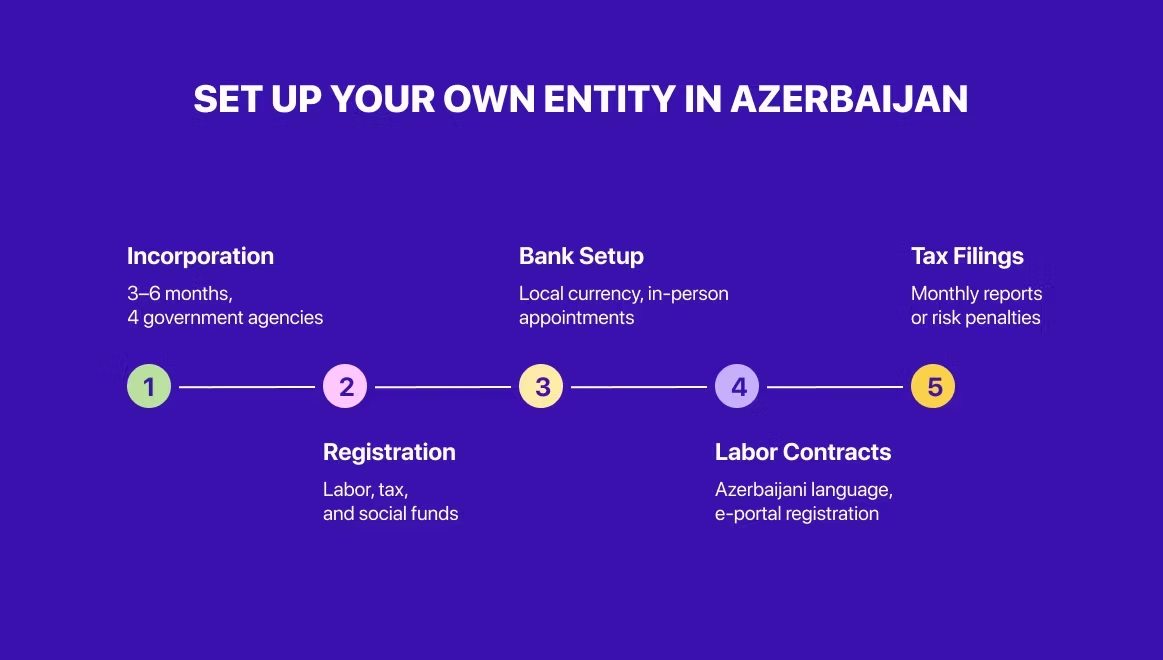
If you establish your own entity, everything shifts to you.
You (your local entity) must handle:
- Company incorporation and registrations
- Annual foreign labor quota requests
- Work permit and residence permit sponsorship
- Government fees and filings
- Address registration for foreign employees
- Payroll setup and monthly tax reporting
- Pension, social insurance, and healthcare enrollment
- Monitoring changes in labor and migration law
This usually requires:
- Local HR staff or external legal advisors
- Payroll vendors
- Continuous compliance oversight
You gain full control, but also full legal liability.
Pros and Cons Comparison
Employer of Record (EOR)
Pros
- Speed: Hire in weeks, not months
- Low setup effort: No entity, no local HR team
- Reduced compliance risk: Experts handle permits, quotas, filings
- Cost-efficient for small teams: Often cheaper than running a full entity
- Flexibility: Easy to scale up or down
- Peace of mind: No accidental early work, no missed deadlines
Many companies choose this route for exactly these reasons. See EOR-08: Top Reasons Companies Choose an EOR in Azerbaijan.
Cons
- Ongoing service fees: Monthly cost per employee
- Less legal control: Employment actions go through the EOR
- Employer branding: Paychecks list the EOR’s entity
- Limited scope: EOR covers employment, not broader business operations
For long-term, large-scale teams, these costs can add up.
Direct Entity Hiring
Pros
- Full control: Employees are legally and culturally yours
- Long-term cost efficiency: Cheaper at scale
- Business expansion: Enables sales, contracts, licensing
- Immigration autonomy: You control quota strategy and timelines
- Stronger local presence: Signals long-term commitment
Best suited for companies treating Azerbaijan as a core market, not a test.
Cons
- Slow startup: Entity setup can take months
- High complexity: Immigration, payroll, and labor law learning curve
- Compliance risk: Errors lead to fines or permit denials
- Fixed overhead: Costs remain even if hiring slows
- Low flexibility: Hard to unwind if plans change
Many companies underestimate the burden until they hit issues with quotas, translations, or filing errors.
Quick Comparison Table
| Aspect | EOR | Own Entity |
| Time to hire | Fast (weeks) | Slow (months) |
| Entity setup | Not required | Required |
| Immigration expertise | Included | Must build |
| Compliance risk | Low | High |
| Cost at a small scale | Lower | Higher |
| Cost at a large scale | Higher | Lower |
| Flexibility | High | Low |
| Business operations | Employment only | Full operations |
Final Thoughts
Remote hiring in Azerbaijan comes with a fair share of paperwork and patience – but it’s a road well-traveled by many international companies, and with the right approach, it’s absolutely manageable.
The key takeaways for any founder or hiring manager are: start early, stay compliant, and don’t go it alone if you don’t have to. Azerbaijan’s work permits and visas have strict rules, but those rules are navigable with expertise. An Employer of Record can be your guide and shield, handling everything from sponsorship under the labor quota to monthly payroll taxes, so you can focus on your business growth.
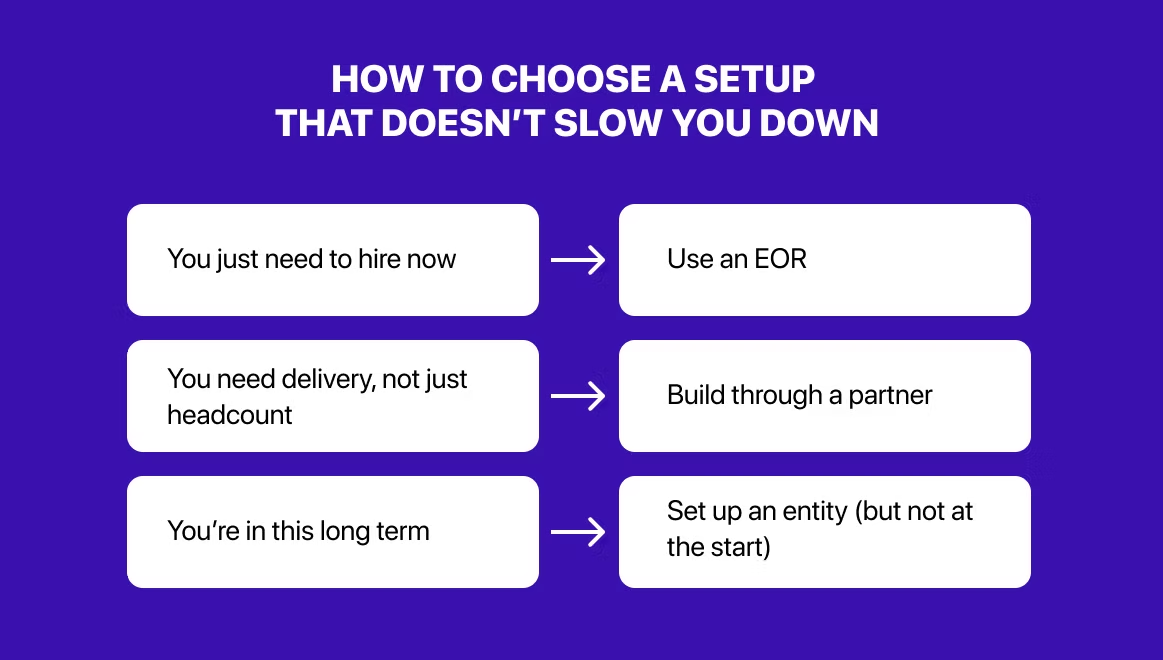
Before you decide on your approach, consider the scale and duration of your plans in Azerbaijan. If you’re testing the waters with one or two hires, an EOR will likely be the most efficient and risk-free choice.
If Azerbaijan is slated to become a major hub for you with dozens of hires, you might eventually set up shop directly – but even then, starting with EOR is a smart way to avoid delays and assess the market. And remember, this isn’t an isolated decision: what you learn here applies to other markets too.
The challenges of work visas, sponsorship, and compliance pop up in every country (each with a twist), and the EOR model is a proven solution worldwide – be it in the USA, India, the Middle East, or the Caucasus.
At the end of the day, the ability to hire the best talent wherever they are is a huge competitive advantage. Azerbaijan has a lot to offer, from engineering talent in Baku’s growing tech scene to specialists in its traditional oil and gas industries.
Don’t let the paperwork scare you off. With this guide, you have a clear roadmap for work permits and EOR sponsorship. And with Team Up’s support as a potential partner (or any reputable global EOR service), you have an on-the-ground team ready to carry the compliance burden for you. That means you can hire confidently and get your new team members working – legally and efficiently – all while maintaining the sharp, no-nonsense approach that your business deserves.

Frequently Asked Questions
1. Do foreign employees need a work permit to work in Azerbaijan?
Yes. All foreign nationals must have a work permit and a temporary residence permit to legally work in Azerbaijan. Standard visas (tourist, business, e-visa) do not grant the right to work, even for short-term assignments.
2. Who can sponsor a work permit in Azerbaijan?
Only a legal entity registered in Azerbaijan can sponsor a work permit. This can be:
- Your own Azerbaijani subsidiary, branch, or representative office, or
- A licensed Employer of Record (EOR) with an existing local entity
Foreign companies without a local entity cannot sponsor work permits directly.
3. Can we hire a foreign worker in Azerbaijan without setting up a company?
Yes. This is exactly what an Employer of Record (EOR) is used for. The EOR acts as the legal employer, sponsors the work permit, runs payroll, and handles all compliance while you manage the employee’s day-to-day work.
4. Is there a “short-term” or 90-day work visa in Azerbaijan?
No. Azerbaijan does not offer a special short-term work visa. Even assignments lasting only a few weeks or months require a work permit and residence permit if the person is performing paid work in-country.
5. How long is an Azerbaijani work permit valid?
Work permits are typically issued for one year and can be renewed annually. The temporary residence permit is issued for the same duration.
After two years of continuous legal residence, foreign employees may become eligible to apply for permanent residence.
6. How long does it take to obtain a work permit in Azerbaijan?
Official processing time is about 20 working days, but in practice, employers should plan for 6–8 weeks. Delays are common if:
- Documents are missing or improperly notarized
- Apostilles are incorrect
- The labor quota is nearing its limit
Most companies plan 2–3 months ahead of the desired start date.
.svg)


