


Local vs Global Employer of Record (EOR) in Eastern Europe: A Comprehensive Guide
TL;DR
The strategic expansion of multinational enterprises into Eastern Europe and the Caucasus region has undergone a fundamental transformation throughout 2025 and into 2026. As the global landscape for remote and hybrid work matures, the reliance on Employer of Record (EOR) services has transitioned from a temporary tactical "workaround" for small teams to a cornerstone of sophisticated global human resources architecture.
This guide provides an exhaustive analysis of the choice between Global EOR platforms and Local EOR specialists, specifically tailored for founders, human resources directors, and legal counsels navigating the regulatory complexities of Poland, Romania, Bulgaria, Hungary, and the emerging tech hubs of the Caucasus and Central Asia.
Quick Navigation
- TL;DR
- The Macroeconomic Context of Eastern European Talent Acquisition
- Defining the Models: Wholly-Owned Global EOR vs. Local Regional Specialists
- Regional Specialisation: The Rise of the Local EOR
- Poland: Navigating the 2026 Labour Reform and B2B Scrutiny
- Romania: The Transition to Fiscal Rigour and the End of IT Exemptions
- Bulgaria: Eurozone Entry and the Denominated Compliance Shift
- Hungary: Maximising the KIVA Regime and Benefit Flexibility
- Intellectual Property and Data Protection in Eastern Europe
- Cost Comparison: Flat Fee vs. Percentage of Salary
- Setting Up Your Own Entity: When to Transition?
- Managing Distributed Teams: Cultural Nuances and Practicalities
- The Emerging Frontier: The Caucasus and Central Asia
- Risk Shielding and Liability Allocation
- Conclusion: Synthesising the 2026 EOR Strategy
- Frequently Asked Questions
The Macroeconomic Context of Eastern European Talent Acquisition
The Eastern European tech sector has demonstrated remarkable resilience despite navigating significant geopolitical and economic headwinds throughout the mid-2020s. By the beginning of 2025, the region’s cumulative talent pool reached approximately 1.5 million developers, positioning it as a primary destination for software development outsourcing and internal engineering hub establishment. Countries such as Poland, Ukraine, and Romania continue to grow their professional populations, with Ukraine focusing on maintaining resilience at historical levels while Poland and Romania attract significant foreign direct investment from global leaders like Amazon, Google, and Samsung.
This influx of capital and the corresponding demand for high-tier specialists have accelerated the development of the EOR market. According to recent industry projections, the global EOR platform segment is estimated to grow from $5.6 billion in 2025 to over $10 billion by 2035, with Europe currently holding a dominant 30% market share. This growth is fueled by the realisation that compliance with international labour laws remains the top challenge for 86% of HR leaders, while 87% of companies planning expansion cite local tax and employment regulations as their most difficult task for 2026.
Defining the Models: Wholly-Owned Global EOR vs. Local Regional Specialists
The selection of an EOR partner involves a critical evaluation of their underlying operating model. The industry is primarily divided into the wholly-owned (direct) model and the aggregator (partner-led) model, each carrying distinct implications for risk, cost, and employee experience in Eastern Europe.
The Wholly-owned Direct Model
In a wholly-owned model, the EOR provider establishes and operates its own legal entities in the countries where it offers services. This means the provider directly employs the workers and manages all employment-related responsibilities internally, from payroll processing to local tax filings. Providers like Remote and Atlas HXM often prioritise this model in key markets to ensure consistency and data control.
The advantages of this approach include:
- Full Process Control: The provider standardises policies and procedures across regions, offering a consistent experience for both the client and the employee.
- Enhanced Compliance: Client data remains within a single organisation, simplifying GDPR compliance and reducing the risks associated with data transfers between third parties.
- Efficiency: Direct ownership typically leads to faster response times, as the provider does not need to coordinate with external in-country partners across different time zones.
The Aggregator (Partner-Led) Model
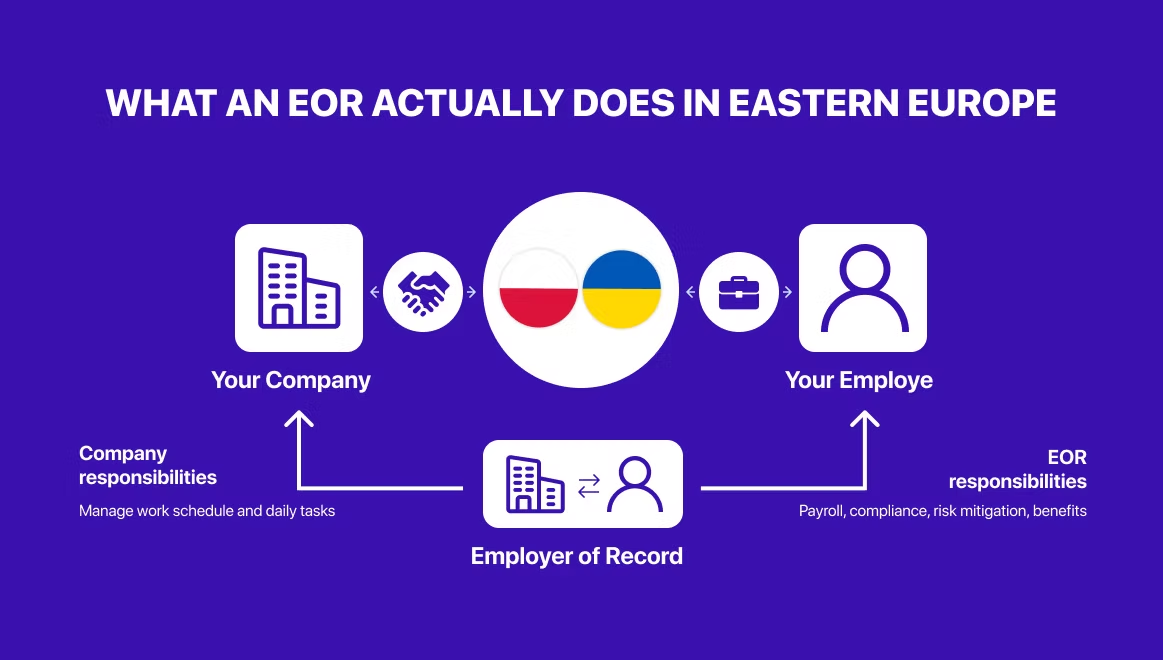
The aggregator model involves an EOR provider partnering with local companies or affiliates in each country to act as the legal employer of record. Approximately 68% of the EOR market share is held by aggregators, who leverage these partnerships to provide rapid coverage across a vast number of jurisdictions.
However, the aggregator model introduces specific risks:
- Dependency on Third Parties: The quality of service and compliance standards may vary significantly between partners, as each local entity operates somewhat independently.
- Inconsistent Experience: Onboarding and offboarding processes may not be uniform across different countries, potentially affecting employee satisfaction and brand perception.
- Hidden Costs: Aggregators often have to account for the markups charged by their local partners, which can lead to higher overall service fees for the client.
Comparison of EOR Operating Models
| Feature | Wholly-Owned Model | Aggregator Model |
| Market Share | Growing among enterprise users | 68% of total market |
| Control | Full control over internal processes | Limited oversight of day-to-day partner ops |
| Scalability | Slower (requires entity setup) | Faster (uses existing networks) |
| Data Security | High (single-point data control) | Variable (shared with third parties) |
| Pricing | Often more transparent/flat | May include hidden partner markups |
Regional Specialisation: The Rise of the Local EOR
In 2026, many companies are moving toward local or regional EOR specialists for their core hubs. A local EOR focuses on a single country or a specific region, such as the Caucasus or Central Asia, providing deep expertise that global platforms sometimes struggle to replicate.
Regional specialists like Team Up focus on markets where compliance cannot be generalised, such as Poland, Romania, Bulgaria, and Hungary. These providers often maintain direct entities and plug directly into official government portals, such as Poland's ZUS, Romania's ANAF, and Hungary's NAV. The choice between a global platform and a local specialist often depends on the scale of hiring; if an organisation is hiring 1–2 people across many countries, a global EOR offers simplified administration. However, if building a team of 15–30 employees in a specific country, a local EOR often provides better cost efficiency and more nuanced compliance.
Poland: Navigating the 2026 Labour Reform and B2B Scrutiny

Poland remains the preeminent destination for tech hiring in Eastern Europe, but the regulatory environment is undergoing its most significant shift in decades. The introduction of the National Labour Inspectorate (PIP) reform, planned for January 1, 2026, represents a major challenge for companies relying on the Business-to-Business (B2B) model.
The Crackdown on "Disguised" Employment
Historically, approximately 65% of software developers in Poland have preferred B2B contracts due to lower taxation and social security costs compared to traditional employment (UoP). Under the 2026 reform, the PIP will gain administrative power to reclassify B2B contracts as employment relationships via an immediately enforceable decision, bypassing the previously required court process.
The PIP will evaluate relationships based on the "substance over form" principle, looking for indicators of employment such as:
- Subordination to managerial instructions.
- Fixed workplace and working hours.
- Performance of work personally without the right to delegate.
- No economic risk is borne by the contractor.
The retroactive effects are severe, potentially requiring companies to settle outstanding social security contributions and taxes for up to three years.
Seniority Calculation and Employee Entitlements
Effective January 1, 2026, the Polish Labour Code will broaden the definition of employment tenure. Periods of professional activity previously excluded, such as B2B cooperation, mandate contracts (umowa zlecenie), and agency agreements, will now count toward an individual's length of service, provided social security contributions were paid.
This expansion of seniority has direct financial implications for employers:
- Holiday Entitlement: Many employees will more quickly reach the 26-day annual leave threshold.
- Notice Periods: Seniority directly correlates to notice periods, which can extend to 3 months for those with over 3 years of tenure.
- Severance Pay: Seniority-based benefits and statutory severance payments will increase across the workforce.
Poland's 2026 Economic and Payroll Indicators
| Parameter | Value as of January 1, 2026 |
| Monthly Minimum Wage | PLN 4,806 gross |
| Hourly Minimum Rate | PLN 31.40 gross |
| Maximum Statutory Severance | PLN 72,090 gross |
| Standard Working Time | 8h/day, 40h/week (4-month settlement) |
| Night Shift Bonus | 20% of the hourly rate from the minimum wage |
Romania: The Transition to Fiscal Rigour and the End of IT Exemptions

Romania is currently implementing a strategy of fiscal consolidation to address its budget deficit, leading to the removal of several long-standing incentives for the technology sector.
The Abolition of IT Tax Exemptions
The most significant change for the Romanian IT sector is the elimination of the income tax exemption for software developers, effective January 1, 2025. Previously, IT professionals enjoyed an exemption from the 10% personal income tax and paid a reduced pension contribution of 20.25%. Starting in 2025 and continuing into 2026, IT salaries are fully taxed, aligning the industry with the general labour market and significantly reducing take-home pay for many specialists.
Micro-enterprise Regime and Deductibility Limitations
The Romanian government has also introduced restrictive measures for the micro-enterprise tax regime. The annual income threshold for a company to qualify as a micro-enterprise is being reduced from €500,000 to €250,000 in 2025, and further to €100,000 by January 1, 2026.
Furthermore, Law no. 239/2025 introduces a deductibility cap for intra-group transactions. Expenses paid to non-resident affiliated entities for management, consultancy, or intellectual property (IP) are deductible only up to 1% of the total annual expenses for companies with a turnover below €50 million. This represents a critical shift for global firms using Romanian EORs or subsidiaries for IP-heavy projects, as it limits the ability to repatriate profits through service fees.
Administrative Reforms and Compliance Enforcement
Romania is modernising its tax administration through systems like RO e-Factura and RO e-VAT. Starting January 1, 2026, companies must transmit invoices through the RO e-Factura system within 5 working days of issuance. Additionally, companies failing to submit annual financial statements or maintain a mandatory local bank account may be declared "fiscally inactive," leading to the suspension of their VAT code and dissolution proceedings by the tax authority (ANAF).
| Romanian Tax/Labour Indicator | 2026 Policy Detail |
| Minimum Gross Wage | RON 4,325 (Effective July 1, 2026) |
| Dividend Tax Rate | 16% (Increased from 10%) |
| Micro-enterprise Revenue Tax | 1% (Single rate, higher 3% rate eliminated) |
| Employee Pension (CAS) | 25% of gross salary |
| Health Insurance (CASS) | 10% of gross salary |
Bulgaria: Eurozone Entry and the Denominated Compliance Shift

Bulgaria’s entry into the Eurozone on January 1, 2026, marks a watershed moment for its economy and labour market. For EOR users, this transition simplifies multi-country payment journeys but requires immediate system updates.
Euro Adoption Impact on Payroll
The adoption of the euro has led to the automatic conversion of all labour remuneration, social security contributions, and benefits into the new currency using the fixed rate of $1 EUR = 1.95583 BGN$. A critical compliance detail is the "rounding in favour of the worker" rule: conversion must use the full five decimal places of the fixed rate, and the final result must be rounded up at the third decimal place.
Employers are mandated to issue addenda to current employment contracts to reflect salaries in euros and must notify the National Revenue Agency (NRA) within three days of any adjustments to comply with the new minimum wage of €620.20.
Social Security Caps and Indicators
Pending the formal approval of the 2026 budget, Bulgaria has "frozen" many of its main thresholds at 2025 levels, converted into euros:
| Indicator | 2026 Threshold in Euro |
| Maximum Monthly Insurable Income | €2,111.64 |
| Minimum Monthly Insurable Income | €550.66 |
| Daily Minimum Unemployment Benefit | €9.20 |
| Daily Maximum Unemployment Benefit | €54.78 |
| Non-taxable Food Vouchers | €102.26 per month |
The Bulgarian labour code is also becoming more flexible, granting employees who are parents of children up to 12 years of age the right to propose temporary changes to their working hours or transition to remote work.
Hungary: Maximising the KIVA Regime and Benefit Flexibility

Hungary continues to offer a unique fiscal landscape for "salary-heavy" businesses through the Small Business Tax (KIVA) and a complex array of non-salary benefits.
The KIVA Threshold Expansion
KIVA serves as an alternative to the standard corporate tax (TAO). For 2026, the eligibility criteria have been significantly expanded, allowing more companies to opt for a 10% tax on personnel costs and dividends rather than the 9% profit tax and 13% social contribution tax.
The 2026 KIVA thresholds are:
- Entry: Balance sheet total and yearly revenue below HUF 6 billion (up from 3 billion), with fewer than 100 employees (up from 50).
- Maintenance: Companies can stay in KIVA as long as their revenue stays below HUF 12 billion and they have fewer than 200 employees.
2026 Minimum Wage and Payroll Taxes
Hungary operates with a two-tiered minimum wage system based on the qualification requirements of the role:
- Standard Minimum Wage: HUF 322,800 gross (for unqualified roles).
- Guaranteed Minimum Salary: HUF 373,200 gross (for roles requiring secondary education).
| Payroll Component (Hungary) | Rate in 2026 |
| Personal Income Tax (Employee) | 15% |
| Social Security Contribution (Employee) | 18.5% |
| Social Contribution Tax (Employer) | 13% |
| Health Service Contribution | HUF 12,300 per month |
Family Tax Benefits and "Cafeteria" Pockets
Hungary’s 2026 tax package expands benefits for parents and young workers. The family tax benefit increases to HUF 20,000 for one child, HUF 80,000 for two children, and HUF 198,000 for three or more children, adding directly to the employee's net take-home pay at no cost to the employer. Additionally, a new "Active Hungarians" pocket for the SZÉP Card allows for HUF 10,000 per month to be spent on sports and fitness activities.
Intellectual Property and Data Protection in Eastern Europe
For tech-focused enterprises, the security of intellectual property (IP) is non-negotiable. One of the primary risks of using an EOR is the potential break in the "chain of title" for IP rights.
The Enforceability of IP Assignment
In many Eastern European jurisdictions, IP created during a working relationship does not automatically belong to the client company unless the individual is formally employed under local law. If a developer is hired through a freelance agreement or a B2B contract that does not meet the "written form" requirements of the local civil code, the IP ownership may remain with the creator, despite any clauses stating otherwise in a global service agreement.
In Romania, for instance, intellectual property created by an external contractor does not automatically transfer to the client without an explicit written assignment. Furthermore, to be enforceable against third parties, these assignments may need to be registered with the State Office for Inventions and Trademarks (OSIM).
GDPR and Data Residency
The wholly-owned EOR model in Eastern Europe is often preferred for data-sensitive roles because it minimises the number of third parties handling employee data. Under an aggregator model, sensitive PII (Personally Identifiable Information) must be shared with the global platform, the local partner, and potentially the local partner’s payroll processor, complicating the GDPR "data protection by design" requirement.
Cost Comparison: Flat Fee vs. Percentage of Salary
The cost of EOR services in Eastern Europe varies significantly between local and global providers. Most global platforms charge a percentage of the employee's gross salary (typically 10–15%) or a high monthly flat fee (starting at $599).
Local and regional specialists, such as Team Up, usually offer a flat monthly fee per employee, which typically ranges from €199 to €500. This flat-fee model is increasingly favoured by CFOs for its predictability, especially as teams grow.
Comparison of Expansion Costs (10 Employees)
| Cost Component | EOR (Local Specialist) | Own Local Entity | Global EOR Platform |
| Setup Fees | Low/None | High (Legal/Registration) | Low |
| Monthly Service Fee | ~€2,500 total | Internal HR/Accounting costs | ~$6,000+ total |
| Time to Market | Days | 3–6 Months | Days |
| Compliance Risk | Managed by Provider | Internal Responsibility | Managed by Provider |
The "Scaling Trap" occurs when a company remains on a percentage-based global platform as it hires senior talent. A developer earning €8,000 gross per month might cost the company an additional €800–€1,200 per month in service fees on a global platform, whereas a local EOR fee would remain constant.

Setting Up Your Own Entity: When to Transition?
While an EOR is an ideal mechanism for market testing and rapid entry, most organisations consider transitioning to their own local entity when their headcount reaches 15–30 employees in a single jurisdiction.
Establishing a local entity provides maximum control over the workforce and brand presence, but it also increases the administrative burden. In Poland, for example, a limited liability company (sp. z o.o.) is the most popular vehicle, but it requires addressing National Court Register (KRS) filings, Central Register of Beneficial Owners (CRBR) duties, and ongoing tax registrations.
EOR vs. Own Entity: Decision Matrix
- Choose EOR if: Speed is critical, headcount is low, or the market is a "proof of concept".
- Choose Own Entity if: Long-term operations are planned, high-volume hiring is required, or specific local licensing is necessary.
- Choose Hybrid if: You need to enter fast using an EOR while simultaneously preparing the legal groundwork for entity ownership.
Managing Distributed Teams: Cultural Nuances and Practicalities
Effective management of Eastern European teams through an EOR requires an understanding of local cultural dynamics and workplace expectations. Research suggests that while technical skills are top-tier, communication styles may differ from Western norms.
Communication Styles and Engagement
Specialists from Eastern European regions often provide "restrained" answers in interviews, which Western employers may misinterpret as a lack of interest or initiative. In reality, this often stems from a focus on technical accuracy over "small talk." Furthermore, workplace hierarchies in some Eastern European cultures may be more rigid, and direct communication common in the US may be perceived differently by local employees.
The 13th and 14th Month Salary Norms
In Eastern Europe, the "13th-month salary" is a common end-of-year bonus used to reward employees and support holiday spending.
| Country | 13th Month Status | Typical Disbursement |
| Poland | Customary (Standard in Public) | December |
| Romania | Customary | December |
| Bulgaria | Customary | December |
| Hungary | Not Mandatory (Bonuses discretionary) | December |
| Czechia | Customary (Performance-linked) | December |
While not legally mandated in these specific countries (unlike in Greece or Italy), providing a 13th-month bonus is a powerful tool for talent retention in the competitive Eastern European tech market.
The Emerging Frontier: The Caucasus and Central Asia
As the cost of talent rises in the EU-member states of Eastern Europe, many organisations are looking toward the Caucasus (Georgia, Armenia, Azerbaijan) and Central Asia (Uzbekistan, Kazakhstan).
The Caucasus Talent Sweet Spot
Georgia and Armenia, in particular, have emerged as hubs for remote-ready, English-proficient developers. Georgia offers the "Individual Entrepreneur" status, which provides significant tax relief for IT services, while Armenia’s government provides dedicated support for tech startups. EORs in these regions must navigate unique digital systems, such as Georgia’s RS.ge tax portal and Azerbaijan’s EMAS system, to ensure that employees are properly registered and taxes are filed on time.
Compliance in Central Asia
Kazakhstan and Uzbekistan are also opening their markets to global hiring. These jurisdictions require a high degree of local expertise, as labour laws are often less aligned with EU standards than those of Poland or Romania. An EOR with a direct presence in these markets is essential to navigate the evolving regulatory landscapes and ensure that employment contracts are both locally compliant and internationally defensible.
Risk Shielding and Liability Allocation
An EOR’s primary function is to contain risk. By acting as the legal employer, the EOR assumes the primary liability for payroll errors, tax compliance, and labour law exposure. However, this risk containment only works if the EOR is directly accountable for execution.
If a global EOR subcontracts the employment to a third-party partner who fails to properly register an employee for insurance or miscalculates social security contributions, the liability can "flow back" to the client company in the form of labour disputes or tax audits. This is why experienced operators often prioritise wholly-owned EORs or regional specialists with direct entities in their target countries.
Common Pitfalls in EOR Engagement
- Misclassification: Relying on a contractor model when the relationship is effectively employment, especially under Poland’s 2026 PIP rules.
- Vague IP Clauses: Failing to ensure that the IP assignment meets the "written form" requirements of the local civil code.
- Termination Missteps: Attempting immediate dismissal without following the mandatory "fair process" outlined in local labour codes.
- Hidden Fee Structures: Failing to account for percentage-based markups or currency conversion fees that increase the true cost of the service.
Conclusion: Synthesising the 2026 EOR Strategy
Choosing between a global and a local Employer of Record in Eastern Europe is no longer just a vendor selection; it is a strategic decision that affects an organisation’s risk profile, cost structure, and ability to attract top-tier talent.
Global EOR platforms provide the administrative "easy button" for organisations making sporadic hires across dozens of countries. Their centralised dashboards and standardised processes offer a level of convenience that is ideal for early-stage expansion and low-headcount markets. However, as organisations scale their core teams in a specific country like Poland or Romania, the limitations of the global aggregator model, including its high cost, lack of local nuance, and fragmented accountability, become more apparent.
For organisations building dedicated engineering or product hubs, local and regional specialists offer a more sustainable path. Their direct-entity models, flat-fee pricing, and deep integration with local government portals provide a level of compliance security and cost predictability that global platforms often cannot match. In the context of Poland’s 2026 B2B crackdown and Romania’s shifting fiscal landscape, the accountability of a partner who "lives and breathes" the local market is a critical asset.
The most successful expansion strategies in 2026 will be those that are modular and adaptive: using global EORs to enter new markets, transitioning to local specialists to scale core hubs, and finally establishing local entities when long-term strategic integration is required. By understanding the origins, mechanisms, and future outlook of each model, global leaders can build resilient distributed workforces that leverage the full potential of the Eastern European talent powerhouse.

Frequently Asked Questions
1. What is the "June 2026 Pay Transparency Wall"?
This is the most significant HR event in the EU this year.
- The Mandate: Every EU member state must comply with the EU Pay Transparency Directive by June 2026. Employers are now legally banned from asking for a candidate's salary history and must include pay ranges in every job posting.
- The EOR Shield: If you have your own entity, you are directly liable for gender pay gap audits. An EOR like Team Up or WorkMotion takes the legal "heat," performing these audits and ensuring your job postings satisfy labor inspectors across Poland and Romania.
2. How is Poland cracking down on B2B contractors in 2026?
Poland has long been the capital of "B2B contracts," but the rules changed on January 1, 2026.
- The Reform: The Polish Labour Inspectorate (PIP) now has expanded powers to reclassify B2B contractors as employees instantly if the relationship looks like employment (e.g., fixed hours, use of company tools).
- The Risk: Many Global EOR platforms still offer "Contractor Management" in Poland as a primary service. In 2026, this is a high-risk gamble. A local EOR specialist will typically push for a full employment contract to protect you from retroactive social security claims.
3. Why is Romania's "Real-Time Tax Reporting" a problem for Global EORs?
Romania has become a leader in "Real-Time Tax Reporting" with its REGES-Online mandate.
- The 24-Hour Rule: Every employment contract modification (salary change, title change, or address update) must be reported via REGES within 24 hours.
- The Execution Gap: Global platforms often use "batch processing" or third-party accounting firms that work on a 5-day cycle. This delay triggers automatic fines in the Romanian system. Local EORs are integrated directly into REGES for instant updates.
4. Local vs. Global EOR Pricing: How do they compare?
In Eastern Europe, "Global" usually means a premium for the software, while "Local" means a premium for the service.
- Local EOR (Specialist): Often charges a flat fee of €199 – €350/month. They are cost-effective for teams of 5–20 people in a single country.
- Global EOR (Platform): Typically starts at $599/month (€550+). While the UI is better, you pay a "convenience tax" that can reach €3,000+ extra per year per employee compared to local providers.
5. Can I use an EOR to hire non-EU talent (e.g., from Ukraine or India) in Poland?
Yes, but the June 1, 2026, Amendment to the Act on Foreigners has introduced a "hard block."
- The Change: You can no longer legalise a worker in Poland if they are staying on a visa from another Schengen state without a specific Polish residence permit.
- The Value: A local EOR manages the Type A Work Permit process directly with the Voivodeship office. Global platforms often "outsource" this to visa agencies, leading to longer wait times and higher rejection rates.
.svg)


