5 Things to Know About EOR-Sponsored Visas in Armenia: Enterprise Guide
TL;DR
Armenia is no longer a well-kept secret. Global teams are waking up to what Yerevan's tech corridors already know: this small Caucasus nation packs serious talent, competitive costs, and a business-friendly environment that makes it genuinely worth building in. But the moment you decide to relocate a key hire or bring in a foreign specialist, one question immediately surfaces: how do you get them legally working here?
That's exactly where EOR-sponsored visas in Armenia become the most powerful tool in your global HR kit. And if you're a decision-maker planning to build a team in this market, this guide was written for you. No fluff. No recycled definitions. Just what you actually need to know, from the labor market test in Yerevan to the digital permits portal, to what happens if you get it wrong.
Let's get into it.
Table of Contents
- TL;DR
- Why Armenia? The Enterprise Case for Hiring Here Right Now
- Thing 1: Armenia Work Visa: EOR-Sponsorship
- Thing 2: Labor Market Test in Armenia: Key Requirement for Work Permit and Visa Sponsorship
- Thing 3: The Work Permit and Residence Permit Are Two Separate Hurdles
- Thing 4: Work Permit Exemptions in Armenia: Who Does Not Need a Visa Sponsorship in 2026
- Thing 5: Armenia Work Entry Visa 2026: New Rules for Hiring and Sponsoring Foreign Employees
- What It Looks Like When an EOR Runs the Full Process
- The Risk of Skipping Proper Sponsorship in Armenia
- Team Up's Advantage: Why Local Presence Changes Everything in Armenia
- Bottom Line
- FAQ: EOR-Sponsored Visas in Armenia
Why Armenia? The Enterprise Case for Hiring Here Right Now
Before we get into EOR compliance, it's worth grounding this in reality.
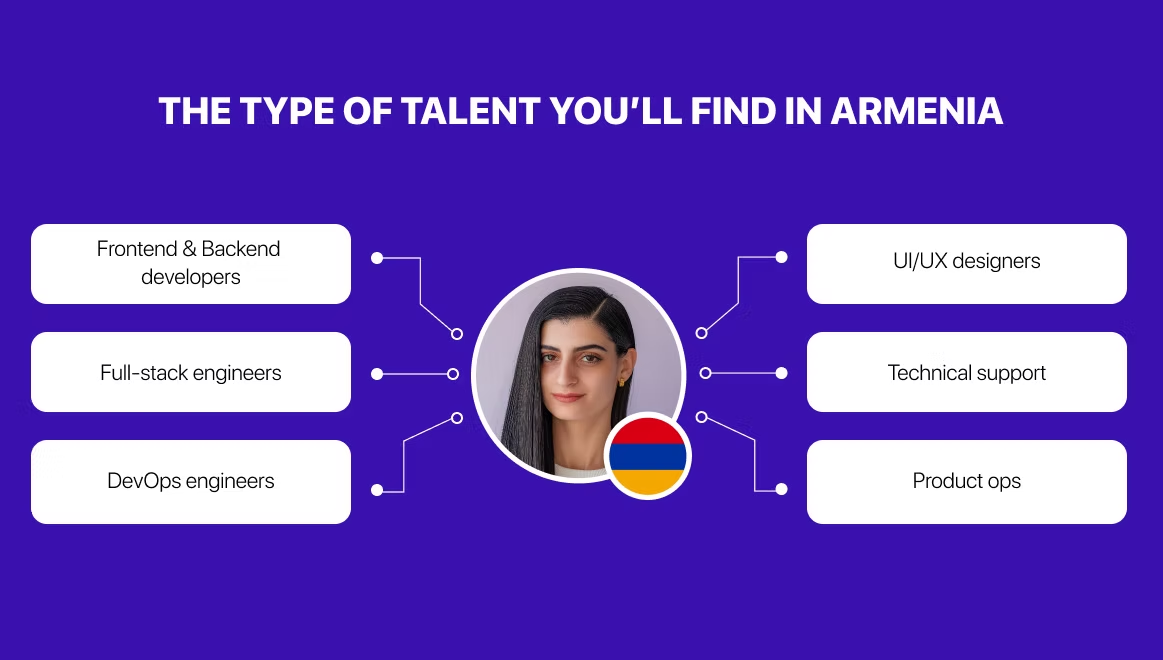
Armenia's IT sector now employs over 58,700 people, approximately 7% of the total labor force. The country's IT industry turnover exceeded 1.15 trillion Armenian Drams (AMD) in 2024, with over 30% growth in the prior year. Yerevan has earned the nickname "Silicon Mountains," and it's not just marketing. Intel and Microsoft have offices here. Picsart was built here. Thousands of developers trained through TUMO, the world-renowned free tech education center, are entering the workforce every year.
What does that mean for you as an employer? You're looking at:
- Senior software developers earning $2,500–$4,000/month (vs. $10,000+ in Western Europe)
- A flat 20% personal income tax, one of the simplest systems in the region
- Zero mandatory employer payroll contributions, a rare structural advantage
- GMT+4 timezone, real-time overlap with both Europe and the Middle East
- English proficiency in the 70–90% range among Yerevan tech professionals
The government is actively backing this momentum, too. In 2025, eligible tech companies received a 60% reimbursement on income tax for new hires. That's not a soft incentive, that's a market signal.
The catch? You can't just hire someone and put them on payroll. If your candidate is a foreign national, there's a regulated, multi-step process to get them legally employed in Armenia. And if you don't have a registered entity here, which most international companies don't have, employer sponsorship through an EOR is the only compliant path forward.

Thing 1: Armenia Work Visa: EOR-Sponsorship

Let's clear something up right away.
Some enterprises hear "EOR-sponsored visa" and assume it's a grey area. A clever hack. Something that works until it doesn't. That's exactly backwards.
In Armenia, only a legally registered local employer can sponsor a work permit for a foreign national. That's not a policy preference, it's the law. The Ministry of Labor and Social Affairs (MLSA) requires that the sponsor be the entity with a valid legal presence, registered payroll, and accountability to Armenian labor authorities.
If your company doesn't have a registered entity in Armenia, you cannot be that sponsor. Period.
This is where visa sponsorship for employment through an Employer of Record (EOR) becomes the only legitimate path. The EOR, with its own legal entity already registered in Armenia, steps in as the official employer on record. It applies for the work permit in its own name, employs the worker on a compliant Armenian contract, runs payroll in AMD, and takes on all statutory obligations under the Labor Code of the Republic of Armenia.
You, as the international business, direct the work. The EOR handles the legal employment relationship.
Here's why this matters in practice:
Imagine you're a US-based SaaS company wanting to relocate a product manager from India to your Yerevan engineering hub. Without an Armenian entity, your only fully compliant option is to engage an EOR. The EOR registers the vacancy with the MLSA, handles the labor market test, and files the work permit application on workpermit.am (Armenia's official digitalized platform, launched in 2022), and then supports the subsequent temporary residence permit application.
Your hire starts work. You stay focused on your product roadmap. And you're compliant from day one.
That's not a workaround. That's exactly how it's supposed to work.
Thing 2: Labor Market Test in Armenia: Key Requirement for Work Permit and Visa Sponsorship
Here's where most enterprise teams get blindsided.
Armenia doesn't have free-flowing work permit approvals. There's a mandatory gate that every application must pass through before a foreign hire can be approved: the labor market test, administered by the MLSA.
The logic is simple: Armenian workers get priority. Before the government approves a work permit for a foreign national, your EOR, as the sponsoring employer, must prove that no qualified Armenian citizen is available and suitable for the role.
Here's how the process actually runs on Armenia's official platform, workpermit.am:
- Vacancy Submission: The sponsoring employer (your EOR) registers the open position on the platform with full job requirements.
- MLSA Review (5–7 business days): The MLSA studies the Armenian labor market. They may refer local candidates to the employer for consideration.
- Candidate Interviews: If local candidates are proposed, the employer must interview them and document why they don't meet the role requirements. "They're not as strong as our candidate" isn't enough; you need legitimate, documented reasons.
- Green Light or Rejection: If no suitable local candidates are found, or if referred candidates are rejected with valid justification, the application moves forward.
This is where enterprise teams without local guidance fail. They underdescribe the role, fail to document rejections properly, or don't account for the 5–7 day test window in their onboarding timelines. Then the permit is delayed or rejected.

An experienced EOR knows how to write vacancy descriptions that accurately reflect genuine specialization needs without gaming the system. There's a meaningful difference between "Senior DevOps Engineer" and "Senior DevOps Engineer with experience in Kubernetes orchestration on AWS GovCloud environments." The second description isn't dishonest. It's precise. And precision is what the MLSA responds to.
A real example: A European fintech company wanted to transfer a cybersecurity specialist from Germany to Yerevan. The specialist had deep expertise in PCI-DSS compliance for card-not-present transaction environments, a niche that the Armenian market simply couldn't fill locally. The labor market test confirmed this within 5 days, and the work permit application moved forward immediately. Total work permit processing: 14 business days. Outcome: fully compliant hire, no delays.
That's what preparation and local expertise look like.
Thing 3: What Is the Difference Between a Work Permit and a Residence Permit in Armenia
This one catches enterprises off guard constantly.
In Armenia, getting a foreign national legally working doesn't end with the work permit. There are two distinct documents your hire needs, processed sequentially:
Step 1: Armenia Work Permit
Issued by the MLSA, tied to a specific employer and specific job role. This is what the EOR sponsors and applies for through workpermit.am. Processing typically takes 10–20 business days from the point of full document submission.
Required documents include:
- A passport copy of the foreign employee
- Educational or qualification certificates (when required for the role)
- Photo of the applicant
- Signed commitment letter from the employer to enter into an employment contract
- Government fee of AMD 105,000 (approximately $275 USD)
The National Security Service (NSS) and police also conduct security checks, which must be completed within 15 working days. If no conclusion is provided within this window, the result is automatically treated as positive.
Critical point: Your foreign hire cannot begin legal employment until this permit is issued. There are no exceptions.
Step 2: Armenia Temporary Residence Permit Requirements 2025 2026
After the work permit is approved, the employee applies for a Temporary Residence Card through Armenia's Migration and Citizenship Service. This is a separate process, with a separate timeline of 30–45 additional days.
The TRC enables the employee to:
- Legally reside in Armenia for the duration of the employment
- Open a local bank account
- Sign a lease and access services requiring proof of legal status
TRCs are issued with one-year validity and must be renewed annually. Renewals should be initiated at least 30 days before expiry.
What does this mean for your hiring timeline?
Plan for 6–10 weeks from permit application submission to a fully authorized and resident foreign employee. Factor this into onboarding plans. If your hire needs to be productive in Yerevan by a specific date, work backwards.
An EOR provider in Armenia with real in-country operations runs both tracks in parallel, prepping TRC documentation while the work permit is being processed, to reduce total elapsed time. Without that coordination, you're looking at delays that compound.
Thing 4: Work Permit Exemptions in Armenia: Who Does Not Need a Visa Sponsorship in 2026
Good news: not every foreign hire requires a full work permit process. Armenia has a meaningful set of exemptions.
Bad news: these exemptions are more narrowly defined than most global employers expect, and misreading them is one of the most common compliance errors in the market.
Here's what Armenian law actually exempts from work permit requirements:
Nationality-Based Work Permit Exemptions in Armenia: Who Does Not Require Visa Sponsorship
- Citizens of EAEU member states, Russia, Belarus, Kazakhstan, and Kyrgyzstan, do not need work permits to be employed in Armenia. However, they may still need to register their employment and obtain a certificate of legal stay. This distinction matters for payroll compliance.
Role-Based Work Permit Exemptions in Armenia: Positions That Do Not Require Employment Sponsorship
- Founders, directors, and representatives of companies with foreign investment
- Highly qualified foreign specialists in natural sciences, IT (specific technical roles), and agriculture
- Foreigners with higher education in ICT, management/administration, food technology, or finance
- Employees remaining on the payroll of a foreign entity (though this creates its own risks around permanent establishment)
Additional Work Permit Exemptions in Armenia: Special Cases and Exempt Employment Categories
- Holders of permanent or special residency permits
- Participants in government-approved innovation programs or incubators
- Employees of internationally accredited organizations
- Foreign investors holding at least 20% equity in an Armenian company
What this looks like in practice:
A UK executive appointed as the CEO of an Armenian company with foreign investment? Exempt from the work permit. Still needs a Temporary Residence Permit, but the full MLSA labor market test process is bypassed. Processing for the TRC alone: 10–15 business days.
A Russian software engineer? No work permit required as an EAEU citizen. But payroll still needs to be run through a compliant local entity, and the employment relationship must be properly structured.
A Canadian marketing consultant? Not exempt. Full process applies, labor market test, work permit, TRC. And that's exactly the scenario where an EOR's in-country expertise makes or breaks the timeline.
The trap enterprises fall into: Assuming that "highly skilled" is a self-defining category. It isn't. Armenian law specifies the fields and credential types that qualify for exemption. If your candidate's specialty isn't on that list, you're in the standard track, regardless of how senior or specialized they are.
Always verify exemption eligibility with your EOR's legal team before making promises to your hire about timelines.
Thing 5: Armenia Work Entry Visa 2026: New Rules for Hiring and Sponsoring Foreign Employees
This is the one most enterprise teams don't know about yet, and it's significant.
Currently, citizens of over 80 countries can enter Armenia visa-free for up to 180 days within a calendar year. This includes US, EU, Canadian, and Japanese passport holders, among many others. In practice, some employers have been onboarding foreign hires under tourist status while work permits were in processing, then switching them to proper work authorization status once it arrived.
That pathway is closing.
From August 2026, foreign employees will be required to enter Armenia on a Work Visa in order to apply for a residence card. Switching from tourist or visitor status to work authorization status inside Armenia will no longer be permitted.
What does this mean for enterprise hiring?
It means the sequence matters more than ever:
- A work permit must be approved before entry (or at least before the residence application)
- Employee must enter on a Work Visa, not a tourist stamp
- The full process must be initiated well in advance of the intended start date
Enterprises that currently rely on informal "enter first, sort permits later" approaches — even inadvertently- need to update their hiring workflows before this deadline. After August 2026, non-compliance won't just be a technical violation. It will mean your employee is working in the country on an immigration status that legally prohibits them from applying for residence authorization.
An EOR that understands this timeline change will build it into your onboarding process automatically. One that doesn't may leave your hire in a genuinely difficult legal position.
What It Looks Like When an EOR Runs the Full Process
Here's the complete sequence when your international employer of record manages end-to-end visa sponsorship in Armenia:
Week 0–1: Pre-check and eligibility assessment: Your EOR's legal team reviews the candidate's nationality, role, and qualifications. They confirm whether an exemption applies, assess the labor market test strategy, and establish the document checklist.
Week 1–2: Vacancy submission and labor market test: The EOR registers the vacancy on workpermit.am with a precisely drafted job description. The MLSA conducts the 5–7 day labor market test. If candidates are referred, the EOR coordinates documented review and rejection where appropriate.
Week 2–5: Work permit application: With MLSA clearance obtained, the EOR submits the full work permit application, including all required documents and government fees. Security checks run in parallel. Processing takes approximately 14 business days under normal conditions.
Parallel track: Residence permit preparation: While the work permit is being processed, the EOR prepares all TRC documentation so it can be filed immediately upon work permit approval.
Week 5–9: Temporary Residence Card: Application submitted to the Migration and Citizenship Service. Processing takes 30–45 days. During this period, the employee should have entered Armenia on the appropriate visa.
Week 9+: Onboarding and payroll: Once both permits are active, the EOR registers the employee with the State Revenue Committee, issues a TIN, enrolls them in Armenia's social contribution system, and processes the first compliant payroll run.
Total elapsed time: 8–10 weeks from engagement to fully authorized, legally resident employee. Faster for exempt categories. Potentially longer if NSS security checks require additional clarification.
This is why enterprise teams partnering with an EOR with genuine in-country expertise can plan with confidence. Without it, the timeline is unpredictable, and unpredictability is expensive.
The Risk of Skipping Proper Sponsorship in Armenia
Let's be direct about what's at stake if you skip or short-circuit the process.
For the employee:
- Working without a valid work permit: AMD 100,000–150,000 fine (approximately $208–$313 USD) under Armenia's Code of Administrative Offenses
- Overstaying or violating immigration status: AMD 50,000–100,000 fine (approximately $104–$208 USD)
- Risk of deportation and ban on future re-entry
- Loss of access to banking, healthcare, and other services requiring legal residency proof
For the employer:
- Administrative fines and potential bans on future foreign hiring
- Reputational damage with Armenian authorities, which matters if you plan to scale
- Exposure to labor audits, especially if the employment relationship has characteristics of misclassification
- After August 2026: additional legal exposure if employees entered on tourist status and attempted to convert to work authorization
Hiring Contractor In Armenia
Some companies try to avoid the permit process by engaging foreign workers as contractors rather than employees. Armenia's labor authorities are alert to this. If the working relationship has the characteristics of employment, fixed hours, direct supervision, company equipment, integrated into team workflows, misclassification carries its own penalties, and the work permit obligation doesn't disappear just because the contract says "contractor."
The real cost: One employment compliance mistake in Armenia won't bankrupt your company. But it will set your expansion back by months, damage your employer brand in a talent pool that is network-driven and reputation-sensitive, and create legal liability that distracts your legal and HR teams.
Getting it right costs less than getting it wrong. Always.
Team Up's Advantage: Why Local Presence Changes Everything in Armenia
Not all EOR services are built the same. In emerging markets like Armenia, the gap between a provider with genuine in-country infrastructure and one that subcontracts to local affiliates can mean weeks of delay, compliance blind spots, and communication failures when it matters most.
Team Up operates with owned entities across the Caucasus, Georgia, Armenia, and Azerbaijan, plus expanded operations in Kazakhstan, Uzbekistan, Turkey, India, Egypt, and beyond. In Armenia specifically, this means:
Direct engagement with Armenian authorities. Team Up's local legal and HR team deals directly with the MLSA, the Migration and Citizenship Service, the State Revenue Committee, and the NSS, without intermediaries. Faster responses. Real accountability. No third-party lag.
Local fluency, literally. Armenia's bureaucratic processes run in Armenian. Workpermit.am, the MLSA's submission portal, and correspondence from the Migration Service are in Armenian. Team Up's Yerevan team navigates these natively, which is not a small advantage.
Proactive compliance. The 2026 entry visa rule change described above? Team Up's clients were briefed on it and had updated hiring workflows in place months ahead of the deadline. That's what a genuine regional EOR partner looks like.
Payroll precision. With Armenia's flat 20% income tax, zero employer contributions, and mandatory registrations with the State Revenue Committee, payroll compliance is manageable, but only if it's set up correctly from day one. Team Up's in-country payroll team runs this without configuration errors or missed filings.
For enterprise teams making their first hires in Armenia, or scaling an existing presence, the right EOR partner isn't just an administrative convenience. It's the difference between a market entry that succeeds and one that stalls in a permit queue.
Bottom Line
Armenia is a serious market for serious enterprise teams. The talent is real. The costs are competitive. The government is actively courting international investment.
But the immigration framework is structured, sequential, and unforgiving of shortcuts. The labor market test, the two-permit process, the new 2026 entry visa requirement aren't bureaucratic obstacles to route around. They're the rules of the market, and navigating them well is what separates teams that scale here from teams that spend six months in a compliance backlog.
EOR-sponsored visas in Armenia give you the fastest, most compliant path to getting foreign talent legally working in this market, without setting up a local entity, without learning Armenian immigration law from scratch, and without putting your employees' legal status at risk.
That's the value. That's the strategy.
If you're planning your first hire in Armenia or scaling an existing team, talk to Team Up. We have the entity, the local team, and the track record to get it done right.
FAQ: EOR-Sponsored Visas in Armenia
What is visa sponsorship for employment in Armenia?
Visa sponsorship for employment means a legally registered employer in Armenia formally sponsors a foreign national's work permit and supports their temporary residence permit. Without a local entity, international companies must use an EOR to provide this sponsorship.
Do I need a local entity to sponsor work permits in Armenia?
Yes. Only employers with a registered legal presence in Armenia can apply for work permits through the MLSA. If you don't have one, an international employer of record provides this infrastructure on your behalf.
How long does a work permit take in Armenia?
After the labor market test (5–7 business days), work permit processing takes approximately 14 business days. Security checks add up to 15 working days, but typically run in parallel. The subsequent Temporary Residence Card takes an additional 30–45 days.
Can EAEU citizens (Russians, Kazakhstanis, etc.) work in Armenia without a permit?
Citizens of EAEU member states (Russia, Belarus, Kazakhstan, Kyrgyzstan) are exempt from Armenia's work permit requirement. However, they still need to establish legal residency and ensure their employment is structured compliantly, particularly for tax registration and payroll purposes.
What happens if a foreign employee starts work before permits are approved?
They are in violation of Armenian immigration and labor law, exposing both the employee (fines, deportation risk) and the sponsoring employer (administrative penalties, future hiring restrictions) to significant legal consequences.
What is the cost of an Armenian work and residence permit?
The government fee for a combined work and temporary residence permit is AMD 105,000 (approximately $275 USD). Additional costs depend on the EOR service provider and the scope of support.
Is Armenia a good market for international hiring in 2025?
Yes. Armenia's IT sector employs over 58,000 people, the government has active incentives for tech hiring, and labor costs are significantly below Western markets at comparable skill levels. The regulatory environment is manageable with the right EOR partner.
What is an employer of record?
An employer of record (EOR) is a third-party organization that legally employs workers on behalf of another company in a given country. The EOR handles compliance, payroll, benefits, and, critically for this guide, work permit and visa sponsorship. The client company retains control of day-to-day work direction.
.svg)