


What is Employer Sponsorship in Eastern Europe And How Does It Work?
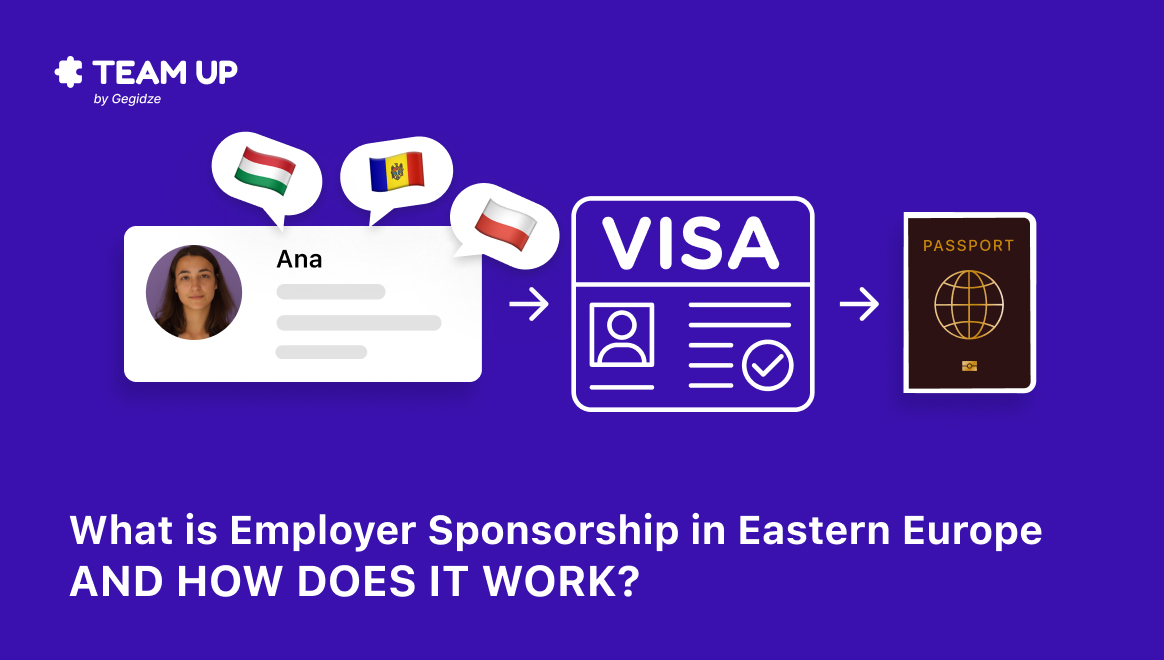
Introduction. What Is Employer Sponsorship in Eastern Europe?
Employer sponsorship in Eastern Europe refers to the formal process where a company takes responsibility for a foreign employee’s legal right to live and work in a specific country.
In practice, the employer sponsors a work visa or work permit for the employee. The sponsoring company confirms to government authorities that:
- The job position is legitimate
- The candidate has the necessary qualifications
- The salary and employment conditions meet local legal requirements
- All immigration and labor regulations will be followed
This is not just an administrative step. It is a legal commitment between the employer and the state.
When a company sponsors an employee, it must:
- Prepare and submit immigration documentation
- Pay government application fees
- Issue a compliant employment contract
- Ensure the employee maintains a valid work authorization
In other words, employer sponsorship signals to the government that the company accepts responsibility for the employee’s legal employment.

What Is Employer Sponsorship in Eastern Europe? (Employment Sponsorship Meaning Explained)
Eastern Europe has become a major hiring destination for global companies. Countries such as Poland, Romania, Hungary, and the Czech Republic attract international businesses with strong technical talent and competitive labor costs.
However, these countries also maintain strict immigration rules.
Foreign nationals cannot simply enter and begin working.
If the employee is not a local citizen or EU/EEA national, a work permit or residence visa is typically required.
This applies across most of the region:
| Country Type | Sponsorship Requirement |
| EU member states (Poland, Hungary, Romania) | Work permit and residence visa required for non-EU citizens |
| Non-EU countries in Eastern Europe | Local work authorization is still required |
Without employer sponsorship, companies cannot legally employ foreign nationals.
Businesses must either:
- Sponsor the visa through their own registered entity, or
- Use an Employer of Record (EOR) that sponsors the employee through its local entity
Both options create a compliant pathway for hiring international talent.
Why Employer Sponsorship Matters. Compliance, Speed, and Talent Access
Employer sponsorship affects three critical areas of hiring in Eastern Europe.
- Compliance
- Hiring speed
- Talent access
Understanding these factors helps companies expand into the region without unnecessary delays or legal risks.
Compliance Risks When Hiring Without Visa Sponsorship for Employment
Immigration compliance is strict across Eastern Europe. Governments enforce work authorization rules closely.
Hiring a foreign worker without proper sponsorship can lead to serious consequences.
Common Compliance Risks
| Risk | Potential Outcome |
| Hiring on a tourist visa | Legal penalties or employee deportation |
| Incorrect employment classification | Back taxes and fines |
| Missing permit documentation | Visa rejection |
| Non-compliant contracts | Restarting the permit process |
Many countries also require employment contracts to be issued in the local language. Failure to meet these requirements can invalidate applications.
Contractor misclassification is another frequent issue.
Countries such as Hungary, Romania, and Slovakia apply strict criteria to determine whether a contractor is effectively an employee. If authorities conclude that a contractor relationship hides an employment relationship, companies may face:
- Backdated tax obligations
- Social security contributions
- Financial penalties
Proper sponsorship prevents these risks and keeps companies operating within the law.
Hiring Speed and Immigration Processing Timelines in Eastern Europe
Hiring international talent always involves immigration processing time.
Work permits and visas often require several weeks or months to approve.
For example, companies may identify an ideal candidate in Bulgaria only to discover that the work authorization process takes two to three months after the offer is accepted.
Without planning for sponsorship timelines, hiring can stall.
Typical Hiring Delays Without Planning
| Hiring Step | Potential Delay |
| Work permit approval | 4–12 weeks |
| Visa processing | Several additional weeks |
| Residence registration | Additional administrative time |
Companies that understand sponsorship requirements can manage these timelines more effectively.
Some organizations use an Employer of Record to speed up onboarding. An EOR can often place the employee on payroll immediately while managing the immigration process in parallel.
This reduces the delay between job offer and first working day.
Speed matters in competitive talent markets.
Companies that streamline sponsorship processes often secure candidates before competitors do.
How Employment Sponsorship Expands Access to Global Talent
Employer sponsorship significantly expands the talent pool available to companies hiring in Eastern Europe.
If companies restrict hiring to candidates who do not require sponsorship, they limit themselves to:
- Local citizens
- Foreign workers who already have work authorization
That restriction excludes many highly skilled candidates.
Sponsorship Expands Talent Access
| Without Sponsorship | With Sponsorship |
| Only local candidates | Global and regional candidates |
| Limited hiring flexibility | Access to specialized talent |
| Smaller talent pool | Larger talent ecosystem |
For example, companies can:
- Hire Ukrainian engineers for teams in Poland
- Relocate specialists from Asia to Romania
- Bring experienced managers to Czechia or Hungary
Eastern Europe is known for its strong engineering talent and growing technology ecosystems.
Companies that embrace employer sponsorship gain access to this broader talent market.
Organizations that avoid it often miss strong candidates simply because of immigration barriers.
Country-by-Country Overview of Employment Sponsorship in Eastern Europe
Eastern Europe is not a single regulatory market. Each country runs its own immigration system, work permit process, and employer obligations.
Companies hiring across the region must understand these local differences. Work permit timelines, documentation requirements, and sponsorship rules vary significantly between countries.
Below is a practical overview of how employer sponsorship works in key Eastern European hiring hubs.
Employer Sponsorship Requirements in Poland
Poland remains one of the region’s most popular technology and engineering hiring locations. However, hiring non-EU employees requires a structured sponsorship process.
Key Sponsorship Requirements
| Requirement | Details |
| Work Permit Type | Type A Work Permit |
| Sponsoring Authority | Provincial Labor Office |
| Local Entity Required | Yes |
| Labor Market Test | Usually required |
| Work Permit Processing | 1–3 months |
| Residence Permit Timeline | 6–18 months due to backlogs |
Key Considerations
- Employers must demonstrate that the role was first offered to Polish or EU candidates.
- Once the work permit is approved, the employee applies for a Visa D to enter Poland.
- After arrival, the employee applies for a temporary residence card.
- Residence card processing often experiences long delays, although employees may work while waiting.
Compliance Checklist
- Register a local company with the tax and social security authorities
- Issue employment contracts in Polish or bilingual format
- Maintain valid payroll and tax registrations
- Support residence permit application after entry
Companies without a Polish entity must hire through a local partner or Employer of Record (EOR).
Visa Sponsorship for Employment in Romania

Romania follows a similar employer sponsorship model but generally offers faster processing timelines.
Key Sponsorship Requirements
| Requirement | Details |
| Work Authorization | Autorizație de muncă |
| Labor Market Test | Typically required |
| Processing Time | Around 1 month |
| Visa Type | Long-stay Visa D |
| Total Timeline | 2–3 months |
Compliance Checklist
- Conduct local job advertising before hiring a foreign worker
- Obtain the work authorization approval
- Register the employment contract in the REVISAL system before day one
- Issue contracts in Romanian or bilingual format
- Register the employee for social security and tax reporting
Romania also offers certain advantages:
- IT professionals may qualify for income tax exemptions
- Highly skilled workers may apply for the EU Blue Card
Despite these incentives, sponsorship still requires a local contract, payroll registration, and full compliance with Romanian labor law.
Employer Sponsorship Process in Bulgaria

Bulgaria maintains one of the more restrictive foreign hiring systems in the region.
Key Sponsorship Requirements
| Requirement | Details |
| Work Permit Authority | Employment Agency |
| Labor Market Test | Strict |
| Foreign Workforce Cap | 20 percent (35 percent for small firms) |
| Visa Type | Type D |
| Typical Timeline | 2–3 months |
Compliance Checklist
- Obtain approval from the Employment Agency
- Demonstrate no suitable local candidate exists
- Issue an employment contract in Bulgarian
- Submit notarized and apostilled educational certificates
- Notify authorities when employment begins or ends
Unlike some countries, Bulgarian law treats employer sponsorship as an ongoing obligation. Employers must report employment changes to immigration authorities.
Work Permit Sponsorship in Hungary

Hungary uses a combined work and residence permit system, often called the Joint Permit.
Key Sponsorship Requirements
| Requirement | Details |
| Permit Type | Joint Work and Residence Permit |
| Labor Market Test | Required in many cases |
| Timeline | 2–3 months |
| Local Entity Required | Yes |
Important Compliance Rules
- Certain occupations have minimum salary thresholds for foreign hires.
- Highly skilled candidates may apply through the EU Blue Card program.
- Documentation must typically be provided in Hungarian or bilingual format.
In most cases, only a Hungarian legal entity can sponsor foreign employees. Companies without a local presence must use an EOR provider.
Employment Visa Sponsorship in the Czech Republic and Slovakia
Both countries operate structured work authorization systems tied closely to local labor market protection.
Czech Republic
| Requirement | Details |
| Permit Type | Employee Card |
| Processing Time | 3–6 months |
| Labor Market Test | Required |
| Sponsorship Method | Employer submits job to the Labor Office |
Key rules:
- The employer must first register the job vacancy with the Labor Office.
- Foreign hires are allowed only if no suitable local candidate fills the role.
- Contracts must be issued in Czech or bilingual format.
- Authorities must be notified when employment starts and ends.
Slovakia
| Requirement | Details |
| Permit Type | Work Permit + Residence Permit |
| Typical Timeline | 2–3 months |
| Labor Market Test | Required |
Compliance requirements include:
- Registration of the job vacancy with the labor authorities
- Issuing contracts in Slovak or bilingual format
- Ensuring the worker is properly classified as an employee rather than a contractor
Slovakia applies strict criteria when evaluating contractor relationships.
Other Eastern European Sponsorship Systems: Ukraine, Serbia, and Georgia
The broader region includes several additional hiring markets with unique sponsorship rules.
Ukraine

| Feature | Details |
| Work Permit Required | Yes |
| Labor Market Test | No |
| Process Complexity | Moderate |
Ukraine’s system is relatively straightforward, though current geopolitical conditions may impact hiring logistics.
Serbia and Western Balkans
| Feature | Details |
| Work Permit Required | Yes |
| Residence Visa Required | Yes |
| Processing Time | Often faster than EU systems |
Serbia also offers digital nomad visa options, which can be useful for remote workers.
Georgia
Georgia operates a unique model.
| Feature | Details |
| Work Permit | Not historically required |
| Long-term stay | Residence permit required after 365 days |
| Sponsorship Model | Employment contract and residence support |
Employers typically assist employees in obtaining residency based on employment rather than a traditional work permit.
What “Require Sponsorship for Employment” Means
Hiring teams frequently encounter the question:
“Will you require sponsorship for employment visa status?”
From an employer’s perspective, this simply means the candidate does not currently have legal authorization to work in the country.
The employer must therefore sponsor the candidate’s work permit or visa.
Example Scenarios
| Candidate Situation | Sponsorship Needed |
| An American developer hired in Romania | Yes |
| Ukrainian engineer working in Poland | Yes |
| Polish citizen hired in Poland | No |
| An EU citizen working in another EU country | Usually no |
When a candidate requires sponsorship, employers must plan for:
- Immigration documentation
- Work permit application fees
- Permit processing timelines
- Local employment compliance
If a company cannot sponsor visas or lacks a local entity, it may need to work with an Employer of Record to hire the candidate legally.
Discussing sponsorship requirements early in the hiring process avoids surprises and helps set realistic timelines.
At its core, employment sponsorship means the employer must legally secure the worker’s authorization to work in the country. When a job application asks whether a candidate requires sponsorship, it simply asks whether the company must handle that immigration process.
How Employer of Record (EOR) Services Handle Visa Sponsorship for Employment in Eastern Europe
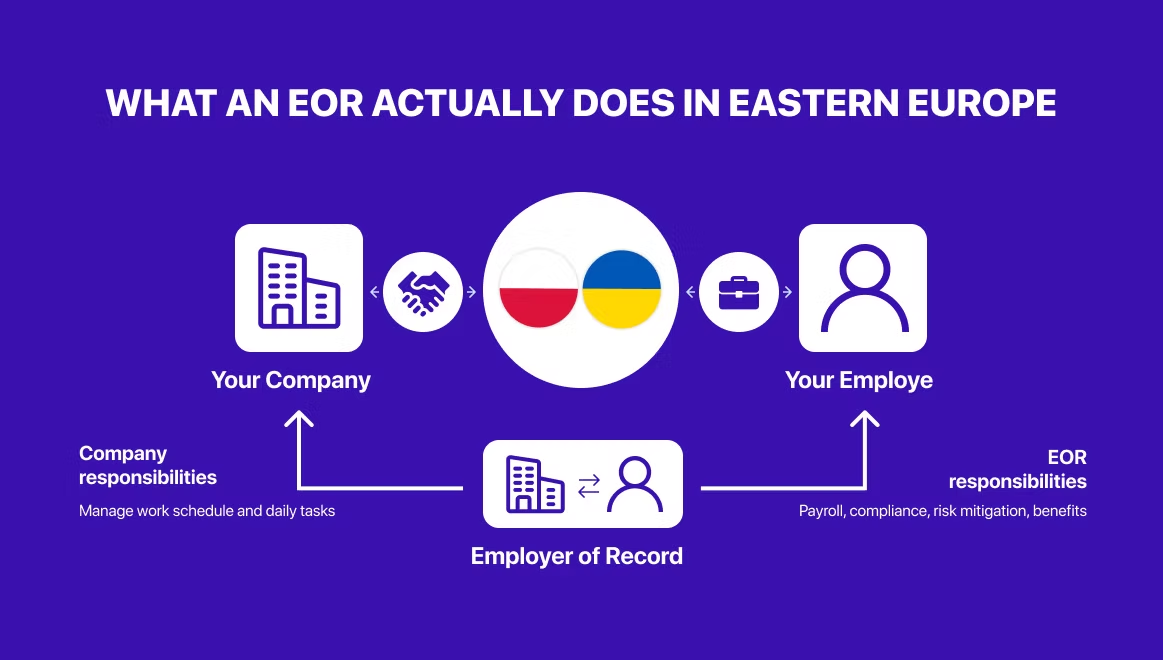
Using an Employer of Record (EOR) in Eastern Europe simplifies the visa sponsorship process for companies hiring in Eastern Europe. Instead of managing immigration procedures internally, the EOR handles the entire process through its local legal entity.
This allows companies to hire international employees without opening a local company or navigating immigration systems themselves.
Below is how the process typically works.
Step 1: EOR Becomes the Legal Employer and Work Visa Sponsor
Once you select an EOR provider and identify your candidate, the EOR hires the employee through its local subsidiary in the target country.
That entity becomes the official employer and visa sponsor.
This step matters because immigration authorities require a locally registered company to sponsor work permits.
The EOR already meets these requirements:
- Registered with tax authorities
- Registered with labor offices
- Compliant with local employment laws
- Eligible to sponsor foreign workers
Your company does not need a legal entity in the country. The EOR’s company name appears as the sponsoring employer on the permit application.
Step 2: Document Preparation for Employment Visa Sponsorship
Visa applications require detailed documentation from both the employer and the employee.
A good EOR manages this step using structured checklists and prepared templates.
Typical Documents Required
| Document | Purpose |
| Passport | Identity verification |
| Academic degrees or certifications | Qualification proof |
| Criminal background check | Immigration clearance |
| Health insurance or medical certificate | Compliance with entry rules |
| Employment contract | Proof of job offer |
EOR providers prepare locally compliant employment contracts, usually in the local language or bilingual format.
They also coordinate:
- Certified translations
- Notarization
- Apostille authentication is required where applicable
Many Eastern European visa applications fail due to small documentation errors. An EOR prevents these issues by ensuring the application package meets government standards.
Step 3: Government Application and Immigration Coordination
After documents are prepared, the EOR submits the work permit application through the appropriate government authority.
Depending on the country, this may include:
- Ministry of Labor
- Immigration Office
- Regional Labor Authority
The EOR also manages communication with government agencies.
This includes:
- Monitoring application progress
- Responding to additional document requests
- Updating forms if regulations change
- Scheduling appointments when required
Because EOR providers work regularly with these authorities, they understand local processes and administrative systems.
Examples include:
- Poland’s immigration portals
- Hungary’s Enter Hungary system
- Country-specific labor office platforms
This experience reduces delays and keeps applications moving.
4. Visa Issuance and Employee Onboarding
Once the work permit is approved, the EOR coordinates the next steps of the immigration process.
These may include:
- Scheduling a consulate appointment for visa issuance
- Supporting residence permit applications after arrival
- Assisting with local immigration office visits
Many EOR providers guide employees through these steps directly.
At the same time, the EOR completes the employment setup.
Employment Setup Checklist
- Register the employee for local tax identification
- Enroll them in social insurance systems
- Add them to the local payroll
- Arrange mandatory benefits if required
- Provide compliant employment documentation
By the employee’s first day of work, the EOR ensures they are fully compliant with immigration and labor laws.
5. Ongoing Compliance and Permit Renewals
Employer sponsorship continues throughout the employee’s time in the country.
Work permits and residence permits often require renewal.
A reliable EOR tracks these deadlines and manages the renewal process.
Ongoing Compliance Responsibilities
| Responsibility | Handled by EOR |
| Work permit renewals | Yes |
| Residence permit renewals | Yes |
| Government reporting | Yes |
| Immigration compliance updates | Yes |
| Employment record maintenance | Yes |
If regulations change, the EOR adjusts the compliance process accordingly.
If employment ends, the EOR also manages:
- Permit cancellation
- Government notifications
- Payroll closure
- Immigration reporting
This ensures the company exits the sponsorship relationship correctly.
Strategic Guidance from an EOR
Beyond administrative support, a good EOR also provides strategic guidance.
They can advise on:
- Faster visa pathways
- Eligibility for EU Blue Card programs
- Local talent visa initiatives
- Country-specific immigration incentives
They also prevent companies from violating immigration rules. For example, an EOR will warn employers if a candidate cannot legally begin work before permit approval.
This expertise helps companies avoid costly compliance mistakes.
Why EOR Works Well in Eastern Europe
Eastern Europe’s immigration systems vary widely by country.
Companies hiring across multiple markets must deal with:
- Different languages
- Different legal systems
- Country-specific visa requirements
An EOR standardises the process.
Instead of managing each country individually, companies rely on a single partner to handle local employment and visa sponsorship.
The result is a predictable hiring process:
- Choose the candidate
- The EOR prepares and submits immigration documentation
- The employee receives work authorisation
- The EOR maintains compliance throughout employment
For companies expanding into Eastern Europe, this approach reduces risk, accelerates hiring, and ensures every employee remains legally authorised to work.
Conclusion
Hiring foreign talent in Eastern Europe offers clear advantages. The region provides strong engineering talent, competitive labor costs, and access to multiple fast-growing tech ecosystems. But expanding across these markets requires navigating different immigration systems, sponsorship rules, and labor regulations.
Employer sponsorship sits at the center of this process. Companies cannot legally hire international employees without securing proper work authorization through a local sponsor. That responsibility normally falls on the employer, which means managing visa applications, employment contracts, payroll registration, and ongoing compliance.
Businesses entering the region have two main options. They can sponsor employees directly through their own legal entity or rely on an Employer of Record to manage the process. Direct sponsorship works well for companies planning large, long-term operations in one country. However, it requires significant setup, legal infrastructure, and ongoing administrative work.
For most companies expanding into Eastern Europe, an Employer of Record provides the faster and more flexible path. An EOR removes the need to establish local entities, manages visa sponsorship, and ensures employees remain compliant with immigration and labor laws from day one.
With the right structure in place, companies can focus on building strong teams rather than navigating bureaucracy. Whether through direct sponsorship or an EOR partner, understanding the visa sponsorship landscape is essential for hiring successfully across Eastern Europe’s diverse and competitive talent markets.
FAQ
In 2026, employer sponsorship in Eastern Europe (including major hubs like Poland, Romania, Hungary, and Czechia) has undergone a digital transformation. With the implementation of the revised EU Single Permit Directive and the introduction of the ESSPASS (European Social Security Pass), the process is now faster but carries stricter salary and compliance audits.
Here are the 10 most frequently asked questions for employers in Eastern Europe.
1. What is the definition of employer sponsorship in Eastern Europe?
Sponsorship is the formal commitment by a locally registered company to employ a non-EU citizen. The employer must submit a binding job offer to the regional labor office and prove the business has the financial capacity to pay the salary and social contributions.
2. Can I sponsor a foreign worker if I don't have a local entity?
No. You must have a registered legal entity in the specific country (e.g., a Sp. z o.o. in Poland or an S.R.L. in Romania). If you do not have an entity, you must use an Employer of Record (EOR) who acts as the "Sponsor of Record" for the work permit while the employee performs work for you.
3. What is the "Labor Market Test" in 2026?
Most Eastern European countries require employers to prioritize local and EU talent first.
- The Process: You must post the vacancy on the state labor portal (e.g., Praca.gov.pl in Poland) for 7 to 14 days.
- The Result: If no suitable local candidate is found, the labor office issues an "Information from the Starosta" or equivalent document, which allows you to proceed with the foreign hire’s sponsorship.
4. What are the 2026 minimum salary thresholds for sponsorship?
Salary requirements have risen sharply in 2026 to align with inflation and the EU Minimum Wage Directive.
- Poland: The minimum gross salary for a Type A Work Permit is PLN 4,806 per month.
- Czechia: The Employee Card threshold is CZK 22,400 per month.
- Hungary: Highly skilled roles (Blue Card) now require approximately HUF 1,001,000 per month.
5. How does the "Single Permit" (Unified Procedure) work?
Under the 2026 directive, the "Single Permit" allows an applicant to apply for both work and residence rights in one step. The processing time is now legally capped at 90 days in most member states, a significant reduction from previous years.
6. Do I need to sponsor "EAEU" citizens in Poland?
Poland continues its Simplified Declaration Procedure for citizens of Armenia, Georgia, Moldova, and Ukraine. For these nationalities, you do not need a full work permit or a labor market test; you simply register a "Declaration of Entrustment" (Oświadczenie) on the digital portal, which takes only 7 days to process.
7. What are the employer's "Post-Hire" compliance duties?
Sponsorship in 2026 includes several digital reporting obligations:
- ZUS/Social Security: You must register the employee within 7 days of their start date.
- MAS/Digital Portals: Any change in job title, salary, or work location must be reported to the migration office within 15 days.
- Housing Proof: In countries like Romania and Poland, the sponsor must often verify that the employee has "adequate accommodation" as part of the permit conditions.
.svg)


