What is Employer Sponsorship in Armenia And How Does It Work?
TL;DR
Let’s be honest: hiring internationally feels like trying to assemble IKEA furniture in the dark. You know the pieces are there, you know the end result will be great, but the manual is in a language you don’t speak, and you’re pretty sure you’re missing a screw.
In Armenia, that "missing screw" is often the legal bridge between a job offer and a legal desk. This bridge is called employer sponsorship.
Employer sponsorship in Armenia is the formal commitment an Armenian legal entity makes to the government, vouching for a foreign professional's right to live and work in the country. It’s not a "set it and forget it" checkbox. It’s a legal handshake with the state that says, "I am responsible for this person's compliance, taxes, and departure."
If you’re a founder or a decision-maker looking at Yerevan’s talent pool, you have two choices: build your own legal infrastructure or use a partner who already has the keys.
Quick Navigation
- TL;DR
- The Strategic Framework of Global Employer Sponsorship
- The Armenian Context: A Regional Tech Superpower
- Decoding the Sponsorship Mechanism: Work Permits and TRCs
- Navigating the Digital Roadmap
- Labor Market Realities: Testing and Justification
- Strategic Fast-Tracks: Exemptions for High-Value Talent
- EOR Services: The "Legal Employer" Model for Efficiency
- Compliance and Financial Obligations for Sponsoring Entities
- Tax Incentives: The 2025–2031 Opportunity Window
- Managing Terminations and Legal Exit Strategies
- The 2026 Reforms: A New Era of Quotas and Work Visas
- Comparative Analysis: Armenia vs. Georgia for Hub Building
- Conclusion: Synthesizing the Sponsorship Value Proposition
The Strategic Framework of Global Employer Sponsorship
In a professional context, employer sponsorship for employment is a formal process whereby an employer supports a prospective employee's application for a specific work visa or residency status. This involves the employer acting as a legal advocate, proving to the state that the candidate is not only qualified for the role but also necessary for the growth of the domestic industry. While global models vary, the underlying theme remains the same: the employer provides the legal "anchor" that justifies the foreign national’s presence in the local labor market.
The responsibilities of a sponsor are ongoing and do not conclude once a visa is issued. Sponsoring organizations are typically required to cover applicable processing fees, provide supporting documentation for the employee's qualifications, and maintain compliance with evolving immigration regulations. In the United States, for example, this might involve complex Labor Condition Applications to certify wage standards. In Armenia, the process is streamlined but equally rigorous, focusing on the legitimacy of the hiring entity and the authenticity of the job offer.
Comparative Overview of Global Sponsorship Obligations
The following table outlines the standard legal and financial obligations across different sponsorship models, providing context for the Armenian framework.
| Obligation Category | Standard Requirement | Sponsoring Entity Responsibility |
| Financial Guarantee | Ability to pay the offered wage. | Must provide proof of funds or corporate standing. |
| Legal Advocacy | Petitioning the government for the visa. | Submitting formal requests via digital or paper channels. |
| Compliance Monitoring | Reporting changes in employment status. | Notifying authorities of termination or role changes. |
| Record Maintenance | Keeping immigration documents on file. | Storing records for up to three years post-employment. |
| Fair Recruitment | Prioritizing the local labor market. | Conducting and documenting labor market tests. |
This global paradigm ensures that migration is used as a strategic tool rather than a way to bypass domestic workforce development. For decision-makers, understanding these obligations is the first step in building a sustainable cross-border talent pipeline.

The Armenian Context: A Regional Tech Superpower
The rationale for pursuing employer sponsorship in Armenia is rooted in the country’s unique position as a high-density tech hub. Inheriting a legacy of Soviet-era excellence in physics and engineering, Armenia has transformed into a product-driven ecosystem with deep roots in Silicon Valley. The concentration of talent is particularly notable in Yerevan, which has seen its startup ecosystem value grow by over 22% annually.
The presence of global tech giants like NVIDIA, Cisco, and AMD has created a "knowledge transfer" effect, where local talent is trained in world-class methodologies.
NVIDIA’s recent expansion into a $4 billion AI initiative, including a data center with over 50,000 GPUs, signals a massive increase in the demand for specialized foreign specialists who can lead these large-scale infrastructure projects. This demand makes the efficiency of the work permit and residency system a critical factor for any company entering the market.
Economic and Innovation Indicators (2024-2025)
| Metric | Value / Rank | Significance for Decision Makers |
| Global Innovation Index | 59th (Up 13 spots since 2023). | Indicates a rapidly improving environment for tech outputs. |
| ICT Share of GDP | 7% (as of 2024). | Tech is a primary driver of national economic policy. |
| IT Professional Count | 58,000+. | A robust local peer group for international hires. |
| Startup Ecosystem Growth | 22.8% Annual growth in value. | High-velocity market for investors and recruiters. |
| Women in IT | 40% (Global lead). | High diversity levels compared to global tech averages. |
These data points suggest that Armenia is not just a low-cost outsourcing destination but a sophisticated environment where highly skilled specialists are increasingly coming from abroad to participate in global-scale innovation.
Decoding the Sponsorship Mechanism: Work Permits and TRCs
In Armenia, the authorization for a foreign national to work is fundamentally tied to their residency status. Unlike jurisdictions where a work visa and a residency permit are entirely separate tracks, Armenia uses an integrated approach. To be legally employed, a foreigner generally needs two things: a work permit and a Temporary Resident Card (TRC).
The work permit is the employer’s specific permission to fill a vacancy with a foreign national, while the TRC is the individual’s legal identity card that allows them to live and work in the country for a period of one year. For the vast majority of cases, these are handled together in a single application process initiated by the employer. This single-card system reduces the administrative burden on the employee, allowing them to focus on onboarding and professional integration.
The Dual-Authorization Workflow
The narrative of sponsorship in Armenia follows a logical progression from the corporate need to the individual’s legal standing.
- Employer Initiative: The company must first register as a legitimate entity on the state platform, proving it is active and compliant with tax laws.
- Labor Market Priority: The government requires the employer to list the role publicly to ensure that no qualified Armenian citizen is being overlooked.
- Security Clearance: The National Security Service and the police review the application to ensure the hire aligns with national safety standards.
- Residency Finalization: Once approved, the employee visits the Joint Office of Public Services to provide biometrics and collect their residency card.
This process ensures that every foreign hire is vetted both as a professional asset and as a resident of the state.
Navigating the Digital Roadmap: workpermit.am
The modern era of employer sponsorship in Armenia is defined by the workpermit.am electronic platform. Launched in January 2022, this system has largely replaced the previous paper-based applications, allowing for a 100% digital experience for the employer. For decision-makers, this means that hiring from an emerging hub no longer requires multiple physical trips to government offices or dealing with physical document queues.
The platform is designed to be a unified portal where the Ministry of Labour and Social Affairs, the Migration Service, and the National Security Service coordinate their efforts. This coordination is what allows for the relatively fast processing times—often as little as 10 to 15 business days for work permit approval, provided all documentation is correct.
Step-by-Step Walkthrough for Employers
| Phase | Actions Taken on Platform | Responsible Party |
| Registration | Input tax ID, company email, and head of executive body details. | Employer. |
| Vacancy Listing | Upload a detailed job description, salary, and requirements. | Employer. |
| Market Test | System monitors local applicants for several working days. | Gov System. |
| Candidate Nomination | Fill in the foreign candidate's passport and personal data. | Employer. |
| State Fee Payment | Transfer AMD 105,000 to the designated central bank account. | Employer. |
| Approval Receipt | Receive electronic notification of the work permit grant. | Employer. |
One nuanced detail for decision-makers: if the executive head of the company is not an Armenian citizen and lacks a local ID, the initial registration may still require a physical visit to the Migration Service at Vazgen Sargsyan 3 in Yerevan to verify their identity and the company's legitimacy.
Labor Market Realities: Testing and Justification

The "labor market test" is often viewed by international employers as a potential hurdle, but in Armenia’s high-tech sector, it typically functions as a procedural formality. The objective is simple: the state wants to verify that there isn't an Armenian citizen readily available to do the job before authorizing a foreign hire. For senior software engineers, AI researchers, or niche hardware specialists, the justification is inherent in the role's complexity.
However, for a successful application, the documentation must be precise. The employer must define the role with enough specificity that the professional requirements match the foreign candidate’s resume. This involves submitting notarized Armenian translations of the candidate’s educational diplomas and professional certificates, often with an Apostille or consular legalization.
Building a Strong Justification Case
Decision-makers should focus on three primary pillars when justifying a foreign hire:
- Advanced Educational Credentials: Highlighting degrees from internationally recognized universities that specialize in the required field.
- Specific Technical Mastery: Detailing the candidate's experience with proprietary technologies, niche programming languages, or unique methodologies not widely taught in local institutions.
- Global Market Access: Showing how the candidate’s international experience and language skills (beyond Armenian and Russian) are vital for the company's expansion into Western or Asian markets.
By framing the hire as a catalyst for local team development and international growth, employers can navigate the labor market test with minimal friction.
Strategic Fast-Tracks: Exemptions for High-Value Talent
The Armenian migration framework includes several "fast-track" options that allow certain categories of workers to bypass the labor market test or even the work permit requirement altogether. These exemptions are a strategic tool for decision-makers who need to move quickly to secure top-tier talent.
The most prominent exemption is for citizens of the Eurasian Economic Union (EAEU), which includes Russia, Belarus, Kazakhstan, and Kyrgyzstan. These professionals do not need a work permit; they only require a certificate of legality of stay, which is issued much faster than a standard TRC. Similarly, founders and executive directors of companies with foreign investment are often exempt from the work permit requirement, as their role is seen as inherently tied to their investment rather than competing with the local labor market.
Key Categories for Work Permit Exemptions
| Category | Exemption Logic | Required Action |
| EAEU Citizens | Treaty-based free movement of labor. | Register on the portal for a residency certificate. |
| Company Founders/Directors | Business ownership and investment status. | Apply for residency based on ownership. |
| Highly Qualified Specialists | Salary ≥ AMD 1.2M/month (~$3,000). | Submit proof of salary and high qualifications. |
| IT Experts (Certified) | Strategic sector priority for high-tech. | Provide an IT company certificate. |
| Scientific Researchers | Academic and innovation contributions. | Submit an invitation from an accredited institution. |
For these categories, the employer’s role shifts from a "petitioner" to a "registrar," significantly reducing the timeline for legal onboarding.
EOR Services: The "Legal Employer" Model for Efficiency
For companies without a local legal entity, the primary mechanism for employer sponsorship in Armenia is an Employer of Record (EOR) service. An EOR acts as the legal employer on paper, assuming all responsibility for sponsorship, payroll, and local compliance, while the foreign company manages the employee’s day-to-day output. This model is particularly effective for organizations testing the Armenian market or hiring their first few remote-based specialists.
Using an EOR provider in Armenia bypasses the need for the foreign company to register with Armenian tax authorities or learn the nuances of the local Labor Code. The EOR already has the necessary standing on workpermit.am and can initiate sponsorship applications immediately upon a contract being signed.
The EOR Advantage for Decision Makers
Decision-makers must weigh the cost of EOR fees against the time and legal expenses of setting up a local subsidiary.
| Feature | Hiring via EOR Services | Hiring via Local Subsidiary |
| Speed to Hire | 1–3 days for local; 4–6 weeks for foreign. | 4–10 weeks for entity setup + visa time. |
| Risk Profile | EOR carries legal and compliance risk. | Direct company liability for all violations. |
| Payroll Management | Handled by EOR (Dram-denominated). | Internal accounting required. |
| Administrative Cost | Flat monthly fee ($199–$599 per head). | High overhead (office, accountant, legal). |
The "Team Up" approach to remote hiring in Armenia often involves starting with an EOR to prove the talent’s value before committing to the full incorporation of a local office.

Compliance and Financial Obligations for Sponsoring Entities
Sponsoring a foreign national carries significant financial and administrative burdens that must be factored into the total cost of employment. In Armenia, all wages must be paid in Armenian Dram (AMD), and the employer is responsible for withholding income tax and social contributions monthly.
The tax landscape for employees is relatively flat, but the social security contributions follow a tiered system that changes based on the employee's gross income. For decision-makers, it is critical to budget for these employer-side contributions, which generally add 2% to 5% on top of the gross salary to cover items like mandatory health insurance and social tax.
Summary of Monthly Payroll Obligations
| Item | Rate / Fee | Responsible Party |
| Personal Income Tax | Flat 20%. | Employer (withheld). |
| Social Security (Pension) | 5% to 10% (capped). | Employer (withheld). |
| Military Stamp Duty | AMD 1,500 to 15,000. | Employer (withheld). |
| Health Insurance | Fixed monthly fee (~$28 USD). | Employer (withheld). |
| Annual PIT Declaration | Required for residents. | Employee (Employer supported). |
Ongoing compliance also includes monitoring the expiration of the residency card. Applications for extension must be submitted at least 30 days before the card expires to avoid a gap in legal work authorization. Failure to renew on time can result in fines of up to AMD 150,000 for the employee and significantly higher penalties for the employer.

Tax Incentives: The 2025–2031 Opportunity Window
Armenia has introduced some of the most aggressive tech sector incentives in the world to attract foreign investment and specialized labor. Between 2025 and 2031, companies registered in the High-Tech sector can leverage a suite of benefits that directly reduce the cost of employer sponsorship.
One of the most powerful tools for decision-makers is the 60% income tax reimbursement for "labor migrants" and new hires in the tech sector. This means that for a sponsored engineer, the employer can recover a significant portion of the personal income tax paid, effectively lowering the cost of the hire without reducing the employee's take-home pay.
Strategic High-Tech Incentives
- Turnover Tax Preference: Qualifying tech companies pay a 1% turnover tax on gross revenue instead of standard profit taxes.
- Wages Reimbursement: 60% refund on PIT paid for new professionals and foreign labor migrants.
- Training Support: 50% state support for internationally certified training for employees.
- R&D Deductions: Ability to deduct 200% of qualified R&D salaries from the corporate income tax liability.
For these incentives to apply, the sponsoring entity must be part of the official High-Tech Registry and maintain over 90% of its revenue from high-tech operations. This framework makes Armenia an incredibly attractive "landing pad" for startups that need to scale their technical headcount rapidly while maintaining capital efficiency.
Managing Terminations and Legal Exit Strategies
A critical aspect of employer sponsorship in Armenia is the legal procedure for ending the employment relationship. Unlike "at-will" jurisdictions, Armenia’s Labor Code requires a valid legal reason for termination and the strict observance of notice periods based on the employee's tenure. For decision-makers, failing to follow these steps can result in expensive litigation and a permanent mark on the company’s sponsorship record.
When a sponsored employee is terminated, the employer must also notify the Migration Service. Since the work permit is tied to the specific employer, the employee’s residency status typically loses validity shortly after termination, unless they find a new sponsor and file a new petition immediately.
Legal Grounds and Notice Requirements
| Ground for Termination | Notice Period Required | Severance Pay Due |
| Employer Liquidation | 2 Months. | 1 Month Salary. |
| Redundancy (Layoff) | 2 Months. | 1 Month Salary. |
| Non-Compliance (Skill) | Varies by tenure (14–60 days). | Tenure-based (10–44 days' wages). |
| Probation Exit | 3 Days. | None (unless contract specified). |
| Misconduct (Alcohol/Absence) | None (Immediate). | None (Immediate). |
Decision-makers should ensure that all termination actions are documented through formal "internal acts" or decrees, as these are the primary evidence used in the event of a labor dispute. For senior roles, it is standard practice to include a detailed arbitration clause in the employment agreement to resolve disputes outside the general court system.
The 2026 Reforms: A New Era of Quotas and Work Visas
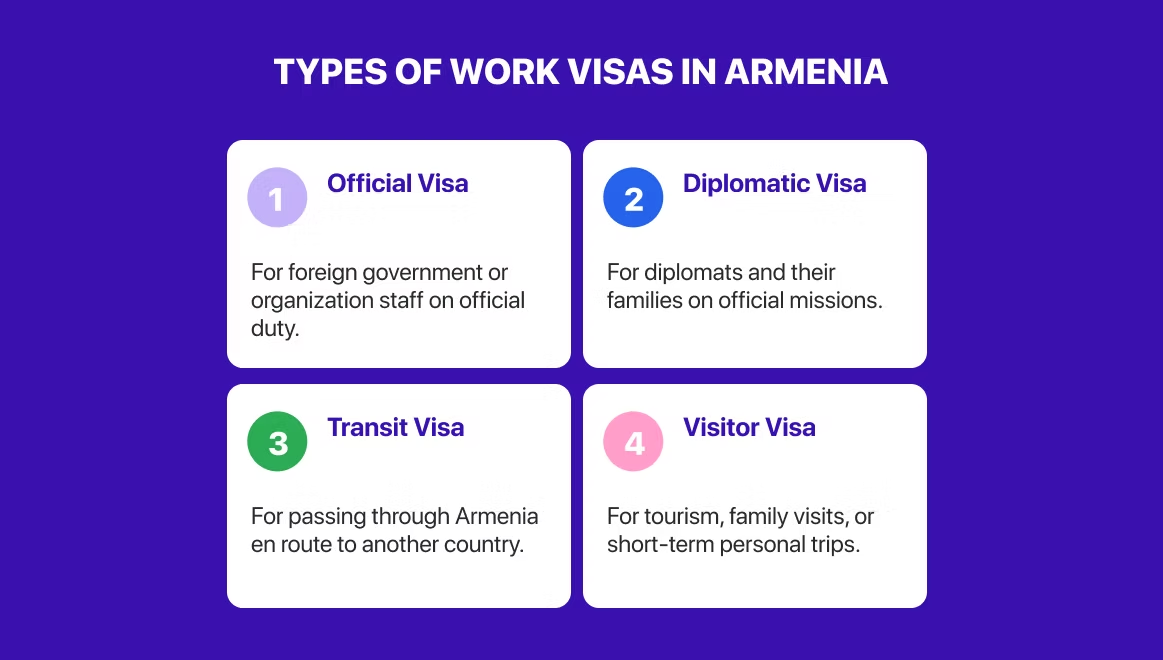
The most important forward-looking insight for decision-makers is the comprehensive immigration reform set to take effect on August 1, 2026. This reform will fundamentally change how employer sponsorship in Armenia is executed, moving from a demand-driven system with labor market tests to a structured "quota" system.
The abolition of the labor market test is a "pro-business" move that will reduce the time spent proving that local candidates aren't available. However, the introduction of annual quotas means that the government will limit the total number of foreign workers allowed in specific sectors or residency categories. This will require companies to be more strategic and forward-thinking in their hiring plans, potentially applying for their quota "slots" well in advance.
Roadmap to the 2026 Reform
| Change | Impact on Decision Makers | Strategic Preparation |
| Work Visa Category | Mandatory entry visa specifically for workers (Cost: AMD 15,000). | Update travel policies to include work visa applications before arrival. |
| Annual Quotas | Limits on total foreign headcount per year. | Budget for talent needs early in the year to secure quota slots. |
| Notification Rules | 15-day limit for reporting a change of employer. | Implement internal audits to track employee movements closely. |
| 100% Digitalization | Elimination of all paper/in-person applications. | Ensure all corporate documentation is scanned and ready for upload. |
These changes represent a maturing of the Armenian system, moving it closer to a "Western-style" managed migration model. For decision-makers, the 2026 shift means less paperwork at the start of the process, but more competition for the limited number of authorized foreign worker slots.
Comparative Analysis: Armenia vs. Georgia for Hub Building
When evaluating where to establish a hub, decision-makers often compare Armenia with its neighbor, Georgia. While Georgia has gained fame for its 1-year visa-free stay for many nationalities and its "Remotely from Georgia" program, Armenia offers a more structured environment for those looking to build a deep-tech company with a permanent local presence.
Georgia’s "Virtual Zone" status, offering 0% corporate tax and VAT on IT exports, is a powerful lure for software companies. However, Armenia’s higher innovation output, superior fixed internet speeds, and aggressive wage-cost reimbursements (up to 60%) often make it a more cost-effective location for scaling large, high-salary engineering teams.
Side-by-Side Comparison for Founders
| Feature | Armenia Strategy | Georgia Strategy |
| Primary Attraction | High-skill hub / Supercomputing. | Digital nomad flexibility / Low tax. |
| Corp Tax Model | 18% Standard; 1% for small tech. | 15% (Estonian model) / 0% for exports. |
| Hiring Incentive | Up to 60% PIT reimbursement. | Generally, no direct wage subsidies. |
| Regulatory Style | Structured, quota-based from 2026. | Flexible, individual assessment. |
| Talent Pipeline | Large physics/math legacy. | Expanding tech-tourist community. |
Armenia is the choice for decision-makers who want to be part of a "hard-tech" ecosystem where they are supported by a government that views IT as its primary economic engine. Georgia remains the choice for those who prioritize immediate regulatory ease and a lower tax burden on distributed profits.
Final Thoughts: Do I Need Sponsorship for Employment?
If you are an employer, the answer is: Yes, if you want to tap into the global talent pool without breaking Armenian law.
Armenia is an incredible hub for tech, engineering, and creative services. The people are brilliant, the culture is deep, and the "honesty" in business is refreshing. But the bureaucracy is real. Don't let a lack of visa sponsorship for employment knowledge stop you from hiring the best person for the job.
Want to bypass the red tape? Team Up specializes in being the most reliable employer of record in the Caucasus.
We don't just "process" people; we provide founder-level clarity on how to build a compliant, happy team in Armenia and Georgia.
Frequently Asked Questions
1. What is sponsorship for employment in Armenia?
In the Armenian context, sponsorship for employment means a local company (the sponsor) taking legal responsibility for a foreign national's right to work. The employer must initiate the application via the government’s unified electronic platform, proving they have a valid job offer and that the company is in good tax standing.
2. Does my company need a specific "Sponsor License"?
Unlike the UK, Armenia doesn't require a separate "license" to be a sponsor. However, any employer wishing to provide visa sponsorship for employment must register their entity on the workpermit.am portal using a local digital signature. The government then verifies the company’s corporate documents and tax compliance automatically through the system.
3. What does it mean to require sponsorship for employment?
If a candidate says they require sponsorship for employment, it means they do not currently hold a "Permanent" or "Special" residency status, nor are they a citizen of an EAEU member state (Russia, Belarus, Kazakhstan, Kyrgyzstan). For these candidates, the employer must "sponsor" their residency by filing a work-based residence application.
4. How does the 2026 "Labor Market Test" work?
Before you can finalize sponsorship for an immigration-related employment benefit, the Ministry of Labor conducts an automated market test. Once you post the vacancy on the portal, the system checks for suitable Armenian citizens.
- The 2026 Shift: While the system may suggest local candidates, the law still allows employers to justify why the foreign hire is necessary (e.g., specific language skills or niche tech expertise).
5. What is the "Work Entry Visa" introduced in 2026?
A major change this year is the Work Entry Visa. Foreigners from visa-required countries can no longer simply enter on a tourist visa and "switch." They must now obtain a specific work-entry visa (valid for up to 120 days), which is granted only after the employer has initiated the sponsorship process on the digital portal.
6. Do EAEU citizens require sponsorship for employment visa status?
No. Citizens of Russia, Belarus, Kazakhstan, and Kyrgyzstan do not require sponsorship for employment visa status. They have a right to "unrestricted" work. However, the employer must still register their employment contract on the electronic platform to ensure the employee receives a Certificate of Legality of Stay.
7. What is the cost of employer sponsorship in Armenia?
While there is no state fee for the work permit itself in 2026, the employer or employee must pay for the Temporary Residence Card, which costs 105,000 AMD (~$260 USD).
Practical Tip: Most employers also budget for professional translation and notarization of the employee’s diploma and passport, which are mandatory for the filing.
.svg)