Employer of Record Cost in France: Fees, Pricing Models & What to Budget in 2026
Table of Contents
- What Drives EOR Pricing in France
- Comparing EOR Fee Structures: Flat Rate vs. Percentage
- Hidden Costs That Inflate Your Total Spend
- How to Estimate Your True Per-Employee Cost
- FAQs
- What to Watch Next
Our guide to Employer of Record (EOR) in France 2026 covers the broad cost picture. It outlines typical fee ranges and the basics of French employer charges. This article goes deeper into the mechanics behind those numbers.
France carries some of the highest employer-side social costs in Europe. Those costs sit underneath the EOR fee and shape everything from pricing models to hidden surcharges. Understanding the full cost stack matters more than comparing headline rates.
This article breaks down every component that affects your total spend. You will learn how flat-rate and percentage-based models compare on French salaries, which hidden charges catch buyers off guard, and how to build a realistic per-employee budget before signing a contract.
What Drives EOR Pricing in France
French Employer Contributions: The Largest Cost Component
The EOR fee is not your biggest expense. French statutory employer contributions are.
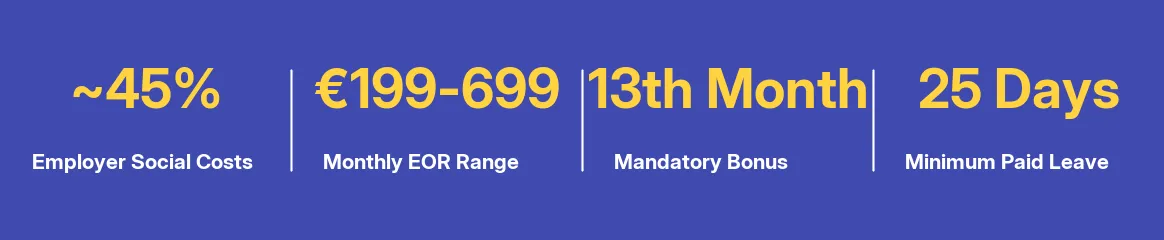
France's Code de la Sécurité Sociale requires employers to fund health insurance, retirement pensions, unemployment insurance, family allowances, workplace accident coverage, and several supplementary schemes. The combined employer contribution rate on gross salary typically runs in the range of 40 to 50 percent, depending on the employee's compensation level and applicable collective bargaining agreement.
That means a €60,000 gross salary generates roughly €24,000 to €30,000 in employer-side charges alone. The EOR service fee sits on top of that. A US fintech company hiring its first product manager in Paris at €65,000 gross would face total employment costs well above €90,000 before the EOR management fee.
Collective Bargaining Agreements Add Layers
France has over 700 active conventions collectives (collective bargaining agreements). These are not optional. Each agreement ties to an industry classification code and dictates minimum salaries, mandatory bonuses, supplementary pension tiers, and specific leave entitlements.
Your employee's convention collective can add two to five percent to the base employer contribution rate. A software company hiring under the Syntec convention faces different supplementary pension obligations than a retail brand hiring under the commerce agreement. The EOR must identify the correct convention and apply it. Some providers build this compliance into their standard fee. Others charge separately for convention collective administration.
The 13th Month Salary
Most conventions collectives in France require a 13th month payment. This is not a discretionary bonus. It functions as an additional month of salary, typically paid in December. Some agreements split it across the year.
The 13th month salary inflates your annual cost by roughly 8.3 percent of gross salary. Every statutory contribution applies to it. An employee earning €60,000 gross effectively costs €65,000 in base salary before employer charges even begin.
Comparing EOR Fee Structures: Flat Rate vs. Percentage
EOR providers in France use one of two pricing models. Each has distinct implications for high-salary and low-salary hires.
FactorFlat Monthly FeePercentage of SalaryTypical range€400–€699/month10%–20% of gross salaryCost predictabilityFixed, budget-friendlyScales with compensationBest suited forMid-to-senior roles (€50K+)Junior roles under €35KRisk to buyerOverpaying on low salariesCosts spike on senior hiresTransparencyHighLower without detailed breakdown
When Flat Fees Win
Flat-fee models favor companies hiring mid-level and senior employees. A London SaaS company hiring a senior engineer in Lyon at €75,000 gross pays the same management fee as it would for a junior coordinator at €30,000. The math favors the higher salary.
Flat fees also simplify budgeting across headcount planning cycles. You know the management cost per head before salary negotiations close. That predictability matters when you are scaling a team from two to eight hires over twelve months.
When Percentage Models Make Sense
Percentage-based pricing works for companies hiring at lower salary bands. If your average French hire earns €28,000 gross, a 15 percent fee adds €4,200 annually. A flat fee of €500 per month adds €6,000. The gap is significant at scale.
The risk emerges as salaries rise. A principal engineer at €95,000 gross under a 15 percent model generates €14,250 in annual EOR fees. That same hire under a €599 flat fee costs €7,188. The difference funds another junior hire. Most companies with mixed salary bands across France benefit from requesting quotes under both models and comparing the blended cost.
Hidden Costs That Inflate Your Total Spend

The advertised EOR fee rarely captures your full obligation. France introduces several cost layers that providers handle differently.
Mandatory Benefits Beyond Statutory Minimums
French law guarantees 25 working days of paid annual leave. Most conventions collectives add further entitlements. The Syntec agreement, for instance, grants additional seniority-based leave days after one year.
Beyond leave, France mandates employer-funded mutuelle (complementary health insurance). The employer must cover at least 50 percent of the premium. Some EOR providers include mutuelle administration in the base fee. Others pass it through as a separate line item, adding €40 to €80 per employee per month depending on the plan selected.
Meal vouchers (titres-restaurant) are standard practice, though not legally required. Most French employees expect them. The employer contribution per voucher is partially exempt from social charges up to a cap set annually by URSSAF. Your EOR may manage the voucher program for an additional administrative fee.
Currency and Payroll Processing Charges
If you fund payroll in USD or GBP, the EOR converts to euros. Foreign exchange markups of 0.5 to 2 percent are common. On a monthly payroll of €30,000 for a small team, a 1.5 percent FX spread adds €5,400 annually. Ask your provider for the exact margin above the mid-market rate.
Some providers also charge per-payroll processing fees. These range from €15 to €50 per pay run per employee. France runs monthly payroll cycles, so twelve processing fees per year per employee add up.
Termination and Offboarding Reserves
France's labor code makes dismissal expensive. Even a straightforward termination for personal cause requires notice periods, severance calculation under the convention collective, and potentially a rupture conventionnelle (negotiated separation). Legal minimum severance equals one quarter of a month's salary per year of service for the first ten years.
Watch out: Some EOR providers require a termination reserve deposit of one to three months' salary per employee, held throughout the engagement. This deposit is not a fee — you recover it — but it ties up working capital that you should factor into cash flow planning.
Providers that do not charge a termination deposit instead build the risk into higher monthly fees. Either way, you pay for French labor protection. The question is whether you prefer upfront reserves or baked-in premiums.
How to Estimate Your True Per-Employee Cost

Building a Realistic Budget
Start with gross annual salary. Apply the employer contribution rate appropriate to the employee's salary band and convention collective. The combined figure is your total employer cost before the EOR fee.
Add the EOR management fee. Then layer in mutuelle premiums, meal voucher contributions, and the 13th month payment. Each of these carries its own social charge implications.
A practical example: a US e-commerce company hiring a marketing manager in Paris at €55,000 gross would estimate employer contributions near €24,000. The 13th month adds roughly €4,580 in gross salary plus associated charges. Mutuelle runs €600 to €960 annually. A flat EOR fee of €500 per month adds €6,000. The all-in annual cost lands near €92,000 to €95,000.
Benchmarking Against Entity Setup
Companies planning five or more French hires within 18 months should benchmark EOR costs against establishing a Société par Actions Simplifiée (SAS). Entity setup in France typically takes three to six months from initial filing to operational payroll. Accounting, legal, and registered office costs run €15,000 to €25,000 in the first year.
At five employees, monthly EOR fees alone total €2,500 to €3,500. Annual EOR management costs reach €30,000 to €42,000. The entity breakeven point for most companies falls between five and eight employees, depending on salary levels and the onboarding timeline in France.
For companies hiring across multiple European markets simultaneously, an EOR service keeps each market entry lean until headcount justifies local incorporation.

FAQs
Does the EOR fee include French employer social contributions?
No. The EOR management fee covers compliance administration, payroll processing, and employment contract management. French employer social contributions are a pass-through cost invoiced separately. Your invoice will show two distinct components: the management fee and the total employer cost including statutory charges. Always request a sample invoice breakdown before signing. Some providers bundle both into one line item, which makes cost comparison between providers harder.
Can I negotiate EOR pricing for multiple hires in France?
Most providers offer volume discounts starting at three to five employees. Discounts typically reduce the per-employee management fee by 10 to 20 percent. Some providers also waive onboarding fees or reduce FX margins for larger engagements. Request tiered pricing scenarios for your projected headcount at six, twelve, and eighteen months. Lock in the rate structure contractually, since verbal discount commitments may not survive provider staff turnover.
What happens to my costs if French social contribution rates change mid-contract?
EOR contracts in France treat statutory contributions as pass-through charges. When URSSAF adjusts contribution rates, your invoice adjusts in the next pay cycle. The EOR management fee itself stays fixed for the contract term. Rate changes typically take effect in January. Your provider should notify you at least 30 days before the adjustment hits payroll. Ask whether the contract includes a cap on pass-through increases or whether all statutory changes flow through without limit.
Are there additional costs for hiring foreign nationals in France through an EOR?
Yes. Work permit and visa sponsorship adds processing fees and administrative time. The French authorities charge application fees that the EOR passes through. Legal review of the employment contract for immigration compliance can add €500 to €1,500 depending on the permit type. Processing timelines run four to twelve weeks. Some EOR providers include basic immigration support in their standard fee. Others treat it as a premium add-on with per-case pricing.
What to Watch Next
French employer contribution rates shift with each annual social security finance law. The 2026 budget cycle may adjust contribution ceilings and specific charge categories. Monitor URSSAF announcements each January.
Beyond rates, France is tightening enforcement on employment classification. Misclassified contractors face retroactive social charges and penalties. Companies using contractor arrangements alongside EOR hires should review classification criteria before year-end.
Build your French hiring budget with a 5 to 8 percent buffer above the all-in estimate. That margin absorbs convention collective reclassifications, mutuelle premium increases, and any mid-year regulatory shifts without forcing a budget revision.
If you need a detailed cost breakdown for hiring through an EOR in France, TeamUp can prepare one specific to your team size and salary bands. Request an estimate.
Written by TeamUp — the people-first EOR partner helping 200+ companies hire compliantly across 20+ countries.
.svg)