


When to Choose an Employer of Record in Canada: Key Scenarios and Use Cases

Our guide to EOR vs payroll outsourcing in Canada compares both models at a structural level. It covers definitions, cost differences, and transition steps. This child article goes deeper on one specific question: under what circumstances should a foreign company choose an EOR over the alternatives?
The answer depends on more than headcount. Provincial labor law variation, timeline pressure, and your long-term Canada strategy all shape the decision. A US fintech hiring two developers in Ontario faces a different calculus than a German manufacturer building a 40-person team in Alberta. This article breaks down the decision criteria that matter most, with concrete thresholds and scenarios to guide your choice.
Scenarios Where an EOR Is the Right Model
An EOR makes sense when the cost or risk of establishing a Canadian entity outweighs the benefits. Three scenarios stand out.
First Hires in an Untested Market
Companies entering Canada for the first time rarely know whether the market will support a permanent presence. A London-based SaaS company hiring its first two customer success managers in Toronto does not need a federal corporation, a CRA business number, provincial workers' compensation registration, and a Canadian bank account. It needs compliant employment contracts and payroll within days.
An employer of record in Canada absorbs that entire setup burden. The EOR already holds registrations with the Canada Revenue Agency and the relevant provincial authorities. Your employees start working while you evaluate whether Canada justifies a long-term entity investment.
Project-Based or Time-Limited Engagements
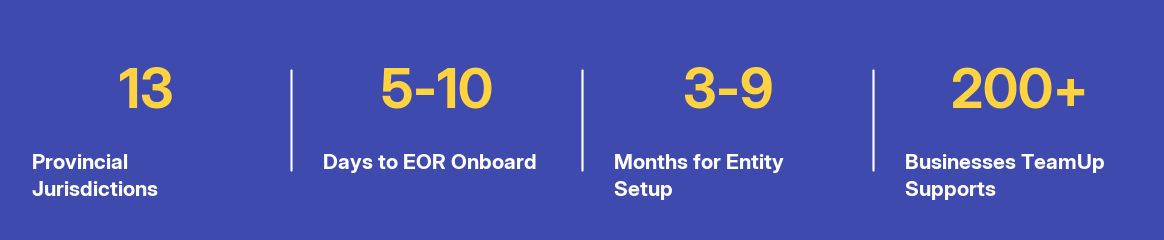
Fixed-term projects create a specific problem. Incorporating a Canadian entity for a 12-month engagement means you spend three to nine months on setup. Then you spend months winding down the entity after the project ends. That wind-down includes filing final tax returns, deregistering from provincial programs, and closing bank accounts.
An EOR eliminates both the ramp-up and the tail. A Copenhagen engineering firm that needed eight QA specialists in Vancouver for a 14-month product launch used an EOR to onboard the team in under two weeks. When the project concluded, the EOR handled all termination compliance, including statutory notice and severance under British Columbia's Employment Standards Act.
Avoiding Permanent Establishment Risk
Foreign companies that hire directly in Canada without proper structuring risk creating a permanent establishment (PE) under the Income Tax Act. A PE triggers Canadian corporate tax obligations on income attributable to Canadian operations. An EOR serves as the legal employer, which can reduce PE exposure depending on the scope of activities. Tax counsel should confirm the analysis for your specific structure.
Provincial Complexity as a Decision Driver
Canada's employment law is not federal. It is provincial. That distinction drives EOR decisions more than most foreign companies expect.
Thirteen Jurisdictions, Thirteen Rule Sets
Each province and territory sets its own employment standards. Minimum wage, overtime thresholds, vacation entitlements, statutory holidays, and termination rules all vary. Ontario's Employment Standards Act, 2000 differs materially from Alberta's Employment Standards Code. Quebec adds a French-language requirement for employment contracts under the Charter of the French Language.
| Decision Factor | Single-Province Hire | Multi-Province Team |
|---|---|---|
| Regulatory complexity | One provincial regime | Multiple overlapping regimes |
| Workers' compensation | One provincial board registration | Separate registration per province |
| Payroll tax variations | One set of provincial rates | Different rates per jurisdiction |
| Language requirements | English (or French in QC) | Bilingual obligations if QC included |
| EOR value | Moderate | High |
A company hiring only in Ontario faces manageable complexity. A company hiring across Ontario, British Columbia, and Quebec faces three distinct regulatory environments. The EOR advantage scales with provincial spread.
Workers' Compensation: A Hidden Multi-Province Burden
Each province operates its own workers' compensation board. Ontario uses the WSIB. British Columbia uses WorkSafeBC. Alberta uses the WCB. A foreign employer building a Canadian entity must register separately with each relevant board, pay premiums based on industry classification, and file annual returns per province.
An EOR carries all workers' compensation registrations. Your employees are covered from day one. You avoid the administrative overhead of managing multiple provincial accounts with different rate structures and reporting deadlines. For companies transitioning from payroll outsourcing to an EOR, this alone can justify the switch.
EOR vs Entity Setup: The Break-Even Analysis
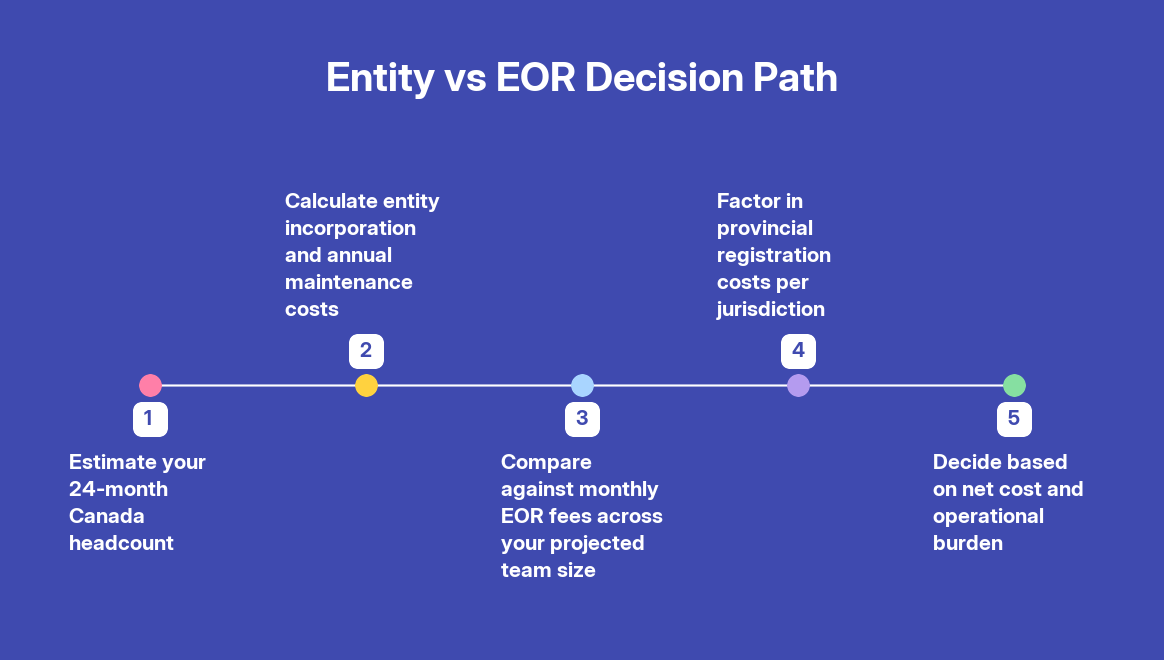
Every EOR engagement has a crossover point. Below a certain headcount and duration, the EOR costs less. Above it, an entity makes financial sense.
The Cost Variables That Matter
Entity incorporation in Canada requires federal or provincial registration fees, legal counsel, a registered office, and a Canadian bank account. Annual maintenance adds corporate tax filings, payroll account administration, and workers' compensation premiums. Legal and accounting fees run alongside these fixed costs regardless of team size.
EOR fees in the Canadian market typically range from $400 to $800 per employee per month, depending on the provider and services included. For a team of three, that totals roughly $14,400 to $28,800 per year. Entity setup and first-year maintenance costs often exceed that figure for small teams.
The Headcount Threshold
The break-even point depends on your specific circumstances, but a pattern emerges across most industries. Below five to eight employees, an EOR is almost always more cost-effective. Between eight and fifteen employees, the decision depends on how many provinces you operate in and how long you plan to stay. Above fifteen employees with a multi-year commitment, entity incorporation usually wins on per-employee cost.
A US logistics company with 22 employees across Alberta and Ontario incorporated a Canadian subsidiary. The per-employee compliance cost dropped below what an EOR would have charged at that scale. But they spent seven months on setup before the first employee could start.
Beyond Direct Cost: The Risk Premium
Cost comparisons often ignore the risk premium embedded in EOR fees. That premium covers wrongful dismissal liability, employment standards compliance, and statutory remittance errors. A single wrongful dismissal claim in Ontario can result in common law damages of up to 24 months' pay. The EOR absorbs that exposure. Your entity would carry it directly, along with the legal defense costs.
How to Evaluate an EOR Provider for Canada

Not all EOR providers serve Canada the same way. The distinction between owned-entity providers and aggregator-network providers matters for compliance accountability.
Owned Entity vs Partner Network
An EOR with its own Canadian legal entity controls compliance directly. It files payroll remittances, manages provincial registrations, and bears legal liability under its own corporate name. An aggregator routes your employees through a local partner. If that partner misfiles a T4 or misses an EI premium remittance, your recourse is indirect.
Ask prospective providers whether they hold their own CRA payroll account or subcontract to a Canadian partner. The answer shapes your risk profile. TeamUp operates owned entities across its core markets, giving clients direct compliance accountability rather than partner-network exposure.
Provincial Coverage Depth
Confirm that your EOR can hire in every province where you need talent. Some providers cover Ontario and British Columbia but lack registrations in smaller provinces like New Brunswick or Saskatchewan. If your hiring plans might expand beyond initial provinces, verify coverage upfront. Switching EOR providers mid-engagement creates employee benefits continuity issues and contract novation headaches.
Termination and Severance Handling
Canadian termination law combines statutory minimums with common law reasonable notice. The common law component varies based on employee age, tenure, role, and availability of comparable employment. Your EOR should demonstrate expertise in calculating both layers. Ask for their approach to constructive dismissal scenarios and how they handle wrongful dismissal claims. This is where compliance depth separates serious providers from payroll processors wearing an EOR label.
Watch out: Some EOR providers quote fees that exclude statutory severance reserves. If your EOR does not set aside funds for potential termination liabilities, you may face unexpected lump-sum invoices when an employment relationship ends.

FAQs
Can I use an EOR in Canada if my company already has a US entity?
Yes. A US entity does not substitute for Canadian employment compliance. The Canada Revenue Agency treats employment in Canada as subject to Canadian payroll tax, CPP contributions, and EI premiums regardless of where the employer is incorporated. An EOR lets you hire Canadian residents without creating a separate Canadian corporate presence, while your US entity continues operating normally.
Does an EOR handle Quebec's unique language and pension requirements?
Quebec requires employment contracts and workplace communications in French under the Charter of the French Language. Quebec also operates its own pension plan, the QPP, instead of the federal CPP. A qualified EOR manages both obligations. Confirm that your provider has specific Quebec experience, since the regulatory differences extend to employment standards, parental leave, and pay equity legislation.
What happens to my employees if I switch from an EOR to my own Canadian entity?
Your employees transfer to your new entity through contract novation or resignation and rehire. Employment continuity, including tenure-based entitlements like vacation and notice periods, must be preserved or compensated. The process typically takes four to eight weeks when coordinated between your legal team and the EOR. Plan the transition during a payroll cycle boundary to avoid mid-period remittance complications.
Can an EOR sponsor work permits for foreign nationals I want to relocate to Canada?
An EOR can support work permit applications by serving as the Canadian employer on the Labour Market Impact Assessment, where required. Not all work permit categories require an LMIA. The Intra-Company Transfer category, for example, does not apply to EOR arrangements since there is no parent-subsidiary relationship. Discuss your specific immigration scenario with the EOR before committing to a relocation plan.
What Comes Next
Provincial payroll tax rules in Canada shift regularly. Quebec's health services fund contribution rates, Ontario's Employer Health Tax thresholds, and workers' compensation premium rates all move on different schedules. Monitor CRA bulletins and provincial employment standards updates quarterly. If your Canadian headcount is approaching the break-even threshold discussed above, start the entity incorporation analysis now rather than after you have already committed to a larger EOR spend.
If you need a province-by-province compliance breakdown for your Canadian hiring plan, TeamUp can prepare one. Request a consultation.
Written by the TeamUp Editorial Team. TeamUp has supported 200+ businesses since 2020, helping companies across North America, Europe, the Middle East, and Singapore hire compliantly in 20+ countries through owned legal entities and in-country teams.
.svg)


