


How to Transition from Payroll Outsourcing to an EOR in Canada

Our guide to EOR vs payroll outsourcing in Canada explains how the two models differ in scope, legal responsibility, and cost structure. This article goes deeper on one specific question: how do you actually move from one model to the other?
The transition involves more than swapping providers. You are shifting legal employer status, migrating employee records, restructuring benefit enrollment, and realigning tax remittance responsibilities. Each step carries compliance risk under Canadian federal and provincial employment law if handled out of sequence.
This guide walks through the audit, the migration process, the employee communication plan, and the mistakes that trip up companies mid-transition. If you are weighing when an EOR makes sense for your situation, this article covers what happens after you make that decision.
Auditing Your Current Payroll Setup Before the Switch
A transition that skips the audit phase creates gaps in compliance records. Those gaps surface months later as CRA reassessments or provincial penalties. Start here before you contact an EOR provider.
Mapping Your Payroll Obligations by Province
Canadian payroll compliance is province-specific. Each province maintains its own workers' compensation board, employment standards legislation, and statutory holiday schedule. A company with employees in Ontario, British Columbia, and Alberta carries three distinct sets of obligations.
Your audit should catalog every active payroll account. That means CRA business numbers for income tax, CPP, and EI remittances. It also means provincial workers' compensation accounts such as WSIB in Ontario or WorkSafeBC in British Columbia.
Document which accounts your current payroll provider manages versus which ones your company holds directly. This distinction determines what needs to be transferred, closed, or kept open during the transition.
Reviewing Benefit Plans and Leave Balances
Your payroll outsourcing provider likely administers group benefit plans, RRSP matching, or health spending accounts. These are contractual commitments to your employees. They do not disappear when you switch models.
Pull a complete inventory of active benefit enrollments, vesting schedules, and accrued leave balances. The EOR will need this data to mirror or replace your current offerings. A Toronto-based SaaS company with 12 employees discovered during its audit that three employees had banked over 40 vacation days each. Without documenting those balances before the switch, the liability would have fallen into a gap between providers.
For a broader look at what EOR benefit structures cover in Canada, the standards include provincial health top-ups, group insurance, and retirement contributions.
Checking Termination Clauses in Your Current Provider Contract
Most payroll outsourcing contracts include termination notice periods ranging from 30 to 90 days. Some include early exit fees or data migration surcharges. Read these clauses before you set a transition date.
Request a written confirmation of your data export rights. Your employee records, T4 history, ROE filings, and remittance records must transfer cleanly. If your current provider uses proprietary software, ask whether they export in standard formats like CSV or XML.
The Step-by-Step Transition Process
Phase One: Parallel Payroll Run
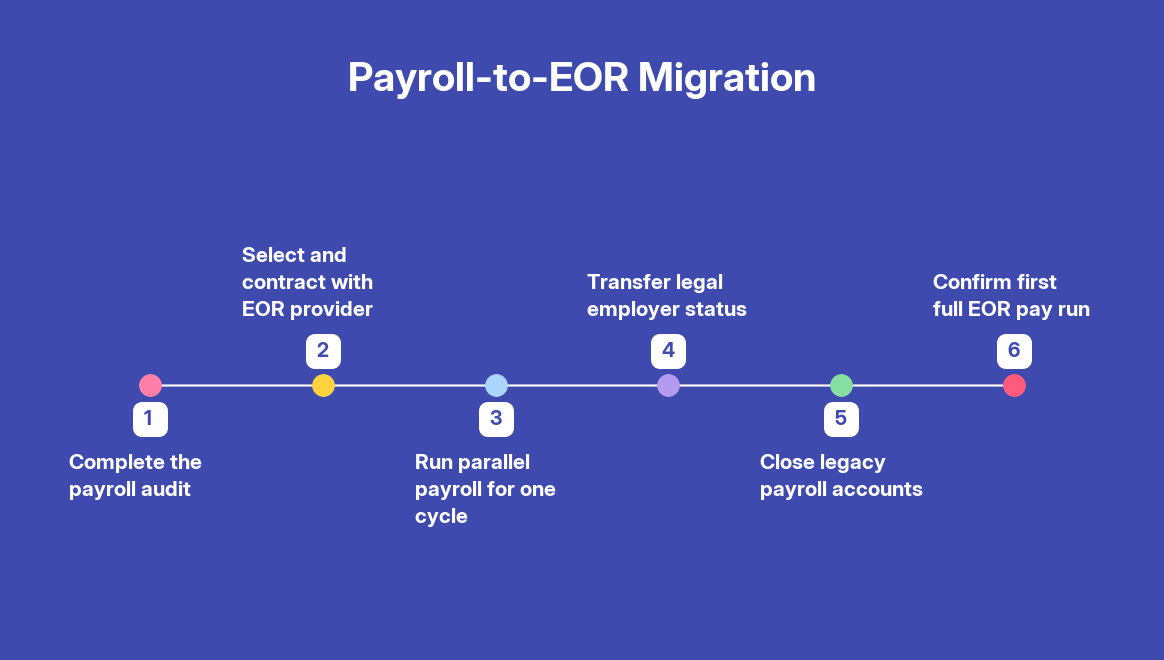
The safest migration approach runs both systems simultaneously for one pay cycle. Your outgoing payroll provider processes the final pay run while the EOR sets up its accounts and validates employee data.
During this phase, the EOR registers as the legal employer with the CRA. It obtains its own business payroll account and begins remitting source deductions under its own number. The parallel run catches data mismatches before they affect employees.
A Montreal fintech company with 8 Canadian employees ran parallel payroll for two weeks. The test cycle revealed that two employees had outdated TD1 federal and provincial tax credit forms. Catching that during parallel testing avoided incorrect withholdings on the first real EOR pay run.
Phase Two: Legal Employer Transfer
This is the core structural change. Under the EOR model, the provider becomes the legal employer on record. Employees sign new employment agreements with the EOR entity. Their terms of employment, including compensation, role, and benefits, carry over.
The transfer triggers several administrative steps. The EOR issues new Records of Employment for each employee under the previous employer's account. It then enrolls employees under its own CPP, EI, and income tax accounts. Provincial workers' compensation coverage shifts to the EOR's policy.
For companies hiring compliantly in Canada through an EOR, this transfer is what removes the need for a local entity entirely.
Phase Three: Post-Migration Verification
After the first full pay cycle under the EOR, verify three things. First, confirm that CRA remittances match the expected amounts for each employee. Second, check that provincial benefit enrollments are active with no coverage gaps. Third, validate that year-to-date totals transferred correctly for T4 reporting purposes.
Year-to-date totals matter most during mid-year transitions. If you switch providers in July, the EOR must carry forward six months of CPP and EI contributions to avoid double-deducting from employees.
Managing Employee Communication and Contract Migration
Employees react to employer changes based on how those changes affect their pay, benefits, and job security. Silence creates anxiety. A structured communication plan reduces friction.
Timing the Announcement
Notify employees at least two weeks before the parallel payroll run begins. Explain three things clearly: their role and compensation stay the same, their benefits will continue or improve, and the EOR is the administrative employer while the client company remains their day-to-day manager.
A Calgary energy services company transitioning 15 employees to an EOR held a single 30-minute video call. The HR lead walked through a comparison of old versus new benefit coverage. Employee questions dropped by 80% after that one session.
| Transition Element | Payroll Outsourcing (Before) | EOR (After) |
|---|---|---|
| Legal employer | Client company | EOR provider |
| CRA remittance account | Client's business number | EOR's business number |
| Employment contract | Signed with client | Signed with EOR |
| Day-to-day management | Client company | Client company (unchanged) |
| Workers' compensation | Client's provincial account | EOR's provincial policy |
| Benefit administration | Payroll provider or client | EOR provider |
Handling Contract Signatures
Each employee signs a new employment agreement with the EOR. Canadian employment law requires that the new contract preserve existing terms. Any reduction in compensation, benefits, or job security could constitute constructive dismissal under common law.
The EOR drafts contracts that mirror existing terms. Employees review and sign before the legal employer transfer date. Most EOR providers use electronic signature platforms that complete this step in two to five business days.
Watch out: If an employee's new EOR contract reduces any term of employment, even unintentionally, the employee may have grounds for a constructive dismissal claim under provincial employment standards. Have the EOR's legal team cross-reference every clause against the existing agreement.
Avoiding Common Transition Pitfalls

Gap in Statutory Remittances
The most frequent error is a gap between when the old provider stops remitting and the new EOR starts. CRA penalties for late source deduction remittances start at 3% for amounts one to three days late. They escalate from there.
Avoid this by confirming exact cutoff dates in writing with both providers. The outgoing provider should remit through the last day of its final pay period. The EOR should begin remitting from the first day of its first pay period. No gap, no overlap.
Losing Provincial Registration Continuity
If your company holds its own workers' compensation account and the EOR takes over coverage, you need to close the old account properly. Leaving it open generates premium assessments with no corresponding payroll. That triggers audit flags.
File a final return with each provincial workers' compensation board. Confirm the effective end date matches the EOR's coverage start date. In Ontario, WSIB requires employers to file a final reconciliation within 60 days of closing an account.
Mid-Year Tax Credit Miscalculations
Employees who change legal employers mid-year risk having their basic personal amount and provincial tax credits applied twice. The EOR must use the employee's year-to-date earnings and deductions from the previous employer to calculate remaining withholdings accurately. Request a detailed year-to-date summary from your outgoing provider before the cutoff date.

FAQs
Can I transition only some employees to an EOR while keeping others on payroll outsourcing?
Yes. Many companies run a hybrid model during expansion. You might keep your existing Ontario team on payroll outsourcing while placing new British Columbia hires under the EOR. The key constraint is that each employee has exactly one legal employer. You cannot split a single employee's payroll between two models. Track which entity is the employer of record for each person to avoid duplicate CRA filings.
What happens to my employees' seniority and tenure during the transition?
Under Canadian common law, continuous service typically carries over when a business transfers employees to a new legal employer without a break in employment. The EOR contract should explicitly recognize each employee's original start date. This matters for statutory entitlements like vacation accrual and termination notice periods, which increase with years of service under most provincial employment standards acts.
How long does a typical payroll-to-EOR transition take in Canada?
Most transitions complete in four to six weeks from the initial audit to the first full EOR pay run. The longest phase is usually the parallel payroll period, which runs one to two pay cycles. Companies with employees across multiple provinces may need an extra one to two weeks to align provincial registrations. A 5-person team in a single province can often complete the switch in three weeks.
Do I need to issue Records of Employment when switching to an EOR?
Yes. When the legal employer changes, the outgoing employer must issue a Record of Employment for each employee. The ROE reason code is typically "K" for "Other," with a comment noting the transfer to a new legal employer. The EOR then begins a new employment record. Failing to issue ROEs can create problems if an employee later applies for EI benefits, since Service Canada uses ROEs to determine eligibility.
What to Watch Next
Canadian provinces continue updating employment standards, minimum wage schedules, and workers' compensation premium rates on independent timelines. If your team spans multiple provinces, each update creates a new compliance checkpoint.
Before starting your transition, confirm the current CRA remittance thresholds and provincial registration requirements with the relevant authorities. The audit phase described above catches most issues. But provincial changes that take effect between your audit and your go-live date can introduce surprises.
Build a 90-day post-transition review into your plan. That review should verify remittance accuracy, benefit enrollment status, and employee satisfaction with the new structure.
If you are planning a payroll-to-EOR transition for your Canadian team, Team Up can walk you through the migration steps specific to your provinces and team size. Book a transition consultation.
Written by the Team Up editorial team. Team Up has supported 200+ businesses across 20+ countries since 2020, with owned legal entities and in-country offices in its core markets.
.svg)


