


Managing Remote Teams in Canada via an Employer of Record

Our guide to onboarding and managing teams via EOR in Canada covers the full lifecycle from first hire to entity transition. This child article goes deeper on one piece: the day-to-day operational reality of managing remote Canadian employees when an EOR is your legal employer.
Remote management in Canada carries complexity that other markets do not. Employment standards differ by province. Expense reimbursement rules vary. Termination obligations shift based on where the employee lives, not where the client operates. A London fintech managing three developers spread across Ontario, British Columbia, and Quebec faces three distinct regulatory environments through a single EOR relationship.
This article breaks down the provincial compliance layer, performance management guardrails, equipment and workspace obligations, and offboarding mechanics that remote team leads must understand.
Navigating Provincial Employment Standards Across Remote Teams
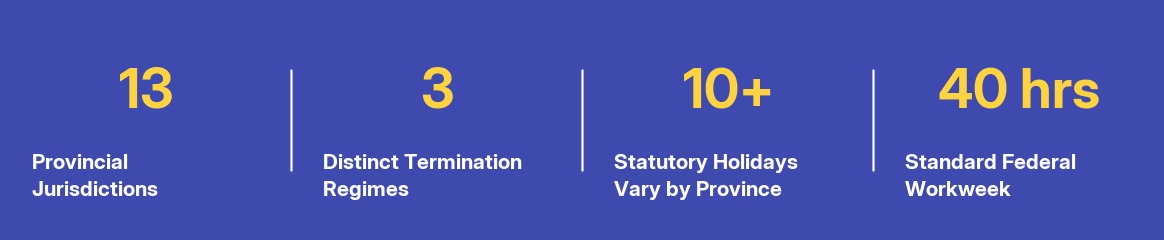
Canada's employment law is jurisdiction-specific. The province where your employee physically works determines the applicable standards. That matters for hours, overtime, leave, and holidays.
Why the Employee's Province Controls Compliance
The Canada Labour Code covers federally regulated industries like banking and telecommunications. Most private-sector employees fall under provincial legislation instead. Ontario's Employment Standards Act, 2000 governs workers in Ontario. British Columbia's Employment Standards Act governs workers in BC. Alberta's Employment Standards Code applies there.
Your EOR must track each employee's province of residence. A remote worker who relocates from Alberta to Quebec triggers a change in applicable law. Overtime thresholds, statutory holiday entitlements, and minimum notice periods all shift.
Key Differences That Affect Daily Management
| Standard | Ontario | British Columbia | Quebec |
|---|---|---|---|
| Standard workweek | 44 hours | 40 hours | 40 hours |
| Overtime threshold | After 44 hrs/week | After 8 hrs/day or 40 hrs/week | After 40 hrs/week |
| Minimum vacation (first years) | 2 weeks | 2 weeks | 2 weeks (3 weeks after 3 years) |
| Statutory holidays | 9 public holidays | 10 statutory holidays | 8 national holidays |
| Right to disconnect legislation | Yes (25+ employees) | No | No |
Ontario introduced right-to-disconnect policies under Bill 27, Working for Workers Act, 2021. Employers with 25 or more employees must maintain a written policy. Your EOR should draft this for Ontario-based remote workers. BC and Quebec have no equivalent requirement yet.
Practical Impact on Scheduling
A team lead in Berlin scheduling a standup at 9:00 AM CET hits 3:00 AM in Vancouver and 4:00 AM in Calgary. Time zones create real friction. But the compliance layer matters more than the clock. If your BC employee works a nine-hour day, the EOR must pay overtime for the ninth hour. That same schedule in Ontario triggers no overtime.
Track hours by province, not by team. Your EOR should flag overtime thresholds automatically. Ask for province-specific payroll reports monthly.
Building Compliant Communication and Performance Workflows

Remote performance management is not just a leadership challenge. It is a legal one.
Documenting Performance Through the EOR
Canadian employment law in every province requires "just cause" for dismissal without notice. The threshold for just cause is high. Courts consistently demand progressive discipline with documented warnings. A Slack message saying "your work needs improvement" does not meet that standard.
Your EOR should provide a formal performance documentation framework. Written performance improvement plans, dated feedback records, and structured review cycles all build the paper trail that Canadian courts expect. A SaaS company in Amsterdam managing four remote marketers in Toronto learned this lesson when attempting to terminate an underperformer. Without documented progressive discipline, the EOR correctly advised that termination required a severance package equivalent to several weeks of pay.
Communication Policies and Privacy Constraints
Canada's Personal Information Protection and Electronic Documents Act (PIPEDA) governs how private-sector employers collect and use employee data at the federal level. Quebec's Act Respecting the Protection of Personal Information in the Private Sector adds stricter provincial rules.
Monitoring employee keystrokes or screen activity raises privacy concerns under both frameworks. Your EOR can advise on what monitoring is permissible. Blanket surveillance tools common in other markets may violate Canadian privacy legislation.
Keep communication policies specific. State which tools you use for work communication. Define expected response windows during working hours. Document these expectations in the employment agreement your EOR issues. The onboarding process for Canadian EOR employees should embed these policies from day one.
Performance Reviews as Legal Safeguards
Schedule quarterly reviews. Document outcomes in writing. Share records with your EOR. This discipline protects you twice. It strengthens your management of remote workers. And it builds the legal record you need if performance issues escalate later.
Managing Equipment, Expenses, and Workspace Obligations
Remote employees in Canada need equipment. They incur work-related expenses. Provincial rules govern who pays.
Home Office Equipment and Provisioning
No federal statute mandates that employers provide home office equipment. But the EOR's employment agreement typically defines equipment provisions. Most Canadian remote arrangements include a company-provided laptop, monitor, and peripherals.
Your EOR handles procurement and shipping within Canada. A US healthtech company building a five-person data team across Calgary and Montreal used their EOR to provision standardized equipment kits. The EOR tracked asset ownership and managed returns at contract end. For companies exploring equipment provisioning for remote workers, your EOR coordinates local logistics and maintains the asset register.
Expense Reimbursement Rules
Ontario's Employment Standards Act, 2000 does not include a general expense reimbursement mandate. British Columbia's legislation is similar. But employment contracts typically include reimbursement clauses for internet, phone, and home office supplies.
The Canada Revenue Agency allows employees to claim home office expenses on personal tax returns under certain conditions. Your EOR should issue the required T2200 form, "Declaration of Conditions of Employment," to each remote worker at year end. Without this form, employees cannot claim eligible deductions.
Watch out: If your EOR does not issue T2200 forms for remote workers, those employees lose legitimate tax deductions. Ask your EOR to confirm T2200 issuance as part of the annual payroll cycle.
Workspace Safety Obligations
Even remote workers fall under occupational health and safety legislation. Ontario's Occupational Health and Safety Act applies to home offices in principle. The practical enforcement is limited, but the legal obligation exists. Your EOR should include a home workspace self-assessment in the onboarding checklist. This documents that the employer took reasonable steps to ensure a safe work environment.
Handling Terminations and Offboarding for Remote Workers
Terminating a remote employee in Canada is more complex than most international managers expect. The province sets minimum notice periods. Common law often extends them.
Statutory Minimums vs. Common Law Entitlements
Every province prescribes minimum notice periods based on length of service. Ontario requires one week per year of service, up to eight weeks. BC follows a similar graduated scale. These are floors, not ceilings.
Canadian courts routinely award "reasonable notice" above statutory minimums. Factors include age, length of service, position seniority, and availability of comparable employment. A 50-year-old senior manager with six years of tenure could receive 12 to 18 months of reasonable notice under common law, far exceeding the statutory minimum.
Your EOR should draft employment agreements with enforceable termination clauses that limit notice to the statutory minimum or a defined amount above it. Without such clauses, common law applies by default.
The EOR's Role in the Termination Process
You decide to end the working relationship. The EOR executes the termination. This split matters. The EOR calculates the final pay, statutory notice or pay in lieu, accrued vacation payout, and any applicable severance. In Ontario, employees with five or more years of service at organizations with a payroll exceeding the threshold set by the Employment Standards Act may qualify for statutory severance pay separate from notice.
Coordinate early. Give your EOR at least two weeks' lead time before a planned termination. The EOR reviews the employment agreement, confirms provincial obligations, and prepares the termination package. Rushing this process creates legal exposure.
Understanding how EOR employee benefits in Canada continue or terminate during the notice period is equally critical. Group benefits typically extend through the notice period, and your EOR manages that continuation.
Recovering Equipment and Closing Access
Remote offboarding requires a coordinated sequence. The EOR sends a prepaid shipping label for company equipment. IT revokes system access on the termination date. The EOR processes the final payroll run, including any outstanding expense reimbursements.
An employer of record in Canada manages the administrative close. But the client must coordinate the access revocation and knowledge transfer on their side. Build an offboarding checklist that both parties follow.

FAQs
What happens if a remote employee moves to a different province mid-contract?
The applicable employment standards change to match the new province. Your EOR must update the payroll configuration, adjust statutory holiday calendars, and review overtime thresholds. The employment agreement may need amendment. Some EOR providers flag relocations automatically through periodic address verification. Others rely on employee self-reporting. Confirm your EOR's relocation protocol before it happens, because a missed update creates retroactive compliance gaps.
Can I require a remote Canadian employee to work specific hours?
Yes, within limits. You can set core hours for overlap with your team's time zone. But you must respect the province's daily and weekly hour limits. Any hours exceeding the overtime threshold require premium pay. Ontario's right-to-disconnect policy also limits after-hours contact expectations for larger employers. Define core hours in the employment agreement your EOR issues.
How does statutory holiday pay work for remote employees across provinces?
Each province has its own statutory holiday list. A remote worker in Quebec observes Saint-Jean-Baptiste Day. A colleague in Ontario does not. Your EOR must apply the correct holiday calendar per province. If an employee works on a statutory holiday, most provinces require premium pay, typically 1.5 times the regular rate plus a substitute day. Your EOR calculates this automatically if the provincial setup is correct.
Are non-compete clauses enforceable for remote workers in Canada?
Ontario banned non-compete agreements for most employees under Bill 27, Working for Workers Act, 2021. Only C-suite executives are exempt. Other provinces still allow non-competes, but courts scrutinize them heavily. Overly broad clauses are routinely struck down. Your EOR should use non-solicitation clauses instead, which Canadian courts enforce more reliably. Confirm the specific provincial stance before including any restrictive covenant.
What to Watch Next
Provincial employment standards in Canada evolve frequently. BC is reviewing its overtime rules. Ontario continues expanding worker protection legislation. Quebec's privacy framework grows stricter with each amendment cycle.
Build a quarterly compliance review into your EOR relationship. Ask for a province-by-province update on any legislative changes affecting your remote team. The cost of reacting to a change after it takes effect is always higher than adjusting proactively.
If your remote Canadian team spans three or more provinces, the compliance burden justifies a dedicated EOR contact who understands your specific team distribution.
If you manage remote employees across multiple Canadian provinces and need province-specific compliance support, request a consultation with TeamUp.
Written by the TeamUp editorial team. Last reviewed June 2025.
.svg)


