


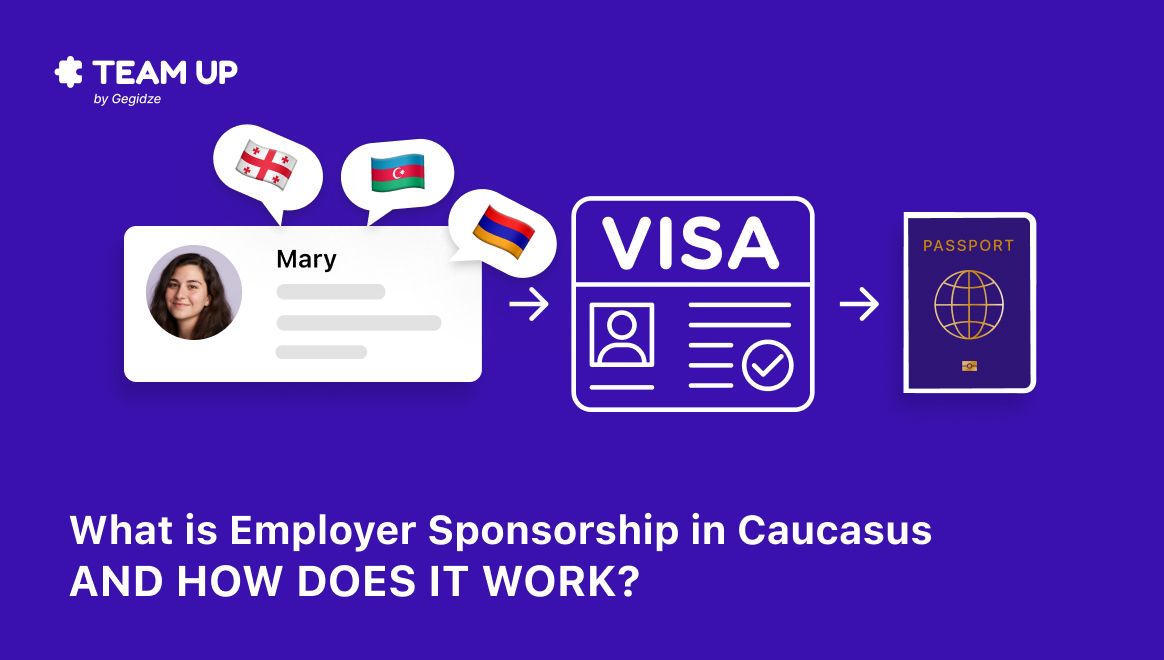
What is Employer Sponsorship in Caucasus And How Does It Work?
TL;DR
- Georgia’s New Permit Rule: Georgia is ending its visa-free hiring era. Effective 2026, most foreign hires must have a work permit obtained by a local employer. This includes a labor market test – a 10-day local job posting before you can sponsor a visa. Existing foreign employees must get permits by Jan 1, 2027, or face fines.
- Armenia’s Streamlined Process: Armenia has used a unified digital platform (workpermit.am) since 2022 to combine work permits and residence cards into one process. You post the job online (5–15 days), and if no local qualifies, you sponsor the foreigner. Citizens of Eurasian Union countries (Russia, etc.) are exempt from work permits here, making Armenia a magnet for regional talent. Typical timeline ~2 months for approvals.
- Azerbaijan’s Quota Barrier: Azerbaijan caps foreign workers under an annual quota system. You must secure quota slots in advance to legally hire foreigners. The process is paper-heavy: corporate docs, a “no local available” proof, then a special entry visa (if hiring from abroad) before the work/residence permit. Incomplete paperwork = almost guaranteed rejection (check that passport expiry!).
- EOR Shortcut: Don’t want to open a local company just to hire one engineer? An Employer of Record (EOR) is your fast-track. An EOR already has entities in Georgia, Armenia, or Azerbaijan and can sponsor work visas on your behalf. That means onboarding in weeks instead of months – often at a flat monthly fee – with full compliance handled for you.
Quick Navigation
- TL;DR
- What is Employer Sponsorship in the Caucasus?
- Country Breakdown: Georgia, Armenia, Azerbaijan
- What Does “Require Sponsorship for Employment” Mean?
- Direct Sponsorship vs Employer of Record (EOR) in Caucasus
- How EOR Services Simplify Visa Sponsorship in the Caucasus
- Why Team Up Is the Best Regional EOR Partner in the Caucasus
- Conclusion
- FAQ
What is Employer Sponsorship in the Caucasus?
Employer sponsorship in the Caucasus is more than a courtesy; it’s a legal necessity. In emerging hubs like Georgia, Armenia, and Azerbaijan, if you want to hire a foreign national, you, as the employer, must sponsor that person’s right to work. In plain terms, visa sponsorship for employment means your company vouches to the government that a job is genuine, the candidate is qualified, and no local worker is being displaced. It’s a formal commitment where you promise to take responsibility for that employee’s status, from paperwork and fees to ensuring they pay taxes and follow the law. Fail to sponsor when required, and your hire is not just “off the books” – they’re working illegally.
Governments in the Caucasus have been tightening the rules to protect local talent and increase transparency. You can’t just pay someone overseas under the table or call them a “contractor” when they’re effectively a full-time employee. Sponsorship is statutory, not optional. Each country has its own spin (we’ll get to those next), but the common principle is: no sponsorship, no legal work. That means most foreign hires need a sponsoring entity in-country that handles work permit applications and ongoing compliance.
What responsibilities come with employer sponsorship? Quite a few. You’ll need to handle government filings, from initial work permit forms to ongoing reports of any changes in role or salary. You must pay the necessary government fees and often prove that you attempted to recruit locally first. Essentially, you become the guarantor for that employee – if they overstay or break visa rules, authorities come knocking on your door, not the traveler’s. This is why sponsorship isn’t just an HR formality; it’s a strategic decision with budget and legal implications.

Country Breakdown: Georgia, Armenia, Azerbaijan
Every country in the Caucasus has unique rules (and bureaucratic quirks) for sponsoring foreign employees. Here’s how each one works:
What is Employer Sponsorship in Georgia

Georgia used to be the easiest place in the region to hire foreigners – no work permits required, one-year visa-free entry for many, and digital nomads everywhere. That era is ending. As of March 1, 2026, Georgia now mandates work permits for most foreign workers. In other words, if you want to put a non-Georgian on your payroll in 2026 and beyond, you (as the employer) must apply for a Special Labour Activity Permit before they can start working legally.
The new process introduces a labour market test requirement: you have to post the job opening on a government portal for at least 10 business days to prove you couldn’t find a local candidate. Only then can you apply for the work permit from the Ministry of Health. Once the work permit is approved, the foreign employee can obtain a D1 work visa or a temporary residence permit to stay in Georgia. Processing takes around a month, so plan accordingly – you can’t have someone start work the week after you decide to hire them anymore. Oh, and Georgia has banned foreigners from a few specific jobs like taxi driving, courier services, and tour guiding – roles the law reserves for its citizens (breaking that rule can lead to fines or deportation).
There is a transition period: if you already have foreign staff working in Georgia without permits (which was perfectly legal before), they must get work permits by January 1, 2027, to continue working. Employers and employees face fines for non-compliance, with repeat offenses doubling or tripling the penalties. The message is clear: Georgia wants to shed its “anything goes” reputation and align with stricter international standards. Hiring in Georgia now comes with more red tape and oversight – make sure your timelines and budgets account for it.
What is Employer Sponsorship in Armenia

Armenia has taken a tech-forward approach to work permits. Since 2022, the entire sponsorship process has been handled online through a unified portal (🏢 workpermit.am). In fact, Armenia issues a single combined document that serves as both the work permit and the temporary residence card for a foreign employee. This means less juggling between agencies – a big win for efficiency. The catch is you still have to complete a labour market test on the platform: for 5 to 15 days, your vacancy must be posted for local job seekers.
Only if no qualified Armenian applies can you move forward with sponsoring your foreign hire. Once you get the green light, the work permit + residence card is processed, with government fees in the few-hundred-dollar range (approximately $50 for the work permit and $220 for the residence card). End-to-end, expect about 60–90 days from start to finish for a typical case.
One advantage in Armenia is the regional talent mobility: citizens of any Eurasian Economic Union (EAEU) country (Russia, Belarus, Kazakhstan, Kyrgyzstan) do not need work permits at all. They can work freely, though they should still register on the platform to get a certificate of legal stay.
Additionally, Armenia makes exceptions for “highly qualified specialists” in IT or science, as well as company CEOs and founders – these folks can sometimes skip the labor test and fast-track the process. In short, Armenia is open to skilled talent and has built a relatively user-friendly system, but you need to know the rules of the game. For most hires, you’ll be navigating the online portal and waiting out that local job posting period. (Want a full rundown on Armenia’s visa types and sponsorship steps? Check out our Armenia work permit guide [immig-03] for an in-depth walkthrough.)
What is Employer Sponsorship in Azerbaijan

Azerbaijan is the toughest of the three when it comes to red tape. Here, the government imposes a strict annual quota on foreign workers nationwide. Well in advance of hiring, companies must apply to secure a slice of that quota – essentially asking permission for how many expats they can bring in a given year. If you don’t have a quota slot, you can’t hire a foreigner, period. This means workforce planning in Azerbaijan needs to happen months ahead (the quota for each year is typically set a few months before the year begins). Small startups find this challenging, as the system is not very forgiving of ad-hoc hires or mid-year expansions.
Once you have a quota and have found your candidate, the Employer sponsorship package for the work permit in Azerbaijan is extensive. You’ll need to submit your company’s registration documents, an employment contract, and evidence that no local candidate could fill the role (similar to a labor test).
If your candidate is overseas, the first step is getting them a Category “D” entry visa from an Azerbaijani embassy using an invitation letter issued under your sponsorship. That visa lets them enter Azerbaijan for work. Then, after arrival, you rush to file the actual work permit and temporary residence permit application with the State Migration Service. It’s a two-step dance – entry visa, then work/residence permit.
Be warned: Azerbaijan’s Migration Service is known to scrutinize every detail. Rejections are common for seemingly minor issues like a form filled out incorrectly, a missing notarized translation of a diploma, or a passport that’s set to expire within the next 6–12 months. As an employer, you must double-check every document (and then check again).
Also, factor in some extra time; even with everything in order, getting a work permit can take a couple of months or more. Patience and meticulous compliance are the name of the game in Baku. (For more tips on navigating Azerbaijan’s work permit maze or using an EOR to bypass some hassles, read our Azerbaijan sponsorship guide [immig-03].)
What Does “Require Sponsorship for Employment” Mean?
If you’ve ever seen a job application form that asks, “Will you now or in the future require sponsorship for employment visa status?”, it’s basically asking: Do you have the legal right to work here without the company sponsoring a visa for you? In other words, are you a citizen or permanent resident (who doesn’t need any special work visa), or will this employer need to go through the process of getting you a work permit/residence visa to let you work legally?
From an employer’s perspective, a candidate who “requires sponsorship” is one who will need the company to handle their immigration paperwork. For example, a software developer from India applying to a job in Georgia will definitely require sponsorship – there’s no automatic work authorization for them, so you’d have to sponsor a Georgian work permit and possibly a visa.
Conversely, if a candidate is an Armenian applying to your Georgia office, they might not require sponsorship if they already have status under regional agreements (like an Armenian with Georgian residence, or in Armenia’s case, an EAEU citizen working in Armenia doesn’t need a permit). But generally, “requires sponsorship” = not currently authorized to work in-country without an employer visa petition.
For employees, the question is typically answered “yes” if they’re on any temporary or non-immigrant status. For instance, someone working in the US on an H-1B visa would say “yes” because a new employer would have to sponsor the transfer of that visa. In the Caucasus context, it’s simpler: foreigners almost always require sponsorship since work visas are not transferable person-to-person. So if a candidate checks “yes, I need sponsorship,” you, as the employer, must be ready to shoulder that process (or use an EOR service to do it for you). It’s a crucial clarity point in hiring – it sets the stage for the compliance steps we’ve been talking about.
Bottom line: “requiring sponsorship” means the person can’t work for you unless you become their legal sponsor. If they say “no, I don’t require sponsorship,” that implies they already hold a work permit or citizenship that lets them work freely. Always verify such claims — in high-compliance regions like these, assumptions can be risky. (We discuss how sponsorship works for different visa types in our immigration FAQ [immig-01] as well, if you want to dig deeper.)
Direct Sponsorship vs Employer of Record (EOR) in Caucasus
When hiring in the Caucasus. Georgia, Armenia, or Azerbaijan. Companies usually choose between two sponsorship paths.
You can sponsor the employee directly through your own local entity. Or you can use an Employer of Record (EOR) to handle the employment and visa process.
Both approaches lead to the same outcome. A compliant hire with the right work authorization. The difference lies in setup time, operational responsibility, and cost structure.
Direct Sponsorship (Your Own Entity)
Direct sponsorship means your company becomes the legal employer in the country. Your local entity sponsors the visa, runs payroll, and manages employment compliance.
To do this, you must first establish a local company.
Typical legal structures include:
- Subsidiary company
- Local branch
- Limited liability entity
The process is manageable in Georgia and Armenia, but still requires administrative work. In Azerbaijan, expect more bureaucracy and higher entry requirements.
What Direct Sponsorship Requires
Before sponsoring employees, your company must complete several setup steps.
Entity setup checklist
- Register a local legal entity
- Open corporate bank accounts
- Obtain tax registration
- Secure a registered office address
- Register for payroll and social contributions
Once operational, your company must handle ongoing employment administration.
Operational responsibilities
| Area | Responsibility |
| Work permit sponsorship | Your company |
| Visa applications | Your HR or legal team |
| Payroll and taxes | Internal payroll management |
| Labor law compliance | Internal HR/legal oversight |
| Immigration renewals | Internal management |
This gives your organization full control. It also creates full compliance responsibility.
Cost and Timeline Considerations
Setting up an entity is not just a legal step. It requires infrastructure.
Typical setup factors
| Factor | Impact |
| Incorporation fees | Legal and registration costs |
| Legal advisory | Immigration and labor law guidance |
| Accounting services | Local reporting and tax filings |
| HR operations | Payroll and employee administration |
Opening and maintaining an entity can cost $50,000 or more, depending on legal support, staffing, and operational overhead.
It can also take several months before the company is ready to sponsor employees.
Employer of Record (EOR) in Caucasus
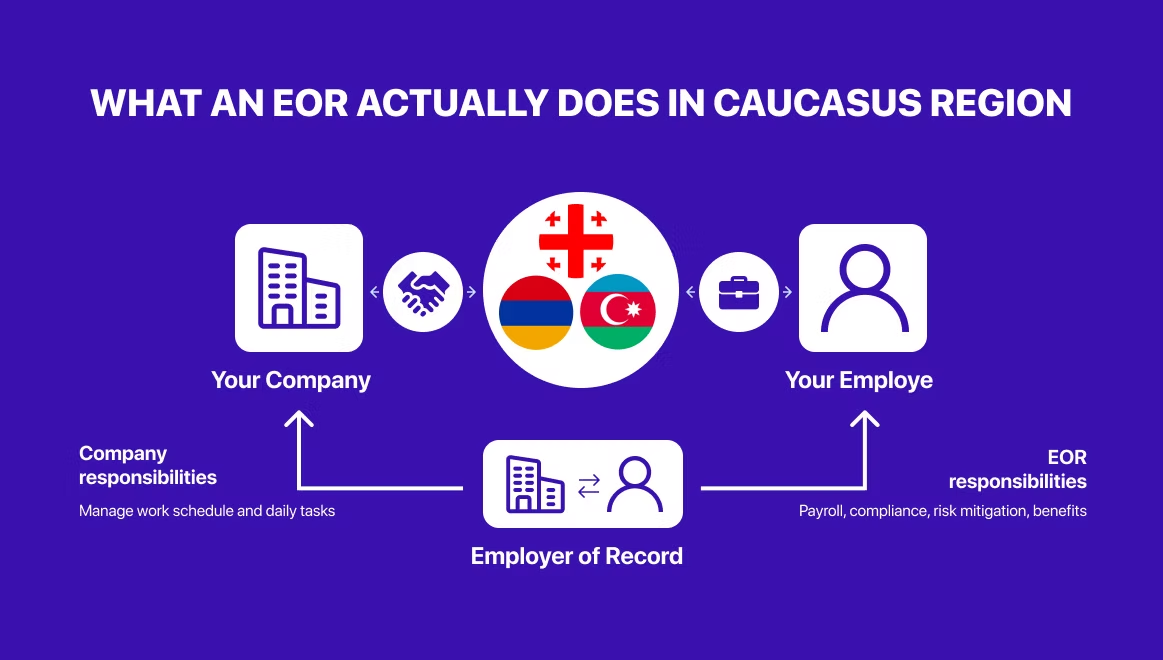
An Employer of Record offers a faster way to hire without establishing your own company locally.
The EOR already operates a compliant entity in the target country. That entity becomes the legal employer for your hire.
Your company still manages the employee’s work.
The EOR manages the legal and administrative framework.
How the EOR Model Works
When hiring through an EOR, the provider becomes the official employer on paper.
They handle all regulatory responsibilities required by local law.
Typical EOR responsibilities:
| Area | Responsibility |
| Work permit sponsorship | EOR |
| Employment contracts | EOR |
| Payroll and salary payments | EOR |
| Tax withholding and filings | EOR |
| Social contributions | EOR |
| Compliance with labor laws | EOR |
Your company still controls the operational side.
You assign tasks. You manage performance. You integrate the employee into your team.
Example: Hiring Through an EOR
Imagine your company hires a developer in Tbilisi.
If you use an EOR such as Team Up, their Georgian entity becomes the legal employer.
Team Up:
- Sponsors the visa
- Issues with the employment contract
- Runs payroll
- Handles taxes and compliance
Your company simply manages the employee’s day-to-day work.
Benefits of the EOR Model
The biggest advantage of EOR is speed.
You do not need to create a local entity before hiring.
Advantages of using an EOR
- No entity setup required
- Faster hiring timelines
- Built-in local compliance expertise
- Reduced legal risk
- Scalable hiring across multiple countries
Companies can often hire in days or weeks instead of months.
Trade-Offs
The EOR model does come with some limitations.
Typical considerations
| Factor | Description |
| Service fees | Monthly cost per employee |
| Legal employer | Employee is technically on the EOR payroll |
| Contract control | Some legal processes handled by the EOR |
However, experienced EOR providers structure the arrangement so the employee experience remains seamless.
Direct Sponsorship vs EOR. Quick Comparison
| Factor | Direct Sponsorship | Employer of Record |
| Local entity required | Yes | No |
| Setup time | Months | Days or weeks |
| Payroll management | Internal | EOR |
| Visa sponsorship | Internal | EOR |
| Compliance responsibility | Your company | EOR |
| Upfront cost | High | Low |
When to Choose Each Model
Use the following rule of thumb when deciding.
Choose Direct Sponsorship if
- You are building a long-term regional operation
- You plan to hire large teams
- You have the resources for entity setup and compliance
How EOR Services Simplify Visa Sponsorship in the Caucasus
Using an Employer of Record (EOR) in the Caucasus is often the fastest way to hire. Instead of navigating work permits, labor regulations, and payroll systems yourself, the EOR manages these processes behind the scenes.
You focus on choosing the right talent. The EOR handles the legal and administrative framework that allows the employee to work legally in Georgia, Armenia, or Azerbaijan.
Below is how the model works in practice.
Local Entity Already in Place
An EOR already operates a legally registered company in the target country. This removes the need for your company to establish a local entity before hiring.
For example, if you hire in Armenia through an EOR such as Team Up, their Armenian subsidiary becomes the official employer.
What This Means for Your Company
Without an EOR
- Register a local company
- Open bank accounts
- Register for payroll taxes
- Establish HR infrastructure
With an EOR
- Sign a service agreement
- Choose the candidate
- Begin onboarding immediately
The hiring process starts with the employee, not the company setup.
Work Permit and Visa Sponsorship
The EOR becomes the legal sponsor for the employee.
They submit the work permit application through their entity and manage all interactions with immigration authorities.
Visa Sponsorship Tasks Handled by the EOR
| Task | Responsibility |
| Work permit application | EOR |
| Labor market test postings | EOR |
| Immigration filings | EOR |
| Residence permit processing | EOR |
| Communication with authorities | EOR |
Even though the EOR appears on official paperwork, the employee performs work for your organisation.
The end result remains the same. The employee receives full legal authorization to work.
Compliance With Local Labor Laws
Labor regulations differ significantly across the Caucasus.
An EOR ensures employment remains compliant with local legislation.
Compliance Areas Managed by the EOR
| Area | Description |
| Employment contracts | Locally compliant bilingual contracts |
| Salary regulations | Minimum salary thresholds where applicable |
| Tax registration | Employee tax filings |
| Pension contributions | Social security registration |
| Employment protections | Overtime, termination, and leave compliance |
This eliminates the need for your company to become an expert in Georgian, Armenian, or Azerbaijani labour law.
Payroll and HR Administration
The EOR handles the operational side of employment once the employee is onboarded.
Payroll Responsibilities
| Payroll Function | Managed By |
| Salary payments | EOR |
| Local currency transfers | EOR |
| Income tax withholding | EOR |
| Pension contributions | EOR |
| Payslip generation | EOR |
The employee receives a salary through a local payroll system with proper tax deductions.
Your company simply funds the payroll through the EOR.
HR Administration
The EOR can also manage:
- Expense reimbursements
- Leave tracking
- Local HR documentation
- Benefits administration where required
This removes the need to build internal HR operations in the country.
One Invoice Instead of Multiple Payments
Hiring directly often involves multiple financial obligations.
Companies must manage:
- Employee salary payments
- Tax payments to government agencies
- Pension contributions
- Currency exchange transfers
An EOR simplifies this process.
Billing Structure
| Payment Type | How It Works |
| Employee salary | Included in EOR invoice |
| Employer taxes | Included in the invoice |
| Social contributions | Included in the invoice |
| Service fee | Included in the invoice |
Your finance team pays one monthly invoice.
The EOR distributes payments to employees and government authorities.
Faster Hiring and Onboarding
Because the EOR already understands the process and maintains a compliant entity, onboarding happens faster.
Typical Timeline Comparison
| Hiring Step | Direct Entity Setup | With EOR |
| Entity registration | 1–3 months | Not required |
| Work permit preparation | Internal process | Managed by EOR |
| Payroll setup | Internal setup | Already established |
| Employee onboarding | Months | Weeks or days |
Some EOR providers even evaluate candidates before hiring to confirm they meet work permit criteria.
This prevents unexpected immigration issues after the offer stage.
Ongoing Immigration and Compliance Support
Visa sponsorship does not end after approval.
Work permits must be renewed. Regulations may change. Employees may need additional immigration support.
An EOR manages these ongoing responsibilities.
Lifecycle Support Provided by the EOR
- Work permit renewals
- Residence permit extensions
- Immigration compliance monitoring
- Regulatory updates
- Employee offboarding
- Notification of authorities when employment ends
If regulations change, the EOR adjusts processes to maintain compliance.
Why Team Up Is the Best Regional EOR Partner in the Caucasus
Choosing the right Employer of Record partner matters. Especially in a region where immigration rules, payroll regulations, and labor laws can change quickly.
Team Up focuses specifically on the Caucasus region. Georgia, Armenia, and Azerbaijan. That regional focus allows us to deliver faster hiring, stronger compliance, and lower operational friction for companies expanding into these markets.
Below are the core reasons companies choose Team Up as their EOR partner.
Local-First Expertise
Team Up operates directly in the Caucasus.
Our team works daily with the systems and authorities that regulate employment and immigration in the region.
That includes:
- Georgian Revenue Service procedures
- Armenia’s workpermit.am platform
- Azerbaijan’s migration and employment approval processes
Because we operate locally, we stay aware of regulatory changes as they happen.
What This Means for Clients
- Immediate awareness of regulatory updates
- Faster navigation of government systems
- Reduced risk of missed compliance changes
If a new rule affects foreign hiring in Georgia or Armenia, we identify it quickly and adjust the process.
Compliance That Is Actually Executed
Many EOR providers talk about compliance. Team Up builds its service around it.
Every step of employment and immigration is handled according to local legal requirements.
Compliance Checklist Managed by Team Up
- Employment contracts drafted in English and the local language
- Contracts reviewed by local legal counsel
- Payroll taxes filed on time
- Social contributions registered correctly
- Immigration documentation submitted in the correct sequence
If a filing must happen on the 15th of the month, it happens on the 15th.
This structured approach prevents the small administrative mistakes that can create larger legal issues.
Transparent Flat Pricing
Team Up uses a simple pricing structure.
EOR services start at €199 per employee per month.
This fee includes the core compliance and employment services required to legally employ someone in the region.
What the Fee Covers
| Service | Included |
| Employment contract | Yes |
| Payroll processing | Yes |
| Tax filings | Yes |
| Social contributions | Yes |
| Immigration coordination | Yes |
| HR compliance support | Yes |
Many global EOR platforms charge $599 or more per employee per month for similar markets.
Because Team Up focuses on the Caucasus, we eliminate unnecessary platform markups and keep pricing accessible for startups and growing companies.
Speed and Responsiveness
Regional specialization allows Team Up to move quickly.
Instead of navigating multiple internal layers across dozens of countries, our team focuses on the Caucasus.
What Clients Experience
- Faster onboarding timelines
- Direct communication with account managers
- Immediate support when regulations change
When Georgia introduced new labor permit requirements, Team Up provided updated hiring procedures to clients immediately.
That level of responsiveness prevents disruption to hiring plans.
Complete HR Support
Team Up does more than process visas and payroll.
We support the full employment lifecycle for remote teams.
Additional HR Services
| Service | Support Provided |
| Health insurance | Local coverage options |
| Equipment setup | Laptop and office equipment solutions |
| Workspace access | Coworking arrangements |
| HR administration | Leave tracking and documentation |
| Employee onboarding | Local employment setup |
This allows companies to manage remote teams without building their own HR infrastructure in each country.
Proven Experience in the Caucasus
Team Up has supported hiring across the region for years.
Our clients range from early-stage startups to global technology companies expanding into Eastern Europe and Central Asia.
We have successfully managed:
- Large remote team deployments
- Complex immigration cases
- Rapid hiring timelines
- Government compliance reviews
Companies trust Team Up with one of their most important assets. Their people.
Our experience helps prevent common expansion mistakes and allows organizations to focus on growth rather than administrative challenges.

Conclusion
Hiring international talent in the Caucasus offers a clear opportunity. Georgia, Armenia, and Azerbaijan have strong technical talent pools and growing ecosystems for global companies. At the same time, each country operates under its own immigration rules, employment laws, and sponsorship requirements.
Companies entering the region must decide how they want to manage those responsibilities. Direct sponsorship through a local entity provides full operational control but requires significant investment in infrastructure, legal support, and compliance management. For organizations planning large-scale, long-term operations, that investment can make sense.
That is where Team Up delivers the most value. With deep regional expertise, transparent pricing, and a strong compliance framework, Team Up allows companies to access the talent markets of Tbilisi, Yerevan, and Baku without navigating the regulatory complexity alone.
Hiring in the Caucasus can unlock amazing talent for your company, as long as you respect the process. Stick to the steps, mind the details (or let us mind them for you), and you’ll build your distributed team legally and confidently. Good luck, or as we say locally – წარმატებები (Georgia), հաջողություն (Armenia), and uğurlar (Azerbaijan)!
FAQ
1. What is "Employer Sponsorship" in the Caucasus context?
In 2026, sponsorship is the legal obligation of a local company to vouch for a foreign national’s work status. It is no longer a passive process. The employer must initiate the application, prove the business need, and act as the guarantor for the employee's tax and migration compliance. Without an employer's digital filing, a foreigner cannot obtain a work-based residence permit in any of the three countries.
2. Can I still hire foreigners under "Visa-Free" rules?
No. In Georgia, the "1-year visa-free gap" that allowed foreigners to work without a permit was officially closed on March 1, 2026. Similarly, Armenia and Azerbaijan now require an electronic work permit as a prerequisite for any long-term labor activity, regardless of the individual’s nationality.
3. What is the mandatory "Labor Market Test"?
Before you can sponsor a foreigner, you must prove you tried to hire locally.
- Georgia: You must post the vacancy on worknet.moh.gov.ge for 10 business days.
- Azerbaijan: You must advertise through the State Employment Agency.
- Armenia: While the 2026 reforms have simplified some areas, employers still use workpermit.am to notify the government of the vacancy.
4. What are the 2026 sponsorship fees?
Costs vary based on the country and processing speed:
- Georgia: Standard permit costs 200 GEL (~$75 USD), while expedited 10-day processing is 400 GEL.
- Armenia: The combined state fee for work and residence permits is 105,000 AMD (~$270 USD).
- Azerbaijan: Fees depend on duration; a 1-year permit typically costs around 1,000–1,200 AZN (~$580–$700 USD).
5. What is the "50,000 GEL Turnover Rule" in Georgia?
A critical 2026 compliance pillar in Georgia is the turnover threshold. To sponsor a Work Residence Permit, the employing company must show an annual turnover of at least 50,000 GEL (~$18,500 USD) for each foreign employee sponsored. This prevents shell companies from being used for "ghost" sponsorships.
6. Are there exemptions for IT professionals?
Yes, the region is competing for tech talent. In Georgia, "International Company" status or a high-income threshold ($25,000/year) allows for 3-year work permits instead of the standard 1-year. In Armenia, many high-tech roles are exempt from the labor market test entirely.
7. Does an EAEU citizen (Russia, Belarus, etc.) need sponsorship?
In Armenia, citizens of the Eurasian Economic Union (EAEU) can work without a permit, but the employer must register their contract on the government portal to receive a "Certificate of Legality of Stay." In Georgia and Azerbaijan, these citizens are treated as standard foreign nationals and require full sponsorship.
8. What are the "Post-Hire" obligations for sponsors?
Sponsorship does not end at hiring. In 2026, employers must:
- Notify termination: Report an employee’s departure within 5–15 days (varies by country) or face hefty fines.
- Maintain Health Insurance: Employers in Georgia and Azerbaijan are now legally required to ensure foreign staff have valid local medical coverage.
9. What are the fines for "Illegal Entrusting" of work?
Fines have increased across the region in 2026:
- Georgia:2,000 GEL for the first offense, rising to 12,000 GEL for subsequent violations.
- Azerbaijan: Corporate fines can reach 35,000 AZN (~$20,000 USD).
- Armenia: Fines are tied to the minimum wage and can lead to a suspension of the company's right to hire foreigners.
10. Can I use an Employer of Record (EOR) to handle sponsorship?
Yes. Many firms use an EOR (like Papaya or Deel) that already has a local entity in the Caucasus. The EOR becomes the legal "sponsor" on paper, managing the digital portals, social security contributions, and work permit renewals so the foreign company doesn't have to set up a local branch.
.svg)


