What is Employer Sponsorship in Azerbaijan And How Does It Work?
TL;DR
The geopolitical and economic landscape of the Republic of Azerbaijan has undergone a profound transformation, culminating in the 2026 legislative reforms that have redefined the relationship between the state, the employer, and the foreign worker.
At the heart of this transformation is a highly centralized and digitalized system of employer sponsorship, a mechanism designed to facilitate the influx of specialized global talent while strictly safeguarding the domestic labor market. As the nation pivots from an oil-dependent economy to a knowledge-based, diversified structure, the employer sponsorship framework has become the primary instrument for managing human capital and ensuring that international expertise aligns with national socio-economic priorities, particularly in the fields of high technology, renewable energy, and the reconstruction of liberated territories.
Quick Navigation:
- TL;DR
- Employer of Record (EOR) in Azerbaijan as a Market Entry Strategy
- The Strategic Philosophy of the 2026 Labor Migration Framework and Employment Sponsorship Policy
- Legislative Foundations and 2026 Structural Reforms for Visa Sponsorship for Employment
- The Mechanics of the Employment Sponsorship Process in Azerbaijan
- Financial Obligations and State Fees for Employment Sponsorship in Azerbaijan
- The Highly Skilled Migrant Programme (HSMP): An Alternative to Standard Employment Sponsorship
- Exemptions Under Article 64 of the Migration Code from Employment Sponsorship Requirements
- The Annual Quota System and Future Projections for Employment Visa Sponsorship
- Fiscal Realities: Payroll, Taxes, and Employer Load
- Compliance Monitoring and Penalties
- Conclusion: Strategic Recommendations for Employers Managing Employment Sponsorship
- Frequently Asked Questions
Employer of Record (EOR) in Azerbaijan as a Market Entry Strategy

For international companies that do not wish to establish a local legal entity, the Employer of Record (EOR) model has become a dominant entry strategy in Azerbaijan. An EOR provider acts as the official employer on behalf of the client, managing all local compliance, payroll, and, crucially, work permit sponsorship.
Operational Mechanism of an Azerbaijan EOR
In this setup, the Azerbaijan EOR hires the worker through their own Azerbaijani entity, handles the "market test" and SMS submission, and ensures that the employee is registered on the EMAS portal. The client company retains operational control over the employee's tasks while the EOR assumes all legal risks associated with labor law and tax compliance.
Top EOR Service Providers in 2026
The market for EOR services in the Caucasus is competitive, with several providers offering different levels of service and regional reach.
| Provider | Service Specialty | Pricing Model | Onboarding Speed |
| Team Up | Local Caucasus expertise | €199 / month flat rate | 3 - 7 Days |
| Deel | Global automation & UI | Variable / Monthly | 7 - 14 Days |
| Remote | SME-focused transparency | Flat Rate | 1 - 2 Weeks |
| Papaya Global | Large enterprise analytics | Custom / Enterprise | 2 - 4 Weeks |
| LTA | Legal and tax integration | On Demand | 1 - 3 Weeks |
Employer of Record in Azerbaijan is particularly useful for companies hiring "Highly Skilled Migrants" or technology specialists who qualify for exemptions in industrial parks, as the EOR's local legal team can navigate these specific niches much faster than an international HR department.

Employer sponsorship rules in 2026 and work permit basics in Azerbaijan

The Azerbaijani approach to employer sponsorship in 2026 is characterized by "regulated liberalism", a philosophy that balances the ease of doing business for high-value entities with rigorous oversight of labor migration quotas and local hiring mandates. This framework is not merely a bureaucratic process but a strategic alignment with the country's development goals.
The 2026 amendments to the Labor Code and the Migration Code have introduced a level of institutional maturity that requires sponsoring employers to demonstrate a genuine, verified need for foreign talent that cannot be met by the domestic workforce.
Underpinning this system is a total commitment to digitalization. The use of the ASAN signature (mobile electronic signature) and the integration of the State Migration Service (SMS) portals with the Ministry of Labour and Social Protection’s electronic systems (EMAS) have created a transparent, real-time ecosystem. For a sponsoring employer, this means that compliance is no longer a matter of periodic reporting but a continuous digital obligation where payroll, tax, and migration data are permanently synchronized.
The Role of the Sponsoring Employer: What Employment Sponsorship Means in Azerbaijan
In Azerbaijan, the employer, whether a legal entity, a branch of a foreign company, or an individual entrepreneur, acts as the legal guarantor for the foreign national. This sponsorship role carries heavy legal weight. The employer is responsible for initiating the work permit application, justifying the hire to the State Employment Service, paying all associated state fees, and ensuring that the employee adheres to the specific terms of their permit, including their job function and geographical location.
Sponsorship is essentially a three-way contract between the state, the company, and the individual. The state grants the right to work based on the company’s stability and the individual’s unique qualifications. If the employer fails to maintain its good standing, for instance, by falling behind on tax payments or social insurance contributions, the sponsorship can be revoked, leading to the immediate cancellation of the employee's work and residence permits.

2026 Structural Reforms for Visa Sponsorship for Employment in Azerbaijan
The legal basis for employer sponsorship is found in the interplay between the Migration Code of the Republic of Azerbaijan and the Labor Code. Significant amendments introduced as of January 16, 2026, have clarified the obligations of both parties and modernized the definition of labor relations to include modern forms of work and expanded social protections.
The 2026 Labor Code Amendments Affecting Employment Sponsorship and Work Permits
The latest amendments have addressed several critical areas that affect how employers manage sponsored talent. One of the most significant changes involves the recognition of workers whose ability to perform functions is restricted due to the provision of care to family members in need, such as spouses, parents, or children. This reflects a shift toward a more human-centric labor policy, even for foreign employees. Furthermore, the Code now explicitly applies to foreigners who conclude employment contracts with foreign legal entities but perform their labor functions within branches or representative offices operating in Azerbaijan—a group that was previously in a legal gray area.
Another key update clarifies the rights and obligations regarding business trips. Both employers and employees now have explicitly defined roles: the employer has the right to send employees on business trips within the limits of the Code, and the employee is obligated to comply, provided the trip aligns with the approved labor functions and is supported by state-approved expense norms. This ensures that sponsored workers cannot be exploited through excessive or unfunded travel requirements.
Integration with the Migration Code: How Visa Sponsorship for Employment Works
The Migration Code remains the primary document governing the entry and stay of foreigners. In 2026, the synergy between the Labor Code and the Migration Code is absolute; an employment contract can only be legally valid if a corresponding work permit is in place. The Code mandates that for most categories of foreign workers, a work permit (İş İcazəsi) is the prerequisite for obtaining a temporary residence permit (TRP) based on employment.
| Feature | Description in the 2026 Framework | Relevant Legislation |
| Sponsorship Required | Mandatory for all full-time foreign talent; contractors cannot apply for these visas. | Migration Code Art. 64 |
| Permit Linkage | Labor contract validity is tied strictly to the work permit duration. | Labor Code 2026 Amendments |
| Digital Oversight | Real-time monitoring via ASAN and EMAS portals. | E-Government Decree 2024 |
| Quota System | Annual limits set based on sectoral needs and domestic labor supply. | Cabinet of Ministers Dec. 99 |
| Local Hiring Ratios | Requirement to maintain specific ratios (often 4:1 or 80% local staff). | Migration Code Art. 45 |
How The Employment Sponsorship Process Goes in Azerbaijan
Sponsoring a foreign worker in Azerbaijan is an employer-led process that requires a sequence of approvals from multiple state bodies. In 2026, this process has been streamlined through the "one-stop shop" principle, but the burden of proof regarding the necessity of the hire remains high.
Step 1: Verification of Need and the Labor Market Test
Before an application can be submitted, the employer must demonstrate that they have made a good-faith effort to hire an Azerbaijani citizen. This involves advertising the vacancy through the State Employment Service and explaining why local candidates were not suitable. The government is particularly strict regarding common roles; for example, while a restaurant owner can sponsor a foreign "chef" or "cashier" if a genuine shortage is proven, applications for "waiters," "drivers," or "plumbers" are almost universally rejected on the grounds that these roles can and should be filled by the local workforce.
Step 2: Document Preparation and Authentication
The sponsoring employer must gather a comprehensive dossier. This includes notarized copies of the company's founding documents, tax identification, and charter. From the employee, the employer must obtain notarized and translated copies of professional qualifications (diplomas, certificates) and a history of work experience spanning at least the last five years. In the 2026 environment, all documents must be translated into Azerbaijani or English and authenticated (apostilled or notarized) according to international standards.
Step 3: The Mandatory Health Assessment
A critical component of the sponsorship is the health certificate. The employee must undergo a medical examination at an approved clinic in Azerbaijan to confirm they are not carriers of infectious diseases, specifically HIV, Hepatitis B, and Hepatitis C. The results are uploaded directly into the Migration Service's system. This requirement is non-negotiable and serves as a public health safeguard.
Step 4: Submission and SMS Review
The employer submits the package to the State Migration Service. The review process typically takes between 10 and 20 business days, depending on the urgency and the fees paid. During this time, the SMS may conduct on-site inspections of the employer's premises to verify the authenticity of the business and the necessity of the role.
Step 5: Visa Issuance and In-Country Finalization
If the employee is abroad, they apply for an entry visa at an Azerbaijani embassy or consulate based on the employer's invitation. Upon arrival, they have 15 days to register their place of stay with the SMS. The employer then finalizes the temporary residence permit (TRP), which acts as the physical card authorizing both stay and work.
| Processing Timeline Phase | Action Item | Typical Duration |
| Preparation | Role definition, local recruitment, and doc gathering. | 2 - 4 Weeks |
| Market Test | State Employment Agency review of vacancy. | 1 - 2 Weeks |
| SMS Submission | Processing of work permit application. | 10 - 20 Business Days |
| Visa Issuance | Consular processing for entry. | 1 - 2 Weeks |
| Finalization | TRP issuance and in-country registration. | 10 - 15 Business Days |
Financial Obligations and State Fees for Employment Sponsorship in Azerbaijan
Employer sponsorship in Azerbaijan is a significant financial commitment. The state fees are tiered based on the duration of the permit and the desired speed of processing. In all cases, the law stipulates that the employer, not the employee, is responsible for paying these fees.
Work Permit Fee Structure for Employment Visa Sponsorship
The fees for work permits are substantial and represent a revenue stream for the state as well as a deterrent against frivolous applications.
| Permit Duration | Standard (20 Days) | Fast-Track (15 Days) | Urgent (10 Days) |
| Up to 3 Months | 350 AZN | 500 AZN | 700 AZN |
| Up to 6 Months | 600 AZN | 700 AZN | 900 AZN |
| Up to 1 Year | 1,000 AZN | 1,200 AZN | 1,400 AZN |
Failure to pay the state fee within 30 days of the application's approval results in the automatic cancellation of the permit. Furthermore, the employer must account for the costs of notarization, translation, and the mandatory medical check, which can add several hundred dollars to the total sponsorship cost.
Temporary Residence Permit (TRP) Fees for Sponsored Employees
In addition to the work permit fee, the issuance and extension of the TRP involve separate costs. While the work permit authorizes the labor activity, the TRP is the document that allows the foreigner to live in the country.
| TRP Validity Period | Standard Fee (20 Days) | Fast-Track Fee (15 Days) |
| Up to 3 Months | 30 AZN | 40 AZN |
| Up to 6 Months | 60 AZN | 80 AZN |
| Up to 1 Year | 120 AZN | 160 AZN |
| 1 - 1.5 Years | 180 AZN | 240 AZN |
| Up to 2 Years | 240 AZN | 320 AZN |
The Highly Skilled Migrant Programme (HSMP): An Alternative to Standard Employment Sponsorship
A major innovation in the 2026 migration landscape is the full operationalization of the Highly Skilled Migrant Programme (HSMP). This program is designed to attract elite international talent by bypassing many of the traditional sponsorship hurdles.
Points-Based Assessment System
The HSMP utilizes a rigorous points-based system to evaluate candidates. To qualify for HSMP status, an applicant must score at least 70 out of 100 points based on criteria such as education, experience, and alignment with national economic goals.
| Criterion Category | Maximum Points | Evaluation Authority |
| Relevant Work Experience | 35 Points | Sector-specific Ministry |
| National Goal Alignment | 20 Points | Ministry of Economy |
| Education & Credentials | 15 Points | Ministry of Science and Ed |
| Financial/Income Proof | 15 Points | State Migration Service |
| Labor Market Contribution | 10 Points | Ministry of Labour |
| Language Proficiency | 5 Points | Ministry of Science and Ed |
Strategic Benefits for Employers and Workers
HSMP status offers several transformative advantages over standard sponsorship. Successful applicants receive a specialized status valid for up to five years, which can be renewed. Most importantly, HSMP holders are exempt from the requirement to obtain a separate work permit for any activity within their professional field. They are also exempt from the annual labor migration quotas, and their family members receive simplified processing for their own residence permits.
For employers, the HSMP provides access to a pre-vetted pool of international talent via a government-managed portal. This allows companies to identify and hire high-level specialists without having to prove the "market test" for each individual, as the individual's high-skilled status already serves as sufficient justification.
Exemptions Under Article 64 of the Migration Code from Employment Sponsorship Requirements
While the default requirement for foreign labor in Azerbaijan is a work permit, Article 64 of the Migration Code lists several categories of individuals who are exempt from this requirement. Understanding these exemptions is crucial for companies to avoid unnecessary bureaucratic costs.
Core Exemptions for Business and Leadership
- Permanent Residence Holders: Individuals who have lived in Azerbaijan long enough to secure permanent residency do not require a separate work permit.
- Business Owners and Entrepreneurs: Foreigners engaged in entrepreneurial activity are exempt. This specifically includes the heads of legal entities in Azerbaijan where at least 51% of the ownership is held by foreign persons.
- Diplomats and International Officials: Staff of foreign embassies, consulates, and international organizations are exempt by virtue of international agreements.
- Heads of Foreign Branches: The heads and deputy heads of branches or representative offices of foreign legal entities in Azerbaijan are exempt.
Sectoral and Institutional Exemptions
- Special Economic Zones: Employees in the Alat Free Economic Zone (AFEZ) and residents of industrial and technology parks (specifically ICT specialists) enjoy a streamlined exemption to encourage high-tech investment.
- Academics and Media: University lecturers, researchers, and accredited representatives of foreign media organizations do not requires work permits for their primary professional duties.
- Government Invitations: Specialists invited by the President or the Cabinet of Ministers for specific national projects, as well as military personnel invited for training or defense cooperation.
Family and Humanitarian Grounds
- Spouses of Citizens: Foreigners married to Azerbaijani citizens and registered at their place of residence are exempt from work permits.
- Refugees and Asylum Seekers: Individuals granted refugee status or political asylum, as well as victims of human trafficking, have the right to work without sponsorship.
- Guardians: Persons caring for Azerbaijani citizens who are minors or have severe disabilities (81–100% disability status) are exempt from work permits to facilitate their caregiving roles.
The Annual Quota System and Future Projections for Employment Visa Sponsorship
The Azerbaijani government manages the total volume of foreign labor through an annual quota system. This is a top-down mechanism where the Cabinet of Ministers, advised by the Ministry of Labour and Social Protection, sets the maximum number of work permits available for the following year.
The 2026 Quota Cycle
Employers are required to submit their projected foreign labor needs for 2026 by May 1, 2025. These reports are processed through the ASAN signature system, allowing the government to analyze demand trends across different sectors. For 2026, the government has signaled a priority for highly qualified specialists in renewable energy, mining, and large-scale construction, while showing a decreasing trend in quotas for general administrative or service roles.
Replacing Foreign Labor with National Reserves
A primary goal discussed in the 2024 and 2025 commission meetings is the gradual replacement of foreign skilled workers with local personnel. To this end, the state is investing in vocational training and higher education to ensure that the domestic labor market can meet the needs of a diversifying economy. Consequently, sponsoring employers are increasingly expected to have a "succession plan" or a knowledge-transfer mechanism in place when they hire foreign experts.
| Economic Sector | 2026 Quota Outlook | Rationale |
| ICT & Technology | High / Expanding | Focus on digital transformation and tech parks. |
| Renewable Energy | High / Expanding | New green energy projects and climate goals. |
| Construction (Liberated Areas) | High / Stable | Focus on the "Great Return" and reconstruction. |
| Oil & Gas | Stable / Decreasing | Mature sector; focus on localizing management. |
| General Service / Retail | Very Low | Sufficient local labor supply. |
Fiscal Realities: Payroll, Taxes, and Employer Load
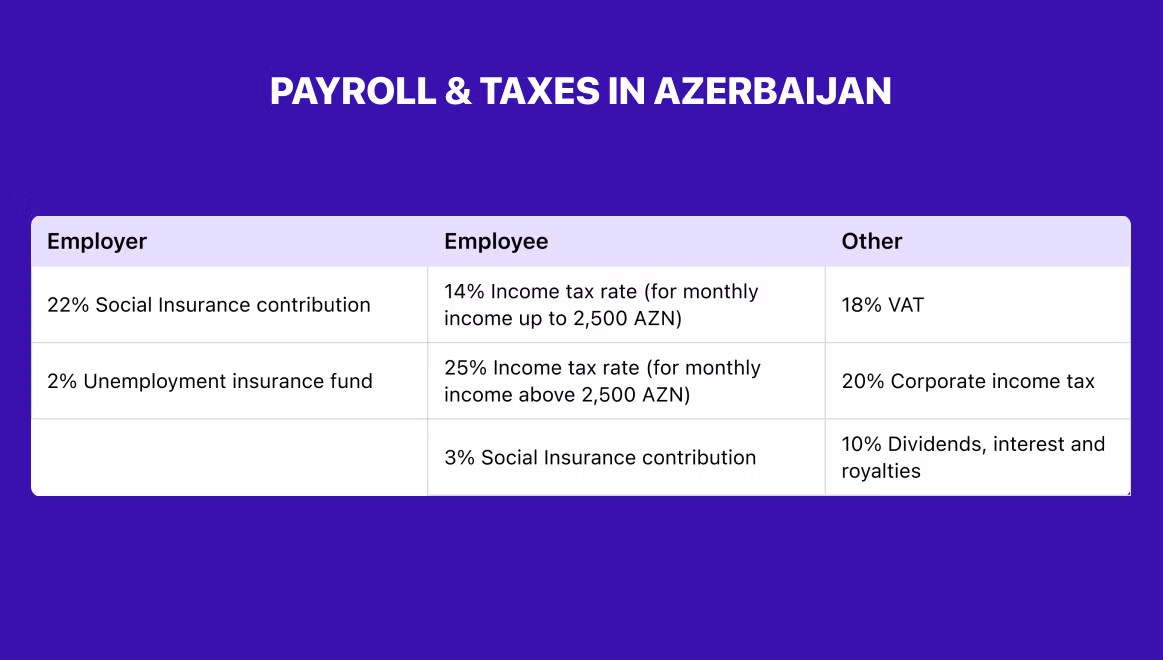
Sponsoring a worker in Azerbaijan involves more than just permit fees; it requires navigating a complex tax and social insurance system. In the non-oil sector, Azerbaijan offers attractive income tax rates, but the employer's social security burden remains a significant factor in total cost of employment (TCE) calculations.
Employer Social Contributions (DSMF)
For non-oil, non-state companies, the employer tax load is approximately 25% of the gross salary. This includes:
- Social Insurance (SSPF): Roughly 22% of the gross salary (up to a certain cap, after which it decreases).
- Unemployment Insurance: 0.5% paid by the employer and 0.5% by the employee.
- Mandatory Medical Insurance (ICHI): 2% paid by the employer.
Salary Benchmarks for 2026

The average monthly salary in Azerbaijan is projected to reach 1,170.8 AZN by 2026, a 9.1% increase from 2025 levels. When sponsoring foreign workers, employers must ensure that the salary offered is not only competitive but also sufficient to justify the hire to the Migration Service. For mid-level professionals, typical gross salaries in 2026 range significantly by role.
| Professional Role | Avg. Gross Salary (AZN) | Total Employer Cost (AZN) |
| Software Engineer | 3,200 | 3,940 |
| Product Manager | 4,000 | 4,920 |
| HR Manager | 3,500 | 4,305 |
| Marketing Specialist | 2,000 | 2,460 |
| Customer Support | 1,400 | 1,720 |
Compliance Monitoring and Penalties
The 2026 migration regime is backed by aggressive enforcement. The State Migration Service has expanded its powers to include on-site inspections and digital "raids" on offices to verify that all foreign nationals have the correct authorization.
The Danger of Non-Compliance
A common trap for employers is allowing foreign workers to perform labor on tourist or business e-visas. In Azerbaijan, an e-visa issued for "business" is only for attending meetings or conferences, not for performing day-to-day job functions. If a foreigner is caught working without a permit, the company faces a fine of up to 35,000 AZN (approximately 20,500 USD), and the individual is deported and potentially banned from future entry.
Reasons for Permit Revocation
Sponsorship is not a permanent right; it can be revoked at any time if the conditions are not met. The most common reasons for revocation in 2026 include:
- Late Extension Filing: Employers must apply for extensions at least 30 days before the permit expires. Failure to do so can lead to a gap in legal status.
- Unpaid State Fees: If the 1,000–1,400 AZN fee is not paid within 30 days of approval, the permit is canceled.
- Denial of TRP: If the Migration Service approves the work permit but subsequently denies the residence permit (often due to security or health concerns), the work permit is automatically revoked.
- Unauthorized Relocation: If an employee is sponsored for a role in Baku but is found working in Ganja without prior SMS approval, the permit is considered invalid.
Conclusion: Strategic Recommendations for Employers Managing Employment Sponsorship
Navigating the Azerbaijani employer sponsorship framework in 2026 requires a sophisticated understanding of both the legal requirements and the digital ecosystem. For organizations looking to succeed, the following strategies are essential:
- Prioritize the HSMP: For high-level technical or executive roles, the Highly Skilled Migrant Programme offers a much more efficient path with 5-year stability and quota exemptions. The investment in documenting high-level skills for the points-based test pays off in long-term compliance ease.
- Digitalize Early: All sponsoring entities must secure an ASAN signature and ensure their HR teams are proficient in the EMAS and SMS portals. The era of paper-based migration management is over.
- Respect the Market Test: Do not attempt to sponsor generalists or low-skilled workers unless operating in a specific shortage area approved by the state. The justification letter must be robust and supported by evidence of local recruitment efforts.
- Leverage Special Zones: If the business model allows, establishing operations in the Alat Free Economic Zone or a Technology Park provides substantial exemptions from work permit quotas and simplifies the path for foreign specialists.
- Utilize EORs for Speed: If a quick market entry is required, partnering with a regional EOR like Team Up can bypass the 3–7 week incorporation timeline and provide immediate, compliant sponsorship for initial hires.
In summary, employer sponsorship in Azerbaijan has evolved into a high-stakes, digital-first system that rewards transparency and strategic alignment with national goals while severely punishing those who attempt to bypass the formal work authorization process. For the professional peer, the key to success lies in viewing sponsorship not as a task, but as a comprehensive compliance partnership with the Azerbaijani state.
Frequently Asked Questions
1. What is an Employer of Record (EOR) in Azerbaijan?
An Employer of Record (EOR) is a local service provider that legally employs staff on your behalf. While the employee works for you daily, the EOR handles all Azerbaijani legal obligations, including:
- Registering the employment contract in the MAS (Məşğulluq Alt Sistemi) portal.
- Running payroll in Azerbaijani Manat (AZN).
- Withholding and paying taxes and social security.
- Ensuring compliance with the Labor Code of Azerbaijan.
2. Can I hire employees in Azerbaijan without opening a company?
Yes. This is the primary purpose of an EOR. Normally, hiring requires a local legal entity, a local bank account, and a tax ID (VÖEN). An EOR allows you to bypass this month-long setup process, letting you hire and onboard talent in as little as 2–5 business days.
3. Does an EOR in Azerbaijan handle work permit sponsorship?
Yes. Most EORs in 2026 provide "Immigration-as-a-Service." They act as the corporate sponsor for the Work Permit and Temporary Residence Permit (TRP).
Note: The EOR will typically handle the mandatory Labor Market Test (proving no local can fill the role) and the required medical checkups for the employee.
4. How much does it cost to employ someone in Azerbaijan?
Beyond the gross salary, you should budget for the following (2026 estimates):
- Employer Statutory Contributions: Approximately 22.5% – 24.5% of the gross salary.
- EOR Management Fee: Typically a flat fee ranging from $399 to $800 USD per month, per employee.
- Minimum Wage: As of 2026, the national minimum wage is 400 AZN per month.
5. What are employer payroll taxes in Azerbaijan?
For most private-sector (non-oil/gas) companies in 2026, the employer's tax burden includes:
- Social Insurance (SSPF): 22% (on the portion of salary up to 200 AZN) plus 15% (on the portion above 200 AZN).
- Unemployment Insurance: 0.5%.
- Mandatory Health Insurance: 2% (on the portion up to 8,000 AZN).
6. What is the difference between EOR, PEO, and Contractor of Record?
| Feature | Employer of Record (EOR) | Professional Employer Org (PEO) | Contractor of Record |
| Local Entity | Not required for you. | Required (Co-employment). | Not required. |
| Legal Liability | Rests with the EOR. | Shared between you and PEO. | Minimal (Civil contract). |
| Best For | Full-time staff (No entity). | Existing local branches. | Short-term/Freelance. |
| Compliance | High (Labor Code). | High (Labor Code). | Risk of misclassification. |
7. Are foreign workers allowed to work on a business e-visa?
Strictly No. In 2026, the State Migration Service is highly active in auditing offices.
- Business e-Visas: Are for meetings, conferences, and negotiations only.
- The Risk: Working on a business visa can result in the company being fined 30,000 – 35,000 AZN (~$20k USD) and the employee being deported and banned from Azerbaijan. All work must be done under a Labor Visa (Type D) and a valid Work Permit.
.svg)