Nearshoring to Turkey 2025: the complete guide for businesses
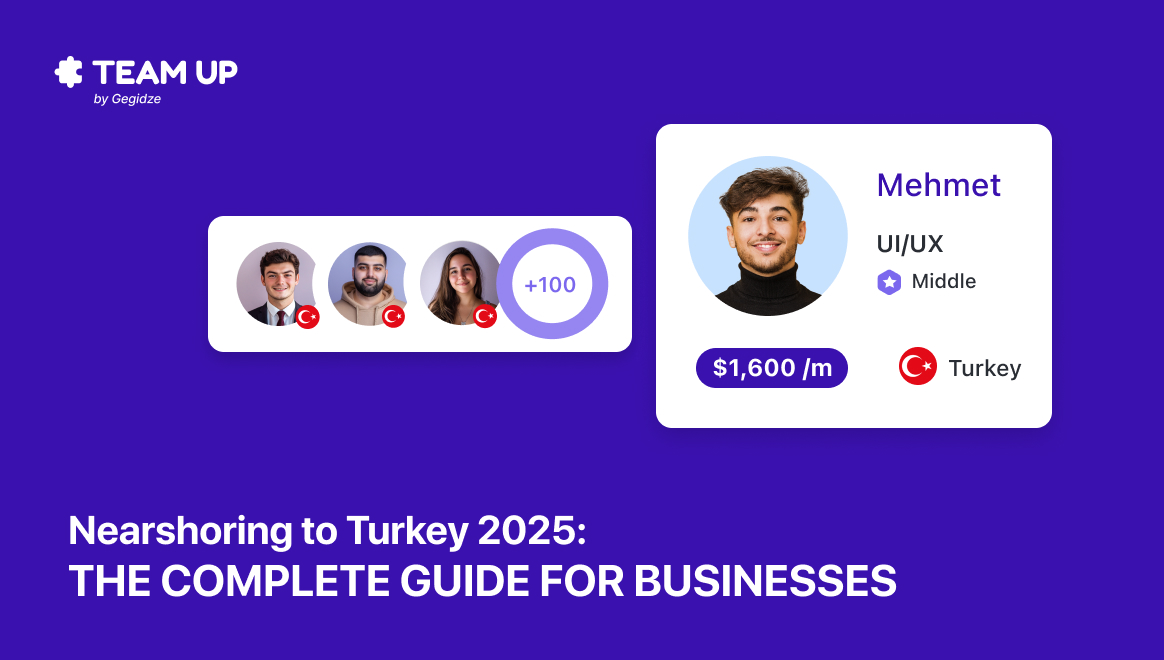
Table of Contents (Top 10 Most Important H2s)
- Why nearshoring to Turkey is gaining traction in 2025
- What is nearshoring and why it works for EU/UK teams
- What the talent pool in Turkey looks like
- Key benefits of nearshoring to Turkey
- What nearshoring to Turkey actually costs
- Nearshoring to Turkey vs setting up a local entity
- Legal compliance in Turkey
- What kind of benefits can you offer through a nearshoring partner?
- How to onboard and manage a nearshored team in Turkey
- What to look for in nearshoring companies in Turkey
Why nearshoring to Turkey Is gaining traction in 2025
Everyone's looking east. But the smartest teams? They're looking just far enough to Turkey.
In 2025, Turkey is no longer the backup plan. It's the main strategy for EU and UK businesses that need affordable, skilled talent without sacrificing time zone, culture fit, or operational speed.
Here’s why nearshoring to Turkey isn’t just trending anymore, it’s taking over:
- It’s close. Istanbul is a three-hour flight from Berlin, and business hours fully overlap with most of Europe and MENA.
- It’s fluent. English proficiency is rising, especially among younger professionals in Istanbul, Ankara, and Izmir.
- It’s cost-efficient. Salaries for roles like software development, product design, and customer support are 40–60% lower than in Western Europe.
- It’s scalable. The talent pool is deep, especially in tech, finance, and digital ops, and it’s growing fast.
Talent in Turkey is underrated, but not for long
Startups and scale-ups are quietly building distributed teams in Turkey. Why? Because it delivers:
- Strong STEM education and a pipeline of tech talent
- A westernized business culture used to working with global teams
- Time-tested experience in BPO, fintech, logistics, and e-commerce ops
- Faster hiring than in oversaturated hubs like Poland or the Baltics
Cost pressures are forcing a rethink
Hiring in Poland? Salaries have jumped 25% since 2020.
Setting up in Romania? Prepare for months of paperwork and legal delays.
Outsourcing to India? Time zones clash, and talent churn is high.
Turkey solves for all of that: affordable, well-aligned, and legally straightforward when you go through the right partner.

What is nearshoring and why it works for EU/UK teams
You don’t need a local office in every country to build a global team.
You just need to be close enough in hours, culture, and compliance.
That’s what nearshoring does.
Nearshoring means hiring talent in nearby countries, typically within a 1–3 hour time difference, to get the benefits of global hiring without the headaches of long-distance outsourcing.
Here’s why EU/UK companies love it:
- Time zone overlap: Real-time collaboration across product, support, and ops
- Faster onboarding: No visa headaches or relocation drama
- Cultural alignment: Shared business values and communication norms
- Lower total cost of employment: Especially when hiring outside the EU
Why nearshoring to Turkey hits the sweet spot
For companies in Germany, the Netherlands, the UK, or the Nordics, Turkey offers the ideal nearshore blend:
- GMT+3 time zone, full overlap with CET, and only two hours ahead of London
- A huge pool of remote-ready tech and design talent
- Significantly lower salaries than Eastern Europe or the Baltics
- Strong English fluency in major cities (Istanbul, Ankara, Izmir)
You’re not sacrificing quality, you’re skipping red tape and unlocking a talent market that’s still overlooked by slower competitors.
What the talent pool in Turkey looks like
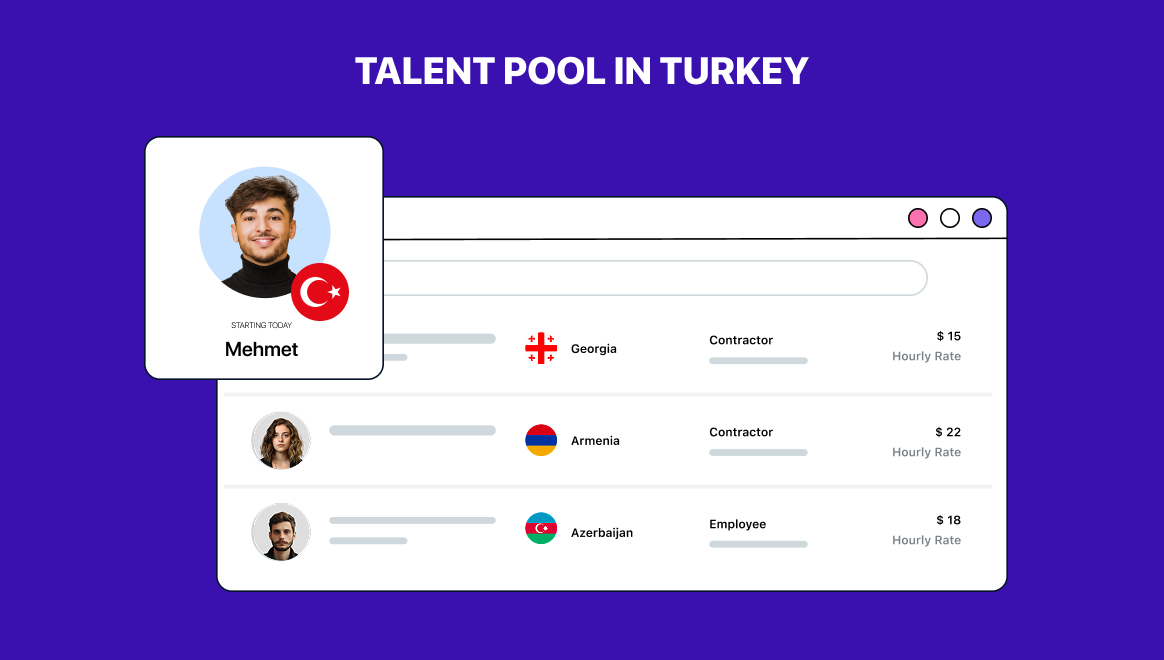
You don’t nearshore for the scenery.
You nearshore for the people and in Turkey, the talent speaks for itself.
It’s not just quantity. It’s quality.
With over 900,000 STEM graduates annually and an education system increasingly aligned with global tech standards, Turkey’s workforce is young, skilled, and ready.
In 2025, here’s what that looks like:
- Software Developers: From mobile to full-stack, Turkish engineers are building for companies across Europe and MENA.
- Product Designers: Istanbul and Ankara are quietly becoming Figma-native hubs.
- DevOps & Cloud Engineers: Highly sought-after for EU compliance, CI/CD, and Kubernetes fluency.
- Customer Support: EU-hour coverage, fluent English, and service experience in SaaS, fintech, and ecommerce.
- Digital Marketing & Growth: Cost-effective hires with experience in international campaign management.
Language skills? Handled.
You’ll find strong English proficiency, especially in Istanbul, Izmir, and Ankara with many professionals having studied or worked abroad. And it’s not just speaking, it’s business-ready communication, documentation, and async workflows.
What makes Turkish talent unique?
- Remote-first culture: Turkey adopted hybrid work early. Most candidates are used to distributed teams and cross-border collaboration.
- Work ethic: There’s a strong local culture of ownership, urgency, and accountability — especially in high-performance teams.
- Availability: Unlike in saturated EU markets, the competition for top-tier talent isn’t as fierce yet, but that’s changing fast.
What you’re really paying for
Talent in Turkey brings senior-level skills at mid-level cost. You’re not hiring juniors to save cash. You’re hiring top performers at a fraction of what you’d pay in Berlin, Paris, or Amsterdam.
Key benefits of nearshoring to Turkey
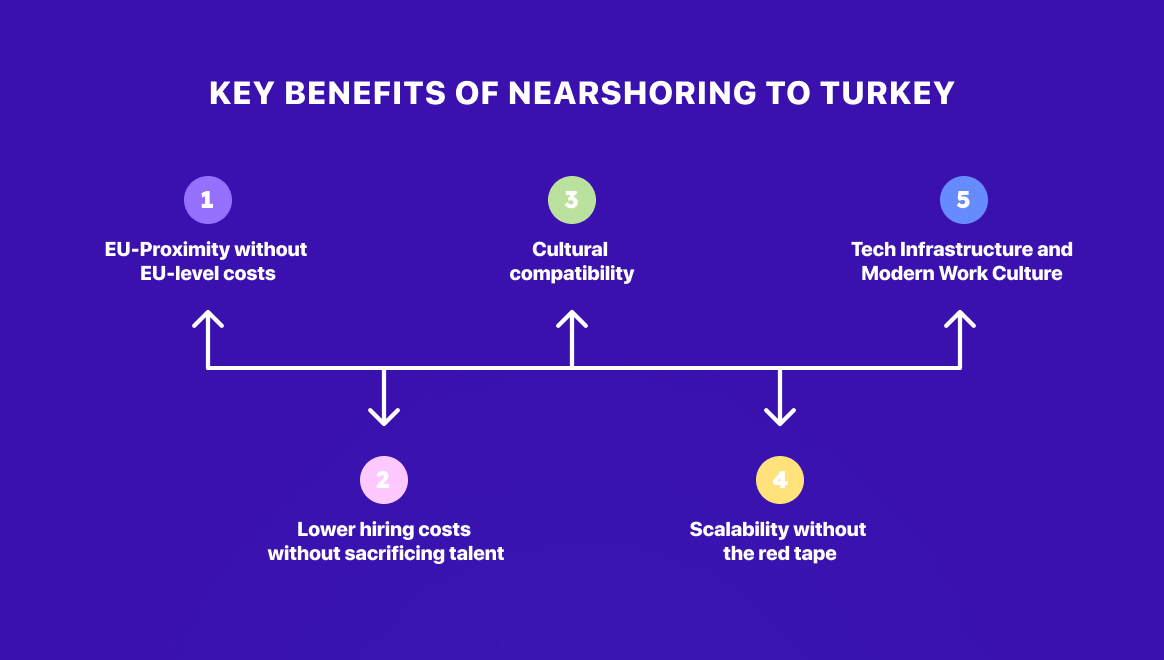
Nearshoring to Turkey isn’t only a workaround, it’s a business advantage.
Because when the pressure is on to reduce costs without compromising on quality or delivery speed, Turkey checks every box.
1. EU-proximity without EU-level costs
Turkey sits just outside the EU, but it feels like it's right next door:
- Time zone alignment: Full workday overlap with Central Europe
- Flight times: 2–4 hours from Berlin, Paris, London
- Response time: No delays due to time differences. Work gets done in real-time
But the key difference is… you’re not paying € 65 K+ for a mid-level engineer.
2. Lower hiring costs without sacrificing talent
A senior software developer in Istanbul typically earns €2,500–€3,200/month.
That’s up to 60% less than in most EU markets with no drop in output, communication, or ownership.
Whether you’re hiring for tech, design, support, or operations, the economics are hard to ignore.
3. Cultural compatibility
Turkey bridges Europe and the Middle East literally and culturally. You’ll find:
- Direct communication style
- High adaptability to Western management structures
- Strong remote work culture post-2020
Teams in Turkey don’t just follow instructions; they take initiative, raise red flags, and move fast when it counts.
4. Scalability without the red tape
With the right Employer of Record (EOR) in place, you can:
- Hire in under 10 days
- Skip the local entity setup
- Stay fully compliant with Turkish labor and tax law
No lawyers. No notaries. No six-month wait.
5. Tech infrastructure and modern work culture
Turkey’s startup and tech scene is booming, backed by:
- Fast, reliable internet (even outside major cities)
- Coworking spaces in Istanbul, Ankara, and Izmir
- Candidates with experience at international companies and remote-first orgs
Turkey doesn’t feel like a frontier market; it feels like a ready-made hub.
What nearshoring to Turkey actually costs
You’re not just comparing salaries. You’re calculating the total cost of doing it right without legal gaps, missed filings, or wasted time.
Let’s break down what nearshoring to Turkey really costs in 2025.
1. Real monthly salaries in Turkey (2025)
Salaries in Turkey are significantly lower than Western Europe while still offering top-tier talent across tech, design, and ops.
| Role | Western Europe | Turkey |
| Software Developer | €5,000–€6,000 | €2,800–€3,200 |
| QA Engineer | €4,000–€5,000 | €2,000–€2,500 |
| DevOps Engineer | €5,500–€6,500 | €3,200–€3,500 |
| UI/UX Designer | €4,500–€5,500 | €2,200–€2,800 |
| Project Manager | €5,000–€6,000 | €2,400–€2,900 |
| Customer Support Lead | €3,200–€4,000 | €1,600–€2,000 |
You’re looking at 40–60% lower salary costs, without compromising on quality or timezone alignment.
2. Total monthly cost per employee (Via EOR)
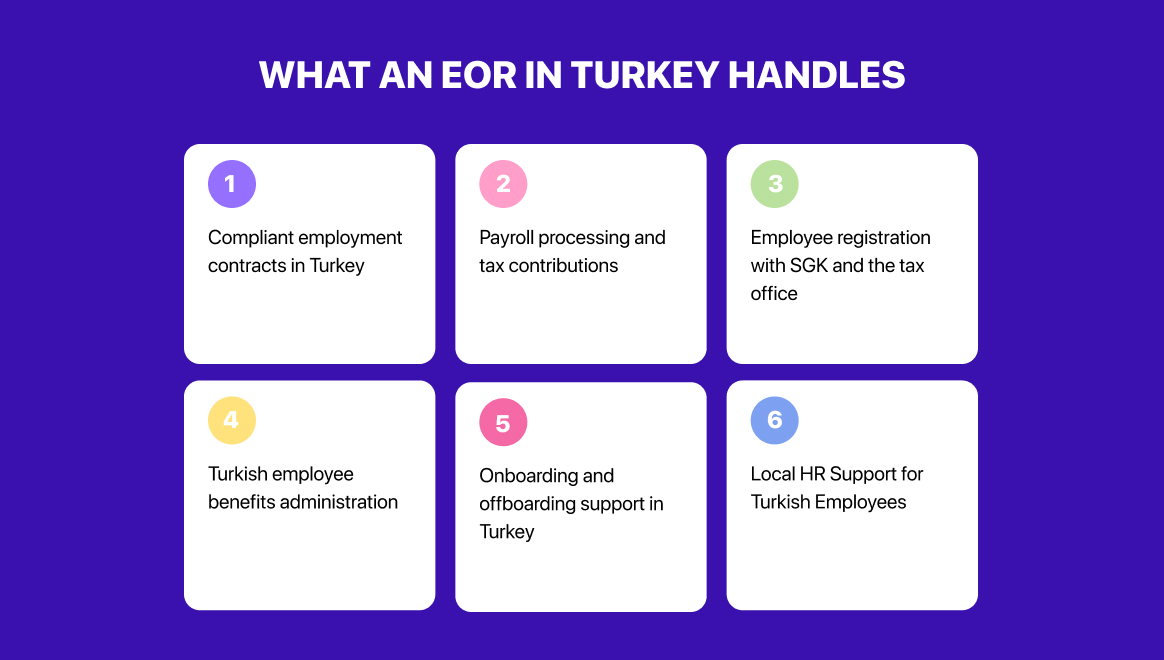
Hiring through Team Up’s Employer of Record (EOR) in Turkey means one flat rate and one monthly invoice.
Here’s how it breaks down:
Example: DevOps Engineer in Istanbul
- Gross Salary: €3,200
- Employer Contributions (~22.5%): €720
- TeamUp EOR Fee (flat): €299
→ Total Monthly Cost: €4,219
This includes:
- Fully compliant employment
- Payroll and tax filings
- Local registration (SGK, tax authority)
- Benefits management
- HR support and documentation
No setup. No overhead. No legal risk.
3. Employer contributions in Turkey (2025)
Turkish law requires employers to pay approximately 22.5% on top of the gross salary. That covers:
- Social Security (SGK): ~20.5%
- Unemployment Insurance: 2%
- Stamp Tax: ~0.75%
All calculated, filed, and paid by Team Up, no spreadsheets needed.
4. What the €299 EOR fee covers
No surprises. No add-ons. Just one monthly fee for full coverage.
- Legal contracts in Turkish
- Monthly payroll and tax filings
- SGK registration and reporting
- Leave tracking and public holiday compliance
- HR support for your team in Turkish and English
- Onboarding, offboarding, and local lifecycle management
- Optional perks: coworking, stipends, private health coverage
This is more than payroll. It’s full legal employment infrastructure in Turkey, ready in under 10 days.
5. Annual hiring cost comparison (Turkey vs EU)
| Role | Western Europe (Annual) | Turkey (via TeamUp) |
| Software Developer | €75,000–€85,000 | ~€47,000 |
| DevOps Engineer | €80,000–€95,000 | ~€50,500 |
| QA Engineer | €65,000–€75,000 | ~€37,500 |
| Project Manager | €70,000–€80,000 | ~€43,000 |
| Customer Support | €50,000–€60,000 | ~€31,000 |
Even with employer tax and our fee, you’ll save 35–50% while staying 100% compliant.
6. Want a custom breakdown?
We’ll model the cost of hiring your team in Turkey role-by-role, fully transparent, no fluff.
Nearshoring to Turkey vs setting up a local entity
Hiring in Turkey sounds like a strategic move. But how you do it? That’s where most companies hit a wall.
You’ve got two paths:
- Build your own local entity and deal with the red tape.
- Or partner with a nearshore provider (like TeamUp) that already has the infrastructure in place.
Let’s break down the difference.
Entity setup in Turkey: what it actually takes
Opening a company in Turkey isn’t impossible. But it’s far from fast.
To establish a legal entity, you’ll need:
- A registered business address in Turkey
- A Turkish bank account
- A local tax number
- Notarized Articles of Association
- A Turkish accountant and legal representative
- Minimum capital injection
- Payroll, HR, and social security infrastructure
The process typically takes 6–12 weeks, and the upfront cost ranges from €5,000 to €15,000+, depending on your legal setup and advisors.
And once you’re live? You’re on the hook for:
- Local tax filings
- SGK registration and monthly reporting
- Drafting Turkish employment contracts
- Managing paid leave, holidays, and severance
- Tracking and complying with Turkish labor law
In short, you’re not just opening an office. You’re building a full HR and finance department in a new country.
Nearshoring via Team Up: A shortcut without shortcuts
If your goal is to hire legally in Turkey and get to work fast, nearshoring with TeamUp cuts out the complexity without cutting corners.
Here’s how it works:
- You choose the hire.
- We onboard them under our Turkish legal infrastructure.
- We issue compliant contracts in Turkish, register them with SGK, and handle payroll and benefits.
- You stay in control of the day-to-day work.
You skip:
- Entity formation
- Legal setup
- Banking
- Monthly filings
- Labor law headaches
And instead get:
- Local payroll and tax compliance
- Statutory benefits fully managed
- Optional perks (healthcare, coworking, stipends)
- One monthly invoice with no hidden fees
You can start in 7–10 days, not 2–3 months.
Comparison table of nearshoring to Turkey vs local entity setup
| Feature | Nearshoring to Turkey (TeamUp) | Your Own Local Entity |
| Time to hire | 7–10 days | 6–12 weeks |
| Setup cost | €0 | €5,000–€15,000+ |
| Legal employer | TeamUp | Your company |
| Payroll & tax filings | Included | Your responsibility |
| Contracts and documentation | Handled by TeamUp | Requires legal team |
| Local registrations (SGK, tax) | Fully managed | In-house burden |
| HR support for your team | Included | Build your own |
| Risk and liability | TeamUp assumes it | On you |
| Monthly cost control | One invoice | Multiple providers and costs |
Which approach Is right for your team?
Go with a local entity if:
- You’re building a 20+ person office in Turkey
- You want full local control and long-term investment
- You have internal HR and legal support
Choose nearshoring to Turkey with TeamUp if:
- You’re hiring 1–10 people and need to move fast
- You want legal employment with no setup overhead
- You need cost clarity and full compliance
- You’re testing the Turkish market before committing
Legal compliance in Turkey
Hiring in Turkey might look simple at first until you start dealing with tax codes, labor law, and Social Security filings in Turkish.
Here’s the reality: Turkey isn’t a back-office shortcut. It’s a serious hiring market with real legal expectations. And if you miss a form, misclassify a role, or mistime a payroll report, you’re exposed.
Let’s break down what compliance actually means when nearshoring to Turkey in 2025.
Turkish labor law: what you must get right
Turkey has a highly protective labor code. No matter the company size or industry, every employer is expected to follow local rules.
Here’s what needs to be built into every contract and enforced throughout the employment lifecycle:
- Employment contracts must be in Turkish Even if your hire is fluent in English, only Turkish-language contracts are legally enforceable.
- Standard working hours: 45 hours per week Overtime is allowed but must be tracked and paid separately unless compensated with time off.
- Notice periods Based on tenure, ranging from 2 to 8 weeks, unless extended in the employment agreement.
- Termination protections Turkey doesn’t support at-will employment. You must documentthe cause, provide written notice, and calculate severance when applicable.
- Paid annual leave Minimum of 14 working days (increases with years of service).
- Public holidays 15+ national holidays must be granted as paid days off.
Payroll, tax, and social contributions
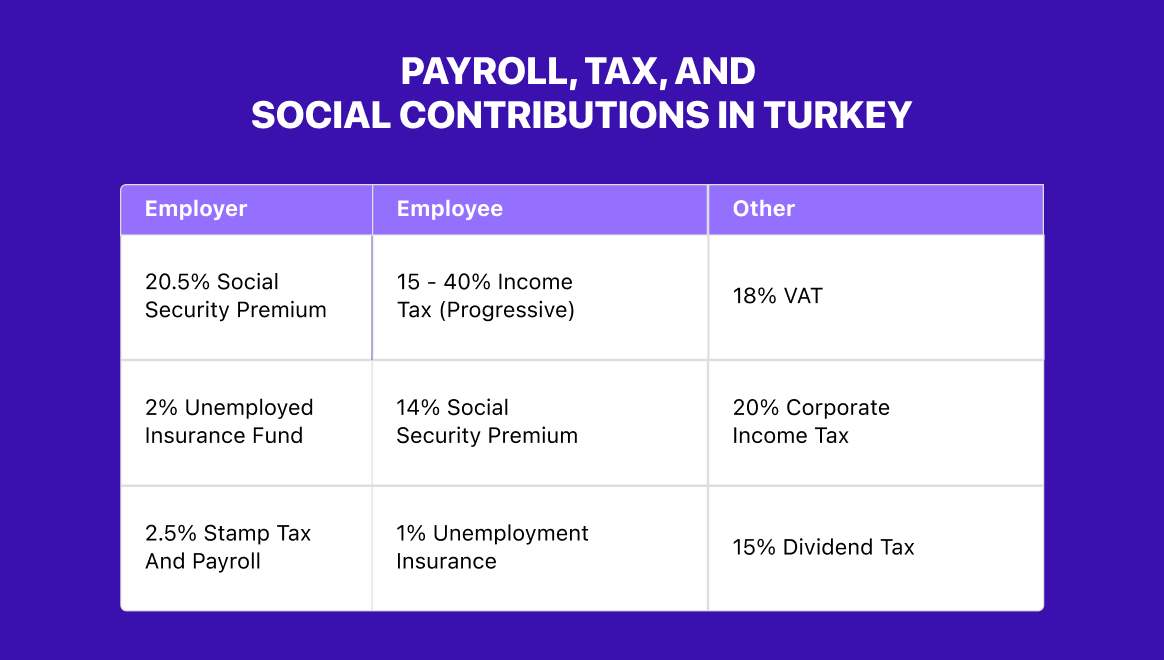
Paying an employee in Turkey isn’t just about transferring money. You’re legally required to withhold, contribute, file, and report every single month.
Here’s what that includes:
- Income tax Progressive rates from 15% to 40%, withheld at source by the employer.
- Employer contributions (~23%)
These are added on top of the gross salary and include:
- Social Security (SGK): ~20.5%
- Unemployment Insurance: 2%
- Stamp Tax: 0.759%
- Employee contributions Roughly 14% total, also withheld by the employer.
- SGK registration Both the employer and the employee must be registered with the Turkish Social Security Institution.
- Monthly filings Employers are expected to file reports and make payments to multiple government agencies on time or face penalties.
Remote ≠ exempt
Even if your team works from home, you still need to follow Turkey’s employment law. Labor inspectors can audit companies that violate notice rules, misclassify contractors, or fail to pay social contributions.
How Team Up keeps you fully compliant
Nearshoring to Turkey with Team Up means full compliance from day one without building internal HR, legal, or payroll teams.
Here’s how we keep you covered:
- We draft and issue Turkish employment contracts
- We register your team with the tax office and SGK
- We run monthly payroll in Turkish Lira
- We handle all withholding and employer contributions
- We calculate leave, notice, and severance
- We keep contracts updated with labor law changes
- We provide HR support in Turkish and English
You get full transparency. Your team gets full protection. And your company avoids legal exposure in a high-compliance market.
What kind of benefits can you offer through a nearshoring partner?
Let’s be clear: nearshoring to Turkey isn’t just only for saving money. It’s building real teams ones that feel supported, valued, and committed for the long run.
But the catch is: talent in Turkey knows what good employment looks like. If you want to compete for top developers, ops leads, or product talent, offering a legal salary isn’t enough.
Through a reliable nearshoring partner like Team Up, you can provide a full employee experience that rivals (and often exceeds) what big local employers offer without building in-house HR or navigating Turkish labor law alone.
Here’s what that actually includes:
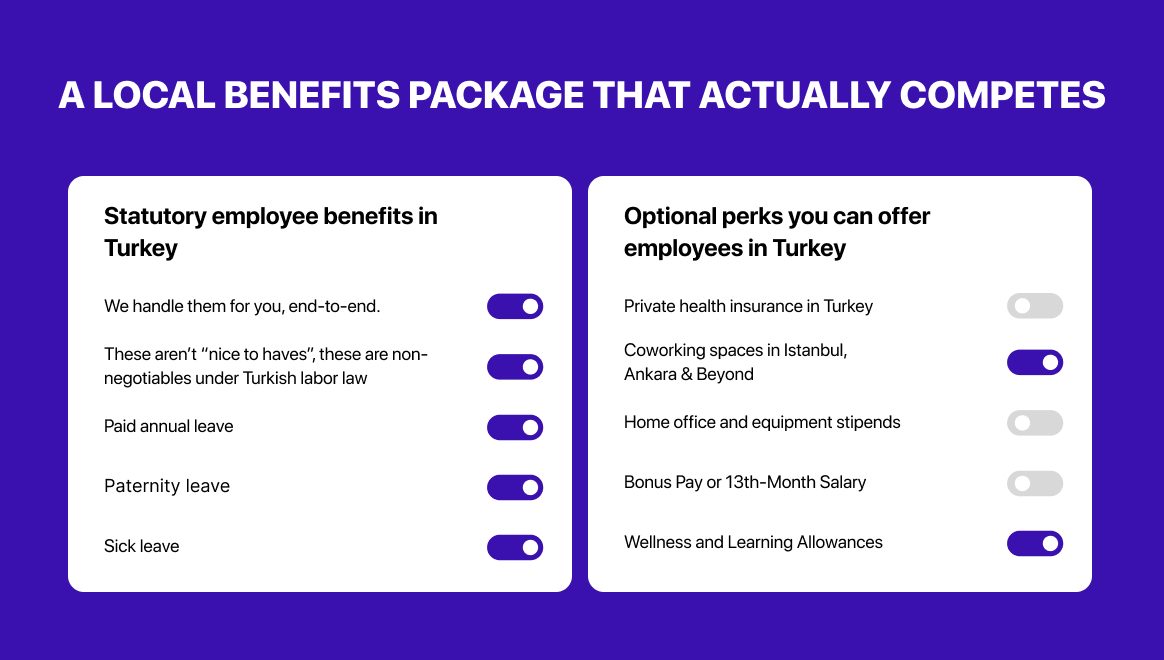
Statutory benefits (compliant by default)
Every full-time employee hired through Team Up receives all required benefits under Turkish labor law:
- Paid Annual Leave: Minimum 14 working days per year increases with tenure.
- Public Holidays: Over 15 official holidays, including national and religious observances, are fully paid.
- Maternity Leave: 16 weeks of paid leave (8 before, 8 after birth), managed through SGK.
- Paternity Leave: 5 days of paid leave for new fathers.
- Sick Leave: covered by social security when backed by a doctor’s note.
- Social Security & Health Contributions: All required employer and employee contributions are calculated and filed monthly, without error.
Optional perks you can add easily
To stand out in Turkey’s fast-growing tech and product scene, optional perks are the differentiator. Through Team Up, you can offer:
- Private health insurance Not legally required, but increasingly expected by mid- to senior-level candidates. We help you set up custom plans with trusted local providers.
- Coworking space access Ideal for hybrid or remote teams. Choose flexible memberships in Istanbul, Ankara, or Izmir.
- Home office stipends Internet costs, ergonomic furniture, tech, we help you structure monthly stipends legally through payroll.
- Laptop & equipment delivery We handle local sourcing and delivery to avoid customs delays and surprise costs.
- Performance bonuses & 13th-month pay Structured as part of the employment contract and processed legally.
- Learning & wellness allowances From Udemy subscriptions to gym memberships, we help you roll them out cleanly and compliantly.
Why benefits matter more than ever
In 2025, top Turkish talent isn’t just looking for cash. They’re looking for security, growth, and a sense that they’re part of something real, not just another remote contract.
With Team Up, you can match (or beat) what top local employers offer, even without having a company on the ground.
How to onboard and manage a nearshored team in Turkey
Hiring is only half the job.
Once your team in Turkey is signed, sealed, and employed, what comes next matters just as much: how you onboard them, manage them, and make them feel like part of something real, not just a name on payroll.
The good news is that nearshoring to Turkey makes this easier than you think.
With the right partner, you’re not just compliant. You’re operational in 7–10 days with a team that’s legally hired, locally supported, and fully ready to work.
Let’s walk through how that looks.
Fast, compliant onboarding (no paperwork headaches)
When you partner with TeamUp, we handle every legal and compliance step:
- Employment contract signed in Turkish is fully compliant with Turkish labor law, tailored to the role, and reviewed with the employee.
- Tax & social security registration. We register each employee with the SGK (Social Security Institution) and tax office, no delays, no missed filings.
- Payroll setup in local currency (TRY). Monthly salary processed, taxes withheld, benefits enrolled, all handled automatically.
- Onboarding docs & HR file creation, from ID verification to signed policies, we build the required local HR record, stored and tracked legally.
As a result, your new hire in Istanbul or Izmir can start work legally, smoothly, and confidently in under 10 days.
Managing Nearshored Employees Day to Day
Your nearshored employee reports to you, not to us. You set their goals, manage their schedule, run performance reviews, and assign tools or workflows.
But we make it easier behind the scenes:
- Time off tracking & leave requests: We handle leave balance tracking, public holiday calendars, and approvals — all integrated with payroll.
- Local HR support in Turkish & English: Your team can contact us directly for questions about sick leave, payslips, contracts, or benefits.
- Contract amendments & promotions: Want to give a raise, add a bonus, or change a title? We will update the contract and notify the authorities for you.
- Performance & exit support: If you need to let someone go, we walk you through Turkish labor law, ensuring the offboarding is smooth, fair, and compliant.
Tools we recommend for managing remote teams in Turkey
Our clients typically combine legal coverage with tools that support productivity and collaboration. Some recommendations:
- Slack or MS Teams – For daily comms
- Notion or Confluence – For async documentation
- Jira, Linear, or Trello – For project management
- Loom or Zoom – For fast walkthroughs and team meetings
- Team Up (us!) – For EOR and employment compliance
We don’t just hire your team. We help you keep them aligned, engaged, and focused.
Bonus tip: run a localized welcome
Turkish employees value warmth and inclusion even more when they’re remote.
A few small gestures go a long way:
- Send a local treat (Turkish coffee? Lokum?)
- Offer coworking space access in Istanbul or Ankara
- Host a virtual “get to know the team” call
With Team Up handling compliance and payroll, you can focus on culture not contracts.
What to look for in nearshoring companies in Turkey
You don’t just need a nearshoring partner in Turkey. You need the right one.
Because not all nearshoring companies are created equal. Some subcontract.
Some vanish after onboarding. Some tack on surprise fees. And some don’t actually understand Turkish labor law, which means you’re still at risk.
Here’s what to look for when choosing a nearshoring company in Turkey that won’t slow you down, trip you up, or put your team at risk:
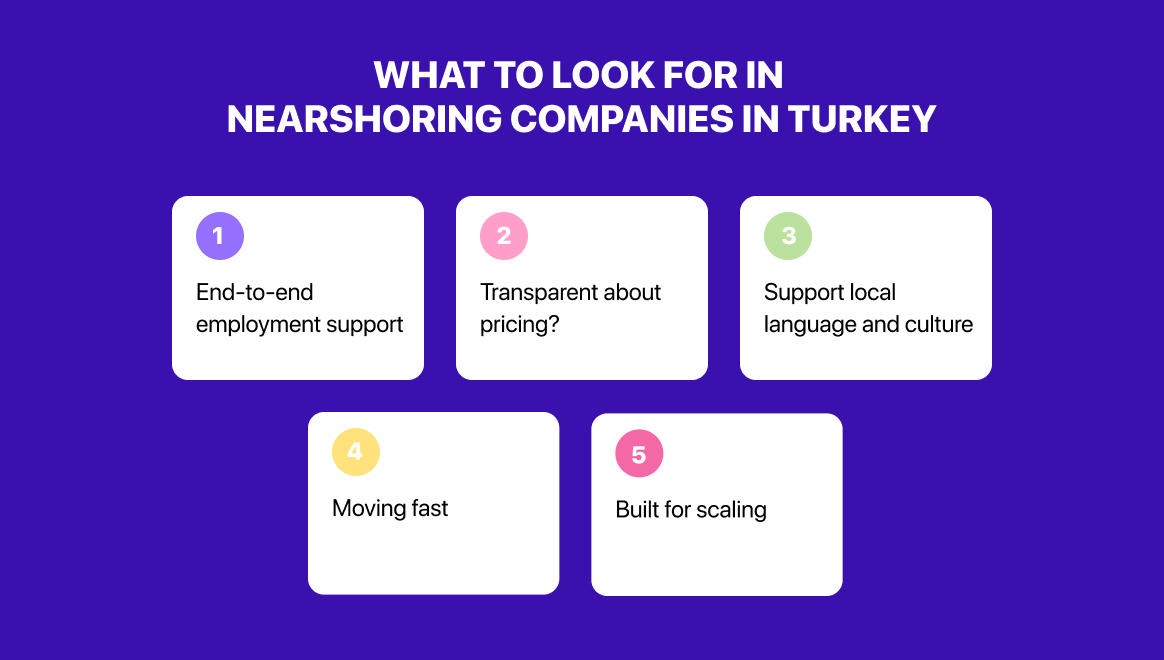
1. Do they offer end-to-end employment support?
It’s not just about hiring. It’s about staying compliant across the full lifecycle.
Your provider should handle:
- Turkish employment contracts are bilingual and labor-code compliant
- Payroll in Turkish Lira with taxes, SGK contributions, and monthly filings
- Leave, benefits, bonuses, and severance are all tracked and processed correctly
- Termination support with proper notice, paperwork, and final payments
If they only do payroll or expect you to run offboarding, they’re not built for nearshoring.
2. Are they transparent about pricing?
Flat fee? Good. Hidden costs? Dealbreaker.
Ask:
- Do you charge extra for onboarding or offboarding?
- Is health insurance included or separate?
- Are bonuses or benefits handled through payroll or as add-ons?
- Do you offer FX transparency or apply a markup?
At Team Up, it’s €299 per employee, per month. That includes onboarding, payroll, local filings, HR support, and compliance coverage without surprises.
3. Can they support local language and culture?
Turkish employees expect structure, clarity, and local responsiveness. If your nearshoring provider doesn’t support Turkish-language HR, you’ll lose trust fast.
Look for companies that:
- Communicate with your team in Turkish and English
- Understand local labor expectations and holiday calendars
- Can offer localized perks like coworking access or wellness stipends
We’ve helped teams set up operations in Istanbul, Ankara, and Izmir, and we know the culture inside and out.
4. Do they move fast?
If a nearshoring partner quotes you four to six weeks for onboarding, they’re behind.
You should be able to:
- Approve a candidate today
- Sign a compliant contract tomorrow
- Have your new hire live within 7–10 business days
Team Up gets teams live in Turkey in under two weeks, fully legal, fully operational.
5. Are they built for scaling?
Today, you need two hires. In six months, maybe ten. You don’t want to rebuild your HR infrastructure every time you grow.
Look for a partner who offers:
- Flexible scaling without long-term contracts
- Easy onboarding for new roles or team changes
- Regional knowledge across MENA and Eastern Europe
- One dashboard or point of contact to manage it all
Nearshoring to Turkey should be a long-term advantage, not a short-term patch.
Bottom line
Nearshoring to Turkey isn’t just trending in 2025, it’s proving itself where it counts: talent, speed, and cost.
You’re probably a strong fit if you:
- Need to hire tech, ops, or support roles quickly
- Don’t want to spend 3–6 months setting up a local entity
- Care about legal compliance, but don’t want to manage Turkish labor law
- Want a competitive edge in sourcing high-quality talent without draining your budget
- Are scaling across the EU, MENA, or Central Asia, and want timezone overlap
The smart play isn’t always building from scratch. Sometimes it’s about moving with the least friction, lowest cost, and full compliance, and then scaling from there.
So if Turkey is on your radar, the time to move is now.
Salaries are still competitive. Talent is still available. And you’ve got a partner ready to help you do it right.
Want to see how nearshoring to Turkey would work for your team?
Book a free consultation
.svg)