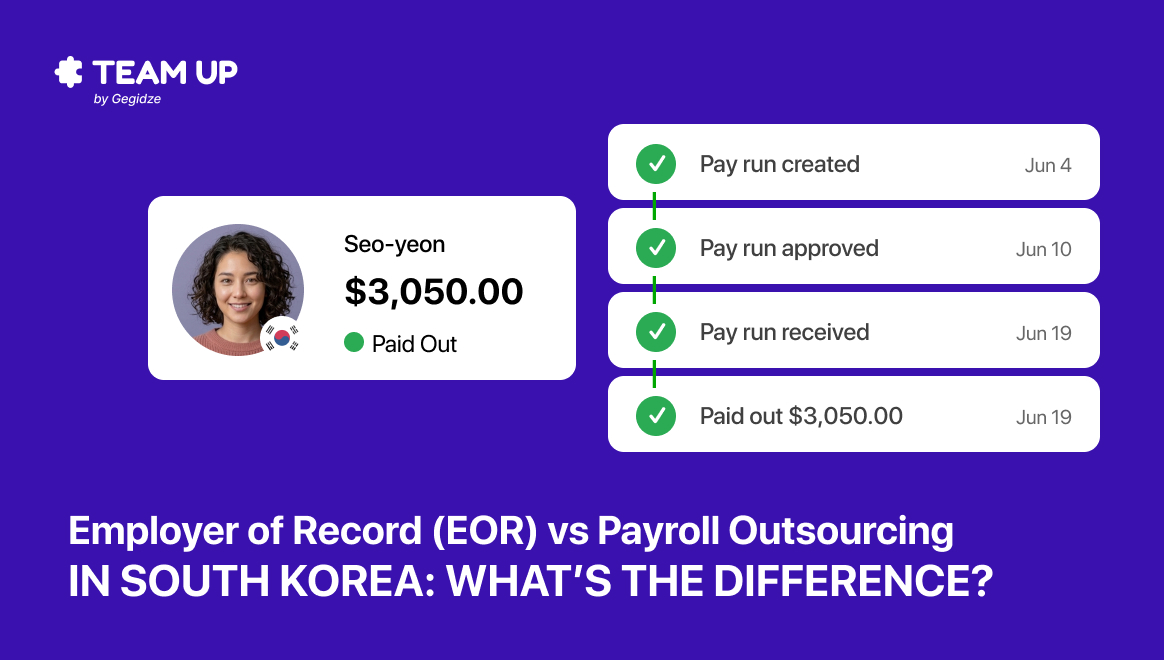
Employer of Record (EOR) vs Payroll Outsourcing in South Korea: What’s the Difference?
TL;DR
- Payroll outsourcing and EOR services are frequently confused — but they solve different problems and carry different legal consequences in South Korea.
- Payroll outsourcing is an administrative service: a provider processes your payroll, calculates NPS/NHIS/EI/WCI contributions, remits taxes, and produces payslips — but your company remains the registered Korean employer of record. All Labour Standards Act liability, NLRC wrongful dismissal exposure, and four-insurance audit risk remain with you.
- An EOR is a legal structure: the EOR becomes the employer of record. The employment contract is between the EOR and the employee. Labour Standards Act liability, NLRC exposure, and four-insurance audit risk transfer to the EOR. Your company directs the work operationally but is not the named employer.
- Payroll outsourcing requires an existing Korean entity. The EOR does not. If your company does not have a Korean business registration, payroll outsourcing is not available to you — the EOR is the only compliant option.
- The 2020 amendments to the Dispatched Workers' Protection Act tightened the standard for determining when a third-party employment arrangement constitutes illegal dispatch. A payroll outsourcing arrangement where the payroll provider is listed as the formal employer but the client exercises all operational control may be reclassified as illegal dispatch — with joint liability consequences for the client company.
- For companies with a Korean entity and 50+ employees, payroll outsourcing adds genuine administrative efficiency without changing the legal employer relationship. For companies without a Korean entity, or for companies that want genuine employer liability transfer, the EOR is the correct structure.
- Team Up operates as an EOR — not a payroll outsourcing provider — because the EOR model is the structure that delivers genuine compliance transfer in South Korea's post-reform regulatory environment.
The EOR vs payroll outsourcing South Korea question is one of the most practically important distinctions in Korean employment services — and one of the most consistently confused. Both services involve a third party managing aspects of your Korean payroll. Both produce Korean payslips. Both handle NPS, NHIS, EI, and WCI contribution remittances. The overlap in operational appearance creates the impression that the two models are interchangeable with different price points. They are not.
The difference is legal, not operational. In a payroll outsourcing arrangement, your company is the employer of record. The payroll provider is an administrative vendor. Labour Standards Act liability, NLRC wrongful dismissal exposure, and four-insurance contribution audit risk all remain with your company — because your company is the registered Korean employer. In an EOR arrangement, the EOR is the employer of record. The legal employment relationship is between the EOR and the employee. The compliance obligations and the liability they carry sit with the EOR.
That distinction determines whether you need a Korean entity, who is named in NLRC claims, who carries the NPS audit liability, and whether your employment arrangement is compliant with the Dispatched Workers' Protection Act. This article maps both models precisely, with the legal and operational specificity that South Korea's employment environment requires.
What Is Payroll Outsourcing in South Korea?
The Operational Scope of Korean Payroll Outsourcing
Payroll outsourcing in South Korea is a service arrangement in which a specialist provider manages the administrative payroll function on behalf of a company that already holds — or is forming — a Korean legal entity. The payroll provider calculates monthly salary amounts, applies the correct National Tax Service (NTS) income tax withholding using the current graduated table, calculates NPS, NHIS, EI, and WCI contributions per employee, remits those contributions to the relevant government bodies by the applicable deadlines, produces Korean-format payslips (급여명세서) for each employee, manages the annual year-end tax settlement (연말정산) in January, and prepares the payroll-related NTS reporting filings.
The payroll provider is an administrative vendor. It executes the employer's payroll obligations on the employer's behalf. It does not become the employer. The employment contracts remain between the client company and the employees. The four-insurance employer registrations remain in the client company's name. The NTS payroll tax obligations are reported under the client company's business registration number. If an NPS auditor sends a query about contribution accuracy, the query goes to the client company — not the payroll provider.
What Payroll Outsourcing Does Not Cover
Payroll outsourcing covers the administrative execution of payroll. It does not cover: employment contract drafting or Labour Standards Act compliance advisory; NLRC wrongful dismissal defence or labour dispute management; DC retirement plan establishment (the client company must set this up independently — the payroll provider processes the contributions once the plan is in place); annual leave tracking and compensation target management beyond what the client reports to them; or work permit and visa sponsorship for foreign national employees. These are employer functions, not payroll administration functions. They remain with the employer — the client company.
| A common misconception about Korean payroll outsourcing: many companies assume that engaging a payroll provider reduces their Korean employment compliance exposure. It does not. The payroll provider reduces the operational burden of running the payroll administration. The compliance exposure — the Labour Standards Act obligations, the four-insurance contribution liability, the NLRC claims, the NTS audit risk — remains entirely with the company that is the registered employer of record. Outsourcing the payroll does not outsource the legal employer status. |

What Is an EOR in South Korea?
The EOR as Legal Infrastructure, Not Administrative Service
An Employer of Record in South Korea is a Korean-registered legal entity that formally employs workers on behalf of an international client company. The employment contract is between the EOR and the employee. The EOR holds the Korean business registration number, the four-insurance employer registrations with NPS, NHIS, MOEL, and COMWEL, and the NTS payroll withholding infrastructure. The EOR is the employer listed in the employee's NHIS health insurance records, the entity contributing to their NPS pension account, the party responsible for meeting LSA severance obligations when employment ends, and the entity named in any NLRC wrongful dismissal claim.
The client company directs the day-to-day work. It sets the role requirements, the performance standards, the compensation, and the working arrangements. But it is not the employer of record. The legal employment relationship — and the compliance obligations that flow from it — sits with the EOR. The client company is the operational principal in a commercial service relationship with the EOR, not the employer in an employment relationship with the Korean employees.
What the EOR Manages That a Payroll Provider Does Not
The EOR manages everything a payroll provider manages — payroll processing, four-insurance contributions, NTS withholding, year-end tax settlement — plus the employer functions that a payroll provider explicitly does not touch: Labour Standards Act-compliant employment contract drafting; probationary period management; annual leave tracking and compensation target administration; DC retirement plan establishment and monthly contribution management; justifiable cause assessment for dismissal events; NLRC wrongful dismissal defence as the named employer; four-insurance de-registration at termination; LSA severance calculation and 14-day payment management; and work permit and E-7 visa sponsorship for foreign national hires.
The EOR is not a more comprehensive payroll provider. It is a different category of service: a legal employer that also happens to manage the payroll administration. The payroll administration is a subset of what the EOR does. The legal employer function is what distinguishes it.
The Core Legal Difference: Who Is the Employer of Record in South Korea?
Why Employer of Record Status Determines Compliance Architecture
In South Korea's employment law framework, the registered employer of record is the party that carries every statutory obligation toward the employee and every regulatory obligation toward the government. The Labour Standards Act creates rights that run directly between the employee and the employer of record. The four-insurance contribution obligations run from the registered employer to the relevant government body. The NLRC wrongful dismissal claim is filed against the employer of record. The NPS contribution audit targets the employer of record's registration number.
Under payroll outsourcing, the client company is the employer of record. The payroll provider's involvement does not change that. The provider is a contractor performing administrative tasks on the employer's behalf — no different in legal terms from an internal payroll team, except that the team is external. Under the EOR model, the EOR is the employer of record. The client company is the operational principal directing the work — a distinct legal relationship from the employment relationship.
Practical Consequences of the Difference
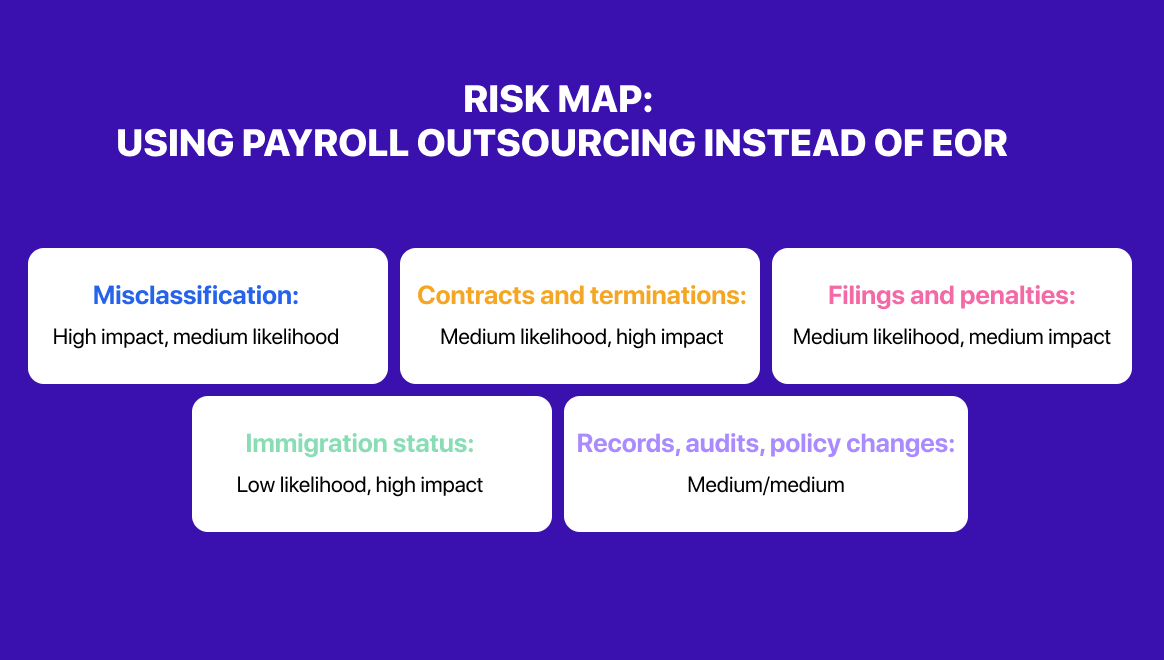
When a Korean employee is dismissed and files an NLRC wrongful dismissal claim: under payroll outsourcing, the claim names the client company. Under the EOR model, the claim names the EOR. When NPS audits contribution records for the five-year audit window: under payroll outsourcing, the audit targets the client company's employer registration. Under the EOR model, the audit targets the EOR's registration. When MOEL conducts a workplace inspection: under payroll outsourcing, the client company's employment records are examined. Under the EOR model, the EOR's records are examined. These consequences are not abstract. They determine which entity faces a Labour Commission hearing, which entity's management team responds to a tax authority audit, and which entity bears the cost of a compliance failure.
Korea's Four-Insurance System: Who Carries the Audit Risk Under Each Model?
Each of Korea's four mandatory insurance schemes — NPS, NHIS, EI, and WCI — conducts independent contribution audits. NPS audits can reach back five years. NHIS conducts annual reconciliations. MOEL's Employment Insurance division periodically reviews employer contribution accuracy. COMWEL reviews WCI risk classification and assesses back-premiums for miscategorised workplaces. Under each model, the entity carrying the audit risk is the registered employer.
| Insurance Scheme | Audit Authority | Audit Lookback | Who Carries Risk: Payroll Outsourcing? | Who Carries Risk: EOR? |
| NPS | National Pension Service | 5 years | Client company | EOR |
| NHIS | NHIS Corporation | Annual + retrospective | Client company | EOR |
| EI | Ministry of Employment & Labour | 3 years | Client company | EOR |
| WCI | COMWEL | Annual declaration + audit | Client company | EOR |
Under the payroll outsourcing model, the client company bears the four-insurance audit risk across all four schemes. If the payroll provider has been calculating NPS contributions on an incorrect SMI base for three years — a common error when the November SMI update process is not properly managed — the back-contribution liability lands on the client company's registration, not the payroll provider's. Under the EOR model, all four audit risks sit with the EOR. The client company receives a monthly cost report and does not interact directly with any of the four government bodies.
| NPS SMI back-contribution risk: the Standard Monthly Income (SMI) must be updated by November 30 each year to reflect salary changes from the preceding April-October period. When a payroll outsourcing provider manages this update only when notified by the client — rather than proactively tracking salary changes and triggering the update — the result is systematic NPS underpayment for each employee whose salary increased but whose SMI was not updated. NPS calculates the shortfall during its annual reconciliation and assesses back-contributions plus a 9% annual surcharge. Under payroll outsourcing, this liability arrives at the client company. Under the EOR model, it is the EOR's operational responsibility to manage proactively. |
Labour Standards Act Compliance: How Liability Is Distributed Between Models
The LSA Obligations That Do Not Transfer Through Payroll Outsourcing
The Labour Standards Act creates employer obligations that a payroll provider does not — and cannot — manage on the client company's behalf. These include: employment contract drafting with LSA-compliant terms (written contracts required from day one under Article 17; failure is a criminal offence at KRW 5,000,000 per violation); the justifiable cause requirement for dismissal under Article 23 (the employer must document the cause, follow the procedural standard, and defend the decision at the NLRC if challenged); the 52-hour weekly working cap under the 2018 Working Hours Reform (criminal penalties for management — up to two years' imprisonment — for knowing violations); annual leave tracking and compensation target management for unused leave (연차수당); and DC retirement plan establishment and monthly contribution management under the Employee Retirement Benefit Security Act.
A payroll provider can process the DC retirement plan contributions once the plan is established and the contribution amounts are provided by the client. It does not establish the plan, select the IRP provider, verify that contributions are calculated on total wages rather than basic salary, or process the retirement benefit payment at termination. These are employer functions. They remain with the client company under the payroll outsourcing model.
How the EOR Transfers These Obligations
The EOR assumes full responsibility for all LSA obligations as the registered employer of record. Employment contracts are drafted by the EOR to LSA standards and reviewed by the client for commercial terms. Dismissal decisions are assessed against the justifiable cause requirement before the dismissal is executed. The NLRC claim, if it comes, is directed at the EOR. The 52-hour cap applies to the employment relationship between the EOR and the employee — the EOR advises the client on working hour compliance and structures contracts accordingly. Annual leave is tracked by the EOR's payroll system and compensation targets are calculated and processed at year-end. The DC plan is established by the EOR with a Korea-licensed IRP provider, contributions are calculated on total wages, and the retirement benefit payment is managed at termination.
The Dispatched Workers' Protection Act: Why It Changes the Risk Profile of Payroll Outsourcing in Korea
The Act on the Protection of Dispatched Workers (파견근로자 보호 등에 관한 법률) restricts worker dispatch to 32 specifically designated job categories. Outside those categories, dispatching workers — supplying them to a client who exercises operational control over the work — is prohibited. The 2020 amendments significantly expanded how Korean courts determine when a dispatch relationship exists, looking at the practical reality of who controls the work rather than the contractual label.
This matters for payroll outsourcing in a specific way. If a company engages a Korean payroll provider that also formally employs the workers (listing them under the provider's employer registration rather than the client's), and the client company exercises day-to-day operational control over those workers in roles that are not within the 32 designated categories, a Korean court may find that the arrangement constitutes illegal dispatch — regardless of what the contracts call it. The consequence is joint employer status: the client company becomes liable for all LSA obligations of the "dispatched" workers from the date the arrangement began.
This risk does not apply to a genuine payroll outsourcing arrangement where the client company is the registered employer of record and the payroll provider simply administers the payroll function. It applies when a provider attempts to serve as a de facto employer under a payroll outsourcing label — a structure sometimes encountered in the Korean market, particularly from smaller providers, and one that creates exposure for clients who do not examine the actual registration arrangement carefully.
The EOR model, correctly structured, is not subject to this risk. The EOR is the genuine registered employer of record with its own operational employer functions — not a labour supply intermediary performing dispatch under a different label. The legal structure is clear and the Dispatched Workers' Protection Act framework recognises the distinction.
| How to check: before engaging any Korean payroll provider or EOR, ask for the Korean business registration certificate (사업자등록증) and confirm which entity's employer registration number is used for the employees' four-insurance registrations. If the employees are registered under the payroll provider's employer number rather than the client company's, the arrangement may be structured as a de facto employer relationship under the provider's entity — which needs to be evaluated against the Dispatched Workers' Protection Act standards. If employees are registered under the client company's employer number and the provider is purely administrative, it is a standard payroll outsourcing arrangement. |
When Payroll Outsourcing Makes Sense in South Korea
The Conditions That Make Payroll Outsourcing the Right Model
Payroll outsourcing is the right model under a specific set of conditions. Your company must already have an active Korean business registration (Jusik Hoesa or branch office) with four-insurance employer registrations in place. The payroll provider you engage must be registered as a pure administrative service provider — not as a de facto employer under the Dispatched Workers' Protection Act framework — with employees registered under the client company's employer number. And your company must have, or be willing to build, the internal HR and legal capability to manage the employer functions that the payroll provider does not cover: LSA employment contracts, justifiable cause dismissal management, annual leave compliance, DC retirement plan administration, and NLRC claims.
When those conditions are met, payroll outsourcing delivers genuine administrative efficiency. Korean payroll is complex — five contribution streams, multiple government portals, a January year-end settlement process, and an annual November SMI update — and outsourcing the administrative execution to a specialist provider frees internal HR resources for higher-value people management activities. For a Korean operation with 50 to 100 employees, a mature internal HR function, and a clear internal understanding of LSA employer obligations, payroll outsourcing is a sensible and cost-effective service model.
What Payroll Outsourcing Costs in South Korea
Korean payroll outsourcing fees are typically lower than EOR fees because the scope is narrower. Standard payroll outsourcing fees range from KRW 50,000 to KRW 150,000 per employee per month depending on headcount volume, payroll complexity, and service inclusions. For a company with 50 Korean employees, a mid-range payroll outsourcing fee of KRW 100,000 per employee per month is KRW 5,000,000 per month — KRW 60,000,000 per year. The same headcount through an EOR at KRW 350,000 per employee per month would cost KRW 17,500,000 per month — KRW 210,000,000 per year. The KRW 150,000,000 annual fee difference reflects the different scope: the EOR carries the employer liability, the payroll provider does not.
When an EOR Makes Sense in South Korea

Companies Without a Korean Entity
The EOR is the only legally available employment structure for companies that do not have a Korean business registration. Payroll outsourcing requires a registered employer on the client side. Without one, there is no client employer for the provider to serve administratively. Companies entering Korea for the first time, testing the market before committing to entity formation, or operating with headcount levels that do not justify the entity formation timeline and maintenance overhead — all of these situations call for the EOR.
Companies That Need Genuine Employer Liability Transfer
Some companies have a Korean entity but want to transfer the employer liability for a specific workforce segment — foreign national contractors transitioning to employment, a new function with uncertain headcount trajectory, or a Korea operation being wound down where the entity is still active but employment should be managed independently of it. In these cases, the EOR provides the legal employer transfer even alongside an existing entity. The EOR becomes the employer of record for the specific employees in scope, carrying the LSA liability, the four-insurance obligations, and the NLRC exposure for those employees.
Companies That Need Work Permit Sponsorship
Any company that needs to sponsor E-7 or other work visas for foreign national hires in Korea and does not have an established Korean entity with MoJ employer standing needs an EOR. The payroll provider cannot provide that sponsorship standing. The EOR can.
Companies in the Early Scaling Stage
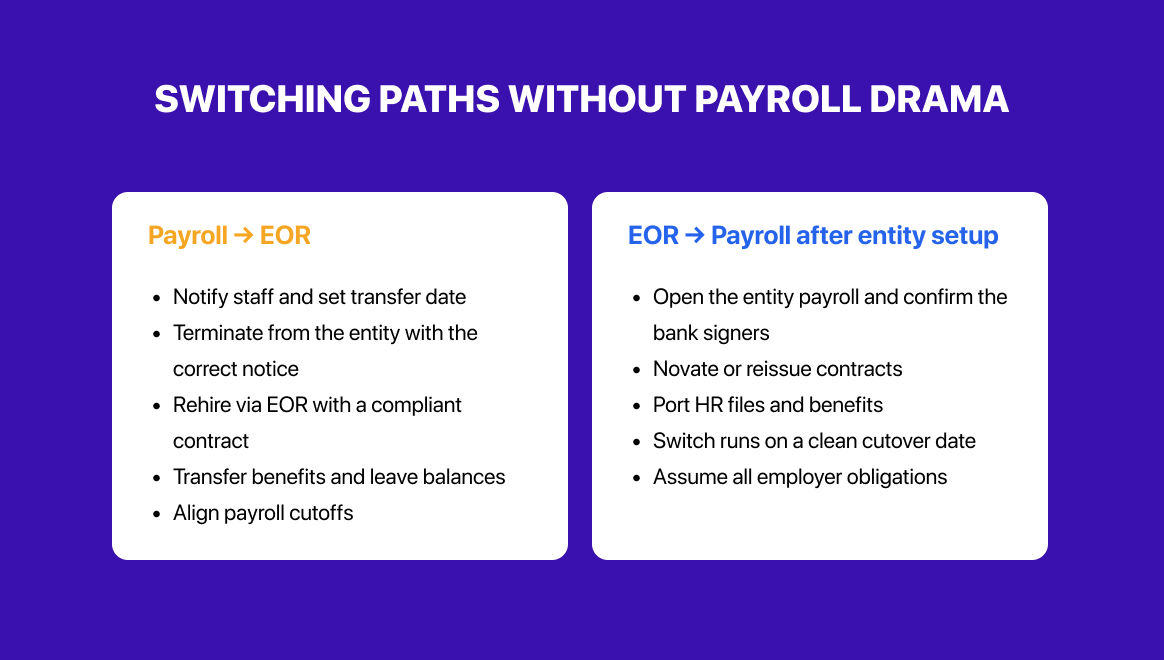
For a Korean operation growing from five to thirty employees over 18 to 24 months, the EOR provides compliance management that scales with the headcount without requiring the client company to hire internal Korean HR staff, build Korean payroll expertise, or manage the complexity of the four-insurance system and LSA employer obligations internally. At the point where the operation justifies a fully staffed internal Korean HR function — typically 50+ employees with permanent operations — the transition from EOR to payroll outsourcing (with the company's own entity) becomes operationally viable.
Combined Models: Using Payroll Outsourcing Alongside an EOR in South Korea
Some larger Korean operations use both models simultaneously for different workforce segments. The most common configuration: the company's own Korean entity employs its core permanent workforce directly, using a payroll outsourcing provider to manage the administrative payroll function. Simultaneously, the company uses an EOR for a specific workforce segment — foreign national hires on E-7 visas, a new function being piloted before integration into the entity, or a temporary project team with a defined end date.
This configuration works well when the segments are clearly defined and the employment relationships are properly documented. The EOR employees have employment contracts with the EOR. The directly employed workers have employment contracts with the client entity. The payroll outsourcing provider manages the administrative payroll for the directly employed workers. There is no overlap, no ambiguity about employer of record status for any worker, and no Dispatched Workers' Protection Act exposure created by the arrangement.
The configuration becomes problematic when the boundaries are unclear — when some workers have EOR contracts but are routinely described internally as "company employees" in a way that conflicts with the employment contract reality, or when the payroll provider is managing payroll for workers who are actually employed under the EOR's registration. Clear documentation and consistent internal communication about the employment structure of each worker segment is the operational requirements for a combined model.
EOR vs Payroll Outsourcing South Korea: Full Comparison Table

Every decision-relevant dimension in one place. Use it to determine which model fits your specific Korean situation.
| Dimension | Payroll Outsourcing | Employer of Record (EOR) |
| Employer of record status | Client company | EOR |
| Korean entity required? | YES — client must have a Korean entity | NO — EOR is the entity |
| Employment contract between | Client company and employee | EOR and employee |
| Four insurance registrations held by | Client company | EOR |
| Four-insurance audit risk | Client company | EOR |
| NPS SMI update responsibility | Client company (provider executes) | EOR manages proactively |
| NLRC wrongful dismissal exposure | Client company named in claims | EOR named in claims |
| LSA employment contract drafting | Client company's responsibility | EOR's responsibility |
| 52-hour working week compliance | Client company's criminal liability | EOR structure + client management |
| DC retirement plan establishment | Client company's responsibility | EOR establishes and manages |
| DC retirement contribution base | The client company's responsibility is to specify | EOR calculates on total wages |
| LSA severance calculation | Client company's responsibility | EOR calculates and pays in 14 days |
| Annual leave tracking (연차수당) | Client company's responsibility | EOR tracks and processes |
| Year-end tax settlement (연말정산) | Provider manages (under client's RFC) | EOR manages (under EOR's RFC) |
| Work permit (E-7) sponsorship | Client entity sponsors (if registered) | EOR sponsors independently |
| Dispatched Workers Act compliance | Risk if provider is de facto employer | EOR is genuine employer — no risk |
| Monthly service fee | KRW 50,000–150,000/employee/month | KRW 320,000–600,000/employee/month |
| Best suited for | 50+ employees, existing entity, internal HR | 1–50 employees, no entity, or liability transfer |
How Team Up Approaches This: EOR Only, Full Scope, No Shared Liability
Team Up operates exclusively as an Employer of Record — not as a payroll outsourcing provider, not as a hybrid arrangement, not as a staffing intermediary. The distinction is deliberate. In South Korea's post-2020 regulatory environment, the correct structure for third-party employment is one where the legal employer is unambiguous, the compliance obligations are held by the party with the operational infrastructure to manage them, and the Dispatched Workers' Protection Act risk is eliminated through genuine employer-of-record status rather than managed through contract language.
- EOR as employer of record, not payroll agent: Every Korean employee hired through Team Up has an employment contract with Team Up as the legal employer. Team Up's business registration and four-insurance employer numbers are the registrations under which the employee's contributions are filed. Team Up is named in any NLRC wrongful dismissal claim. Team Up carries the four-insurance audit risk.
- Full LSA scope included: Employment contract drafting, probationary period management, annual leave tracking and compensation target administration, 52-hour cap compliance advisory, DC retirement plan management (Korea-licensed IRP provider, total wages contribution base, retirement benefit payment at termination), LSA severance calculation and 14-day payment management — all included in the standard EOR service scope.
- Work permit sponsorship: Team Up's established Korean employer registration supports E-7 and other work visa sponsorship independently — no client entity required. Full MoJ application management, visa status maintenance, and termination notification management included.
- Four-insurance management with proactive SMI update: NPS, NHIS, EI, and WCI registrations held by Team Up. November SMI update managed as a scheduled compliance event tied to every salary change notification. LTCI surcharge included in NHIS contribution calculations.
- Year-end tax settlement as scheduled compliance: The full January yeommal jeongsan cycle — employee communication, deduction receipt collection, NTS reporting, February payroll adjustment — managed as part of the standard annual compliance calendar, not a billable add-on.
- Transparent employer cost reporting: Monthly breakdown showing gross salary, NPS, NHIS (including LTCI surcharge), EI, WCI, DC retirement contribution, and Team Up service fee as distinct line items. No lump-sum invoicing.
- Global EOR coverage: Team Up covers South Korea alongside Eastern Europe, the Caucasus, Turkey, Central Asia, India, and MENA — single contract structure, consistent employer cost reporting, one operational contact for clients managing Korea alongside other emerging market operations.
Final Thoughts
The EOR vs payroll outsourcing South Korea distinction is not a pricing question. It is a legal question. Payroll outsourcing reduces the administrative burden of running Korean payroll while leaving every employer obligation — every LSA liability, every four-insurance audit risk, every NLRC exposure — with the client company that is the registered employer of record. The EOR transfers those obligations to the EOR as the employer of record. The fee difference between the two models reflects the difference in scope.
The right model depends on your situation, not on the fee level. If your company has a Korean entity, mature internal Korean HR capability, and 50 or more employees with a clear understanding of every LSA obligation you are carrying as the registered employer — payroll outsourcing is a sensible and cost-effective administrative service. If your company does not have a Korean entity, does not want to carry direct LSA and four-insurance liability, needs work permit sponsorship for foreign national hires, or is at the early scaling stage where the entity maintenance overhead does not yet justify itself — the EOR is the correct structure.
The worst outcome is using payroll outsourcing when you need the EOR — discovering, through a contested dismissal or a COMWEL audit, that the employer liability you thought was managed by your provider was sitting with your company the entire time. Know which model you are using and make sure it matches the liability position you actually want to be in.
Frequently Asked Questions
Can I use a payroll outsourcing provider in South Korea without forming a Korean entity?
No. Payroll outsourcing requires an existing Korean employer on the client side — your company must hold a Korean business registration number, four-insurance employer registrations, and NTS payroll infrastructure before a payroll provider can administer your payroll. Without a Korean entity, there is no employer registration for the provider to serve administratively. For companies that need to hire in Korea without forming an entity, the EOR is the only legally available model. The EOR is already the registered employer — no client entity required.
If I switch from payroll outsourcing to an EOR, do my Korean employees' rights change?
The change in employer of record — from the client company to the EOR — requires employment contracts to be novated: the original employment relationship between the client company and the employee is transferred to the EOR through a tripartite agreement signed by all three parties. Seniority accruals continue from the original hire date — the employee's years of service for LSA severance, annual leave entitlement, and DC retirement benefit purposes are not reset by the transfer. Four-insurance registrations are transferred from the client entity to the EOR through a baja-patronal equivalent process — employer de-registration with the client's numbers, employer registration under the EOR's numbers — coordinated to avoid coverage gaps. Employee rights do not diminish in the transfer; the legal employer changes, but the substantive employment terms remain.
Is payroll outsourcing cheaper than an EOR in South Korea?
The per-employee fee for payroll outsourcing is significantly lower than for an EOR — typically KRW 50,000 to KRW 150,000 per employee per month versus KRW 320,000 to KRW 600,000 for an EOR. However, the payroll outsourcing fee is only a meaningful cost comparison when the client company already has a Korean entity. When the full cost of operating that entity — accounting, legal counsel, HR administration, registered office — is included alongside the payroll outsourcing fee, the total cost of the payroll outsourcing model at small headcount (fewer than 30 employees) often exceeds the total cost of the EOR model. The comparison is not payroll outsourcing fee versus EOR fee. It is the payroll outsourcing fee plus entity maintenance cost versus the EOR fee only.
What happens if a payroll outsourcing provider makes an error in NPS contributions?
The liability for incorrect NPS contributions falls on the registered employer — the client company — regardless of which party made the calculation error. NPS sends the back-contribution notice, surcharge assessment, and any penalty to the client company's employer registration address. The client company may have a contractual claim against the payroll provider for costs arising from the provider's error, but that is a commercial dispute between the client and the provider — NPS's enforcement relationship is with the registered employer. Under the EOR model, the NPS enforcement relationship is with the EOR's employer registration, and the EOR bears the consequence of any contribution error within its operational scope.
Can a payroll outsourcing provider manage the DC retirement plan on my behalf?
A payroll outsourcing provider can process DC retirement plan contributions — calculating the monthly 1/12 amount, remitting contributions to the IRP provider, and including the contributions in the payroll records. However, the client company must establish the DC plan independently, select the Korea-licensed IRP provider, and execute the trust agreement. The client company must also specify the contribution base correctly — total annual wages including all regular allowances, not just basic salary. If the client specifies an incorrect contribution base, the payroll provider will process the contributions on that incorrect base, creating a retroactive liability against the client company. Under the EOR model, the EOR establishes the plan, selects the provider, verifies the correct contribution base, and takes operational responsibility for correct contributions.
How does the Dispatched Workers' Protection Act affect standard payroll outsourcing in practice?
For standard payroll outsourcing — where the client company is the registered employer and the provider administers the payroll administratively — the Dispatched Workers' Protection Act is not directly engaged. The Act targets worker dispatch: supplying workers to a hirer who exercises operational control. A payroll provider that processes payroll for the client company's own employees is not supplying workers — it is providing a service to the employer. The Act risk arises when a provider is formally employing the workers (registering them under the provider's employer number) but the client company is exercising operational control over their work in non-designated categories. Verify that employees are registered under the client company's employer number, not the payroll provider's, to ensure the arrangement is structured as genuine payroll outsourcing rather than as a potentially non-compliant dispatch arrangement.
.svg)