


Guide to the top 5 trends in Employer of Record services in the Caucasus for 2026
Introduction
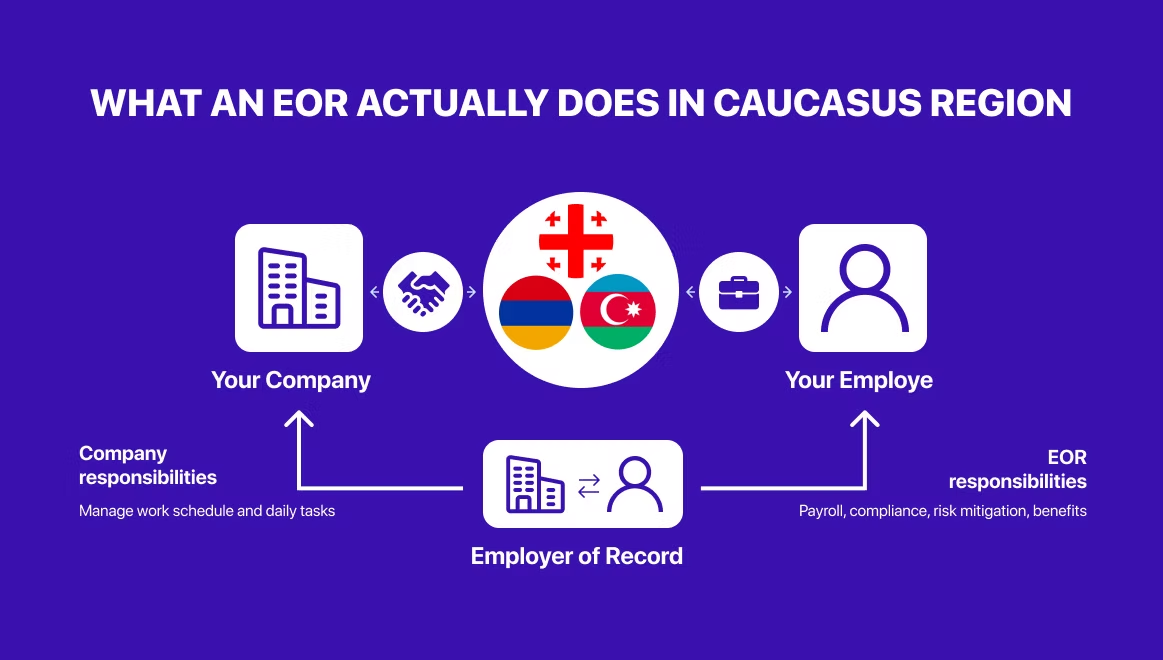
An Employer of Record hires workers on your behalf and takes on full legal responsibility.
You manage the work.
The EOR manages local compliance, employment contracts, and payroll taxes.
That clarity matters because hiring in the Caucasus without an EOR exposes companies to real risks.
Fines. Misclassification. Tax violations. Worker claims.
None of these are theoretical, and none of them wait until you’re “ready” to deal with them.
The region is growing fast. Talent is strong. Regulations are strict enough to punish mistakes but clear enough when you follow the right structure. An EOR gives you that structure, so you can focus on building your team instead of navigating three different labor systems.
This guide walks through the top trends shaping Employer of Record services in the Caucasus for 2026, what’s changing, why it matters, and how companies are using EOR to hire quickly and stay fully compliant.
Why the Caucasus is becoming a major EOR hub in 2026
The Caucasus is becoming one of the easiest regions for global teams to hire in. Companies want fast access to talent without navigating three separate legal systems. An Employer of Record in the Caucasus makes that possible with clean, predictable hiring.

The region offers a mix of advantages that are hard to find elsewhere.
Large multilingual workforce
Georgia, Armenia, and Azerbaijan have strong English proficiency, plus Russian and regional language coverage. This gives global teams immediate communication flexibility.
Strong technical and operational talent
Engineering, product, QA, customer support, and finance roles are well developed. Companies can hire full teams instead of isolated contributors.
Competitive and sustainable salaries
The region delivers skilled professionals at compensation levels that work for startups, scaleups, and enterprise teams.
Simple onboarding through an EOR
With EOR support, new hires receive compliant employment contracts, tax setup, and clear payroll processes. No delays. No guesswork.
Companies are avoiding entity setup
Opening a local entity in each country is slow and expensive. Most companies want the benefits of hiring in the region without the administrative load. EOR gives them that path.
Trend #1: Companies are replacing contractors with full EOR employment
Compliance pressure is rising across the Caucasus
Regulators in Georgia, Armenia, and Azerbaijan are taking a closer look at how foreign companies classify workers. If someone is working fixed hours, receiving direction from a manager, and using your internal systems, local authorities expect them to be employed, not labeled as a “contractor.”
Companies are updating their hiring model because the cost of misclassification is now higher than the convenience of avoiding payroll.
Labor inspections are getting stricter
Labor departments across the region are tightening enforcement. Inspectors are checking:
- Whether contractors have a real business activity
- Whether the relationship matches the contract
- Whether tax reporting aligns with actual work
This doesn’t just increase risk, it increases admin time. Every questionable contract becomes a potential negotiation with authorities.
Contractor hiring creates IP and data issues
Freelancers rarely offer the legal guarantees needed in cross-border hiring. Without proper employment contracts:
- IP rights may not transfer correctly
- Confidentiality rules are weaker
- Data handling becomes a liability
EOR employment solves this by issuing enforceable contracts that meet the region’s legal requirements and transfer IP cleanly to the company.
Predictable payroll matters
Companies want predictable payroll cycles. But with contractors, payments vary by platform, bank, and currency. This causes:
- Inconsistent reporting
- Irregular tax declarations
- Confusion during audits
EOR payroll provides a fixed schedule, compliant deductions, and documentation that aligns with local law.
Employees in the region want real employment contracts
Talent pool in the Caucasus is seeking stability. Real benefits. Clear protections.
High-performing engineers, designers, support staff, and analysts increasingly turn down contractor roles in favor of EOR-backed employment.
Companies that ignore this trend lose candidates to competitors who offer proper employment.

Trend #2: EOR is now the fastest way to hire across the Caucasus
Work permits and visas require correct structures
Foreign specialists relocating to Georgia or Armenia need employment contracts that meet local immigration rules. Contractor paperwork doesn’t qualify. EOR structures provide the contract, documentation, and legal foundation required for residency.
Direct hiring creates onboarding delays
Without a local entity, companies struggle with the basics:
- Obtaining tax IDs
- Setting up payroll
- Registering employees locally
- Filing mandatory paperwork
Each step delays onboarding by weeks. EOR removes that entire pipeline.
EOR handles contracts and payroll setup instantly
Because the EOR already operates legal entities in the region, onboarding is fast.
The EOR provides compliant contracts on day one, handles tax setup, and places the employee into a functioning payroll system.
This removes the slowest part of the expansion.
Foreign specialists prefer EOR-supported relocation
Relocation into the region becomes smoother because:
- Employment status is clear
- Documentation is correct
- Immigration authorities trust the structure
This consistency increases approval rates and reduces processing time.
Paperwork bottlenecks move off your plate
Companies want to grow, not learn three different employment systems.
EOR providers handle documentation, registrations, tax reporting, and contract updates, removing the administrative burden from internal teams.
Trend #3: Companies want transparent EOR costs in the Caucasus
Flat fees are replacing percentage-based pricing
Teams no longer want EOR fees tied to salary.
Percentage pricing:
- Penalizes raises
- Complicates forecasting
- Creates mistrust
Flat fees give companies full control over future payroll costs.
Monthly invoices must be simple
Finance teams want clarity. One invoice with:
- Salary
- Payroll taxes
- Employer obligations
- Benefits
- EOR fee
No hidden adjustments, no new categories appearing mid-year.
Companies want a visible cost breakdown
Detailed breakdowns let finance teams answer internal questions quickly and avoid back-and-forth with providers.
This makes budgeting and headcount planning easier.
CFOs reject hidden charges
Hidden fees, onboarding charges, “local support” surcharges, currency adjustments, slow adoption.
Transparent pricing wins because it removes friction from approval cycles.
Local compliance requires clear tax mapping
Each country has distinct rules.
Payroll must reflect:
- Georgian social fund contributions
- Armenian income tax structures
- Azerbaijan’s social and unemployment insurance laws
EOR providers must map these accurately to avoid future audits or corrections.
Trend #4: EOR providers are becoming full people-ops partners
Equipment support

Companies want clean laptop procurement, delivery, and tracking.
EORs now handle:
- Local purchasing
- Asset management
- Replacements
Workspace options
Global teams often want hybrid structures.
EORs provide:
- Coworking memberships
- WFH support
- Ergonomic stipends
Health insurance and benefits
Talent in the Caucasus values:
- Private health insurance
- Supplemental benefits
- Structured leave policies
EORs administer these without the company building local HR infrastructure.
HR support
Local HR questions, leave rules, attendance, holidays, documentation are handled by the EOR.
This removes a major load from internal teams.
Compliance-aligned documentation
Probation, performance records, warnings, and terminations must follow local rules.
EOR ensures documents and steps are legally valid.
Smooth onboarding and offboarding
Companies avoid administrative errors that lead to disputes.
EOR fully manages:
- Onboarding
- Role updates
- Offboarding
- Final settlements
Trend #5: EOR adoption is rising due to regional expansion strategies
The Caucasus is a strategic bridge market
The region sits between Europe, the Middle East, and Central Asia. Companies use it as a base to operate across multiple time zones.
Multilingual teams are easy to build
Regional languages plus widespread English and Russian make it simple to serve international customers from one region.
Strong engineering and operations talent
Companies can build full technical and operational teams, not just isolated roles.
This shifts the region from “support hub” to “team location.”
24/7 coverage becomes easier
Time zone overlap with both Europe and Asia allows global teams to fill coverage gaps without hiring multiple shifts.
EOR removes multi-entity complexity
Instead of opening three different entities, companies rely on one EOR partner to manage hiring across the entire region.
What companies want most from EOR services in the Caucasus
When expanding into high-growth, high-complexity markets like Georgia, Armenia, and Azerbaijan, companies need more than just a payroll processor. They need a strategic partner that fully absorbs the local legal risk. Companies are increasingly demanding EOR services in the Caucasus that deliver certainty and control.
Here is what global businesses prioritize when selecting an EOR service provider in the Caucasus region:
- Predictable Hiring: The ability to onboard talent within days, bypassing the months-long entity setup process.
- Local Compliance Certainty: Guarantee that all employment practices, from contracts to tax filings, adhere strictly to the specific, evolving laws of each country.
- No Legal Surprises: Protection against employee litigation, tax penalties, and misclassification risks (e.g., classifying an employee as a contractor).
- Transparent Costs: Clear, predictable, and flat-rate pricing that eliminates uncertainty caused by percentage-based fees or hidden administrative costs.
- Strong HR Support: Localized advice on competitive compensation, benefits, and statutory leave policies to attract and retain top talent.
- Reduced Risk Exposure: Complete transfer of the legal employer burden, effectively insulating the client company from direct liability.
Why TeamUp is the Solution for the Caucasus
Team Up is built specifically to address these core demands. We handle compliance, EOR payroll taxes, employment contracts, and ongoing support through our own local entities across the region. This means companies don’t carry the legal burden; we do.
How to choose the right Employer of Record provider in the Caucasus

Selecting the right EOR partner in the Caucasus is the single most important decision you will make for a compliant and successful expansion. Use this checklist to vet providers and ensure they meet the high standards required for this complex region:
| Feature | Requirement for the Caucasus Market |
| Strong Local Compliance Knowledge | Proven, in-house expertise in Georgian, Armenian, and Azerbaijani labor and tax codes. |
| Enforceable Employment Contracts | Ability to draft and execute contracts in the correct local language (e.g., Georgian, Armenian) and format to ensure legal validity. |
| Transparent Pricing | Flat-rate pricing model to guarantee predictable monthly costs, eliminating salary volatility risk. |
| Benefits Administration | Capability to administer and advise on both statutory and enhanced benefits packages (e.g., private health insurance) to compete for talent. |
| Immigration Capability | Direct management of the entire work permit and visa application process for foreign hires and expats. |
| Legal Presence | Must have a wholly-owned legal entity in each Caucasus country (Georgia, Armenia, Azerbaijan), not relying on risky third-party subcontractors. |
| Reliable Platform | User-friendly, secure platform for seamless payroll and onboarding, providing real-time compliance reporting. |
Final takeaway: The Caucasus EOR market Is accelerating hast
The expansion into the Caucasus region is no longer a fringe strategy; it’s a mainstream move for global companies seeking high-quality, cost-effective talent.
- The Caucasus is rapidly becoming a global hiring hub for IT, finance, and logistics talent.
- As regulatory scrutiny rises, compliance standards are rising rapidly.
- Companies demand two things above all else: speed + safety.
- The EOR is now the default hiring model for protected, rapid market entry.
- TeamUp is the cleanest way to hire across Georgia, Armenia, and Azerbaijan, offering the local expertise and predictability required for success.
Team Up lets you hire in the Caucasus without managing compliance, payroll taxes, or entity setup. One system. No friction.
FAQ
1. What exactly is an Employer of Record (EOR), and how does it protect my company from risk?
The EOR is the legal entity that officially employs your staff in a foreign country on your behalf. This model creates a crucial legal firewall: the EOR handles all local labor law compliance, tax withholdings, and mandatory social contributions. Your company manages the employee's work, while the EOR assumes the liability for legal risks, such as misclassification and contract non-compliance. This protection is essential when hiring abroad without a local legal entity.
2. We're worried about misclassification fines. Does using an EOR completely eliminate this risk?
Yes, using a legitimate global employer of record is the most effective way to eliminate misclassification risk. The EOR establishes a legally valid, W-2 style employment relationship with the worker in the target country (e.g., in the manner required for an employer of record in Armenia).
This means the employee is officially on the EOR's payroll, removing your company's exposure to fines, back taxes, and penalties associated with incorrectly treating an employee as an independent contractor.
3. How can I ensure transparent and predictable costs when evaluating EOR providers?
When evaluating multiple providers, always demand a flat-rate pricing model instead of percentage-based fees. Percentage models cause cost uncertainty because your fee increases every time you give an employee a raise. A flat rate, which Team Up prioritizes, guarantees predictable monthly costs, allowing CFOs and Founders to budget accurately for global expansion.
4. What critical services should an international employer of record manage beyond basic payroll?
A top-tier international employer of record must manage far more than just payments. Key services include: drafting legally valid local employment contracts (in the required language), administering competitive and statutory benefits administration, managing immigration (work permits/visas), and handling complex termination procedures compliant with local labor law (e.g., an employer of record in the Caucasus must manage mandatory severance).
5. We need to hire quickly. How much faster is using an EOR versus setting up our own entity?
The speed difference is dramatic. Setting up a legal entity (e.g., an LLC or TOO) can take 3 to 6 months of intense legal and administrative work. Using EOR services allows you to onboard talent and commence work within days or a few weeks, depending on the country. This speed is critical for time-poor operations managers and founders looking to seize market opportunities quickly.
6. Do I lose control over my employees if an EOR becomes the legal employer?
Absolutely not. This is a common concern. Your company retains full functional control over the employee. You manage their daily tasks, performance reviews, team integration, and compensation structure. The EOR only handles the legal and administrative control (compliance, contracts, employer of record payroll services). The employee works for you, but their paperwork is handled safely by the EOR.
7. How does an EOR country with complex labor laws (like in MENA or Southeast Asia) ensure up-to-date compliance?
A reliable EOR uses proprietary, dedicated local entities and technology. They employ in-country legal and HR experts who track legislative changes (e.g., tax code amendments or new social contribution rates) in real-time. This ensures your employer of record payroll services and employment contracts are always 100% compliant, mitigating the fear of legal mistakes.
8. What's the risk of using an EOR that relies on local subcontractors instead of owning its own entity?
Using an EOR that relies on third-party subcontractors introduces unnecessary risk. You lose control over data security, compliance standards can be inconsistent, and accountability is fractured when facing an audit or employee dispute. Decision-makers should seek a global EOR services provider that owns its legal presence in every EOR country to ensure centralized control and transparency.
9. As a CFO, how do I ensure the EOR's platform is reliable for secure global payroll and reporting?
CFOs should prioritize EORs with a unified, secure platform for global EOR services. The platform must offer advanced security (data encryption, ISO certification), provide clear and timely reporting on all tax and social contributions, and integrate reliably with your existing financial systems. Look for providers that demonstrate expertise in both compliance and technological robustness.
10. We are currently evaluating multiple employer of record services. What is the single best predictor of success?
The single best predictor of success is the EOR's demonstrable commitment to local legal certainty. Look for evidence of wholly-owned entities and locally based legal experts, not generic global call centers. Choosing a provider that eliminates complexity and manages your legal fear, like Team Up, is key to moving from overwhelmed to confident.
.svg)


