


Relocation to Eastern Europe: Legal Requirements and Practical Steps
TL;DR
Eastern Europe is attracting global employers with its deep talent pools, competitive salaries, and large multilingual workforce. But tapping into this region comes with red tape. Each country – from Romania and Bulgaria to Serbia, Ukraine, and beyond – has its own complex rules for work permits, visas, tax, and labour law. In practice, many teams waste months on paperwork or risk fines by underestimating the bureaucracy. One Team Up guide warns that “hiring in Eastern Europe without an EOR increases the risk of fines, misclassification, tax violations, and worker claims”.
Companies often find that the best path is partnering with an experienced Employer of Record (EOR). An EOR becomes the official employer of your hires in-country, handling local compliance so you can focus on work. As one scenario put it: you might identify a top engineer in Romania, but setting up a legal entity could take 3 months, whereas the right EOR can finish onboarding in days.
This guide walks you through the legal requirements and practical steps for relocating staff to Eastern Europe, from visas and permits to payroll and regional nuances – so you can plan with confidence.
Quick Navigation:
- TL;DR
- Why Eastern Europe is a strategic relocation target
- Navigating Visas and Work Permits in Eastern Europe
- Employment Law and Payroll in Eastern Europe
- Step-by-Step Relocation Process to Eastern Europe
- Employer of Record (EOR) Services in Eastern Europe
- Country Spotlight: Key Eastern Europe Destinations
- Best Practices and Case Study
- Conclusion
- Frequently Asked Questions
Why Eastern Europe is a strategic relocation target
Eastern Europe offers a powerful combination of advantages for growing companies. Talent density and costs: Countries like Poland, Romania, and Bulgaria have well-educated graduates fluent in English and other languages, often at much lower salary levels than Western Europe or the US. Even outside the EU, places like Serbia, Ukraine, and Albania boast deep technical talent and multilingual professionals. For example, one startup found Georgian engineers and support staff fit their needs perfectly, providing U.S. overlap and a strong work ethic.
However, Regulatory complexity is real. Eastern Europe is “bureaucratic” and “country-specific,” as Team Up notes – it’s a “Hunger Games run in four languages”. Labour law details vary wildly: mandatory benefits may include 13th-month pay or extended parental leave, social taxes range from ~23% in Romania to 40%+ in Slovakia, and union requirements or notice periods differ by country. In short, on paper, these markets look great, but the paperwork can be brutal. As one Team Up compliance brief warns, “one wrong document, one untranslated contract, or one missing ministry stamp” can derail your hire.
Key risks of ignoring the details include denied visas, back taxes, and legal penalties. For instance, several Eastern European authorities require contracts in the local language (or bilingual) and often notarised on paper; skip this and the application can be rejected outright. Some countries impose labour market tests or quotas – say, requiring proof no local candidate could fill the job – before approving a foreign work permit. Mess up, and you face fines, retroactive payroll taxes, or even being blacklisted from hiring overseas workers.
In short, Eastern Europe’s growth comes with compliance hurdles. The good news: with the right plan and support, you can navigate these requirements. In the sections below, we break down visas, permits, contracts, and best practices – plus how working with a local or regional EOR can smooth the path.

Navigating Visas and Work Permits in Eastern Europe
Relocating an employee means dealing with both entry visas and work permits/residency. Who needs a permit? If your hire is an EU/EEA national, they can usually work freely in EU member states like Romania or Bulgaria. But any non-EU national will generally need a work permit for those countries. In non-EU countries (Serbia, Ukraine, Moldova, Albania, North Macedonia, etc.), the rules are even stricter: almost always, you must have a local job offer and go through the full permit process.
Key point: Even remote work doesn’t waive the rules. If someone is in-country (or takes a local contract) and not an EU citizen, they typically must be sponsored. This means a work permit and often a long-stay visa (national D-type), even if they never set foot in an office. Quotas and labour market tests are common: for example, Romania and Bulgaria require employers to justify that no local can fill the position. Serbia mandates a detailed “explanation letter” for the role. Failing these steps can lead to permit rejection or fines.
Required documents for Visas and Work Permits in Eastern Europe
Practically every Eastern European work permit application needs a bundle of paperwork.
1. Core Documents (The "Must-Haves")
Regardless of the specific country, you will almost certainly need:
- Passport: Must be valid for at least 3–6 months after your intended stay and issued within the last 10 years.
- Visa Application Form: Completed and signed (often via an online portal like Poland’s e-Konsulat).
- Photographs: Usually two recent, passport-standard color photos (3.5 x 4.5 cm).
- Proof of Health Insurance: Must cover the entire Schengen area with a minimum coverage of €30,000, including repatriation.
- Proof of Accommodation: A lease agreement, hotel reservation, or an official invitation from a host.
- Financial Solvency: Recent bank statements (usually last 3–6 months) to prove you can support yourself until your first paycheck.
2. Employment-Specific Documents
This is where the "Work" part of the Work Permit comes in.
- Work Permit/Authorisation: Usually, your employer must apply for this locally before you apply for the visa.
- Poland:Zezwolenie na pracę (Work Permit).
- Czech Republic: Often handled via an Employee Card, which combines a residence and work permit.
- Employment Contract: A signed copy of your contract or a binding job offer letter on company letterhead.
- Professional Qualifications: Apostilled or legalised copies of your diplomas, degrees, or certifications (often required for "Skilled Worker" or EU Blue Card tracks).
- Police Clearance: An original criminal record certificate from your home country (and any country you've lived in for 6+ months in the last 3 years).
The breakdown of the typical timelines and costs
In 2026, Eastern European countries are continuing to digitalise their immigration systems, which is generally speeding up processing times but also leading to modest fee increases.
Below is a breakdown of the typical timelines and costs for the region’s most popular work hubs.
1. Poland (The High-Volume Leader)
Poland remains the most common destination for foreign workers in the region.
- Work Permit Processing: 30 to 60 days (handled by the employer at the Voivodeship Office).
- Visa Processing (D-Type): 15 to 30 days once you submit at the consulate.
- Costs:
- Work Permit Fee: ~100 PLN (€23) for permits over 3 months.
- Visa Fee: Between €80 and €135 (non-refundable).
- Residence Card Fee: 440 PLN (€100) stamp duty + 100 PLN (€23) for the physical card.
2. Czech Republic (The Unified System)
The "Employee Card" acts as both a work and residence permit, simplifying the process but often lengthening the wait.
- Timeline: Historically 60–120 days, but a new digital system in 2026 aims for 30–90 days.
- Costs:
- Employee Card Application: ~2,800 CZK (€110).
- Biometric Card Production: Included in the application fee or an additional small fee upon collection.
- Pro-Tip: Employers must usually post the job on the National Labour Office portal for 30 days before they can even offer it to you (the "Labour Market Test").
3. Romania (The Rising Tech Hub)

Romania has two main stages: the Work Authorisation and the Long-Stay Visa.
- Work Authorisation (by Employer): 30 days (can be extended by 15 days for extra checks).
- Work Visa (D/AM): 10 to 30 days after the employer receives the authorisation.
- Costs:
- Work Authorisation Fee:€100 (paid by the employer).
- Long-Stay Visa Fee:€120 (paid by the applicant).
- Residence Permit: Approximately €120 in local taxes and fees once you arrive.
4. Hungary (Fast-Track Options)

Hungary offers a "Single Permit" for employment, which combines the work and stay authorisation.
- Timeline: 60 to 90 days for the standard Single Permit.
- Digital Nomad (White Card): Much faster, often processed in 15 to 30 days.
- Costs:
- Single Permit/Visa Fee:€110 if applied for at a consulate.
- Residence Permit Issuance: ~39,000 HUF (€100) if done in person in Hungary, or slightly less (€65) via the Enter Hungary digital portal.
Example: Hiring a Serbian engineer in Romania might involve ~30 days for the Romanian work permit and another ~30 days for the Romanian residence card, with roughly €300 in official fees and €150 in translation/medical costs. However, incomplete paperwork (a missing diploma translation, say) can push any timeline out by weeks.
For step-by-step guidance, Team Up’s [Work Permits & Visa Support] guide shows how an EOR can handle everything from application filing to renewals. As a quick overview: the EOR (your legal employer) collects your candidate’s documents, submits the application with the labour ministry, secures the entry visa, and then finalises the residence permit after arrival. The EOR also ensures your team meets local requirements (e.g. registering with social security or immigration authorities) so that your hire can legally work day one.
Employment Law and Payroll in Eastern Europe
Beyond immigration, local employment rules differ widely. Contracts: In almost every market, the employment contract must meet local labour code standards. Crucially, many countries require bilingual or local-language contracts. Poland, Romania, and Bulgaria, for instance, demand contracts in both English and Polish/Romanian/Bulgarian to be fully enforceable. Notarization of signed contracts is also common.
Payroll and Taxes
Taxes and social security vary by country. Eastern European countries tend to have relatively high social contributions: e.g. over 40% of gross salary in Slovakia versus ~23% in Romania. Income tax may be flat (often 10–18%) or progressive, but employers typically withhold and pay taxes monthly. Each country has its own payroll schedule – for example, Poland withholds taxes by the 20th of the month, Romania files social contributions by the 25th. Missing a filing deadline can trigger fines. Also note mandatory benefits: several countries have bonuses or extra pay. 13th-month salary is legally required in places like Bulgaria and Serbia, and full maternity leave (paid at ~85–100%) is common across the region.
Local registrations
In some states, you cannot even apply for a permit without an on-the-books employer. For example, Poland and Bulgaria require the employer to be fully registered with both the tax and labour offices before sponsoring a visa. This is where a local EOR is essential if you don’t have your own subsidiary.
Compliance pitfalls
Document translation is a perennial headache. If any official document (degree, clearance, contract) arrives untranslated, the process stops. Authorities are strict about format: a tourist can’t just work on a visitor visa – that’s illegal in almost every country (and risks deportation and fines). And be wary of contracting vs hiring: if a so-called “contractor” looks like a full-time employee (uses your tools, follows your hours), labour agencies may reclassify them as an employee retroactively, imposing huge back-taxes and penalties.
In short, your remote employee must be treated as a local employee under the law, with the same payroll taxes, insurance, and statutory leave entitlements. Missing this alignment is a big risk.
Step-by-Step Relocation Process to Eastern Europe
Pre-move planning: First, clearly define the role and determine if the person will be an official employee or a contractor. If the hire is meant to be integrated in your organisation (not a short-term gig), plan for an employment relationship. Team Up’s case study of a tech startup shows they mapped each role to its actual operational need – if it was core and long-term, they used an EOR employment structure, eliminating misclassification risk upfront. Essentially, if the person will work like a full-time employee (set hours, managerial direction, etc.), they need a work permit and full-time employment – not a loose contractor arrangement.
Next, choose whether to set up a local branch or use an EOR. Opening a legal entity in a new Eastern European country can take months. In contrast, an established EOR partner can complete payroll setup, contracts, and even relocation support in days or weeks. The tradeoff is cost: some EORs charge flat monthly fees (Team Up offers ~€199/employee) rather than a percentage of salary.
1. Updated Timelines (EOR vs. Direct)
While an EOR can onboard a "ready" candidate in days, the Work Permit (WP) and Residence Card (TRC) phases are subject to regional backlogs.
| Country | Work Permit (Stage 1) | Visa / Entry (Stage 2) | Residence Card (In-Country) |
| Poland | 30–90 days (Warsaw is slower) | 15–30 days | 6–18 months (Extreme backlogs) |
| Romania | 30–45 days | 10–20 days | 60–90 days |
| Bulgaria | 30–60 days | 35–45 days | 14–30 days |
Critical 2026 Changes:
- Poland’s Digital Shift: As of January 1, 2026, all residence permits must be filed through the MOS (Case Handling Module) portal. While this aims to cut processing times by 30%, initial "teething issues" with the portal are currently causing minor submission delays.
- Romania’s REVISAL: Employers must register contracts in the REVISAL system before the first working day. EORs typically handle this 24–48 hours before the start date to ensure 100% compliance.
2. Estimated EOR & Government Costs
Using an EOR adds a service fee but eliminates the cost of a local office, accountant, and legal team.
Government Fees (Per Person)
- Poland: ~$120 (Visa) + ~$120 (Residence Card). Note: Residence fees quadrupled in early 2026.
- Romania: ~$250 (Combined Permit/Visa fees).
- Bulgaria: ~$600 (Total for Work Permit + Residence).
EOR Service Fees (Monthly)
- Standard EOR:€350 – €600 per employee/month.
- Visa Sponsorship Surcharge: Many EORs charge a one-time "Immigration Support Fee" of $1,000 – $3,000 to handle the heavy lifting of document legalisation and embassy coordination.
3. Compliance & Renewals
- Labour Market Tests: In Bulgaria and Poland, the EOR must often prove that the job was posted locally for 14–30 days and no local/EU candidate was suitable.
- The "Gap" Period: In Poland, once the work permit is approved and the visa is issued, the employee enters the country. They can work legally while the Residence Card is pending, but they cannot easily travel to other Schengen countries if their initial visa expires before the card arrives.
- Degree Legalisation: Expect to spend an additional $200–$500 on Apostilles and sworn translations (into Polish, Romanian, or Bulgarian), which are mandatory for "Skilled Worker" status.
Employer of Record (EOR) Services in Eastern Europe
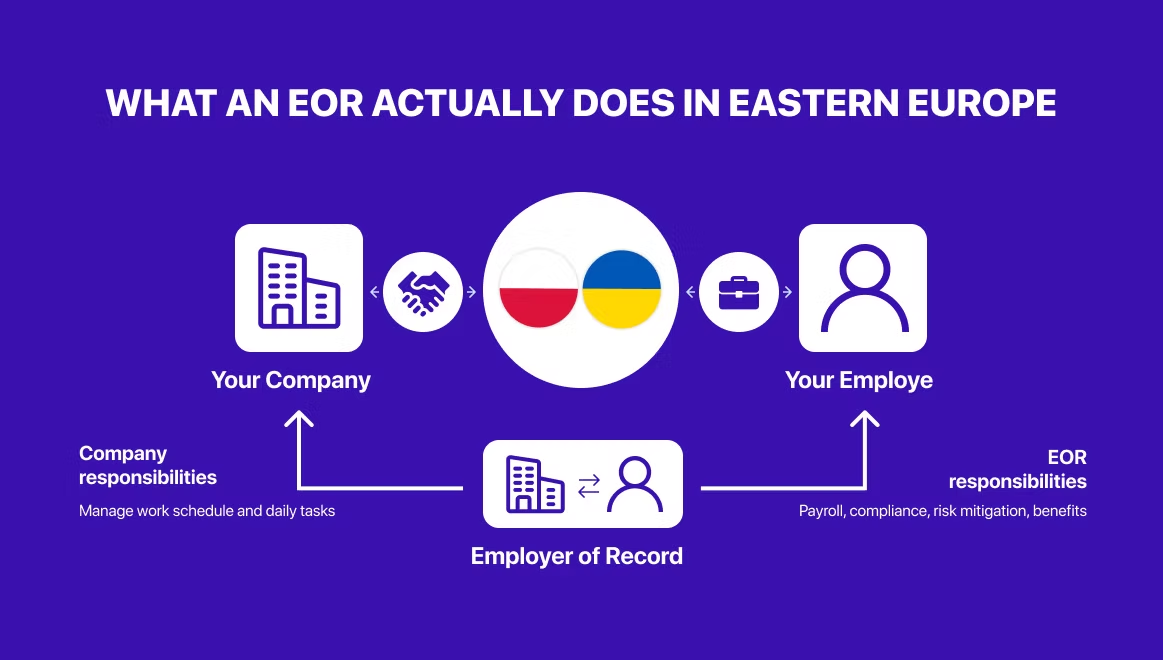
Given the above complexities, many companies use EOR services instead of opening local branches. So, what is an EOR? It’s a local or regional company that legally employs your hire on your behalf. Your team member works for you (you manage them), but the EOR is the official employer of record. This means the EOR issues contracts, processes payroll, withholds taxes, and sponsors the work permit and visa.
When to use an EOR
In general, any time you want to hire in a new country quickly or avoid permanent entity costs, an EOR makes sense. If your headcount in that country is still small (a few people), an EOR is often faster and safer than entity setup. It’s also valuable for short-term or uncertain ventures into a market.
Even if you plan to set up later, you can start through an EOR and migrate to your own entity when volume justifies it. (See Team Up’s analysis [EOR-06] for a full EOR vs. entity comparison.)
Benefits of EOR
Speed and compliance are the big ones. As noted above, an EOR can onboard your new hire in days rather than months.
The EOR partner already has local registrations, bilingual contract templates, payroll systems, and immigration contacts. This means no risk of “our contractor should have been an employee” or “contract in English got rejected” scenarios.
A good regional EOR also provides real local HR support – real people who can solve problems in your employees’ language, escalate issues, and navigate cultural/regional nuances.
What EORs handle
In practice, a full-service EOR manages:
- Local entity setup and registration: The EOR is already registered as an employer with tax and labour authorities in each country. For example, they have the proper tax IDs, social fund accounts, etc. (Team Up notes they directly file through in-country entities like ZUS in Poland or ANAF in Romania.)
- Work permit and visa sponsorship: They act as the legal employer-sponsor for immigration, including collecting required documents, filing the application, and arranging the visa entry.
- Payroll and taxes: The EOR runs monthly payroll – calculating net pay, withholding income tax, and paying social security contributions on schedule. Because each country has its own tax calendar (Poland by the 20th, Romania by the 25th, etc.), the EOR ensures filings happen correctly.
- Benefits and statutory compliance: They administer mandatory benefits – social health, pension, unemployment insurance contributions – and ensure things like sick leave, parental leave, and severance pay follow local law. Multilingual payslips and tax forms are delivered to each employee.
- Local-language documentation: A quality EOR provides bilingual contracts, offer letters, and HR materials. As Team Up points out, having contracts in English and the local language (Polish/Romanian/Bulgarian, etc.) is often legally required. Good EORs handle all translation and notarization.
Choosing an EOR in Eastern Europe
Not all EORs are equal. Look for a provider that has direct local presence (entities) in the countries you need, not just global platforms outsourcing to partners. Check pricing: flat-rate monthly fees are simpler than a percentage of salary – Team Up, for example, charges a flat ~€199/employee (no hidden markups). Ensure the EOR offers immigration support (some only do payroll) and ask how they handle bilingual documentation and local labour law compliance. Our [EOR-08] resource outlines five top reasons companies rely on EOR, including risk mitigation and regional expertise.
In practice, an EOR in Eastern Europe can be the difference between a smooth, quick hire and a multi-month headache.
| Factor | Employer of Record (EOR) | Local Legal Entity (LLC/Branch) |
| Market Entry Speed | 2 to 14 days | 3 to 6 months |
| Upfront Setup Costs | Minimal service fees | $15,000 – $50,000+ |
| Compliance Burden | Outsourced to the provider | Managed internally |
| Legal Employer Risk | Borne by the EOR | Borne by the parent company |
| Fixed Infrastructure | None required | Mandatory office/local staff |
| Monthly Pricing | $349 – $800 per employee | Variable (accounting, legal, audits) |
Country Spotlight: Key Eastern Europe Destinations
Eastern Europe is diverse. Below are highlights for some frequent destinations:
Romania
As an EU member, EU citizens need no permit, but non-EU nationals do (via Romania’s own work permit). Employers must generally justify why no local candidate was available. Romanian permits take ~30–45 days, plus about a month to finalise residence. Romania has a flat 10% income tax and ~45% employer social contributions. Mandatory benefits include contributions to health and pension funds, and typically 2 months’ notice periods. (A Romanian long-stay visa is often required first.)
Bulgaria
Also EU, Bulgaria’s flat 10% income tax makes salaries very cost-effective. Work permits for non-EU hires involve a 45–60 day process (often combined with a residence permit). The employer usually must post the job locally or complete a labour test. Notably, Bulgarian approvals often request proof of company contributions to social funds. Bulgaria mandates 13th-month salary and has a 18% (plus social) package.
Serbia (Western Balkans)
Non-EU Serbia requires all foreign workers to have a permit, typically proving the candidate is essential. For example, a “statement of employment” and an explanation letter are required. Serbia’s process can take 30–60 days. Once in Serbia, local taxes are relatively low (flat 10% tax, with ~15% employer pension contributions).
North Macedonia
Similar to Serbia in practice. (N. Macedonia requires work permits and visas for non-citizens, along with an employer registration process.) Expect on par regulations – language in Macedonian, set quotas, etc.
Ukraine & Moldova
These Eastern Partnership countries have their own nuances. Ukraine requires a work permit for almost all foreign hires, taking ~15–30 days. Special categories exist (e.g. war refugees or some citizens might have an easier status). Moldova also requires permits for non-EU hires. Be aware that political instability or conflict can change timelines, so check local news. Work permits often must be renewed annually.
Albania
A candidate for EU membership, Albania similarly needs permits for foreign workers. The process includes obtaining a work permit from the Department of Immigration, then a residence card after entry. Rules align with other Balkan countries (proof of no local hire needed, translations, etc.).
In each country, always verify specifics before you start. For example, Romania and Bulgaria allow EU Blue Cards for highly skilled workers (an EU-wide visa), whereas many non-EU countries only offer national permits. Timeframes vary: the timelines above are best-case – allow extra time if documentation is complex.
Best Practices and Case Study
Compliance tips:
- Always have bilingual (or local-language) contracts. Never rely on English-only for Eastern Europe.
- Do full labor market testing if required (post the job locally, document the process) before filing for the permit.
- Collect all required documents upfront: a local contract, diplomas, police certificates, and health checks are commonly needed. Keep copies of translations and apostilles.
- Plan around holidays: permit offices may close for national holidays. Start applications early.
- Beware indirect hiring: if your worker has been in-country without permits (e.g. on a tourist visa), resolve status immediately – working illegally is a serious offence (deportation and hefty fines).
Pitfalls to avoid: Don’t treat a full-time hire like a casual contractor. If the person is embedded in your product or team, classify them as an employee and sponsor the work visa. Skipping compliance might save time now, but can cause audits, back taxes, and even blacklist you from the region.
Conclusion
Relocating or hiring in Eastern Europe can unlock new growth, but only with a compliance-first approach.
Key takeaways: Know the EU vs non-EU rules (EU nationals travel freely, others need permits), assemble the right documents (local-language contract, proof of qualifications, etc.), and watch timelines (permits often 4–8 weeks). Budget for permit and visa fees (~€300 total per hire) plus translation costs.
Most importantly, consider a regional Employer of Record service to handle these requirements. A good EOR provider in Eastern Europe will have local legal entities in all the countries you need, provide transparent flat pricing, and handle everything from immigration to payroll. They’ll speak your hire’s language (literally), coordinate with ministries, and keep you out of trouble
Frequently Asked Questions
1. Is the "Single Permit" (Work + Residence) mandatory now?
Yes. Under the EU Single Permit Directive (which must be transposed into national laws by May 21, 2026), non-EU workers generally apply for a single authorization for both stay and work. This "one-stop-shop" model is intended to reduce the 90-day processing backlog commonly seen in Poland and Hungary.
2. Can I still hire using paper contracts?
No. In countries like Poland and Czechia, paper dossiers are legally considered "not filed" as of 2026.
- Poland: Every interaction must be via the praca.gov.pl portal.
- Czechia: The new Unified Monthly Employer Report (JMHZ), mandatory by April 2026, requires all payroll and immigration data to be submitted electronically to the Social Security Administration.
3. What are the new 2026 "Notification Deadlines" for employers?
Deadlines have become much tighter to combat illegal employment:
- Commencement: In Poland, you must notify the Labor Office within 7 days of a foreigner starting work.
- Prior-to-Start: In Czechia, as of July 2026, all employees (including locals) must be registered in the system before their first hour of work.
- Termination: Most Eastern European jurisdictions now require notification within 15 days of an employee’s departure to avoid fines.
4. Has the "Labour Market Test" been abolished?
It’s a mixed bag.
- Poland: Formally abolished the traditional test in many regions to speed up hiring.
- Romania: Still requires proof that no local/EU citizen is available, though they have maintained a high quota of 90,000 work permits for 2026 to help fill shortages.
- Hungary: Still requires a "genuine employment need" justification for standard permits.
5. What are the 2026 salary thresholds for the EU Blue Card?
The Blue Card remains the gold standard for highly skilled tech and management roles. Thresholds are updated annually based on average gross salaries:
- Poland: Approx. 10,700 – 11,500 PLN (recast rules implemented mid-2025).
- Czechia: Approx. 53,400+ CZK.
- Hungary: Approx. 600,000+ HUF.
6. Can I hire Ukrainians under the "Special Protection" scheme in 2026?
The landscape is shifting. The "Special Protection" regime is being phased out in several countries. In Poland, draft rules for post-March 2026 require many Ukrainians to transition from temporary protection to regular Work Permits or residence cards if they wish to remain employed.
7. What are the penalties for "Illegal Entrusting" of work?
Penalties have been adjusted for inflation and stricter enforcement:
- Poland: Fines up to 50,000 PLN per foreigner.
- Czechia: A "Three-Offence Rule" exists where residence permits can be revoked if a foreigner commits three administrative offenses in a year, which puts pressure on employers to ensure perfect compliance.
8. Is a "Sworn Translation" of the employment contract required?
Yes. In 2026, if an employment contract is drafted in a foreign language (e.g., English), a sworn translation into the local language (Polish, Romanian, Czech, etc.) must be uploaded to the government portal before the work permit is finalised.
9. Are there "Strategic Enterprise" lists?
Yes. Poland and Hungary have introduced "strategic" or "fast-track" registers. If your company is on this list (typically for large investors or high-tech exporters), your applications jump to the front of the queue, reducing processing times from 3 months to roughly 3–4 weeks.
10. Can I use an Employer of Record (EOR) to manage these changes?
EORs are at an all-time high in 2026. Because of the full digitalization (requiring local digital signatures and Data Box setups), many foreign employers find it easier to use an EOR that already has the infrastructure to handle the monthly unified reports and immigration filings.
.svg)


