


Employer of Record Costs in Portugal 2026: Fees, Pricing & What to Budget

Our guide to Employer of Record services in Portugal covers the broad cost picture alongside compliance, benefits, and provider selection. This article goes deeper on costs alone. It breaks down exactly what sits inside the monthly fee, which expenses catch buyers off guard, and how to compare EOR pricing against the alternative of setting up your own Portuguese entity.
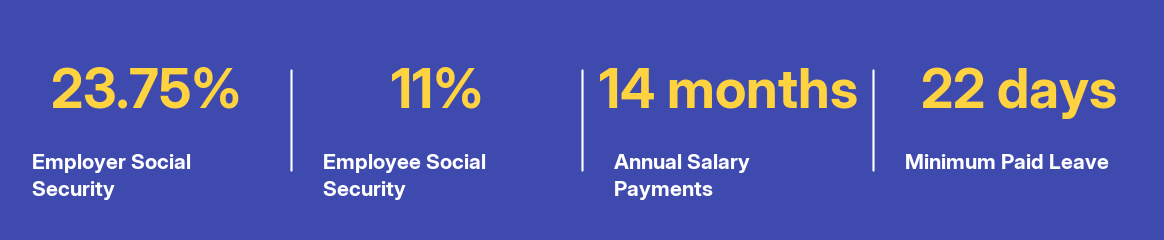
Portugal's employer-side statutory costs are among the higher ones in Western Europe. The social security contribution rate alone reaches 23.75% of gross salary on the employer side. That single line item shapes every cost calculation you run. Understanding how EOR providers wrap that obligation into their pricing model determines whether you overpay or get a competitive deal.
What Makes Up EOR Pricing in Portugal

EOR pricing in Portugal stacks into three distinct layers. Each layer behaves differently as your team grows.
The Management Fee
The management fee is the provider's charge for acting as your legal employer in Portugal. Most EOR providers price this as a flat monthly rate per employee. Across the industry, these fees typically range from €199 to €699 per employee per month, depending on the provider's operating model and entity structure.
A provider with an owned entity in Portugal absorbs compliance risk directly. One that subcontracts to a local partner adds a margin layer. That structural difference explains much of the fee spread. Team Up's EOR service starts at €199 per employee per month in its core markets. For Portugal specifically, confirm current pricing directly, as rates vary by headcount and contract terms.
Statutory Employer Costs
Portugal requires employers to fund several obligations on top of gross salary. The employer's social security contribution sits at 23.75% of gross compensation. Portugal's Labour Code also mandates payment of 14 monthly salaries per year. Employees receive a Christmas subsidy and a holiday subsidy, each equal to one month's base pay.
Meal allowances add another recurring cost. These are not legally mandatory but are standard practice across nearly all Portuguese employers. Work accident insurance is mandatory under Portuguese law. The premium varies by industry and role risk profile.
Variable and Pass-Through Charges
Some providers bundle everything into the flat fee. Others itemize. Common pass-through items include work accident insurance premiums, private health insurance top-ups, and equipment provisioning. Currency conversion markups also appear when your billing currency differs from euros.
A Dutch fintech company hiring five customer support agents in Lisbon discovered its EOR bill included a 1.8% FX markup on every payroll run. That markup, applied to total compensation rather than just the management fee, added roughly €400 per month across the team. Ask providers whether FX markups apply and to which portion of the cost.
Hidden Cost Drivers Most Buyers Miss
The management fee gets all the attention. The real surprises live elsewhere.
The 14-Month Salary Structure
Portugal's 14-month pay cycle catches many foreign employers off guard. Your annual salary cost is not gross monthly pay multiplied by twelve. It is gross monthly pay multiplied by fourteen. The Christmas and holiday subsidies are statutory entitlements under Portuguese labour law.
Some EOR providers spread this cost evenly across twelve monthly invoices. Others charge the subsidy months as lump sums in June and November. The total annual cost is the same. Cash flow timing is not. Clarify the invoicing pattern before signing.
Termination Costs
Portuguese employment law provides strong protections against dismissal. Severance compensation follows a formula tied to years of service and base salary. The Labour Code sets minimum compensation levels that apply regardless of what the employment contract states.
Watch out: Portuguese courts can declare a dismissal unlawful even when the employer follows the formal process. If that happens, the employer owes back pay from the dismissal date through the court ruling, plus reinstatement or enhanced compensation. Your EOR contract should specify who bears this litigation risk.
A UK digital agency terminated a Lisbon-based designer after eight months. The EOR had not flagged that Portugal requires a structured disciplinary process with written charges and a response period. The resulting settlement cost the agency three months of additional salary. The step-by-step hiring guide for Portugal covers the onboarding side, but understanding termination exposure from day one shapes your true cost of employment.
Benefits Benchmarking Pressure
Portugal's tech talent market, particularly in Lisbon and Porto, has pushed private benefits expectations upward. Meal allowances, private health insurance, and remote work stipends are now standard in competitive offers. An EOR that quotes only statutory minimums may leave you unable to attract the candidates you need. Budget an additional 5-10% of gross salary for competitive benefits.
EOR Fees vs. Entity Setup: A Real Cost Comparison
The break-even question depends on headcount, timeline, and how you value management attention.
What Entity Setup Actually Costs
Incorporating a Portuguese subsidiary involves notarial fees, trade register filings, and capital requirements. You need a local director or authorized representative. Monthly accounting and tax compliance services run between €500 and €1,500 depending on complexity. Annual corporate audit requirements apply above certain thresholds.
Entity formation in Portugal typically takes four to eight weeks through the streamlined "Empresa na Hora" process. That timeline covers registration only. Opening a corporate bank account, registering with Social Security as an employer, and establishing payroll operations add weeks.
Side-by-Side Comparison
| Cost Element | EOR Model (5 employees) | Own Entity (5 employees) |
|---|---|---|
| Setup cost | None | €3,000–€8,000 |
| Time to first hire | 5–10 business days | 6–12 weeks |
| Monthly management | €995–€3,495 (fees only) | €500–€1,500 (accounting/HR) |
| Statutory costs | Passed through at cost | Identical obligations |
| Termination risk | Shared per contract | Fully yours |
| Annual compliance | Included in fee | €2,000–€5,000 additional |
| Exit cost if you leave | Contract notice period | Entity liquidation: €3,000+ and 3–6 months |
At five employees, the EOR model typically costs more per month in management fees. At that scale, you avoid €8,000 to €15,000 in first-year setup and compliance overhead. The break-even point generally falls between eight and fifteen employees, depending on the EOR's fee structure and your internal HR capacity.
The Opportunity Cost Factor
A Berlin SaaS company spent four months setting up a Portuguese entity to hire three engineers. By the time payroll ran, the project had consumed 120 hours of the CFO's time and delayed product development by one sprint cycle. The direct cost comparison favored the entity by €300 per month. The indirect cost of executive distraction was not on the spreadsheet.
How to Evaluate EOR Pricing Before You Commit
Request the Right Breakdown
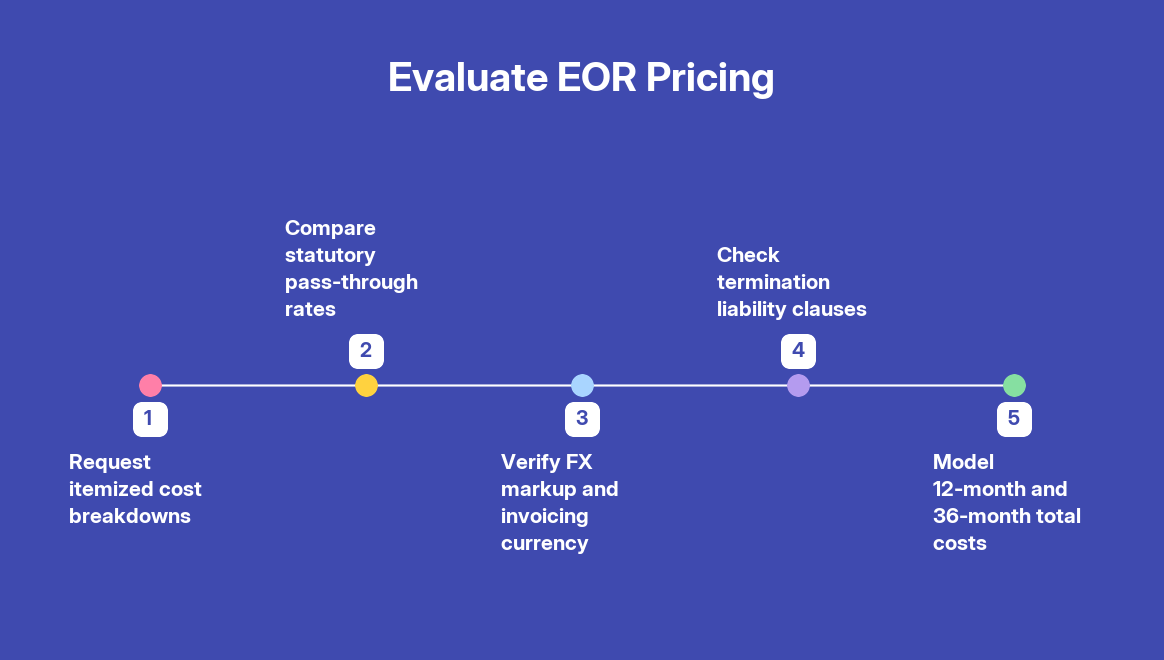
Ask every provider for a line-by-line cost breakdown that separates management fees from statutory costs and pass-through charges. A provider quoting a single bundled number makes comparison impossible. You need to see the employer social security contribution, meal allowance, work accident insurance, and any benefits costs as separate lines.
Compare the statutory cost lines against Portugal's published rates. The employer social security rate is 23.75%. If a provider's pass-through figure materially exceeds that, they are adding margin to statutory costs. That practice is not illegal, but you should know it is happening.
Model the Full Employment Lifecycle
A 12-month cost model is insufficient. Model 36 months. Include one termination scenario with severance. Include the 14th-month salary payments. Include annual salary reviews, which Portuguese employees expect given the country's inflation-adjusted minimum wage adjustments.
Factor in payroll processing fees if they are charged separately from the EOR management fee. Some providers include payroll in the flat rate. Others add €30 to €75 per payroll run per employee.

FAQs
Does the EOR management fee include Portuguese social security contributions?
It depends on the provider. Some bundle employer social security into the monthly invoice as a single line. Others quote management fees separately and pass through social security at cost. The employer rate is 23.75% of gross salary. Always request an itemized breakdown. A provider quoting €500 per month "all-in" for a €3,000 gross salary is likely underquoting, since social security alone would be €712.50 monthly.
Can I reduce costs by classifying workers as contractors in Portugal?
Portuguese tax authorities actively enforce misclassification rules. If a worker operates under your direction, uses your tools, and works fixed hours, they are an employee under Portuguese law regardless of the contract label. Reclassification triggers back-payment of employer social security contributions plus penalties. The risk far exceeds any short-term savings. Use a compliant contractor structure only when the working relationship genuinely qualifies.
Are Portuguese meal allowances tax-exempt for the employer?
Meal allowances paid via meal card enjoy a higher tax-exempt threshold than cash payments. The exempt limit is periodically adjusted. Amounts within the exempt threshold avoid both employer and employee social security contributions. Amounts above the threshold are treated as regular compensation and taxed accordingly. Your EOR should structure meal allowances via card to capture this benefit automatically.
What happens to my costs if Portugal increases the minimum wage mid-contract?
Portugal has raised its national minimum wage annually in recent years. If your employee's salary sits at or near the minimum, the EOR must adjust compensation mid-year to comply. That adjustment flows through to your invoice immediately. EOR contracts typically include a clause allowing pass-through of legally mandated cost increases without renegotiation. Budget a 5-8% annual buffer on minimum-wage-adjacent roles.
What to Watch Next
Portugal's government has signaled continued annual minimum wage increases through 2028. Social security contribution rates, while stable for years, face periodic review pressure as the population ages. Monitor the Portuguese Social Security Institute's publications each January for rate changes. If your team in Portugal exceeds eight employees, run an entity setup cost model alongside your EOR renewal to check whether the break-even has shifted. Start that analysis six months before your contract renewal date, not two weeks before.
If you need an itemized cost comparison for hiring through an EOR in Portugal, request a breakdown from TeamUp.
Written by TeamUp — a people-first EOR and nearshoring partner helping businesses hire compliantly across 20+ countries since 2020.
.svg)


