


How to Hire an Employee in Portugal Through an EOR: Step-by-Step Guide 2026

Our guide to Employer of Record (EOR) in Portugal covers the overall model, its costs, and how it compares to setting up a local entity. This article goes deeper on one specific question: what does the actual hiring process look like, step by step, when you use an EOR to bring someone on in Portugal?
The mechanics matter more than most companies expect. Portugal's labor code imposes specific contract requirements, trial period rules, and social security registration timelines. Missing any of these creates compliance exposure from day one. The sections below walk through pre-engagement planning, the onboarding sequence, contract structuring, and ongoing compliance management. Each step includes the deadlines and documentation your EOR should be handling on your behalf.

Preparing Your Hiring Plan Before Engaging an EOR
Define the Role Scope and Classification First
Before your EOR drafts a single document, you need to confirm the role classification. Portugal's labor code distinguishes sharply between employees and independent contractors. Misclassification carries penalties from the Autoridade para as Condições do Trabalho (ACT), Portugal's labor inspectorate.
Your EOR should review the working relationship against Portuguese law criteria. Fixed schedules, client-provided equipment, and exclusivity arrangements all point toward employment. A London fintech that engaged two "contractors" in Lisbon through a basic payments platform discovered this the hard way. ACT reclassified both as employees, triggering back-dated social security contributions.
Confirm Compensation Structure Against Portuguese Norms
Portugal mandates 14 monthly salary payments per year. Employees receive a Christmas subsidy and a holiday subsidy, each equal to one month's base salary. These are not optional bonuses. They are statutory entitlements under the Código do Trabalho.
Your compensation offer must account for this structure from the start. A base salary of €3,000 per month means your actual annual cost includes two additional €3,000 payments. Factor in employer social security contributions as well. The employer rate has historically been 23.75% of gross salary, paid to Segurança Social. Confirm the current rate with Segurança Social before finalizing your budget. For a full breakdown of what these obligations add up to, see our analysis of EOR costs in Portugal.
Gather Required Employee Information Early
The EOR will need specific data before it can register the employee. Collect these documents during the offer stage to avoid delays:
- Portuguese tax identification number (NIF), or confirmation that the employee needs one
- Segurança Social identification number (NISS)
- Valid identification document (citizen card or residence permit)
- Bank account details for salary transfers (Portuguese IBAN preferred)
- Proof of address in Portugal
Non-Portuguese nationals need a valid residence permit or visa with work authorization. Your EOR handles the legal employer side, but the employee must supply the underlying immigration documentation.
The EOR Onboarding Process in Portugal: From Offer to First Payroll
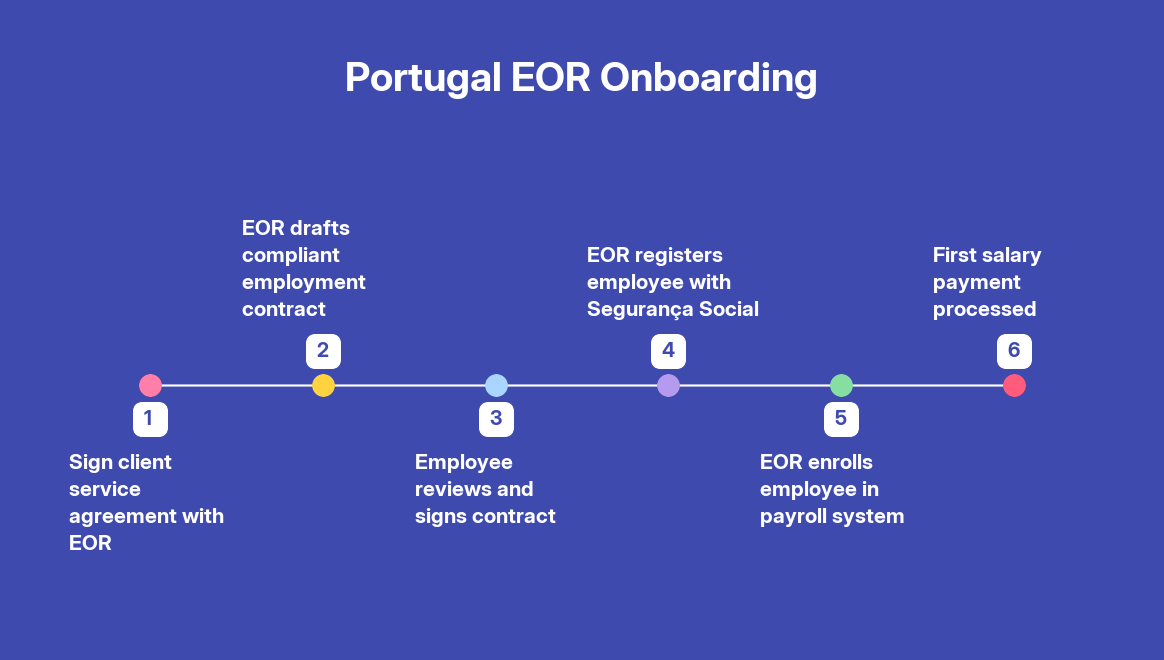
Client Service Agreement
The process begins with your agreement with the EOR, not the employee's contract. This master service agreement defines your relationship. It specifies the management fee, invoicing terms, and the scope of services. Team Up's EOR service starts at €199 per employee per month in its core markets. Portuguese pricing depends on role complexity and team size.
Employment Contract and Segurança Social Registration
Once you approve the offer terms, the EOR drafts the employment contract under Portuguese law. The employee reviews and signs. The EOR then registers the employee with Segurança Social. This registration must happen before the employee's first working day.
That sequence matters. A Milan-based design agency hired a senior UX researcher in Porto and wanted her to start within three days. The EOR completed contract execution and Segurança Social registration in four business days. Skipping the registration step would have exposed both parties to compliance risk from the first hour of work.
Payroll Enrollment and First Payment
After registration, the EOR enrolls the employee in its Portuguese payroll cycle. Portugal requires employers to pay salaries by the last business day of each month. The EOR handles income tax withholding (IRS retenção na fonte) and social security deductions. The employee's net salary reaches their account on schedule. Typical end-to-end onboarding through an EOR service provider takes 5 to 10 business days from signed service agreement to payroll enrollment.
Portuguese Employment Contract Requirements the EOR Must Handle
Mandatory Contract Elements Under the Código do Trabalho
Portuguese law requires written employment contracts. The contract must specify several elements. These are not suggestions. They are legal requirements.
| Contract Element | Requirement |
|---|---|
| Employer identity | Full legal name and NIF of the EOR entity |
| Employee identity | Full name, NIF, and NISS |
| Job description | Role, category, and professional duties |
| Workplace | Physical location or remote work arrangement |
| Working hours | Normal period (standard is 40 hours per week, 8 hours per day) |
| Compensation | Base salary, 13th and 14th month payments, any allowances |
| Start date | First day of work |
| Contract type | Open-ended or fixed-term with duration and justification |
| Trial period | Duration specified per contract type |
| Collective agreement | Applicable CCT if the sector has one |
Trial Period Rules
Portugal's trial period framework depends on the contract type and role seniority. Open-ended contracts carry a trial period of 90 days for most employees. Roles classified as high complexity or senior management positions can have trial periods up to 180 days. Fixed-term contracts of six months or longer allow a 30-day trial period. Contracts under six months allow 15 days.
During the trial period, either party can terminate without cause or compensation. Your EOR should flag the exact trial period end date. Missing it means the employee gains full termination protection under Portuguese law.
Fixed-Term Contract Restrictions
Portugal restricts fixed-term contracts to specific justifications. Temporary project needs, seasonal demand, and replacement of absent employees qualify. Indefinite use of rolling fixed-term contracts is not permitted.
A fixed-term contract can be renewed up to three times. The total duration cannot exceed two years for contracts with a stated term. Exceeding these limits converts the contract to open-ended automatically. Your EOR must track renewal dates and flag conversions before they trigger.
Managing Ongoing Compliance After Onboarding

Monthly Payroll Obligations
Each month, the EOR calculates gross-to-net pay, withholds IRS (income tax), and deducts the employee's social security contribution. The employee contribution rate has historically been 11% of gross salary. The EOR remits both employee and employer contributions to Segurança Social by the 20th of the following month.
The EOR also processes the 13th month payment (holiday subsidy, typically paid before the employee's vacation period) and the 14th month payment (Christmas subsidy, paid by December). Some employers split these payments across 12 months by agreement. The contract must specify the payment method.
Annual Leave and Absence Tracking
Portuguese employees are entitled to a minimum of 22 business days of paid annual leave per year. This is a statutory floor under the Código do Trabalho. Collective bargaining agreements in some sectors set higher minimums.
Your EOR tracks leave balances, approves requests through its platform, and ensures the holiday subsidy aligns with the vacation schedule. Unused leave from one year typically must be taken by April 30 of the following year.
Reporting and Compliance Updates
Portugal's regulatory environment evolves. Minimum wage levels are revised annually. Tax brackets and withholding tables change with each state budget. The EOR monitors these changes and adjusts payroll calculations without requiring action from you.
A Hamburg SaaS company with six employees in Lisbon relies on its EOR for exactly this. Each January, the EOR updates withholding tables and confirms whether any collective agreement changes affect their team. The client reviews a summary report. That is the extent of their compliance workload.
Watch out: Portugal's collective bargaining agreements (CCTs) can override standard labor code provisions on working hours, overtime rates, and minimum pay. If your employee's role falls under a sector-specific CCT, the EOR must apply those terms instead of the general code. Ask your EOR which CCT applies before signing the contract.

FAQs
Can an EOR hire a non-Portuguese national to work in Portugal?
Yes, but the employee must hold a valid residence permit or visa with work authorization. The EOR acts as the legal employer and can support the process, including providing the employment contract and company documentation required for visa applications. EU/EEA nationals have freedom of movement and do not need a work permit. Third-country nationals must obtain a residence permit through SEF (now AIMA) before starting work. The EOR cannot override immigration requirements.
What happens if the employee wants to switch from fixed-term to permanent?
If a fixed-term contract exceeds its maximum duration or renewal limits, it converts to an open-ended contract automatically under Portuguese law. The employee does not need to request this. The EOR should track all renewal dates and notify you before any automatic conversion triggers. Once converted, the employee gains full termination protections, including severance entitlements.
How does the EOR handle employee termination in Portugal?
Portuguese termination law strongly protects employees. The EOR must follow the Código do Trabalho's procedural requirements, including written notice, justification grounds, and mandatory notice periods. Notice periods scale with tenure and can reach 60 days or more. Severance compensation applies in most termination scenarios. The EOR calculates the correct amounts and manages the exit process to avoid wrongful dismissal claims.
Can I transfer an EOR-employed person to my own entity later?
Yes. If you establish a Portuguese entity, the EOR can coordinate the employee transfer. The standard approach involves terminating the EOR contract and signing a new contract with your entity, preserving the employee's seniority and accrued benefits. Negotiate the transfer process and timeline with your EOR in advance. Most providers, including Team Up, support structured offboarding that protects both the employee's rights and your continuity.
What to Monitor Next
Portugal's 2026 state budget may adjust income tax brackets and the national minimum wage. Both changes affect your payroll costs directly. Track announcements from the Ministério das Finanças and the Diário da República for confirmed figures. AIMA (the successor to SEF) continues processing backlogs for residence permits. If you plan to hire non-EU nationals, factor in extended processing times. Your EOR should flag these changes proactively. If they do not, ask.
If you are planning your first hire in Portugal and want a compliance walkthrough specific to your team structure, request a consultation with Team Up.
Written by Team Up — a people-first EOR and nearshoring partner helping companies hire compliantly across 20+ countries from owned entities in the Caucasus, Central Asia, Turkey, India, and Eastern Europe.
.svg)


